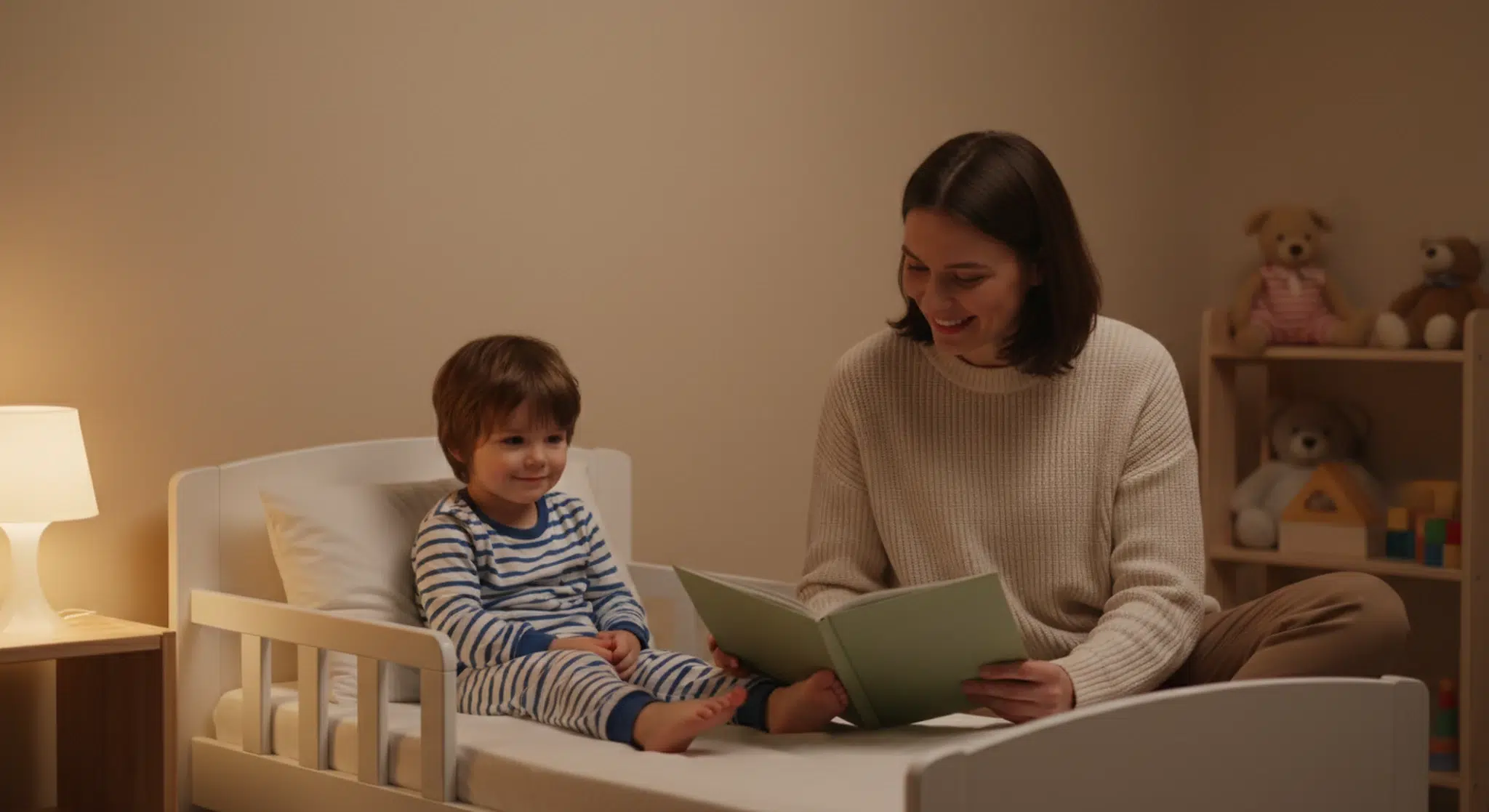
Yes, there is real preschooler sleep help for 3 to 6 year olds: the AASM recommends 10 to 13 hours per 24 hours for ages 3 to 5, and the usual problems (stalling, getting out of bed, fears, dropped naps) respond to calm limits and a steady routine.
Most sleep advice stops at the first birthday, which can leave the parent of a 4 year old feeling like everything out there is for babies. It is not. What changes after age 3 is the kind of problem you face and the tools that work, because your child can now understand rules, routines and rewards.
This hub explains what is different about preschooler sleep, how much sleep a 3 to 6 year old needs, what time a 4 year old should go to bed, and where to start with stalling, night visits, fears and regressions. Each section links to a detailed Betteroo guide when you need more.
Key Takeaways
The AASM recommends 10 to 13 hours per 24 hours for ages 3 to 5 and 9 to 12 hours for ages 6 to 12.
Work out bedtime backward from wake-up time; the right clock time depends on your child.
Most children stop napping between ages 3 and 5, per Nationwide Children’s Hospital.
Stalling and night visits respond to clear limits, a steady routine and calm, brief returns to bed.
Frequent snoring or breathing problems at night are a reason to call your pediatrician.
Table of Contents
Preschooler Sleep: Is There Help for a 4 Year Old, or Is Everything Just for Babies?
Quick Answer
Yes, there is real sleep help for 3 to 6 year olds. What changes after age 3 is the problem itself: fewer feeding and crib issues, more stalling, getting out of bed, fears, dropped naps and early or late bedtimes. The tools change too. A preschooler can understand simple rules, a picture routine and a morning reward, which a baby cannot. The American Academy of Sleep Medicine (AASM) recommends 10 to 13 hours of sleep per 24 hours, including naps, for ages 3 to 5, and 9 to 12 hours for ages 6 to 12.
Betteroo’s State of Parent and Baby Sleep 2026 report counted 83,901 parent responses from 118 countries (July 2025 to October 2026). In its night-waking chart, about 30% of children aged 2 to 6 years woke 3 or more times a night, compared with about 66% of babies aged 7 to 9 months.
One honest caveat: the respondents are parents who came to Betteroo for help with their child’s sleep, so this is not a random population sample.
What Is Different About Sleep After Age 3?
Most sleep advice is written for the first year: feeds, swaddles and crib sleep. Here is what usually shifts after age 3:
Naps start to go: Nationwide Children’s Hospital says most children stop napping between ages 3 and 5. That moves a lot of sleep into the night and makes bedtime timing matter more.
Bedtime becomes a negotiation: children this age talk, bargain and remember what worked last night. Nemours KidsHealth notes it is common for kids this age not to want to go to bed.
Big beds mean getting up: once your child can walk out of the room, the job shifts from settling them to helping them stay put.
Imagination grows, and so do fears: Nationwide Children’s Hospital describes nighttime fears and nightmares as common and part of normal development in the preschool years.
Deep-sleep events peak: Nationwide Children’s Hospital also says sleepwalking and sleep terrors are common in the preschool years and peak in this age group.
The good news: a preschooler can take part in the plan. You can explain a rule in the afternoon, practice it with a stuffed animal and celebrate a good night at breakfast.
How Much Sleep Does a Preschooler Need?
The AASM consensus statement (Paruthi and colleagues, Journal of Clinical Sleep Medicine, 2016) gives these ranges per 24 hours, and the American Academy of Pediatrics (AAP) says on HealthyChildren.org that it supports the AASM guidelines:
Age
AASM recommended sleep per 24 hours
What it includes
1 to 2 years
11 to 14 hours
Night sleep plus naps
3 to 5 years
10 to 13 hours
Night sleep plus naps
6 to 12 years
9 to 12 hours
Mostly night sleep
Source: AASM pediatric sleep duration consensus, Paruthi et al., 2016, supported by the AAP.
Two other U.S. pediatric sources say much the same in their own words. Nemours KidsHealth puts preschoolers at about 10 to 13 hours a day, including naps. Nationwide Children’s Hospital says preschoolers need about 11 to 13 hours, and adds that the total varies by child but should stay roughly the same from day to day.
Why it matters: the AASM statement says that regularly sleeping fewer than the recommended hours is associated with attention, behavior and learning problems.
There is no single correct clock time: it depends on when your 4 year old wakes up and whether they still nap. Work it out from the AASM range of 10 to 13 hours per 24 hours for ages 3 to 5.
The arithmetic: asleep-by time = wake-up time minus the hours of night sleep you are aiming for. For a child who no longer naps, aiming for 10, 11 or 12 hours of night sleep keeps you inside the AASM range. If your child still naps, subtract the nap from the total first (for example, 11 hours total with a 1 hour nap leaves 10 hours of night sleep).
Wake-up time
Asleep by (10 h of night sleep)
Asleep by (11 h)
Asleep by (12 h)
6:00 a.m.
8:00 p.m.
7:00 p.m.
6:00 p.m.
6:30 a.m.
8:30 p.m.
7:30 p.m.
6:30 p.m.
7:00 a.m.
9:00 p.m.
8:00 p.m.
7:00 p.m.
7:30 a.m.
9:30 p.m.
8:30 p.m.
7:30 p.m.
8:00 a.m.
10:00 p.m.
9:00 p.m.
8:00 p.m.
Planning aid derived from the AASM 10 to 13 hour range for ages 3 to 5 (no-nap child). Not a medical prescription.
Treat this table as a planning aid, not a rule. The times are when your child should be asleep, so start the routine early enough to cover bath, teeth, books and drifting off. If your child gets only the 10 hour column and still melts down by late afternoon, try the next column for a week.
Nationwide Children’s Hospital points out that some children get an evening “second wind” and suggests shifting bedtime earlier or later to match when your child is actually ready for sleep. For sample days, see our 3 year old sleep schedule.
Stuck on night two or three?
Our free two-minute quiz builds a gentle, personalized sleep plan that adapts when progress stalls.
Dropping the nap rarely happens in a straight line: some days your child needs one, and some days a nap pushes bedtime late.
Expect the change between 3 and 5: per Nationwide Children’s Hospital, that is when most children stop napping.
Keep naps short and regular if they continue: Nemours KidsHealth says preschoolers who still nap should have a regular time and routine, usually about an hour.
Look for signs a nap is still needed: KidsHealth lists not getting enough night sleep, rubbing eyes, crankiness and hyperactivity.
Keep quiet time: KidsHealth suggests daily quiet time for children who no longer nap, so they still get a chance to rest.
Move bedtime earlier on no-nap days: the same total sleep has to fit into the night, so the table above is your friend.
A routine turns bedtime into familiar steps instead of a debate. The AAP says on HealthyChildren.org that all children thrive on a regular bedtime routine, and suggests a simple “brush, book, bed” pattern for young children. For 3 to 6 year olds:
Same order, same time: the AAP’s bedtime tips stress being consistent, with bedtime at the same time each night, and its sleep-hours page adds a consistent wake time, including weekends.
Screens off early: the AAP recommends turning screens off at least 1 hour before bedtime and keeping them out of children’s bedrooms, especially at night. Nationwide Children’s Hospital says a nightlight is fine in the bedroom but a television is not.
Calm, not active: the AAP suggests a story, quiet music or a bath, and notes that active play may make a child too excited to sleep.
Needs met before lights-out: the AAP suggests taking care of things like a drink of water, a light left on or a door left slightly open before bedtime, so they do not become reasons to call you back.
Move during the day: KidsHealth notes that daytime exercise can improve sleep.
A picture chart of the steps lets a 3 or 4 year old “run” their own routine, which cuts down on reminders. Our toddler bedtime routine guide has a full step-by-step routine you can adapt for an older child.
Bedtime Stalling and Kids Coming Into Your Bed
Both are common, and both respond well to calm, predictable limits.
Bedtime stalling (one more book, one more hug, one more glass of water):
Set the limits in advance and keep them visible. Nationwide Children’s Hospital suggests clear limits such as a fixed number of books.
Build the usual requests into the routine (water, bathroom, a last hug) so you can say, kindly, “We already did that.”
Give choices inside the routine (which pajamas, which of two books), not about whether bedtime happens.
Coming into your bed at night:
Decide on your family’s plan during the day, explain it simply to your child, and stick to it at 2 a.m. The AAP’s bedtime tips advise not letting your child sleep in your bed, because it can make it harder for them to fall asleep alone.
Walk your child back calmly with few words and little light. KidsHealth suggests that if your child is afraid or very upset, you comfort them, then return them to bed and keep the visit short.
If early-morning visits are the issue, a simple color or light cue that means “morning” helps a child who cannot read a clock yet know when it is okay to come in.
Night Waking, Fears, Nightmares and Night Terrors
Everyone wakes briefly during the night, Nationwide Children’s Hospital explains, and a child who has not learned to fall asleep on their own may need a parent’s help to fall back asleep. KidsHealth suggests not answering right away when your child calls out, so they have a chance to settle themselves first.
Fears are very common at this age. The MGH Clay Center for Young Healthy Minds cites a study of Dutch schoolchildren (Muris and colleagues, Behaviour Research and Therapy, 2001) in which 73.3% of 176 children aged 4 to 12 reported nighttime fears. If the dark is the sticking point, our guide to a toddler afraid of the dark has a step-by-step plan.
Nightmares and night terrors look different and call for different responses, according to the AAP:
Nightmares
Night terrors
When in the night
Usually the second half of the night (AAP)
During deep sleep, usually early in the night (AAP)
Ages
Can start as early as 6 months and peak between ages 3 and 12 (AAP)
Most common in toddlers and preschoolers (AAP)
Does your child remember it?
Often; the AAP suggests encouraging them to talk about the dream
Usually not (AAP)
How to help
Go quickly, reassure, let them talk, a light on if it helps (AAP)
Stay calm and keep them from getting hurt; gently hold them back if they try to get out of bed (AAP)
Source: AAP, HealthyChildren.org, Nightmares, Night Terrors and Sleepwalking in Children.
For more detail, read our guides to night terrors in toddlers and nightmares in babies and young children. If your child sleepwalks, the AAP advises clearing tripping hazards, locking outside doors, blocking stairways and gently leading them back to bed rather than waking them.
Sleep Regressions at 2.5, 3 and 4
Rough patches often come with big changes such as a new sibling, starting preschool or a move to a big bed. The calm, consistent approach above still applies, and we cover each age in its own guide:
Start with the issue that costs your family the most sleep and change one thing at a time. The AAP’s advice to “give it time” applies here: children need time and opportunity to learn to fall back asleep on their own.
What you are seeing
A good first step
Bedtime takes an hour or more
Check the bedtime table above, then set a short routine with fixed limits
Lying awake for a long time
Try a slightly later bedtime and screens off at least 1 hour before bed
Calling out or walking in at night
Brief, calm, boring returns to bed, the same every time
Scared at bedtime
Name the fear, add a dim night-light, practice brave steps by day
Loud snoring or pauses in breathing
Talk to your pediatrician (see below)
Starting points drawn from AAP, Nemours KidsHealth and Nationwide Children’s Hospital guidance.
How Betteroo Can Help
Betteroo builds a personalized sleep plan for your child, including preschoolers up to age 6, starting from a short sleep assessment. You can take the assessment from any page of this guide.
Most preschooler sleep problems are behavioral and improve with a steady routine. Some signs, though, deserve a conversation with your child’s doctor.
Snoring and possible sleep apnea. On HealthyChildren.org, the AAP lists frequent snoring, problems breathing during the night, sleepiness during the day, difficulty paying attention and behavior problems as symptoms, and says to let your pediatrician know right away if you notice them. The AAP explains that large tonsils and adenoid can block a child’s airway during sleep, though not every child with large tonsils has sleep apnea, and that a doctor may recommend an overnight sleep study (polysomnogram).
Call 911 or your local emergency number if your child’s breathing stops for more than 20 seconds, or if their skin turns pale, bluish or grayish, per the AAP.
Also talk to your pediatrician if:
Your child has trouble breathing, snores or is a noisy breather (Nationwide Children’s Hospital).
Night wakings or nighttime fears are unusual or worry you (Nationwide Children’s Hospital).
Your child has trouble falling or staying asleep, or sleep problems are affecting daytime behavior (Nationwide Children’s Hospital).
Night terrors keep happening (AAP).
Ask your pediatrician before giving any sleep aid or supplement to a preschooler.
Frequently Asked Questions
Is there preschooler sleep help, or is sleep training only for babies?
There is plenty of help for preschooler sleep. Children aged 3 to 6 usually struggle with stalling, getting out of bed, fears and dropped naps rather than feeding or crib issues. Because they understand rules and routines, a short visual routine, clear limits and calm returns to bed tend to work well at this age.
How much sleep does a 4 year old need?
The American Academy of Sleep Medicine recommends 10 to 13 hours per 24 hours, including naps, for children aged 3 to 5, and the American Academy of Pediatrics supports those guidelines. Many 4 year olds no longer nap, so most or all of that sleep needs to happen at night.
What time should a 4 year old go to bed?
Count backward from wake-up time. A 4 year old who wakes at 7 a.m. and no longer naps would be asleep between about 7 and 9 p.m. to get 10 to 12 hours of night sleep, which sits inside the AASM range of 10 to 13 hours. Adjust for naps and your child’s cues.
Should a 4 year old still nap?
Some do and some do not. Nationwide Children’s Hospital says most children stop napping between ages 3 and 5. Nemours KidsHealth suggests that preschoolers who still nap keep a regular nap of about an hour, and that children who have stopped napping still get daily quiet time.
Why does my 4 year old keep waking up at night?
Everyone wakes briefly at night, and a child who has not learned to fall asleep alone may need a parent to settle again. Fears, nightmares, a new sibling or a change in routine can also play a part. Frequent snoring or breathing problems are a reason to talk to your pediatrician.
How do I stop my preschooler from coming into my bed at night?
Choose your plan during the day and explain it simply. When your child comes in, walk them back calmly with few words, the same way every time. The AAP advises against letting your child sleep in your bed, because it can make falling asleep alone harder. Consistency over a couple of weeks usually helps.
Gentle changes, peaceful nights.
Betteroo builds a personalized sleep plan for your baby or toddler. Take the free two-minute quiz to get started.
Paruthi S, et al. Recommended Amount of Sleep for Pediatric Populations: A Consensus Statement of the American Academy of Sleep Medicine. J Clin Sleep Med. 2016;12(6):785-786. https://pubmed.ncbi.nlm.nih.gov/27250809/