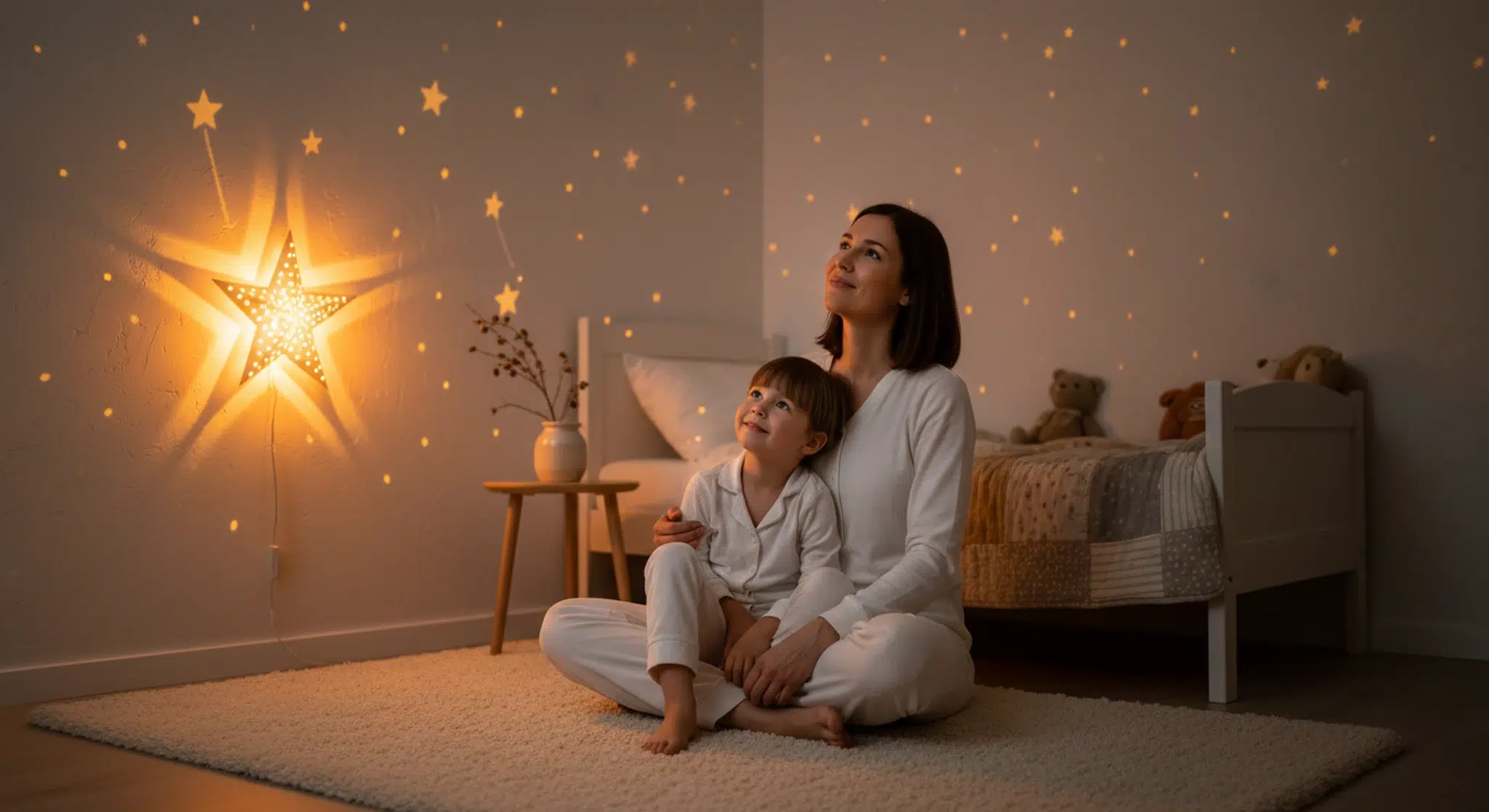
A toddler afraid of the dark is very common and usually a normal developmental phase, and a calm bedtime plan (a dim night-light, a short routine, brave practice and gradually fading yourself out) helps many children sleep alone again.
If your 4 year old is suddenly scared of the dark and won’t fall asleep alone, you are not doing anything wrong: growing imagination often outpaces a young child’s ability to tell real from pretend, and bedtime is where it shows. In a Dutch study cited by the MGH Clay Center, 73.3% of 176 children aged 4 to 12 reported nighttime fears.
Below you will find why this happens, a step-by-step plan for tonight, daytime games that build courage, what to avoid, how fear of the dark differs from nightmares and night terrors, and the signs that mean it is time to talk to your pediatrician.
Key Takeaways
Fear of the dark is a normal, growth-related process in children 3 to 6 years old, according to the MGH Clay Center.
In one study of 176 children aged 4 to 12, 73.3% reported nighttime fears, and parents often underestimated them.
Take the fear seriously without confirming it: no teasing, and no nightly monster hunts.
A dim, warm night-light, a steady routine and no scary media before bed can help.
Fade yourself out with promised check-ins, and call your pediatrician if fears are severe, lasting or present during the day.
As an Amazon Associate, Betteroo earns from qualifying purchases.
Table of Contents
Toddler Afraid of the Dark: The Plain Answer
Quick Answer
Yes, a sudden fear of the dark at age 3, 4 or 5 is common and usually part of normal development. What helps most: name the fear calmly, add a dim, warm night-light, keep a short, predictable bedtime routine, cut scary shows and stories before bed, practice being brave in daytime games, and fade yourself out of the room gradually with brief, promised check-ins instead of staying until your child is asleep.
If your 4 year old used to go to bed without a fuss and now cries, calls you back again and again, or refuses to stay in the room alone, you are describing one of the most common bedtime problems of the preschool years. The MGH Clay Center for Young Healthy Minds at Massachusetts General Hospital calls fear of the dark a normal, growth-related process in children 3 to 6 years old.
Why Is My 4 Year Old Suddenly Scared of the Dark?
The short version: your child’s imagination grew faster than their ability to sort real from pretend. Cincinnati Children’s Hospital explains that younger children can have difficulty telling the difference between what is real and what is imaginary. Cleveland Clinic pediatrician Laura O’Connor, MD, describes vivid imagination as a normal part of healthy development. In a dark room, with a tired brain, that imagination fills shadows with monsters.
Other things often feed the fear:
New information: a scary scene in a cartoon, a story from an older sibling, or a picture in a book. St. Louis Children’s Hospital points out that even cartoons and princess movies can have frightening parts.
Real-life worries: St. Louis Children’s suggests asking whether your child has seen upsetting news, overheard adult worries, or been exposed to violence. The MGH Clay Center also suggests looking at sources of stress unrelated to sleep, such as a move or a new sibling.
Separation: for many toddlers the real fear is being alone, not the dark itself. If your child is also clingy at drop-off, read our guide to separation anxiety in toddlers.
Being overtired: St. Louis Children’s notes that when a child is tired at bedtime, imagination can turn into real fears. The American Academy of Sleep Medicine consensus (Paruthi, 2016) recommends 10 to 13 hours per 24 hours, including naps, for children 3 to 5; see how much sleep a 3 year old needs.
Fear of the dark can overlap with a broader rough patch; our guide to the 4 year old sleep regression covers other causes.
How Common Is Fear of the Dark in Kids?
Very common. In a study of 176 Dutch school children aged 4 to 12 (Muris and colleagues, Behaviour Research and Therapy, 2001), 73.3% of the children reported nighttime fears; the MGH Clay Center cites this study as evidence that over 73% of children aged 4 to 12 have fears at night.
Two other findings from that study’s abstract are worth knowing:
Parents often miss it: parents substantially underestimated how often their children had nighttime fears.
Most fears are learned from information: most children in the study traced their fears to frightening information they had heard or seen, more often than to a bad experience. What your child watches and hears matters.
The same study found nighttime fears were common at ages 4 to 6 and more frequent at ages 7 to 9, so do not be surprised if a version of this returns in the early school years.
Stuck on night two or three?
Our free two-minute quiz builds a gentle, personalized sleep plan that adapts when progress stalls.
How to Help a Toddler Afraid of the Dark: A Step-by-Step Plan
Use these steps together and repeat them every night. Consistency matters more than any single trick, so give the plan time before you judge it.
Step
What to do
Why it helps
1. Name it
In daytime, ask what feels scary at bedtime and listen. Try: “The dark feels scary. You are safe, and I am close by.”
Cincinnati Children’s: let your child tell you what scares them; never mock the fear.
2. Calm the room
Dim, warm night-light; door slightly open if it helps; check for shadows that look like shapes.
Cleveland Clinic and HealthyChildren.org mention a light for comfort; HealthyChildren suggests removing scary shadows.
3. Quiet input
No scary shows, music, videos or stories for 30 to 60 minutes before bed.
Cleveland Clinic recommends this window; Cincinnati Children’s agrees on scary media.
4. Same routine
Bath, pajamas, teeth, two books, song, lights down, in the same order.
The MGH Clay Center lists consistent bedtime routines among its strategies.
5. Comfort object
A favorite stuffed animal or small blanket chosen by your child.
Cincinnati Children’s and the MGH Clay Center both suggest a security or transitional object.
6. Promise and return
Leave while your child is awake and promise a short check-in. Then keep the promise.
Cincinnati Children’s describes check-ins at 5, then 10, 15 and 20 minutes until the child is asleep.
A nightly plan for a toddler afraid of the dark, with the source behind each step.
A note on comfort objects: they are for toddlers and preschoolers. Babies under 12 months sleep alone, on their back, on a firm, flat, bare surface with no pillows, blankets or soft toys.
Does a Night-Light Help a Toddler Who Is Scared of the Dark?
Often, yes. Cleveland Clinic notes that some kids who are afraid of the dark find a sense of safety from a night-light or a very dim lamp, and Cincinnati Children’s says a night-light may provide security even for children who are not afraid. HealthyChildren.org (American Academy of Pediatrics) says a child can keep a light on after a nightmare if it helps.
The catch is brightness. St. Louis Children’s Hospital warns that too much light can disrupt melatonin, which affects falling and staying asleep, and suggests options such as a red light. What to look for:
A low, dim glow you can barely read by, not a bright lamp or overhead light.
No tablet or phone as a light source. St. Louis Children’s advises against an iPad in bed because screen light can inhibit sleep.
A cracked door with a hallway light is a fine alternative. Cleveland Clinic suggests making clear that the open door is not an invitation to wander out after bedtime.
Brave Practice: Daytime Games That Shrink Night Fears
The MGH Clay Center recommends practicing through role play during the day and showing your child how to relax. Try a few of these short, playful ideas, always as a game, never as a test:
Flashlight hunt: in a dim room in the afternoon, hide a few toys and find them with a flashlight.
Brave steps: take turns walking into a dim room for a count of five, then ten. Praise the trying, not just the success.
Rehearse bedtime: act out bedtime with a stuffed animal who feels scared. Let your child be the parent who comforts it, and ask what would help the toy feel brave.
Calm body practice: practice slow “balloon belly” breaths or tightening and relaxing hands and toes. St. Louis Children’s notes that children as young as 2 or 3 can learn to relax their minds.
Stories help too. The MGH Clay Center suggests using stories, and books about nighttime fears, to help children work through them. Pick books where a scared character learns to cope.
“My 4 Year Old Won’t Fall Asleep Alone”: Fading Yourself Out
Cleveland Clinic says staying in the room is not recommended unless your child is extremely frightened, and Cincinnati Children’s says it is okay to occasionally stay by the bed but not often, or even two nights in a row. The goal is to move from your presence to your promise.
Two gradual approaches to try:
Check-ins that stretch: say goodnight, leave while your child is awake, and promise to come back. Cincinnati Children’s describes returning at 5 minutes, then 10, 15 and 20 until your child is asleep. St. Louis Children’s suggests starting with five minutes and extending it over time. Keep each visit brief and boring.
Chair fading: sit on a chair next to the bed until your child falls asleep, without much talking. Every few nights, move the chair a little closer to the door, then into the doorway, then just outside. Our chair method guide explains the steps in detail.
If your child comes out of bed, walk them back calmly. Cincinnati Children’s advises taking them back to their own bed with reassurance, and St. Louis Children’s cautions against regularly letting a scared child sleep with you because it may suggest their own bed is not safe (a sick or truly terrified night is a reasonable exception).
What Not to Do When Your Child Is Scared of the Dark
Do not tease or dismiss it: “Don’t be silly, there’s nothing there” leaves your child alone with the fear. Cincinnati Children’s says never to dismiss or make fun of a child’s fear.
Do not over-validate it: Cleveland Clinic advises acknowledging the feeling without agreeing that the threat is real. “You feel scared” is better than “Let’s make sure the monster is gone.”
Be careful with monster rituals: Cincinnati Children’s warns against rituals to “clear the room of monsters,” and Cleveland Clinic says checking for monsters can make a child believe there is something to fear. St. Louis Children’s takes a different view and suggests checking closets with a flashlight to show your child the room is safe. If you check, frame it as “see, it’s just your closet,” not as a monster hunt, and do it once, not every night.
Often in the second half of the night (HealthyChildren.org)
Usually early in the night, in deep sleep (HealthyChildren.org)
Is your child awake?
Yes
Wakes up crying or afraid
Usually not truly awake; most fall right back to sleep
Remembers it?
Yes, can usually tell you what scares them
Often yes
No (HealthyChildren.org)
Best response
Calm reassurance, dim light, routine, gradual fading
Go quickly, comfort, remind them dreams are not real, a light on if it helps
Stay calm, keep them from getting hurt; talk to the doctor if they keep happening
How fear of the dark differs from nightmares and night terrors, based on AAP HealthyChildren.org.
HealthyChildren.org notes that nightmares tend to peak between 3 and 12 years old, and night terrors occur most often in toddlers and preschoolers, so a child can have a fear of the dark and nightmares at the same time.
How Betteroo Can Help
If bedtime fears are part of a bigger sleep struggle, Betteroo builds a personalized sleep plan for your child. The free sleep quiz is a quick way to see where to start.
Bedtime fears continue despite a consistent plan, are severe, or also happen during the day (Cincinnati Children’s, Cleveland Clinic).
Your child has many fears or worries (Cleveland Clinic), refuses to go to bed, or has panic-like episodes with a pounding heart, fast breathing, dizziness or nausea (MGH Clay Center).
Anxiety signs the CDC lists: fears your child is not outgrowing, worries that interfere with school, home or play, irritability or anger, trouble sleeping, or tiredness, headaches or stomachaches.
Your child has frequent night terrors, or nighttime episodes in which they could get hurt (HealthyChildren.org advises talking with your child’s doctor if night terrors keep happening).
Sleep loss is affecting your child’s mood or behavior during the day, or your family is struggling to cope.
Something happened recently that frightened your child, or there is stress at home you are worried about.
The CDC suggests starting with a healthcare provider such as a pediatrician or a mental health specialist if you are worried about anxiety. None of these signs means something is definitely wrong; they are a reason to get your pediatrician’s view. For the bigger picture on sleep at this age, see our preschooler sleep hub.
Frequently Asked Questions
How do I help a toddler afraid of the dark?
Listen and name the fear without teasing or confirming it, add a dim warm night-light, keep a short consistent bedtime routine, and avoid scary shows and stories before bed. Practice bravery in daytime games, give a comfort object, then leave while your child is awake and return for brief promised check-ins that get further apart over several nights.
Why is my toddler suddenly scared of the dark?
Imagination grows quickly between about 3 and 6, and young children can find it hard to tell real from pretend, so shadows become monsters. A scary show or story, a big change such as a new sibling or school, stress at home, or being overtired at bedtime can all trigger or worsen the fear.
At what age are kids afraid of the dark?
The MGH Clay Center describes fear of the dark as a normal, growth-related process in children 3 to 6 years old. In a study of children aged 4 to 12, nighttime fears were common from ages 4 to 6 and more frequent at ages 7 to 9, so it can return in the early school years.
Should I let my scared toddler use a night-light?
Yes, if it helps. Cleveland Clinic and Cincinnati Children’s say a night-light or very dim lamp can give a sense of safety. Keep it dim and warm toned, such as amber or red, and out of direct view, because St. Louis Children’s Hospital warns that too much light can disrupt melatonin and sleep.
Should I let my child sleep in my bed if they are scared of the dark?
An occasional night when your child is sick or truly terrified is reasonable, but hospital sleep experts advise against making it a habit. St. Louis Children’s says regular co-sleeping may suggest your child’s own bed is not safe. Instead, walk them back calmly, reassure them, and use short check-ins until they fall asleep.
When is fear of the dark a sign of anxiety?
Talk to your pediatrician if the fear is severe, lasts a long time despite a steady plan, shows up during the day, comes with many other worries, or leads your child to avoid bed or have panic-like episodes. The CDC adds that anxiety can also look like irritability, trouble sleeping, headaches or stomachaches.
Gentle changes, peaceful nights.
Betteroo builds a personalized sleep plan for your baby or toddler. Take the free two-minute quiz to get started.
Paruthi S, et al. Recommended Amount of Sleep for Pediatric Populations: A Consensus Statement of the American Academy of Sleep Medicine. J Clin Sleep Med. 2016. https://pubmed.ncbi.nlm.nih.gov/27250809/