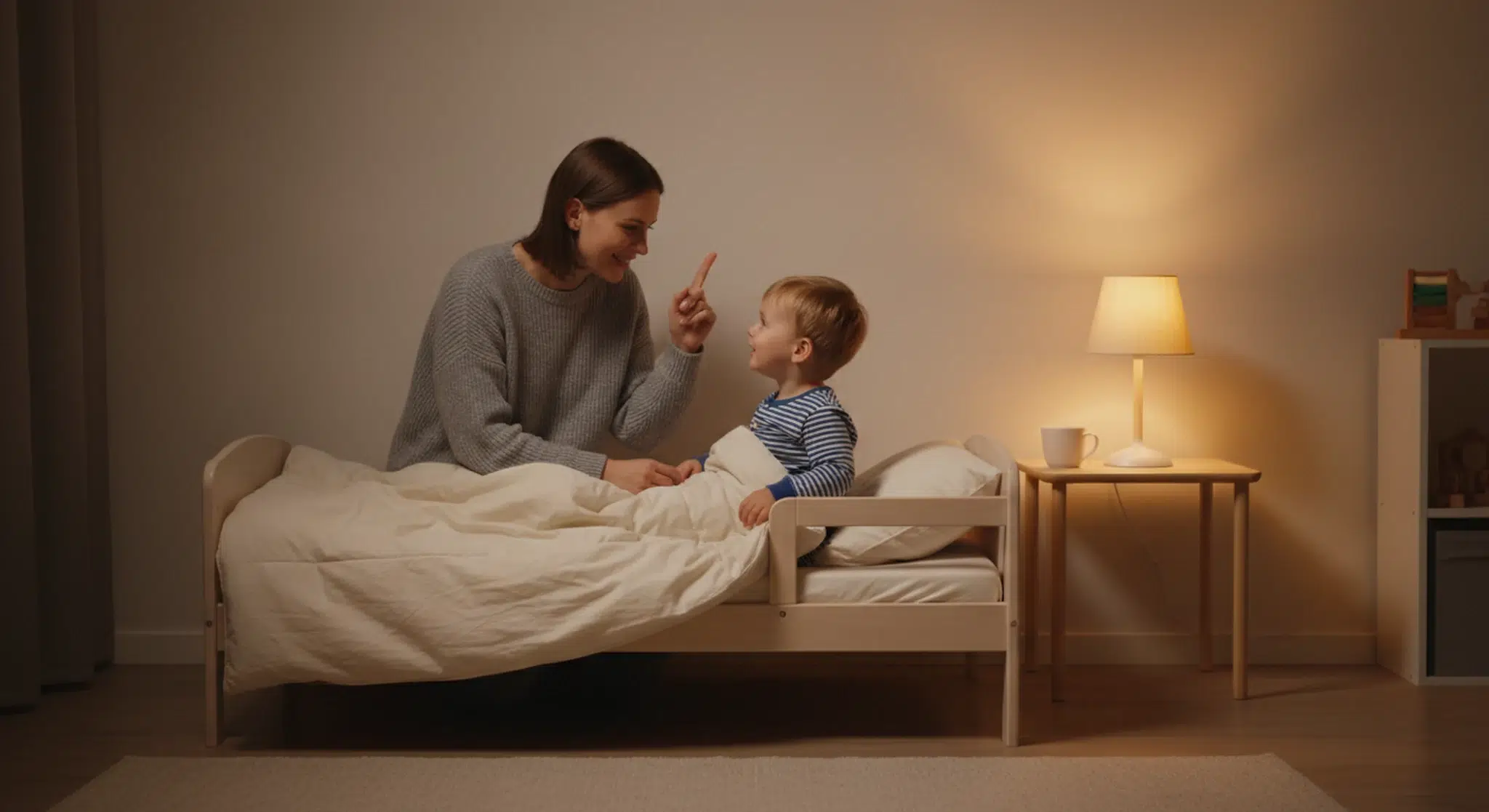
Bedtime stalling is very common in toddlers and preschoolers, and a short predictable routine, one agreed exception such as a bedtime pass, and calm returns to bed usually work better than answering every request.
If your 3 year old stalls at bedtime with a million requests, that is normal: the AAP lists stalling or resisting bedtime among the common sleep problems in children. It is usually driven by a wish for more time with you, a bit of control, and checking whether the limits are real, sometimes stacked on top of a bedtime that does not match your child’s sleep need.
Below: why toddler stalling at bedtime happens, a schedule check, what the bedtime pass studies found, a step-by-step plan, scripts, and when it is something more.
Key Takeaways
Bedtime stalling is common in toddlers and preschoolers and is usually a learned pattern, not a problem with your child.
Check the schedule first: the AASM recommends 10 to 13 hours of total sleep a day at ages 3 to 5, so too much time in bed or a late nap can fuel stalling.
Build the usual requests (water, potty, hug, books) into a short routine and set limits in advance.
The bedtime pass gives one exception per night; a small randomized trial of 19 children aged 3 to 6 found fewer trips out of the room and call-outs.
Talk to your pediatrician about snoring, breathing pauses, daytime sleepiness or intense fears.
Table of Contents
Bedtime Stalling: Is It Normal for a 3 Year Old?
Quick Answer
Yes. Bedtime stalling (one more drink, one more hug, one more book) is among the common sleep problems the AAP lists for young children. It is usually a mix of wanting more time with you, wanting some control, and checking whether the rules are real. What tends to help: a short, predictable routine with the usual requests built in, one agreed exception such as a bedtime pass, and calm, boring returns to bed for everything else.
The American Academy of Pediatrics (AAP) lists stalling or resisting bedtime among the common sleep problems in children. Nationwide Children’s Hospital notes that sleep problems are common in the preschool years and gives a simple first step: if your preschooler stalls at bedtime, set clear limits. Stalling is a learned pattern, and learned patterns can change.
Why Does My 3 Year Old Stall at Bedtime With a Million Requests?
Most stalling is several small drivers stacked together:
Connection: bedtime is the longest separation of the day. A request reliably brings you back for a few more minutes, especially after a busy day.
Control: three year olds are discovering that their choices matter. Bedtime is decided for them, so they make lots of tiny decisions inside it: which cup, which door gap, which song.
Testing limits: if the fourth glass of water worked last night, a fifth is worth a try tonight. Inconsistent answers teach that persistence pays.
Separation worries: some children feel the pull to stay close most strongly at night, and brief, quiet reassurance that you are nearby can settle them. See separation anxiety in toddlers.
Fears: Nationwide Children’s Hospital calls nighttime fears and nightmares a normal part of preschool development. Our toddler afraid of the dark guide covers this in depth.
Not tired yet, or overtired: a child put down before they are sleepy has nothing to do but call for you, and an overtired child can get wired instead of drowsy. Both look like stalling.
Check the schedule before anything else. The American Academy of Sleep Medicine (AASM) consensus statement, which the AAP supports, recommends this much total sleep per 24 hours, naps included:
Age
AASM recommended sleep per 24 hours
What to check if your child stalls
1 to 2 years
11 to 14 hours
Is the afternoon nap ending late?
3 to 5 years
10 to 13 hours
Is your child getting more time in bed than they can sleep?
6 to 12 years
9 to 12 hours
Are activities or screens pushing bedtime later?
Source: Paruthi et al., AASM consensus statement, J Clin Sleep Med 2016.
Nationwide Children’s Hospital puts preschool sleep need at 11 to 13 hours, a slightly higher low end than the AASM range, so treat these as ranges, not targets. If your child gets more time in bed than they can sleep, the extra time is time spent asking for things.
Nationwide Children’s also notes that most preschoolers stop napping between 3 and 5 years of age, and advises moving bedtime earlier or later to when your child is more physiologically ready for sleep. A late or long nap is a common hidden cause of stalling: end it earlier, shorten it, or swap it for quiet time. See when kids stop napping and how much sleep a 3 year old needs for schedules.
What Is a Bedtime Pass, and Does It Work?
A bedtime pass is a simple card your child can trade in once per night for one approved exception: one hug, one sip of water, one bathroom trip, one question. After it is used, other calls get no attention and you calmly return your child to bed. The research is small and comes from one group of researchers and collaborators:
Friman et al., 1999 (Archives of Pediatrics and Adolescent Medicine): two typically developing boys, aged 3 and 10. Crying and leaving the bedroom dropped to zero for both. Surveyed pediatricians (23) and parents (20) rated it highly acceptable.
Freeman, 2006 (Journal of Applied Behavior Analysis): four 3 year olds treated with the pass plus ignoring other bids. Resistance was eliminated for all four, without the extinction bursts (temporary spikes in protest) often seen when crying is simply ignored.
Moore, Friman, Fruzzetti and MacAleese, 2007 (Journal of Pediatric Psychology): a randomized controlled trial of 19 children aged 3 to 6. Compared with a monitoring-only group, children with the pass left their rooms and called out less often and took less time to settle. Effects held at 3 month follow-up, and parents reported high satisfaction.
Because these studies are small, the honest summary is that the pass is promising, well liked and low risk, but not tested in large trials.
Introduce it in the daytime and let your child decorate it.
Agree on what it buys, and keep each use about as long as one hug.
Once used, it goes on the shelf until morning.
Stuck on night two or three?
Our free two-minute quiz builds a gentle, personalized sleep plan that adapts when progress stalls.
Your routine is the foundation. The AAP suggests a quiet routine such as a story, soft music or a bath, and warns that active play right before bed can make a child too excited to sleep. Our toddler bedtime routine guide has a full sample; here is how to layer a stalling plan on top.
Step
What you do
Why it helps
1. Daytime talk
Explain the plan in two sentences, show the pass, practice it as a game.
Rules land better before bedtime.
2. Before-bed checklist
Water, potty, teeth, pajamas, a set number of books, comfort object, light and door set as your child likes.
The AAP advises meeting needs like a drink, a light or an open door before bed so they cannot delay sleep.
3. Last call
“Anything else before lights out?” Handle it, say goodnight once.
Lets you kindly say, “We already did that.”
4. One pass
Hand over the bedtime pass.
Control and connection in a limited dose.
5. Silent return
After the pass, walk your child back with as few words as possible, every time.
CHOC advises putting the child back in bed each time they get out.
6. Morning praise
Notice the effort out loud; a calendar star is optional.
CHOC suggests a star on a calendar for staying in bed all night.
A simple plan for bedtime stalling, layered on your usual routine.
Routine length: a CHOC (Children’s Health Orange County) pediatrician recommends starting quiet time 20 to 30 minutes before bedtime and setting a time limit for the routine. If your child also climbs out repeatedly, the walk-back method in how to get a toddler to stay in bed pairs well with this plan.
Scripts for the Most Common Stalls
Say it warmly, say it once, then follow through.
“I’m thirsty!”: “You had water at last call. It’s right there.” A small cup within reach makes this one disappear.
“I need to go potty!”: Build a bathroom trip into the routine. If your child truly needs to go later, take them quickly with lights low and no chatting. Never refuse a child who is still potty training; just keep it boring.
“One more hug!”: “That’s what your pass is for. Want to use it now?” If it is gone: “Big hug first thing in the morning.”
“One more book!”: Set the number in advance, as Nationwide Children’s suggests: “We read two. Tomorrow you pick first.”
“I’m scared!”: Take it seriously and keep it short: “You’re safe. I’m right downstairs.”
“I’m hungry!”: If this is frequent, check dinner timing and consider a small snack early in the routine, before teeth. Then: “The kitchen is closed. Breakfast is first thing.”
The First Three Nights: What to Expect
Any change is likely to be tested: your child is checking whether the new rule is real. On night 1, explain the plan again, expect the pass to be used fast, and stay calm and repetitive; many returns are normal. Night 2 can be as hard or harder, so do not reopen negotiations. On night 3, keep going and lean on morning praise.
The AAP notes that frustration is normal, but a negative parental reaction can worsen sleep problems, and children need the chance to learn to settle on their own. We cannot promise a timeline: the studies are small and children differ.
What Not to Do When Your Toddler Stalls at Bedtime
Long negotiations: every extra round of “just one more” teaches that the limit is flexible. Decide limits in advance, as Nationwide Children’s suggests.
Screens before bed: the AAP recommends turning off all screens at least 60 minutes before bedtime and keeping TVs, computers, tablets and phones out of children’s bedrooms, especially at night.
Going in every time they call: the AAP advises checking before bedtime that your child is safe and well; if so, there is no need to go in, since even a quick check can teach a child to expect you each time.
Moving them into your bed: the AAP’s bedtime tips advise against it, because it can make falling asleep alone harder. If that habit is already set, see child sleeping in parents’ bed.
When Bedtime Stalling Is Something More
Intense fears: Nationwide Children’s advises contacting your child’s doctor about significant, concerning nighttime fears or unusual nighttime awakenings.
Snoring or breathing problems: the AAP lists snoring, sleep apnea and loud or heavy breathing during sleep among childhood sleep problems to discuss with your pediatrician, and Nationwide Children’s advises seeking care if a child snores, is a noisy breather or has any trouble breathing.
Daytime signs: the AAP lists trouble paying attention, “zoning out,” learning problems and behavior problems.
Real trouble falling or staying asleep: despite a calm routine and a sensible schedule.
For the bigger picture from age 3 to 6, see our preschooler sleep guide.
How Betteroo Can Help
Betteroo builds a personalized sleep plan for your child’s age, schedule and bedtime challenges, including stalling. You can start with the free sleep quiz below.
Bring up bedtime stalling at your child’s next checkup if it is affecting the whole family’s sleep,, and sooner for any of these. The AAP encourages parents to discuss their child’s sleep habits and any problems with the pediatrician, and notes the doctor may ask you to keep a sleep log.
Snoring, loud or heavy breathing, noisy breathing or any trouble breathing during sleep (AAP, Nationwide Children’s).
Trouble paying attention, “zoning out,” learning problems or new behavior problems in the daytime (AAP).
Significant or worsening nighttime fears, or unusual nighttime awakenings (Nationwide Children’s).
Ongoing difficulty falling asleep or staying asleep despite a steady routine and schedule (Nationwide Children’s).
Worry, fear or clinginess that also shows up during the day, or anything about your child’s sleep that worries you.
Your pediatrician can check for medical causes and refer you to a specialist if needed.
Frequently Asked Questions
Is bedtime stalling normal for a 3 year old?
Yes. Bedtime stalling is very common in toddlers and preschoolers, and the AAP lists stalling or resisting bedtime among common childhood sleep problems. It usually comes from wanting more time with you, wanting some control and testing limits. A short routine, limits set in advance and calm returns to bed usually help.
Why does my toddler keep asking for things at bedtime?
Requests bring you back into the room, so they work. Many toddlers also want some control over a decision made for them, and some are anxious about separation or the dark. Others are simply not tired yet because bedtime is too early or the nap ran late. Building requests into the routine removes most of them.
What is a bedtime pass?
A bedtime pass is a card your child can trade once per night for one short exception, such as a hug, a drink or a bathroom trip. Other calls get a calm, quiet return to bed. In a small randomized trial of 19 children aged 3 to 6, children using the pass left their rooms and called out less often.
How long should a toddler bedtime routine be?
Short and the same each night. A CHOC pediatrician recommends starting quiet time 20 to 30 minutes before bedtime and setting a time limit for the routine. Bath, pajamas, teeth, potty, a set number of books and goodnight is plenty for most toddlers.
What time should a 3 year old go to bed?
There is no single right time. The AASM recommends 10 to 13 hours of total sleep per 24 hours at ages 3 to 5, including naps. Count back from your child’s usual wake time, subtract any nap, and choose a bedtime when your child is actually sleepy, so they are not lying awake with time to stall.
Should I go back in every time my toddler calls out?
Not if your child is safe and well. The AAP advises checking before bedtime that everything is fine, and says even a quick check can teach a child to expect you each time. Answer real needs and fears briefly and calmly, then keep further returns short and boring, or use a bedtime pass for one exception.
Gentle changes, peaceful nights.
Betteroo builds a personalized sleep plan for your baby or toddler. Take the free two-minute quiz to get started.
Friman PC, Hoff KE, Schnoes C, Freeman KA, Woods DW, Blum N. The bedtime pass: an approach to bedtime crying and leaving the room. Arch Pediatr Adolesc Med. 1999;153(10):1027-1029. https://pubmed.ncbi.nlm.nih.gov/10520609/
Moore BA, Friman PC, Fruzzetti AE, MacAleese K. Brief report: evaluating the Bedtime Pass Program for child resistance to bedtime, a randomized, controlled trial. J Pediatr Psychol. 2007;32(3):283-287. https://pubmed.ncbi.nlm.nih.gov/16899650/
Paruthi S, et al. Recommended Amount of Sleep for Pediatric Populations: A Consensus Statement of the American Academy of Sleep Medicine. J Clin Sleep Med. 2016. https://pubmed.ncbi.nlm.nih.gov/27250809/