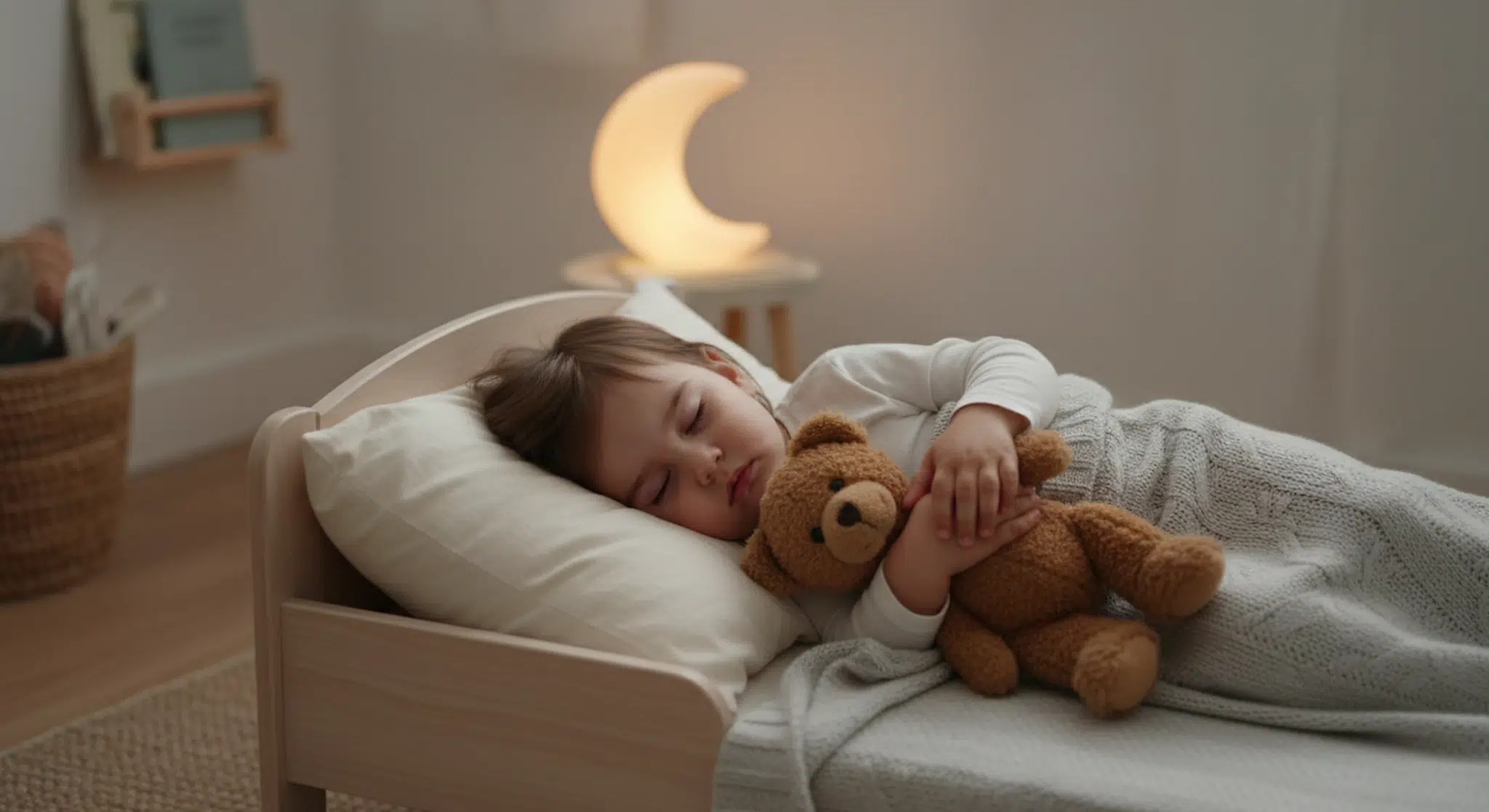
Once a toddler can climb out of bed, staying put becomes a skill you teach, and calm consistency is what makes it stick.
Getting a toddler to stay in bed comes down to three things: a bedtime that matches their real sleep needs, a predictable wind-down, and calmly returning them to bed with as little reaction as possible every time they get up. Do those consistently and most toddlers settle within one to two weeks.
This guide explains why toddlers keep getting out of bed, how to fix the routine and timing underneath the problem, the calm-return method step by step, the tools that help most, and how to handle stalling, fears, and the nights that test your patience.
Quick Answer: My 2 year old keeps getting out of bed over and over. What actually works?
Walk your toddler back to bed every time, calmly, with one short phrase and no discussion, until they stay. Check timing too: the AASM recommends 11 to 14 hours of sleep a day for ages 1 to 2, and the Raising Children Network says taking over 30 minutes to fall asleep can mean bedtime is too early.
Key Takeaways
Getting out of bed is normal boundary-testing after the freedom of a bed, not defiance.
A consistent 20 to 30 minute routine and a well-timed bedtime prevent most struggles.
Return your toddler calmly and boringly every time they get up, with one short phrase.
OK-to-wake clocks and small sticker rewards give toddlers a concrete rule to follow.
Expect the first nights to be hardest; most families see improvement within one to two weeks.
As an Amazon Associate, Betteroo earns from qualifying purchases.
Table of Contents
Why Toddlers Keep Getting Out of Bed
The moment a toddler moves from a crib to a bed, one thing changes everything: they can now get up whenever they want. A crib is a boundary. A bed is an open invitation. So the first thing to understand is that getting out of bed is not defiance, it is a predictable consequence of new freedom colliding with a brain that is still learning impulse control.
Underneath that, a handful of common drivers show up again and again: your toddler is not actually tired yet, bedtime is a little too early or too late, they are testing where the limits are, they are seeking one more dose of connection with you, or something feels off, like fear of the dark or separation anxiety. Naming the reason helps you pick the right response, because a tired-too-early toddler needs a schedule tweak, while a limit-testing toddler needs a calm, consistent boundary.
Start With the Foundation: Routine and Timing
Most staying-in-bed battles get shorter when the fundamentals are solid. A predictable, calming bedtime routine tells your toddler’s brain that sleep is coming, so the transition feels less abrupt. Keep the same order every night, keep it to about twenty to thirty minutes, and end it in the bedroom rather than in the living room so the last thing your toddler experiences is their sleep space.
Timing matters just as much. A toddler put down before they are tired will lie there, get bored, and get up. A toddler kept up too long gets a second wind, becomes wired, and fights sleep even harder. Most toddlers need about eleven to fourteen hours of sleep across a day, including naps. If bedtime is a nightly struggle, experiment with shifting it fifteen to thirty minutes in either direction and watch which way settles them faster. Our guide to building a toddler bedtime routine walks through the steps in order.
My 2 Year Old Keeps Getting Out of Bed Over and Over. What Actually Works?
What works is the combination of a bedtime that fits your toddler’s real sleep need, a short and predictable routine, and the same calm return to bed every single time. The Raising Children Network advises saying “It’s time to sleep. Please stay in your bed,” then returning your child gently and calmly to bed without talking or scolding, as many times as it takes (Raising Children Network).
A bedtime that is too early can leave a toddler lying awake, bored, and getting up. The Raising Children Network says that if your child takes more than 30 minutes to fall asleep, you might be putting them to bed too early, and suggests moving bedtime later, closer to when they actually fall asleep, then moving it earlier by 15 minutes every 3 nights once they settle quickly (Raising Children Network).
How long should the bedtime routine be?
The Raising Children Network suggests a bedtime routine might start 20 to 30 minutes before bedtime for babies, toddlers and preschoolers, and 30 to 45 minutes before bedtime for school age children, with no screens in the hour before bed (Raising Children Network). HealthyChildren.org, from the American Academy of Pediatrics, recommends making bedtime the same time every night and setting up a quiet routine before it (HealthyChildren.org).
The silent return, step by step
Finish the routine in the bedroom, including the last drink, hug and potty trip, so there is nothing left to come out for.
Say goodnight with one short phrase and leave.
Each time your toddler gets up, walk them back without lectures, negotiation or a big reaction, repeat the same phrase, tuck them in and leave.
Repeat as many times as it takes, the same way every time, including during night wakings.
In the morning, praise them briefly for any time they stayed in bed.
Option: timed check ins
Some families prefer brief check ins so their toddler knows they are close. The AASM practice parameters summary (Morgenthaler, 2006) describes graduated checking, for example after 5 minutes, then 10 minutes, or a fixed schedule such as every 5 minutes (AASM summary). HealthyChildren.org cautions the other way for toddlers who call out: if you appear for any reason, even just for checking, they may expect you to come each time (HealthyChildren.org). If check ins seem to keep your toddler up, switch to silent returns only.
Other tools: the bedtime pass and the chair method
A bedtime pass is a card your child can trade for one acceptable request after lights out, such as one more hug. The Raising Children Network describes this free pass idea and says it might work with children over 3 years (Raising Children Network). For a toddler who is anxious rather than testing, sitting in a chair by the bed and moving it toward the door over time (camping out) is gentler; the Raising Children Network says it could take 1 to 3 weeks (Raising Children Network).
When your toddler gets out of bed, the single most effective response is to return them with as little drama as possible. Walk them back calmly, say one short reassuring phrase like it is time for sleep, tuck them in, and leave. No lectures, no negotiation, no big reaction. Toddlers are brilliant at detecting which behaviors get an interesting response, so the goal is to make getting up the most boring thing in the world.
You may have to do this many times the first few nights. That is normal and expected. The consistency is the whole point: your toddler is running an experiment to find out whether the boundary is real, and every calm, identical return is you answering yes. Some families call this the silent return or the boomerang method. Whatever you call it, the magic is in doing the same undramatic thing every single time until the testing stops, which usually takes several nights to a couple of weeks.
Tools That Make Staying in Bed Easier
A few practical supports can do a lot of the heavy lifting. A toddler-friendly clock that changes color or shows a symbol when it is okay to be awake gives your child a clear, concrete rule that does not depend on you being in the room. Our guide to OK-to-wake clocks explains how to introduce one so it actually works.
A simple reward system can help too, because toddlers are strongly motivated by small, immediate wins. A sticker chart where staying in bed earns a sticker, and a few stickers earn a small privilege, turns an abstract rule into a game your toddler wants to win. Keep rewards tiny and immediate. Pair these tools with a comfortable sleep environment: a dark room, a steady sound machine, a lovey if your child uses one, and a temperature that is comfortably cool.
An OK-to-wake clock to signal when it is time to get up
A small, immediate reward or sticker chart for staying put
A consistent lovey, night light, or sound machine for comfort
A quick, predictable goodnight so there is no reason to call you back
A dark, cool, boring bedroom that invites sleep rather than play
Handling the Common Curveballs
Toddlers are inventive, and a few classic stalling tactics will test your patience. The endless requests, one more drink, one more hug, one more trip to the potty, are best handled by folding them into the routine in advance. Offer the drink, the last hug, and the final potty trip as the closing steps of the wind-down, then calmly decline repeats. Consistency is kinder than it feels, because it removes the uncertainty your toddler is probing.
Genuine fears deserve a warmer response than stalling does, and you can tell the difference over time. If your toddler is truly scared of the dark, a dim night light and a matter-of-fact, reassuring attitude help more than long discussions, which can accidentally amplify the fear. If getting out of bed comes with intense crying, confusion, or seems to happen while your child is not fully awake, read up on the difference between nightmares and night terrors, which are handled differently.
How Long Until It Works
Most families see real improvement within one to two weeks of calm, consistent returns, provided the schedule and routine are also solid. The first few nights are usually the hardest, because your toddler is testing the new rule most intensely right at the start. If you hold the boundary steadily, the number of returns drops night by night until staying in bed becomes the new normal.
If weeks go by with no improvement at all, step back and look at the whole picture. Is bedtime timed right for your toddler’s current sleep needs? Did a nap drop or a schedule change throw things off? Is a new sibling, a move, or a developmental leap driving a need for extra connection? Adjust the underlying cause, keep the calm-return method steady, and give it time. When something feels beyond a typical phase, your pediatrician can help rule out sleep or medical issues.
Consistency Is the Kindest Approach
It can feel harsh to keep returning your toddler without long cuddles or conversation, but predictability is actually reassuring to a young child. When the rule is clear and the same every night, your toddler stops having to test it, and everyone gets more rest. The warmth comes from the loving, unhurried bedtime routine that precedes lights-out, not from negotiating at the door.
If getting out of bed comes with extreme distress, breathing problems, or your toddler seems genuinely panicked or not fully awake, or if nothing improves after a couple of consistent weeks, talk with your pediatrician. Occasionally an underlying issue like sleep-disordered breathing or significant anxiety is driving the pattern and deserves a closer look.
Frequently Asked Questions
How do I get my toddler to stay in their bed at night?
Build a calm, consistent bedtime routine, make sure bedtime matches your toddler’s sleep needs, and when they get out of bed, return them calmly with as little reaction as possible. Say one short phrase, tuck them in, and leave. Repeat every single time. Consistency over one to two weeks is what teaches the boundary.
Why does my toddler keep getting out of bed?
The most common reasons are a bedtime that is too early or too late, testing the new freedom a bed allows, seeking extra connection, or a fear like the dark or separation anxiety. Getting up is usually normal boundary-testing rather than defiance. Identifying the driver helps you choose between a schedule change and a calm, firm limit.
What is the silent return method for toddlers?
It means walking your toddler back to bed each time they get up with minimal talking and no big reaction, saying one brief reassuring phrase, tucking them in, and leaving. Because toddlers repeat behaviors that get an interesting response, keeping the return boring removes the payoff for getting up, and the behavior fades within days to a couple of weeks.
At what age should a toddler stay in bed on their own?
Many toddlers move to a bed and begin learning to stay put between about two and a half and three and a half years old, but readiness varies. Whatever the age, staying in bed is a learned skill that depends on a consistent routine, the right bedtime, and calm, repeated returns rather than on hitting a specific birthday.
Do reward charts help toddlers stay in bed?
Yes, for many toddlers a simple sticker chart works well because toddlers respond strongly to small, immediate wins. Give a sticker for staying in bed and let a few stickers earn a tiny privilege. Pair the reward with a consistent routine and calm returns, since the chart supports the boundary rather than replacing it.
What is a bedtime pass for toddlers?
A bedtime pass is a card your child can trade for one acceptable request after lights out, such as one more hug or a sip of water. The Raising Children Network describes this free pass idea and says it might work with children over 3 years. Once the pass is used, return your child to bed calmly and briefly.
How much sleep does a 2 year old need?
The American Academy of Sleep Medicine recommends 11 to 14 hours of sleep per 24 hours, naps included, for children 1 to 2 years old, and 10 to 13 hours for ages 3 to 5. If your toddler regularly takes more than 30 minutes to fall asleep, the Raising Children Network says bedtime may be too early.
Bedtime battles wearing you down
Take our free 3-minute sleep quiz for a toddler sleep plan built around your child’s age, schedule, and temperament.
Paruthi S, et al. Recommended Amount of Sleep for Pediatric Populations: A Consensus Statement of the American Academy of Sleep Medicine. Journal of Clinical Sleep Medicine, 2016. https://pubmed.ncbi.nlm.nih.gov/27250809/