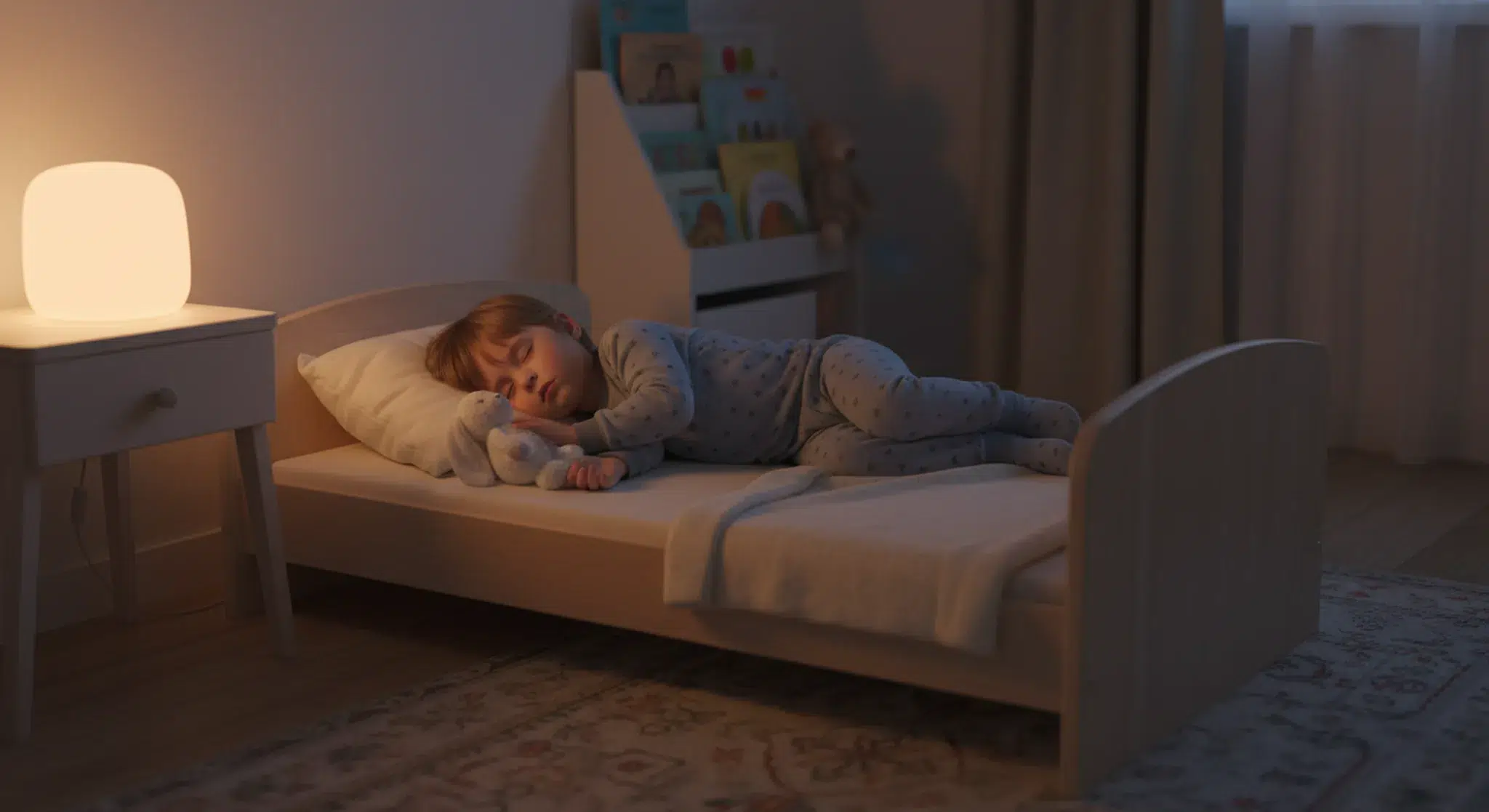


To get a toddler to sleep through the night, anchor a consistent schedule with an age-right bedtime (usually 7:00 to 8:30), run the same 20 to 30 minute wind-down routine every night, and make sure the way your toddler falls asleep at bedtime is the same way they will find themselves at 2 a.m.: in their own bed, without you feeding, rocking, or lying next to them. Fix those three things and most night waking fades within a couple of weeks.
That last piece is the one most families are missing. Every human briefly surfaces between sleep cycles overnight. A toddler who falls asleep independently rolls over and resettles without ever fully waking. A toddler who falls asleep being rocked, held, or lying next to a parent wakes at the end of a cycle, notices the conditions have changed, and calls for a redo.
This guide covers how to get a toddler to sleep through the night step by step: the schedule math, the routine, how to retire the sleep associations that drive 2 a.m. wakeups, what to do about curtain calls and early mornings, and the handful of situations where night waking deserves a pediatrician’s look instead of a sleep plan.
Key Takeaways
- Most toddler night waking is driven by three fixable things: a schedule that does not fit, an inconsistent routine, and sleep associations that require a parent to recreate.
- Toddlers need 11 to 14 hours of sleep per 24 hours; a bedtime between 7:00 and 8:30 with 5 to 6 hours between nap end and bedtime fits most kids.
- However your toddler falls asleep at bedtime is what they will demand at every overnight waking, so independent falling asleep is the core skill.
- Respond to night wakings with boring consistency: brief, calm, minimal light and talk, and the same script every single time.
- See your pediatrician if night waking comes with snoring or gasping, breathing pauses, painful wakeups, or intense fear episodes that do not respond to comfort.
Table of Contents
Why Toddlers Wake at Night in the First Place
Night waking in the toddler years is nearly universal and nearly always behavioral, which is genuinely good news, because behavior is fixable. The usual suspects:
- Sleep associations: falling asleep only while nursing, rocking, holding hands, or with a parent lying nearby, then needing that same help at every overnight arousal.
- Schedule mismatch: a nap that ends too late, a bedtime that is too early or too late, or more total daytime sleep than the child needs.
- Overtiredness: a too-late bedtime raises stress hormones and fragments the night, which is why later bedtimes often backfire into more waking, not less.
- Developmental waves: language bursts, imagination and new fears, molars, illness, and big transitions like a new sibling, a move, or starting daycare.
- Normal regressions: brief relapses around age 2 and 3 that pass in a week or two if you hold your routine steady.
If your toddler recently gave up napping or started climbing out of the crib, sort those first: our guides on when kids stop napping and the toddler bed transition cover both.
Step 1: Get the Schedule Right
Toddlers aged 1 to 2 need about 11 to 14 hours of sleep per 24 hours, and preschoolers 3 to 5 need 10 to 13, per the American Academy of Sleep Medicine. Most toddlers do best with 10.5 to 12 of those hours at night.
The two levers that matter most: wake the day at a consistent time, and protect 5 to 6 hours of awake time between the end of the nap and lights out. A nap that runs past 3:00 or 3:30 quietly steals pressure from bedtime, and the result is a toddler who takes an hour to fall asleep or parties at 3 a.m. If bedtime battles appear, cap the nap before you do anything else. Age-by-age totals are in our guides to 2 year old and 3 year old sleep needs.
Step 2: Build a Bedtime Routine That Ends in the Bed, Awake
A consistent 20 to 30 minute routine is the most evidence-backed tool in pediatric sleep: same steps, same order, same room, every night. A classic sequence is bath, pajamas and teeth, two books, one song, a short cuddle, then into bed awake with a consistent goodnight phrase.
Two design rules. First, put every negotiable inside the routine: the extra story, the water sip, the last hug all happen before lights out, which defuses the curtain calls later. Second, the routine must end with your toddler in bed drowsy but awake. If they are asleep on you at the last step, the routine is doing the falling asleep, and that is the association that will page you at 2 a.m.
Round out the environment: dark room (blackout curtains beat night-light brightness wars), white noise to mask household sounds, a cool comfortable temperature, and no screens in the hour before bed. A lovey or small blanket is fine after 12 months and often helps.
Step 3: Retire the Sleep Associations
If your toddler currently falls asleep nursing, rocking, or with you lying beside them, pick a plan for stepping back and hold it. Two well-studied options:
- Fading (camping out): sit in a chair beside the bed until asleep for 2 to 3 nights, then move the chair halfway to the door, then to the doorway, then out of sight, shrinking your involvement every few nights.
- Check-and-return: leave after goodnight, and if your toddler cries or calls, return briefly on a schedule, deliver one calm scripted line, and leave again, stretching the intervals as nights pass. Details in our toddler cry it out guide.
Both approaches work; the deciding factor is which one you can execute identically for two weeks. Toddlers are world-class pattern detectors, and intermittent rescue (holding firm for 40 minutes, then climbing into their bed) teaches exactly one lesson: persistence pays.
A plan beats another rough night
Betteroo’s free quiz builds a personalized toddler sleep plan: schedule, routine, and night-waking script matched to your child.
Step 4: Handle Night Wakings the Same Way, Every Time
Even with a solid bedtime, expect some overnight callbacks during the transition. When they come: wait a beat before responding (many toddlers resettle in under a minute), then go in calm and boring. Low light, minimal words, no snacks, no screens, no new negotiations. Deliver your script (“It is still night. You are safe. I love you. See you in the morning.”) and leave. Repeat as many times as needed with the enthusiasm of a parking attendant.
If your toddler leaves their room, walk them back silently every single time. For habitual 5 a.m. risers, an OK-to-wake clock gives a concrete green-light target, and any wakeup before it gets the same boring walk-back. Most families who apply this with real consistency see nights consolidate within one to two weeks.
When Night Waking Is Not Behavioral
A minority of night waking has a medical driver, and no sleep plan fixes those. Book a pediatrician visit if you notice:
- Loud nightly snoring, gasping, mouth breathing, or pauses in breathing, which can signal obstructive sleep apnea.
- Waking that looks painful: ear pulling, reflux symptoms, eczema itching, or fever.
- Screaming episodes where your child seems awake but does not recognize you and cannot be comforted, covered in our night terrors guide: these are harmless but commonly mistaken for nightmares.
- Restless sleep with kicking legs or unusual daytime sleepiness despite adequate hours in bed.
Frequently Asked Questions
How do I get my toddler to sleep through the night?
Set a consistent schedule with bedtime between 7:00 and 8:30 and about 5 to 6 hours between nap end and lights out, run the same 20 to 30 minute wind-down routine nightly, and have your toddler fall asleep in bed awake rather than being rocked, fed, or accompanied to sleep. Answer overnight wakeups with brief, boring, identical responses. Most toddlers consolidate nights within two weeks of consistent practice.
Why does my toddler keep waking up at night?
The most common cause is a sleep association: your toddler falls asleep with help (nursing, rocking, a parent lying nearby) and needs that help again at each normal between-cycle arousal overnight. Schedule problems, overtiredness, developmental leaps, teething, and brief age 2 to 3 regressions are the other frequent drivers.
Should I let my toddler cry it out?
Full extinction is not the only option. Gradual methods like camping out (slowly moving your chair toward the door) or timed check-ins are well studied, effective, and gentler on many families. What matters most is picking one method you can apply identically every night for two weeks, because inconsistency is what prolongs crying.
What time should a toddler go to bed?
Most toddlers do best with lights out between 7:00 and 8:30 p.m. Anchor bedtime so your child can get 10.5 to 12 hours overnight before their natural wake time, and keep at least 5 to 6 hours of awake time after the nap ends. A bedtime that drifts too late usually produces more night waking, not less.
When should a toddler sleep through the night consistently?
The skill of linking sleep cycles independently can be in place from the second half of the first year, so healthy toddlers are fully capable of 10 to 12 hour nights. If your toddler has never strung nights together, it is almost always an association or schedule issue rather than a developmental limitation, and it responds quickly to the steps above.
Whole nights are learnable
Get a personalized, step-by-step toddler sleep plan from Betteroo’s free quiz and retire the 2 a.m. wakeups for good.
Related Betteroo Guides
- How to Get a Toddler to Stay in Bed
- A Calming Toddler Bedtime Routine
- OK-to-Wake Clocks: A Parent Guide
4 Sources
- American Academy of Sleep Medicine: Recommended Amount of Sleep for Pediatric Populations (Consensus Statement)
https://aasm.org/resources/pdf/pediatricsleepdurationconsensus.pdf - American Academy of Pediatrics, HealthyChildren.org: Healthy Sleep (Hub)
https://www.healthychildren.org/English/healthy-living/sleep/Pages/default.aspx - Nemours KidsHealth: Sleep and Your Newborn to Preschooler (Sleep Guides)
https://kidshealth.org/en/parents/sleepnewborn.html - Mindell JA, et al. Behavioral Treatment of Bedtime Problems and Night Wakings in Infants and Young Children. Sleep. 2006
https://pubmed.ncbi.nlm.nih.gov/17068979/