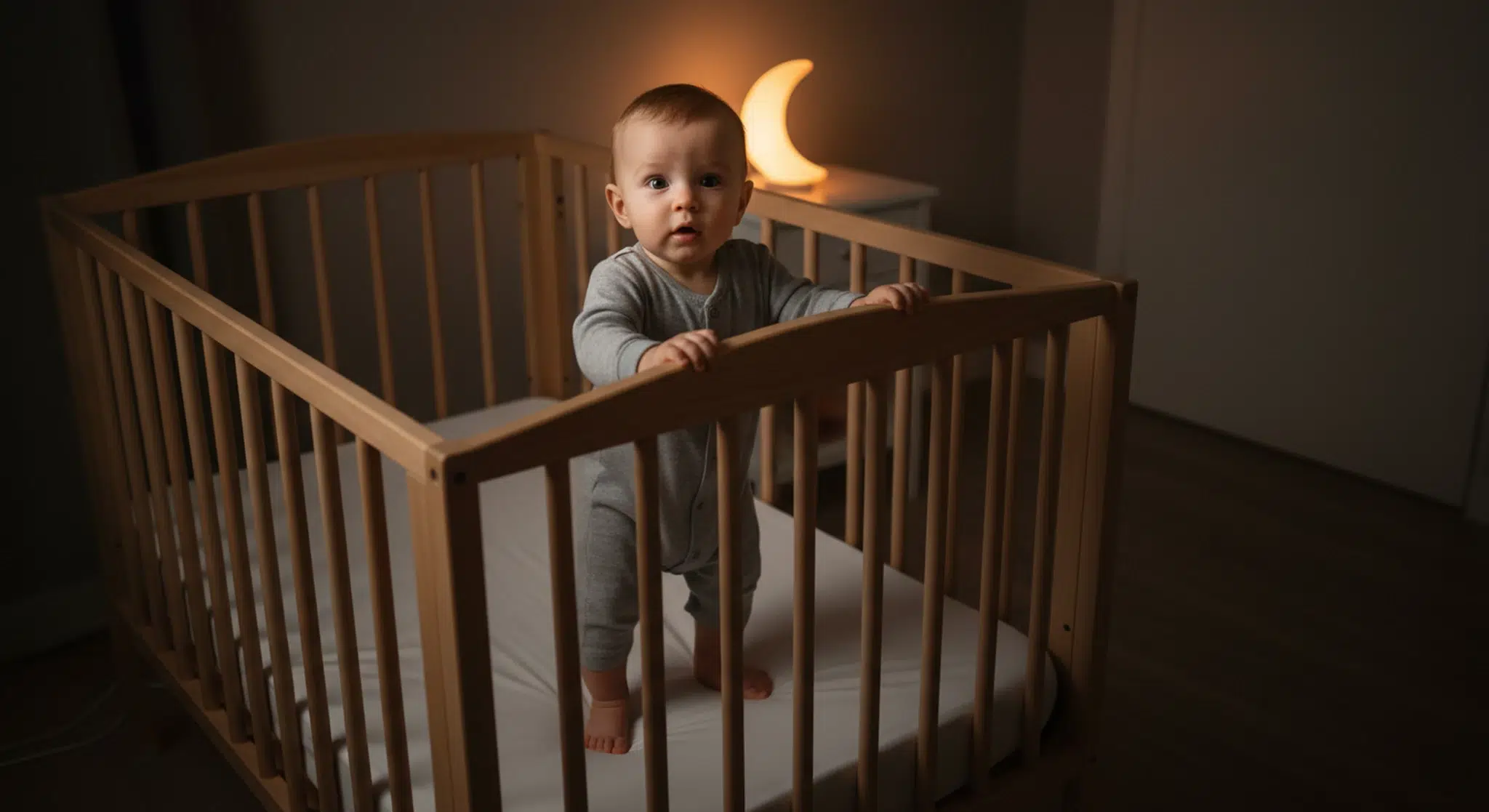


The 9 month sleep regression is a temporary stretch of disrupted sleep, usually lasting 2 to 6 weeks, driven by huge developmental leaps: crawling, pulling to stand, separation anxiety, and a brain that suddenly refuses to switch off at bedtime. Your baby’s sleep skills are not broken. Their world just got much more interesting.
One week your baby is sailing through naps and sleeping solid nights. The next, bedtime is a protest, naps shrink to 30 minutes, and you are back to multiple night wakings that feel like the newborn days. If your baby is somewhere between 8 and 10 months old, you are probably in the thick of the 9 month sleep regression.
This guide explains exactly why sleep falls apart around 9 months, how to tell a regression from a nap transition or an ear infection, and the step-by-step plan that gets sleep back on track without undoing all the good habits you have built. It builds on our full sleep regression ages guide with everything specific to this stage.
Key Takeaways
- The 9 month sleep regression typically lasts 2 to 6 weeks and shows up as bedtime resistance, short naps, early morning wakings, and new night wakings.
- The main drivers are motor leaps (crawling, pulling to stand), peak separation anxiety, teething, and the tail end of the 3-to-2 nap transition.
- Keep wake windows around 2.75 to 3.5 hours and protect two solid naps; an overtired baby sleeps worse, not better.
- Give your baby daytime practice for new skills and extra connection before bed; both directly reduce night wakings at this age.
- Stay consistent with how you respond at night. Regressions end fastest when babies are not learning brand-new sleep associations mid-regression.
Table of Contents
What Is the 9 Month Sleep Regression?
A sleep regression is a sudden, temporary decline in sleep in a baby who was previously sleeping well. Around 9 months (anywhere from roughly 8 to 10 months), many babies hit a perfect storm of development that disrupts both naps and nights. Pediatric sleep researchers do not consider regressions a formal diagnosis; they are a predictable side effect of a healthy, rapidly developing brain.
At this age the disruption often overlaps with what some parents call the 8 month sleep regression. They are the same event landing at slightly different times for different babies. If your baby sailed through month 8, month 9 can still deliver the storm.
Typical signs include: fighting bedtime hard after months of easy goodnights, waking 1 to 3 times overnight, 30-minute crib naps, standing or crawling in the crib instead of sleeping, crying the moment you leave the room, and early morning wakings before 6:00 a.m.
Why It Happens: The 4 Big Drivers
1. Gross motor leaps. Between 8 and 10 months most babies learn to crawl, sit up from lying down, and pull to stand. The brain consolidates new motor skills during sleep and practices them compulsively, which is why you find your baby standing in the crib at 2:00 a.m., delighted and stuck. Our 9-month-old milestones guide covers what is developmentally normal right now.
2. Peak separation anxiety. Around 9 months babies fully grasp object permanence: you still exist after you leave the room. That is wonderful for cognition and terrible for bedtime. Protest crying when you walk out is a healthy attachment behavior, not manipulation. We cover this in depth in separation anxiety and baby sleep.
3. Nap transition aftershocks. Most babies drop from 3 naps to 2 between 7 and 9 months. If the 3-to-2 nap transition happened recently, the schedule may still be settling, and a too-early bedtime or a stretched afternoon can produce overtired nights.
4. Teething and growth. The 9 month window is prime time for new teeth, and many babies also hit a growth spurt with genuinely bigger appetite. Both can cause real discomfort or hunger wakings layered on top of the developmental noise.
Regression, Nap Transition, or Something Else?
Before you change anything, rule out lookalikes. A regression is the likely culprit when sleep fell apart suddenly in an 8 to 10 month old who is otherwise happy, feeding well, and hitting motor milestones.
- Nap transition: if your baby is still on 3 naps and refusing the third, or on 2 naps that keep shrinking, fix the schedule first with our 9 month old sleep schedule.
- Illness: ear infections classically show up as sudden night waking with crying that does not settle, especially after a cold. Fever, ear pulling, or feeding refusal means a pediatrician visit, not a sleep plan.
- Hunger: babies this age need iron-rich solids three times a day plus breast milk or formula. A baby who is genuinely hungrier during a growth spurt may briefly need an extra daytime feed.
- Schedule drift: wake windows that were right at 7 months are often too short at 9 months, and undertiredness produces the same split nights and early wakings as overtiredness.
The Right Schedule During the Regression
Most 9 month olds need about 14 hours of total sleep: 11 hours overnight plus 2 to 3 hours across two naps. Wake windows run roughly 2.75 to 3.5 hours, shortest before the morning nap and longest before bedtime. Our 9 month old wake windows guide breaks this down hour by hour.
| Time | What happens |
|---|---|
| 6:30–7:00 a.m. | Wake for the day, milk feed then breakfast |
| 9:30–10:00 a.m. | Nap 1 (60–90 minutes) |
| 2:00–2:30 p.m. | Nap 2 (60–90 minutes) |
| 6:45–7:15 p.m. | Bedtime routine begins |
| 7:15–7:45 p.m. | Asleep for the night |
During the regression, protect the naps fiercely. It is tempting to let a bad night push the whole day later, but consistent nap timing is the anchor that pulls nights back into place. If a nap fails completely, bring bedtime earlier by 30 to 45 minutes that day rather than adding a third nap back.
Not sure if it’s the regression or the schedule?
Take Betteroo’s free 3-minute sleep quiz and get a personalized plan for your baby’s exact age and sleep struggles.
7 Ways to Get Through It Faster
- Practice skills by day. Give your baby 20 to 30 minutes of floor time daily to crawl and pull to stand. The more daytime practice, the less 2:00 a.m. rehearsal.
- Teach getting down. Babies learn to pull up before they learn to sit back down. Practice lowering from standing during play so a crib standoff does not need your rescue every time.
- Front-load connection. Add 15 minutes of undistracted one-on-one play before the bedtime routine. For a baby in peak separation anxiety, a full connection tank measurably reduces protest.
- Keep the routine identical. Same order, same words, same sleep space every night. Predictability is the antidote to a brain on high alert.
- Play peekaboo goodbyes. Brief, cheerful exits and returns during the day teach that you always come back. Long, sad, lingering goodbyes teach that leaving is scary.
- Respond consistently at night. Comfort your baby the same way you did before the regression. If they fell asleep independently before, give them a few minutes to try before stepping in; babies who could self-soothe usually find the skill again quickly.
- Watch the early wakings. Keep the room dark until your desired wake time and treat pre-6:00 a.m. wakings as night wakings, or you will accidentally set a new (terrible) alarm clock.
What Not to Do
Avoid introducing brand-new sleep associations you do not want to keep. Two weeks of rocking fully to sleep, a return to overnight feeds a baby no longer needs, or moving them into your bed can outlast the regression by months. Comfort generously, but aim to put your baby down aware that they are going into the crib.
Do not slash naps to force better nights. Daytime sleep deprivation reliably makes nights worse at this age because an overtired baby produces more cortisol, wakes more often, and rises earlier.
And do not start formal sleep training in the middle of the storm if your baby is mid-leap or cutting a tooth. If independent sleep was already shaky before the regression, wait for the acute phase to pass, then work on it deliberately. Our guides to the Ferber method and gentler approaches can help you choose.
How Long Does the 9 Month Sleep Regression Last?
Most families see the worst of it resolve within 2 weeks, with the full arc lasting 2 to 6 weeks. The regression ends when the new skills consolidate: crawling becomes boring, pulling to stand stops being novel, and your baby trusts that you return. Babies who had solid independent sleep skills beforehand typically snap back fastest.
If sleep has not improved after 6 weeks, something else is usually going on: a schedule that no longer fits, a new sleep association that took root, or an approaching change like the 10 month sleep regression blending into this one. Reassess the schedule first; it is the fix in the majority of stubborn cases.
When to Call Your Pediatrician
Regressions are normal, but call your pediatrician if night waking comes with fever, ear pulling, or inconsolable crying; if your baby snores, gasps, or pauses breathing during sleep; if they are not crawling, sitting independently, or babbling by 10 months; or if feeding drops off noticeably. These point to medical causes that no schedule change will fix, and they are worth ruling out early.
Frequently Asked Questions
Is there a sleep regression at 9 months?
Yes. The 9 month sleep regression is one of the most common regression windows, driven by crawling and pulling to stand, peak separation anxiety, teething, and schedule changes after the 3-to-2 nap transition. It typically lasts 2 to 6 weeks and resolves on its own with a consistent schedule and consistent responses at night.
How long does the 9 month sleep regression last?
Most babies get through it in 2 to 6 weeks. The worst nights usually cluster in the first two weeks. If disrupted sleep persists beyond 6 weeks, reassess wake windows and check whether a new sleep association (like being fed or rocked fully to sleep) has taken hold.
Should I feed my baby during 9 month regression night wakings?
If your baby had already dropped night feeds, most wakings now are developmental rather than hunger-driven, and reintroducing overnight feeds can create a new habit. Offer comfort first. The exception is a clear growth spurt with big daytime appetite; add calories during the day rather than at night.
Why does my 9 month old stand in the crib and cry?
Pulling to stand is a brand-new compulsion, and many babies practice it the moment they surface from a sleep cycle, then get stuck because lowering down is a separate skill they have not mastered. Practice sitting down from standing during the day, and at night calmly lay them back down once, then give them space to resettle.
Can the 9 month sleep regression affect naps only?
Yes. Some babies keep solid nights but shrink their naps to 30 minutes or fight the second nap entirely. Nap-only regressions usually mean the schedule needs adjusting alongside the developmental leap; hold two naps with wake windows around 2.75 to 3.5 hours and keep the wind-down short and dark.
Get a sleep plan built for your baby
Betteroo analyzes your baby’s age, schedule, and temperament and gives you a step-by-step plan trusted by thousands of parents.
4 Sources
- American Academy of Pediatrics, HealthyChildren.org: Baby Sleep
https://www.healthychildren.org/English/ages-stages/baby/sleep/Pages/default.aspx - CDC: Developmental Milestones
https://www.cdc.gov/act-early/milestones/index.html - Nemours KidsHealth: How Much Sleep Do Kids Need?
https://kidshealth.org/en/parents/sleep.html - NICHD Safe to Sleep: Safe Sleep Environment
https://safetosleep.nichd.nih.gov/reduce-risk/safe-sleep-environment