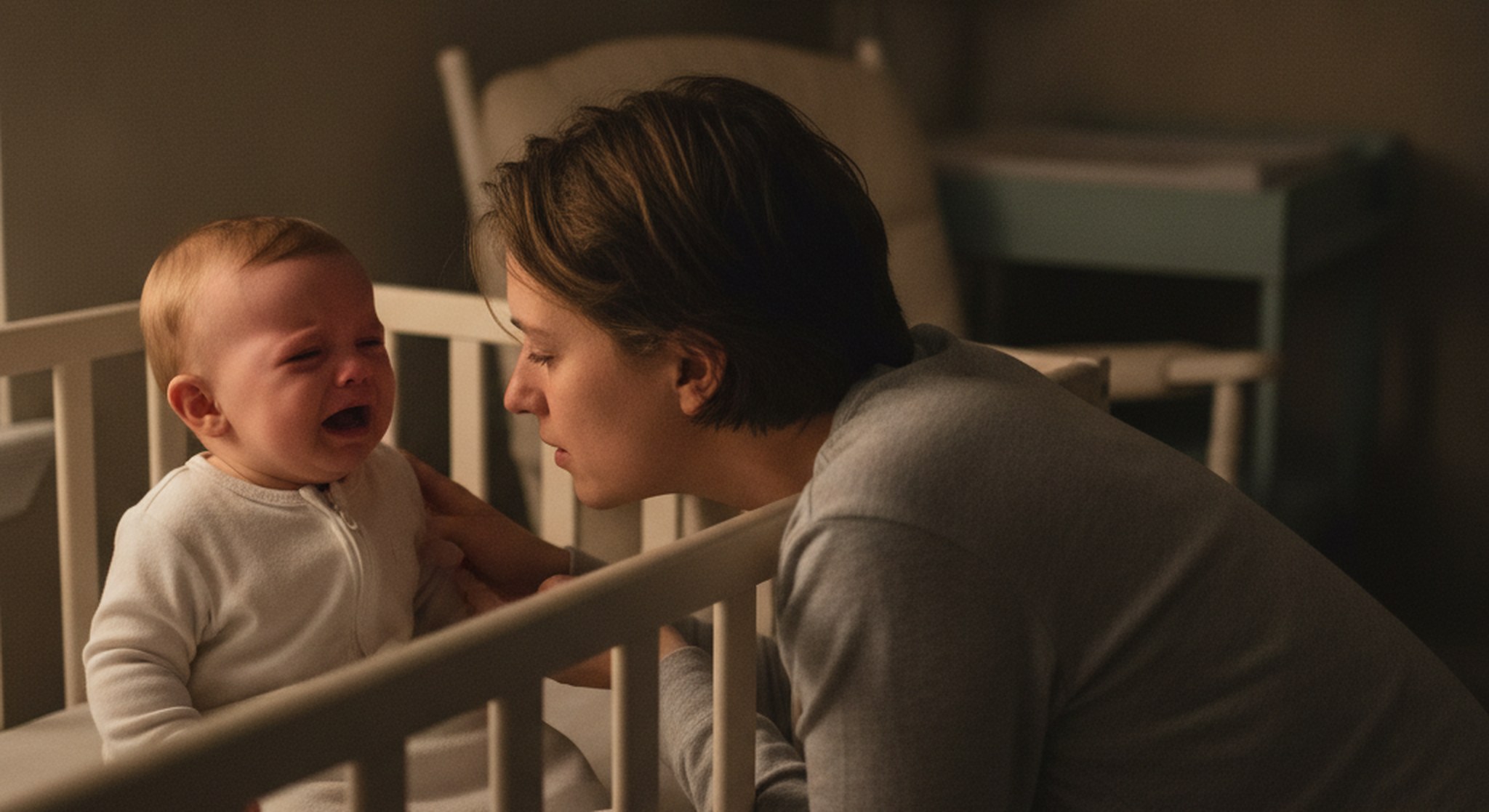
If you’re reading this at 2am because an 11 month old who had finally figured out sleep is suddenly standing at the crib rail every hour, you’re not imagining it and you didn’t undo your progress. The 11 month sleep regression gets talked about less than the 4 month or the 12 month one, but plenty of families hit a rough patch right here. It’s driven by big motor work, separation, and one very common scheduling mistake. The good news: it’s usually short.
Key Takeaways
The 11 month regression is driven by pulling to stand, cruising, pre-walking, separation awareness, and teething, not by anything you did wrong.
The single most common mistake at this age is dropping to one nap too early. Most 11-month-olds still need two naps, and false readiness signs fool a lot of parents.
In our State of Baby Sleep survey (n=5,002), 60.5% of parents of 10 to 12 month olds reported their baby waking three or more times a night, so frequent waking at this age is the norm, not a red flag.
Most families see nights settle within a couple of weeks to about a month once they hold the schedule steady instead of over-correcting it.
Persistent breathing changes during sleep, dramatically below-range total sleep across weeks, or missed milestones are pediatrician conversations, not regression ones.
Before we go further, the question you came here to answer:
How long does the 11 month sleep regression last?
For most families, the 11 month sleep regression lasts about two to four weeks. It tends to track a burst of gross-motor progress (standing, cruising, early walking) plus a wave of separation anxiety, and it eases as those skills consolidate. The fastest resolutions in our experience come from families who protect two naps, keep wake windows age-appropriate, and resist the urge to overhaul the whole schedule mid-regression.
Table of Contents
What is the 11 month sleep regression?
The 11 month sleep regression is a stretch of disrupted nights and shaky naps that shows up around 11 months, usually on the heels of the classic 8 to 10 month window. Unlike the 4 month regression, it isn’t tied to a permanent change in sleep architecture. It’s a behavioral and developmental blip: your baby’s body is racing toward walking, their brain is holding on to the idea that you still exist when you leave the room, and their gums may be sore. All of that leaks into sleep.
“Regression” is a harsh word for what’s really progress. Your baby isn’t losing a skill, they’re gaining several at once, and sleep is temporarily paying the tab. Because the change underneath is developmental rather than structural, it also tends to pass faster than the 4 month version did.
Why it happens
Four things tend to collide right around 11 months, and they all hit sleep:
Pre-walking motor drive. Pulling to stand, cruising the furniture, and taking first steps are consuming, thrilling new skills. Babies practice them at every opportunity, including the middle of the night, standing up in the crib and then not knowing how to get back down.
Separation anxiety. Object permanence is firmly online now. Your baby knows you left and can protest it, which shows up as harder bedtimes and more calling out at 3am.¹
False readiness to drop to one nap. Around 11 months many babies start fighting the second nap. It looks like a nap-transition signal, but at this age it’s usually the regression talking. Dropping to one nap now almost always backfires (more on this below).
Teething. Molars and canines can start moving in this window, and sore gums are worse lying down.
None of these are problems. They’re milestones. The reason it feels like a wall is that they’re arriving together, and each one on its own would already cost you a few nights.
The one-nap trap at 11 months
When your 11-month-old suddenly resists the second nap or takes forever to fall asleep at bedtime, it feels like a green light to move to one nap. It usually isn’t. Most babies aren’t developmentally ready for the 2-to-1 nap transition until 14 to 18 months.
Drop the second nap at 11 months and you typically get an overtired baby, worse night wakings, and earlier morning wakeups, which then look like even more regression. Hold two naps through this window. If a nap gets short, protect the total, not the count.
Signs your baby is in the 11 month sleep regression
The signs that line up most consistently at this age are:
Night wakings pick back up in a baby who had been doing longer stretches.
Your baby stands up in the crib at night and cries because they’re stuck upright.
Bedtime and nap resistance ramp up, especially fighting the second nap.
Early morning wakings creep in, often before 6am.
More clinginess and protest at drop-off and at bedtime as separation awareness peaks.
Fussiness, drooling, or chewing that points to teething alongside the sleep change.
You don’t need all of them. Two or three showing up together around 11 months is usually enough to call it.
What our data shows
Frequent night waking at this age is genuinely common. In our State of Baby Sleep survey of 5,002 families, 60.5% of parents of 10 to 12 month olds reported their baby waking three or more times a night. So if you feel like your 11-month-old is up constantly, you are squarely in the majority, and the internet framing of a “broken sleeper” is not what the data supports.
A few patterns repeat among the families we hear from at 11 months. The ones who bounce back fastest tend to hold the schedule steady rather than overhaul it, keep both naps, and give plenty of daytime floor practice for standing and cruising so it doesn’t all get rehearsed at 2am. The ones who describe it as “never-ending” are often the ones who dropped a nap, changed bedtime, and started a new bottle routine all in the same week. AI-generated sleep advice often gets the basics wrong, and layering several fixes at once is how a two-week regression turns into a five-week one.
“The 11 month regression fools a lot of parents into thinking their baby is ready for one nap. Nine times out of ten, they’re not. Hold two naps, keep the wake windows honest, give them room to practice standing during the day, and most of this passes on its own.”
Six moves do more, in our experience, than any single sleep program during this window. None of them are heroic. All of them are boring on purpose.
1. Hold two naps.
This is the one that matters most at 11 months. Second-nap resistance right now is almost always the regression, not readiness for the 2-to-1 transition. Keep both naps, even if one runs short. For a sense of what the day should look like, the 11 month old sleep schedule guide lays out a realistic two-nap day.
2. Protect the wake windows.
At 11 months, most babies handle about 3 to 4 hours awake between sleeps, with the longest window before bed. Push past that and you get an overtired baby who sleeps worse. If you’re unsure where your child sits, the baby sleep schedule by age guide breaks the windows down month by month.
WAKE WINDOWS AROUND 11 MONTHS (QUICK REFERENCE)
Typical awake-time tolerance between sleeps. Note the nap count holds at two through this whole stretch.
Age
Wake window
Typical naps
Total sleep (24h)
9 months
2.5 to 3.5 hours
2
12 to 15 hours
10 months
3 to 3.5 hours
2
12 to 15 hours
11 months ⭐
3 to 4 hours
2
11 to 14 hours
12 months
3 to 4 hours
2
11 to 14 hours
13 to 14 months
3.25 to 4 hours
2 (transition begins)
11 to 14 hours
Ranges are typical; healthy babies vary. If your baby consistently sits at the high or low end, that’s usually fine. See the full wake windows by age guide for nuance.
3. Let them practice standing all day.
Babies rehearse new motor skills whether or not you’re watching, and a crib at midnight is as good a gym as any. Give lots of supervised floor time for pulling to stand, cruising, and, crucially, getting back down. The more the skill is mastered in daylight, the less there is to work out at 2am.
4. Keep bedtime early enough.
An overtired 11-month-old wakes more, not less. If a nap runs short and the day gets thrown off, move bedtime 15 to 30 minutes earlier rather than letting them coast to an over-tired crash. Hold the earlier bedtime for at least four nights before deciding it isn’t helping.
5. Pick one night response and keep it.
When your baby wakes or stands up in the crib, respond the same calm way each time: lay them back down, a few quiet words of reassurance, and out. The problem isn’t which response you choose, it’s cycling through three of them in one night because everything feels broken. Consistency is what shortens the wakeups.
6. One adult sleeps first.
If there are two adults, take shifts so at least one of you banks a solid block. The version of you who slept four straight hours is a more patient parent than the one who has been co-rocking since 11pm. This isn’t optimization, it’s recovery. Parent sleep loss measurably affects mood and parenting stress, and it compounds across weeks if one adult absorbs all of it.⁶
What doesn’t help (and what to skip this week)
Equal time on the moves that won’t help and might make it worse:
Dropping to one nap. The biggest 11-month trap. Second-nap resistance is almost always the regression, not readiness. Moving to one nap now usually deepens the night wakings and the early mornings.
Overhauling the whole schedule. If you change bedtime, nap timing, the feed routine, and the fall-asleep cue in the same week, you won’t know what helped or hurt. Change one variable at a time.
Rushing in the instant they stir. An 11-month-old often resettles if given a minute. Charging in every time can turn a brief arousal into a full standing-and-crying event.
Extra solids or a big bedtime bottle to “fill them up.” The evidence that loading food changes night wakings is weak, and it can backfire with discomfort or reflux at bedtime.
When it’s NOT just the regression
The 11 month regression is common, but it’s not the only thing that can disrupt sleep at this age. Talk to your pediatrician, not your sleep app, if any of the following are happening:
Persistent breathing changes during sleep: snoring with pauses, unusually heavy breathing, or mouth breathing that won’t resolve. AAP safe sleep guidance treats this as a flag worth raising.²
Total daily sleep dramatically below the AASM range (roughly 11 to 14 hours including naps at this age) across multiple weeks, not single bad nights.⁵
Missed developmental milestones alongside the sleep change.
Signs of ear infection or feeding pain that escalate at bedtime: ear-tugging with fever, crying that won’t soothe lying down, or reflux discomfort.
A sudden change in alertness, tone, or temperature.
Outside of those, what you’re seeing is almost certainly the regression. Tiring, but typical. And if the disruption is still going strong past a month, it’s worth looking ahead to whether the 12 month sleep regression is starting to blend in.
A note on sleep training during the regression
By 11 months your baby is well within the age range the major sleep-training studies looked at, so this isn’t the “too early” conversation the 4 month regression is. Mindell’s 2006 review and Hiscock’s follow-up trials studied infants 6 months and older, and both found consistent behavioral approaches can help.³ ⁴ That said, starting a brand-new method in the thick of a separation-and-standing spike is hard on everyone. If nights are chaotic, it’s often kinder to steady the schedule first, let the regression peak pass, and then start a method with a clear head.
If you do want to compare approaches, the common sleep training methods guide walks through what the research actually says about each one.
Frequently asked questions
Is the 11 month sleep regression real?
Yes, though it’s less discussed than the 4 month or 12 month ones. It’s driven by pre-walking motor skills, a peak in separation anxiety, teething, and a false readiness to drop the second nap. Unlike the 4 month regression, it isn’t a permanent change in sleep architecture, so it tends to pass faster.
How long does the 11 month sleep regression last?
For most families it lasts about two to four weeks. It eases as your baby’s new motor skills consolidate and separation anxiety settles. Holding two naps, keeping wake windows age-appropriate, and not overhauling the schedule mid-regression tend to shorten it.
Should I drop to one nap at 11 months?
Almost always no. Most babies aren’t ready for the 2-to-1 nap transition until 14 to 18 months. Second-nap resistance at 11 months is usually the regression, not readiness. Dropping the nap now typically causes more night wakings and earlier mornings. Hold two naps through this window.
Why does my 11 month old keep standing up in the crib at night?
Because pulling to stand is a brand-new skill and babies practice it whenever they can, including mid-sleep. They often stand up before they can get back down, then cry because they’re stuck. Lots of daytime practice at standing and lowering back down, plus a calm lay-them-back-down response at night, helps it pass.
How much should an 11 month old be sleeping?
Roughly 11 to 14 hours across 24 hours, including two naps, is typical at this age. Frequent night waking is common right now: in our State of Baby Sleep survey, 60.5% of parents of 10 to 12 month olds reported three or more wakings a night. Total sleep dramatically below range across multiple weeks is worth a pediatrician conversation.
Should I sleep train during the 11 month regression?
Eleven months is within the age range the major sleep-training studies looked at, so it isn’t too early biologically. But starting a brand-new method during a separation-and-standing spike is hard. It’s often easier to steady the schedule first, let the peak pass, then begin a method with a clear head.
What’s the difference between the 11 month and 12 month regression?
They overlap heavily and can blur together. The 11 month version is driven mainly by pre-walking, separation, and false nap-drop readiness. The 12 month one adds walking, a bigger separation-anxiety wave, early molars, and language. If disruption at 11 months is still going strong a month later, you may simply be rolling into the 12 month window.
Key takeaway
The 11 month sleep regression is short, common, and mostly a side effect of everything going right: your baby is about to walk, they know you exist when you leave, and their molars are on the move. You didn’t cause it and you can’t force it to end early. Hold two naps, keep the wake windows honest, give them daytime practice standing up, respond the same calm way at night, and protect your own sleep. That’s most of what separates a two-week regression from a five-week one.
You’re not behind. You’re in the middle of a two to four week thing.
See where your baby sits and which move is likely to help yours fastest. Three minutes, free.
Want hands-on help near you? Betteroo maintains verified directories of baby sleep consultants in 11 US cities, every listing checked monthly against the consultant’s own site and certifying program, with transparent pricing. Browse sleep consultants by city or see what a sleep consultant costs.
6 Sources
Galland, B. C., Taylor, B. J., Elder, D. E., & Herbison, P. (2012). Normal sleep patterns in infants and children: a systematic review of observational studies. Sleep Medicine Reviews, 16(3), 213-222.https://pubmed.ncbi.nlm.nih.gov/21784676/
American Academy of Pediatrics Task Force on Sudden Infant Death Syndrome. (2022). Sleep-Related Infant Deaths: Updated 2022 Recommendations for Reducing Infant Deaths in the Sleep Environment. Pediatrics, 150(1).https://pubmed.ncbi.nlm.nih.gov/35726558/
Mindell, J. A., Kuhn, B., Lewin, D. S., Meltzer, L. J., & Sadeh, A. (2006). Behavioral treatment of bedtime problems and night wakings in infants and young children. Sleep, 29(10), 1263-1276.https://pubmed.ncbi.nlm.nih.gov/17068979/
Hiscock, H., Bayer, J. K., Hampton, A., Ukoumunne, O. C., & Wake, M. (2008). Long-term mother and child mental health effects of a population-based infant sleep intervention: cluster-randomized, controlled trial. Pediatrics, 122(3), e621-627.https://pubmed.ncbi.nlm.nih.gov/18762495/
Paruthi, S., Brooks, L. J., D’Ambrosio, C., et al. (2016). Recommended Amount of Sleep for Pediatric Populations: A Consensus Statement of the American Academy of Sleep Medicine. Journal of Clinical Sleep Medicine, 12(6), 785-786.https://pubmed.ncbi.nlm.nih.gov/27250809/
Meltzer, L. J., & Mindell, J. A. (2007). Relationship between child sleep disturbances and maternal sleep, mood, and parenting stress: a pilot study. Journal of Family Psychology, 21(1), 67-73.https://pubmed.ncbi.nlm.nih.gov/17371111/