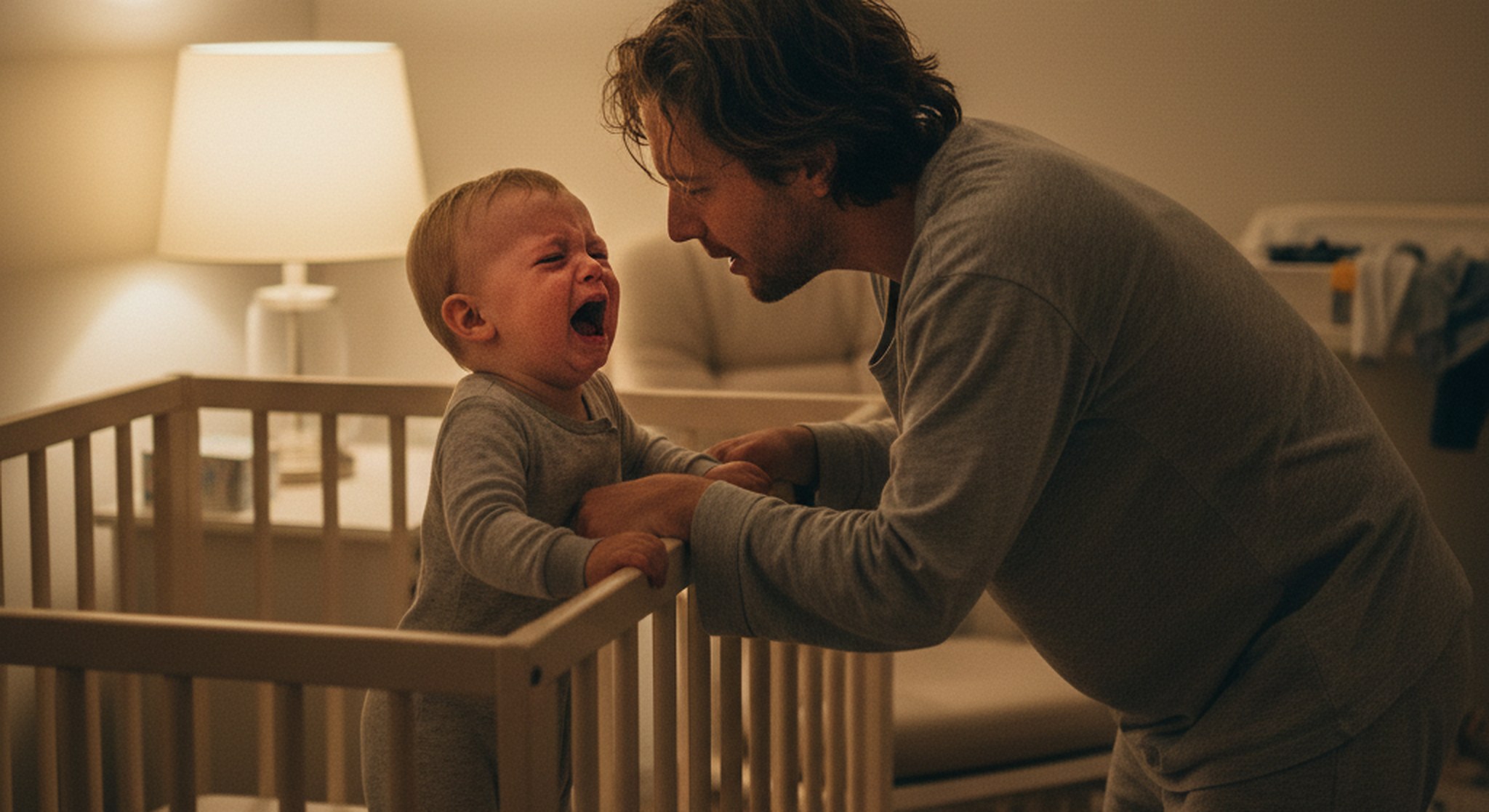
If your happily-sleeping toddler suddenly fights bedtime, wakes overnight, or refuses the afternoon nap right around 13 months, you’re not imagining it and you didn’t undo months of progress. The 13 month sleep regression is real, and more often than not it’s the same thing wearing a costume: your toddler’s nap needs are shifting, they’re busy learning to walk, and teeth are on the move. The good news is that it’s temporary, and once you know what’s driving it, it’s manageable.
Key Takeaways
The 13 month sleep regression is usually driven by the 2-to-1 nap transition, new walking skills, and molars starting to move, not by anything you did wrong.
Most 13-month-olds are not actually ready to drop to one nap yet. A toddler fighting the second nap is often showing false readiness, and holding two naps a little longer usually settles nights faster.
In our State of Baby Sleep survey of 5,002 families, 53.5% of parents of 13 to 18 month olds reported their child still woke three or more times a night, so frequent wakings at this age are common, not a red flag.
Most families see nights settle within 2 to 6 weeks once the nap schedule and wake windows are matched to what the toddler actually needs.
Persistent breathing changes during sleep, dramatically low total daily sleep across weeks, or missed milestones are pediatrician conversations, not regression ones.
Before we go further, the question you came here to answer:
How long does the 13 month sleep regression last?
For most families, the 13 month sleep regression lasts 2 to 6 weeks. Because it is usually tied to the 2-to-1 nap transition, the timeline depends on how well the daytime schedule matches your toddler’s real needs. Toddlers who hold two naps until they are genuinely ready, and whose wake windows are kept age-appropriate, tend to settle on the shorter end. The developmental changes underneath, walking and new teeth, are permanent progress. The sleep disruption is not.
Table of Contents
What is the 13 month sleep regression?
The 13 month sleep regression is a stretch of disrupted nights and cranky naps that shows up in the early toddler months, usually somewhere between about 12 and 15 months. Unlike the 4 month regression, which is caused by a permanent change in sleep architecture, the 13 month version is driven by what your toddler is doing in the daytime: outgrowing the old nap schedule, learning to walk, and cutting new teeth. It feels like a regression because a child who slept well is suddenly protesting sleep, but the underlying causes are all signs of forward progress.
The single most common thread we see at this age is the 2-to-1 nap transition. Around 13 months, a lot of toddlers start fighting the afternoon nap, which makes parents wonder if it is time to drop to one nap. For most 13-month-olds, it is not, and the tug-of-war between a still-needed second nap and a toddler who suddenly resists it is what powers this whole regression.
Why it happens
Three things tend to overlap around 13 months, and all of them land on sleep:
The 2-to-1 nap transition looms. Toddlers this age often start protesting one of their two naps, usually the afternoon one. Most are not truly ready to drop it yet, so the second nap gets shorter or skipped, the toddler ends the day overtired, and night sleep fragments. This is the biggest single driver at 13 months. Our 2-to-1 nap transition guide covers the real readiness signs.
Walking takes over. Many babies take first steps around 12 to 14 months, and the drive to practice a brand new gross-motor skill is intense. The brain consolidates that learning overnight, which can mean lighter, more broken sleep, plus toddlers who literally stand up in the crib instead of settling.
Teething and separation awareness. The first molars often start pushing through in this window, and separation awareness is still strong. Discomfort plus a stronger preference for you at bedtime adds friction to an already wobbly stretch.
None of these are problems. They are milestones. That is also why the fix is rarely a new sleep method and almost always a schedule adjustment that respects what your toddler’s body is doing.
Signs your toddler is in the 13 month sleep regression
The signs that line up most consistently at this age are:
Fighting one nap, usually the afternoon one, in a toddler who used to take both easily.
Night wakings return or increase in a child who had been sleeping through.
Bedtime battles: stalling, standing up, crying at drop-off when goodnights used to be smooth.
Early morning wakings, often before 6am.
Practicing new skills in the crib, standing, cruising the rails, or babbling instead of settling.
Extra clinginess and bigger emotions around every sleep transition, often tied to teething.
You don’t need all of them. Two or three showing up together around the right age is usually enough to call it the regression.
What our data shows
In our State of Baby Sleep survey of 5,002 families, more than half of parents of 13 to 18 month olds, 53.5% to be exact, said their child still woke three or more times a night. That number matters at 13 months for one reason: it tells you that frequent night waking in the second year is common, not a sign that something is broken. It is lower than the 7 to 9 month peak of 67.3%, which fits the pattern of sleep slowly consolidating across the toddler year even when a regression flares up along the way.
The other pattern worth naming: the toddlers who moved through this stretch fastest were the ones whose parents adjusted the schedule instead of adding new sleep interventions. Dropping to one nap too early, or stacking a new bedtime crutch on top of a shortened nap, tended to stretch the regression out rather than end it.
“At 13 months, the most common mistake we see isn’t a sleep-training failure. It’s dropping the second nap a month or two too early because the toddler protested it once. Hold two naps until the readiness signs are real, and most of these regressions shorten on their own.”
If you’d rather see where your specific toddler sits relative to that dataset than read more general guidance, that’s what the Betteroo quiz was built for.
Stuck in the middle of the regression?
Take the free Betteroo quiz. Three minutes, built on data from thousands of families. We’ll tell you what we see and what to try first.
Five moves do more, at this age, than any single sleep program. None of them are heroic. Almost all of them are about the daytime schedule, not the night.
1. Hold two naps until readiness is real.
This is the big one at 13 months. A toddler protesting the afternoon nap is usually showing false readiness, not true readiness. Most children are closer to 15 to 18 months when they genuinely drop to one nap. If your toddler is fighting the second nap, try capping the morning nap at about an hour so the afternoon nap still has a chance, rather than dropping straight to one. The 13 month old sleep schedule guide shows what a solid two-nap day looks like.
READY TO DROP TO ONE NAP, OR NOT YET?
At 13 months, most toddlers are still in the “not yet” column. Use this before you cut the second nap.
READYReal one-nap signs
Consistently refuses one nap for 2+ weeks, not just a few days.
Takes both naps but bedtime pushes very late or night wakings start.
Stays happy and rested on the days one nap is skipped.
Usually closer to 15 to 18 months old.
NOT YETFalse readiness
Fights the nap for a few days, then takes it again.
Gets overtired, cranky, and wakes more at night when a nap is skipped.
Nap resistance lines up with walking or a new tooth.
Under about 14 months old.
When in doubt at 13 months, hold two naps. It is easier to drop a nap late than to rebuild one.
2. Match the wake windows.
At 13 months on two naps, most toddlers handle roughly 3 to 3.5 hours of awake time before the first nap and a longer stretch before bed. Push wake windows too short and naps get resisted; push them too long and you get an overtired toddler who sleeps worse. If you’re unsure where your child sits, the wake windows by age guide breaks it down.
TODDLER WAKE WINDOWS (QUICK REFERENCE)
Typical awake-time tolerance between sleeps. The 13-month row is the one to memorize this week.
Age
Wake window
Typical naps
Total sleep
11 months
3 to 3.5 hours
2
13 to 14 hours
12 months
3 to 3.5 hours
2
12.5 to 14 hours
13 months ⭐
3 to 4 hours
2
12.5 to 14 hours
14 months
3.25 to 4 hours
2 (to 1)
12.5 to 14 hours
15 months
3.5 to 5 hours
1 to 2
12.5 to 14 hours
Ranges are typical; healthy toddlers vary. If your child consistently sits at the high or low end, that’s usually fine. See the full wake windows by age guide for nuance.
3. Protect a consistent, slightly earlier bedtime.
When naps run short during the transition, your toddler ends the day with a sleep debt. An earlier bedtime is the simplest fix. Move it 15 to 30 minutes earlier than your usual time, keep the routine identical, and hold it for at least four nights before deciding whether it worked. Overtired toddlers wake more overnight and earlier in the morning, so earlier to bed often means later to rise.
4. Give plenty of daytime practice for walking.
A toddler who is learning to walk will practice, and if they don’t get enough space during the day, the crib becomes the practice studio at 5am. Build in lots of supervised floor time and safe walking practice. It won’t make the milestone happen faster, but it takes some of the pressure off the crib and helps the drive to move burn off before bed.
5. Stay consistent and don’t stack new crutches.
Keep your bedtime routine and overnight responses steady, even when nights are rough. If teething pain is clearly the issue, treat the pain with your pediatrician’s guidance rather than inventing a new sleep habit you don’t want to keep. Adding a crutch under desperation, then trying to remove it a few weeks later, is one of the most predictable ways to turn one regression into two.
What doesn’t help (and what to skip this week)
Equal time on the moves that won’t help and might make things worse:
Dropping to one nap at the first protest. This is the most common misstep at 13 months. A few rough nap days is not the same as readiness. Cutting the second nap too early usually deepens the overtiredness and lengthens the regression.
Schedules from social media. The viral “perfect toddler schedule” you saved was written for someone else’s child. Your toddler’s wake windows and temperament matter more than any shareable graphic.
Changing five things at once. If you shift the nap schedule, bedtime, the crib setup, and the routine all in the same week, you won’t know what helped or hurt. Change one variable at a time.
Cutting total sleep to “tire them out.” An overtired toddler sleeps worse, not better. Protecting day sleep and an early bedtime almost always beats keeping them up.
When it’s NOT just the regression
The 13 month sleep regression is common, but it isn’t the only thing that can disrupt sleep at this age. Talk to your pediatrician, not your sleep app, if any of the following are happening:
Persistent breathing changes during sleep, such as snoring with pauses, heavy breathing, or mouth breathing that won’t resolve. AAP safe sleep guidance treats this as a flag worth raising.²
Total daily sleep dramatically below the AASM range (roughly 11 to 14 hours including naps at this age) across multiple weeks, not single bad nights.⁴
Missed developmental milestones alongside the sleep change.
Signs of ear infection or illness: fever, tugging at ears, or waking in obvious pain that doesn’t match typical teething.
A sudden change in alertness, tone, or temperature.
Outside of those, what you’re seeing is almost certainly the regression. Tiring, but typical.
A note on sleep training during the regression
At 13 months, your toddler is well past the age when structured sleep methods were first studied. Mindell’s landmark review of behavioral sleep interventions covered children in this range and found the approaches broadly safe and effective.³ So sleep training is not off the table the way it is at 4 months. The catch is timing: starting a new method in the thick of a nap transition, while teeth are coming in, tends to muddy the results. If nights are the core problem and the schedule is already dialed in, a consistent method can help. If the schedule is the problem, fix that first.
If this stretch feels like it is bleeding into the next one, the 15 month sleep regression guide covers what comes next as molars and the single-nap schedule take center stage.
Frequently asked questions
Is the 13 month sleep regression real?
Yes. It’s a common stretch of disrupted sleep in the early toddler months, usually driven by the 2-to-1 nap transition, learning to walk, and teething. It isn’t tied to a permanent change in sleep architecture the way the 4 month regression is, but the disruption is real and very familiar to parents of one-year-olds.
How long does the 13 month sleep regression last?
For most families, it lasts 2 to 6 weeks. Because it is usually tied to the 2-to-1 nap transition, the timeline depends on how well the daytime schedule matches your toddler’s needs. Holding two naps until readiness is real and keeping wake windows age-appropriate tends to settle nights on the shorter end.
Should my 13-month-old drop to one nap?
Usually not yet. Most toddlers are closer to 15 to 18 months when they truly drop to one nap. A 13-month-old who protests the afternoon nap is often showing false readiness. Try capping the morning nap at about an hour so the second nap still happens, and hold two naps until your toddler consistently refuses one for two weeks or more and stays happy on the days it is skipped.
Is the 13 month sleep regression caused by teething or walking?
Often both, plus the nap transition. First molars commonly start pushing through around this age, and many toddlers are learning to walk, which the brain consolidates overnight. Add the pressure of the 2-to-1 nap transition and you get the perfect storm that parents label the 13 month regression.
Is it normal for a 13-month-old to still wake at night?
Yes. In our State of Baby Sleep survey of 5,002 families, 53.5% of parents of 13 to 18 month olds said their child still woke three or more times a night. Frequent wakings at this age are common, not a sign that something is broken, though persistent breathing changes or waking in obvious pain are worth a pediatrician visit.
Can I sleep train during the 13 month regression?
You can, since 13 months is past the age structured methods were first studied. But timing matters. Starting a new method in the middle of the nap transition and teething tends to muddy the results. If the schedule is already solid and nights are the core problem, a consistent method can help. If the schedule is off, fix that first.
Key takeaway
The 13 month sleep regression is mostly a scheduling story. Behind the rough nights are three good things happening at once: your toddler is outgrowing the old nap rhythm, learning to walk, and cutting new teeth. Hold two naps until readiness is real, match the wake windows, protect an earlier bedtime, give plenty of daytime practice, and stay consistent at night. That is most of what separates a 2 week regression from a 6 week one.
You’re not behind. This is a 2 to 6 week nap-transition bump.
See where your toddler sits relative to thousands of other families, and which move is likely to help yours fastest. Three minutes, free.
Want hands-on help near you? Betteroo maintains verified directories of baby sleep consultants in 11 US cities, every listing checked monthly against the consultant’s own site and certifying program, with transparent pricing. Browse sleep consultants by city or see what a sleep consultant costs.
4 Sources
Galland, B. C., Taylor, B. J., Elder, D. E., & Herbison, P. (2012). Normal sleep patterns in infants and children: a systematic review of observational studies. Sleep Medicine Reviews, 16(3), 213-222.https://pubmed.ncbi.nlm.nih.gov/21784676/
American Academy of Pediatrics Task Force on Sudden Infant Death Syndrome. (2022). Sleep-Related Infant Deaths: Updated 2022 Recommendations for Reducing Infant Deaths in the Sleep Environment. Pediatrics, 150(1).https://pubmed.ncbi.nlm.nih.gov/35726558/
Mindell, J. A., Kuhn, B., Lewin, D. S., Meltzer, L. J., & Sadeh, A. (2006). Behavioral treatment of bedtime problems and night wakings in infants and young children. Sleep, 29(10), 1263-1276.https://pubmed.ncbi.nlm.nih.gov/17068979/
Paruthi, S., Brooks, L. J., D’Ambrosio, C., et al. (2016). Recommended Amount of Sleep for Pediatric Populations: A Consensus Statement of the American Academy of Sleep Medicine. Journal of Clinical Sleep Medicine, 12(6), 785-786.https://pubmed.ncbi.nlm.nih.gov/27250809/