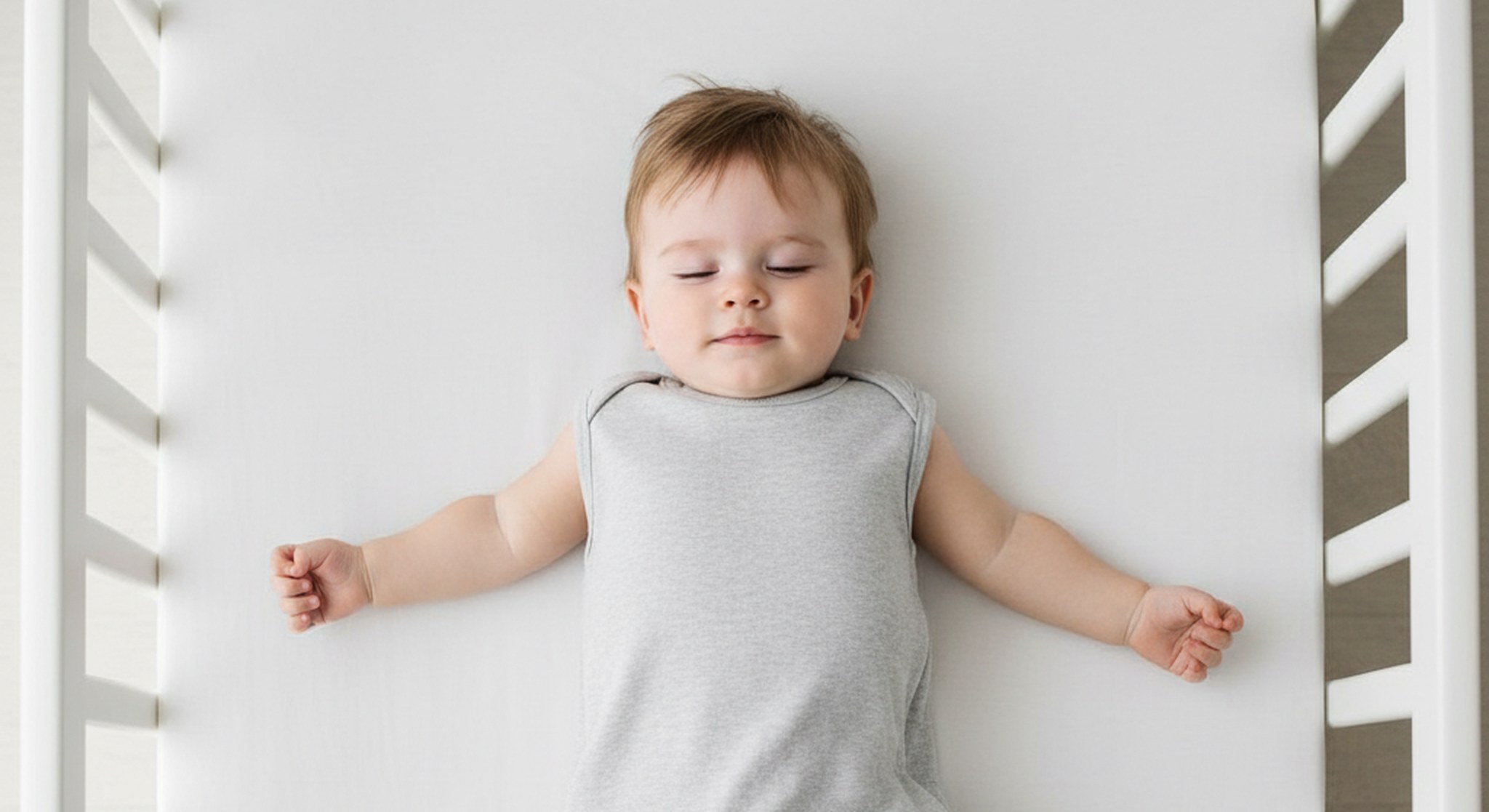
Thirteen months is officially toddler territory, and it usually shows up in sleep before it shows up anywhere else. Many babies are newly walking, or on the very edge of it, and that surge of physical skill has a way of rippling into naps and nights. Parents searching for a 13 month old sleep schedule are often chasing one of three things: a second nap that has started to fight back, early-morning wake-ups that arrive before the sun, or a suspicion that the two-nap days might be numbered.
Here is the reassuring part: at thirteen months your child almost certainly has a solid sleep foundation. The bumps now are developmental, not structural. Walking, the approaching 2-to-1 nap transition, and a burst of independence are the real story, and each of them is temporary.
This guide covers how much sleep a thirteen month old needs, a sample two-nap day and a sample one-nap day, what our survey of tens of thousands of parents shows about night waking at this age, and how to read the early signs that a nap transition is on its way.
As an Amazon Associate, Betteroo earns from qualifying purchases.
Table of Contents
At a Glance: 13 Month Sleep Expectations
At thirteen months, most toddlers sleep 11.5 to 14 total hours per day: roughly 10 to 12 hours overnight plus 2 to 3 hours of daytime sleep. Most are still on 2 naps, though some have started sliding toward 1. Wake windows run about 3 to 4 hours on a two-nap day and stretch closer to 5 hours on a one-nap day. Bedtime typically falls between 7:00 and 8:00 p.m.
Some perspective from Betteroo’s State of Baby Sleep survey: in the 13 to 18 month band, 53.5% of babies still wake three or more times a night (n=5,002). If your thirteen month old is still calling out at 2 a.m., you are squarely in the majority, and the trend from here bends downward.
How Much Should a 13 Month Old Sleep?
The American Academy of Sleep Medicine recommends 11 to 14 hours per 24 hours for toddlers aged 1 to 2 years, naps included 1. Most thirteen month olds land comfortably inside that window, and reference studies of childhood sleep show broad, healthy variation around those numbers 2.
Sleep Type
Typical Range at 13 Months
Total Sleep
11.5–14 hours
Night Sleep
10–12 hours
Naps
2 (transitioning to 1), 2–3 hours total
Wake Windows
~3–4 hrs (2 naps) / ~5 hrs (1 nap)
The two-nap day is still the norm at thirteen months, and for most children it is worth protecting. The formal 2-to-1 nap transition usually lands between 14 and 18 months, so thirteen months is often the stage where the first cracks appear without the change being ready to happen yet.
A Sample 13 Month Old Sleep Schedule (An Example, Not a Rule)
Most thirteen month olds are still thriving on two naps. Here is a sample two-nap day:
7:00 a.m. – Wake
10:00–11:00 a.m. – Nap 1
2:30–3:45 p.m. – Nap 2
7:30 p.m. – Bedtime
Notice the rhythm: a wake window of about 3 hours before the first nap, a longer midday stretch, and roughly 3.75 hours between the afternoon nap and bedtime. If your child is edging toward one nap, a sample one-nap day looks quite different:
7:00 a.m. – Wake
12:30–2:30 p.m. – Single midday nap
7:30 p.m. – Bedtime
On one nap, wake windows stretch to roughly 5 hours on either side of the midday sleep. Do not rush to this schedule. Most thirteen month olds are not ready, and pushing it too early tends to create overtiredness that shows up as those dreaded early-morning wake-ups. Bedtime between 7:00 and 8:00 p.m. suits both schedules, and a consistent, predictable bedtime routine remains one of the most evidence-backed sleep tools you have 3.
Why 13 Month Old Sleep Gets Bumpy
If sleep has wobbled lately, development is almost always the reason, not a broken schedule:
New walking. Learning to walk is a full-body obsession, and toddlers rehearse it everywhere, including the crib. Standing up and cruising the crib rail at 5 a.m. is a classic thirteen month scene.
Early signs of the 2-to-1 nap transition. A first nap that suddenly refuses to start, or a second nap that pushes bedtime late, is often the earliest hint the day is shifting. It usually means bridging with a flexible schedule, not dropping a nap outright.
Early-morning false starts. Waking at 5 a.m. wide awake is common now, often driven by too much day sleep, a last wake window that is too short, or a room that is not dark enough.
Independence and separation feelings. A newly mobile toddler with big opinions may protest bedtime more loudly. It is a phase of asserting will, not a sign the routine has stopped working.
Some parents call the wobble around now the 15 month regression arriving early. Whatever you name it, the pattern is the same: a temporary disruption sitting on top of a fundamentally stable schedule. Our 12 month old sleep schedule covers the stage just behind you, and the 14 month old sleep schedule looks ahead to when the nap transition often gets real.
From Betteroo’s State of Baby Sleep
Night waking by age, share of babies waking 3+ times: 7–9 months 67.3% (the peak), 10–12 months 60.5%, 13–18 months 53.5%. Thirteen months sits on the downhill side of the curve. If your toddler still wakes at night, it is the statistical norm, and the trend from here is steadily down. Explore the full data →
Helping Your 13 Month Old Sleep Better
A few high-leverage moves at this age:
Give walking daytime reps. The more standing, cruising, and toddling practice happens at 10 a.m., the less novelty there is to rehearse at 5 a.m. Floor time is sleep time’s best friend right now.
Hold the two-nap line, but stay flexible. Resist dropping a nap on the strength of one rough week. When the transition does begin, alternate two-nap and one-nap days rather than switching overnight, and read our 2-to-1 nap transition guide for the timing cues.
Protect early mornings. A dark room and steady white noise buy back that 5 a.m. hour, and a slightly earlier bedtime often fixes early waking faster than a later one does.
Keep night responses calm and brief. Help your toddler lie back down, offer a quiet word, and step away. Long interventions at this age tend to become the new expectation.
Watch wake windows, not just the clock. Our wake windows guide shows how the day stretches as your toddler moves from two naps toward one.
If independent sleep is still a struggle, thirteen months is a very workable age for gentle change. Toddlers respond quickly to consistency, and research shows bedtime routines alone significantly reduce night wakings 3.
When to Talk to a Pediatrician
Reach out if your toddler consistently sleeps well under 11 total hours, snores or has breathing pauses, wakes screaming inconsolably most nights, or if feeding and growth are a concern. Keep the crib bare and the mattress at its lowest setting now that pulling to stand and climbing are in full swing, in line with AAP safe sleep guidance 4.
13 Month Old Sleep Schedule FAQ
What is a good 13 month sleep schedule?
Most thirteen month olds do well on two naps: wake around 7:00 a.m., a mid-morning nap, an early-afternoon nap totaling 2 to 3 hours, and bedtime between 7:00 and 8:00 p.m. The one-nap version is a single midday nap with roughly 5-hour wake windows on either side.
Should a 13 month old be on one nap or two?
Most are still on two naps. The 2-to-1 nap transition usually happens between 14 and 18 months, so thirteen months is often where the first signs appear without the change being ready. Hold two naps until your child consistently refuses one for a week or two.
How many hours should a 13 month old sleep?
About 11.5 to 14 total hours per day: roughly 10 to 12 hours overnight plus 2 to 3 hours of daytime sleep. The American Academy of Sleep Medicine recommends 11 to 14 hours per 24 hours for toddlers aged 1 to 2 years.
Why does my 13 month old wake up so early?
Early waking at this age is often driven by too much day sleep, a last wake window that is too short, or a room that is not dark enough. Try a darker room, steady white noise, and a slightly earlier bedtime, which often resolves early morning waking faster than a later bedtime does.
Is there a sleep regression at 13 months?
Many families see a rough patch around now, often blamed on new walking, the approaching nap transition, and a burst of independence. It is temporary. Keeping the schedule steady and night responses brief usually settles it within a few weeks.
Walking, nap shifts, early mornings: 13 months is a lot
Get a personalized sleep plan built around your toddler’s age, temperament, and your family’s needs.
Thirteen month old sleep is mostly a story of a good schedule meeting big development. The schedule is not the problem; the growth is the point. Give walking plenty of daylight hours to burn off, hold the two-nap frame until your child is truly ready to let it go, protect the early morning, and respond at night with calm brevity. The curve keeps bending in your favor: night waking declines steadily from here through toddlerhood.
Paruthi, S., et al. (2016). Recommended Amount of Sleep for Pediatric Populations: A Consensus Statement of the American Academy of Sleep Medicine. Journal of Clinical Sleep Medicine, 12(6), 785–786.https://pmc.ncbi.nlm.nih.gov/articles/PMC4877308/
Iglowstein, I., Jenni, O.G., Molinari, L., & Largo, R.H. (2003). Sleep duration from infancy to adolescence: Reference values and generational trends. Pediatrics, 111(2), 302–307.https://pubmed.ncbi.nlm.nih.gov/12563055/
Mindell, J.A., Telofski, L.S., Wiegand, B., & Kurtz, E.S. (2009). A Nightly Bedtime Routine: Impact on Sleep in Young Children and Maternal Mood. Sleep, 32(5), 599–606.https://pubmed.ncbi.nlm.nih.gov/19480226/
American Academy of Pediatrics. (2022). Sleep-Related Infant Deaths: Updated 2022 Recommendations for Reducing Infant Deaths in the Sleep Environment.https://pubmed.ncbi.nlm.nih.gov/35726558/