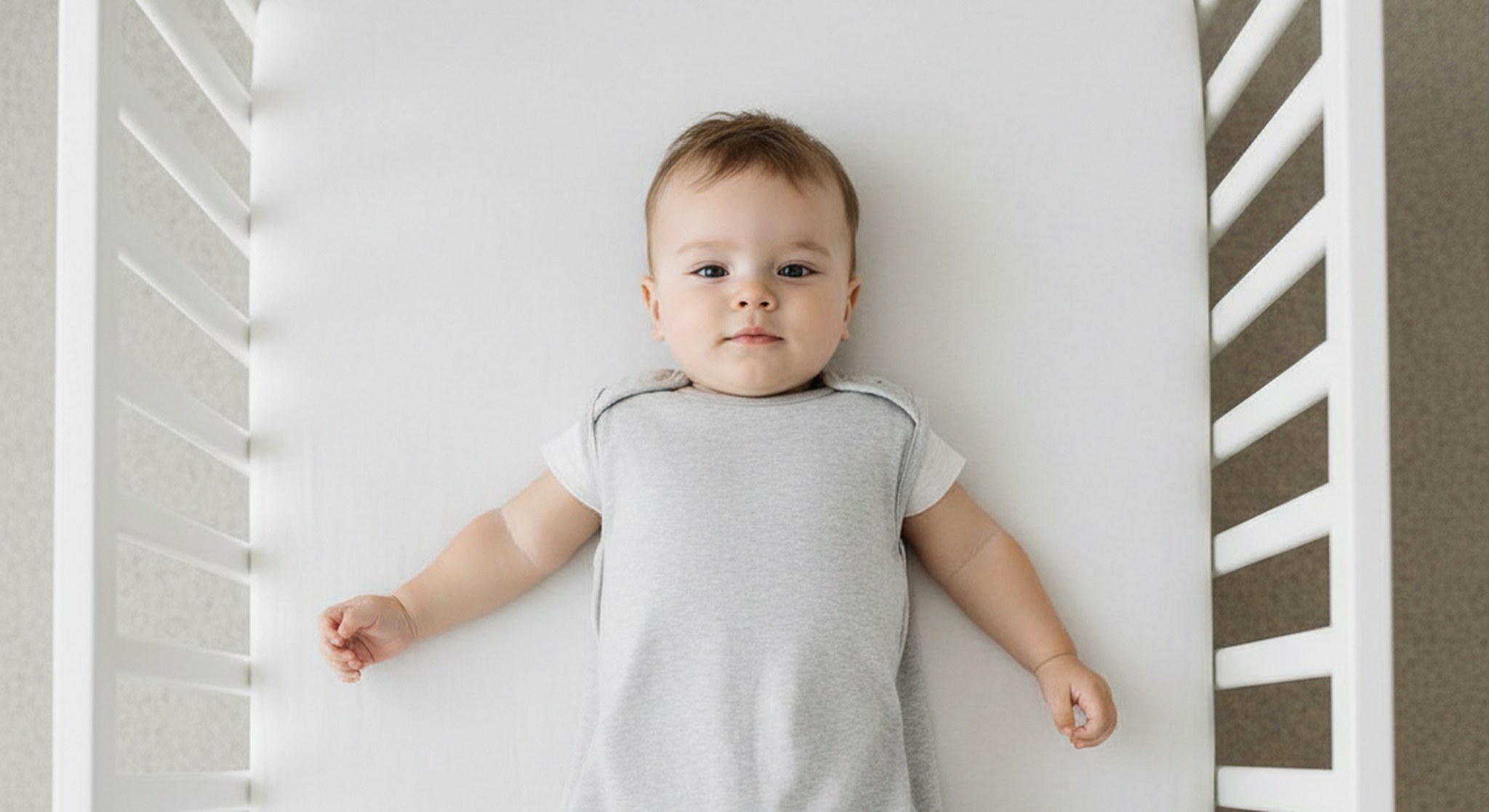
Twenty-one months is a stretch of loud, fast growth. Words are arriving in bunches, opinions are firm, and your toddler is testing where the edges of the day actually sit. Parents searching for a 21 month old sleep schedule are usually chasing one of a few things: a single nap that suddenly resists, a run of night wakings or bad dreams that came out of nowhere, or a small person who has figured out how to hoist a leg over the crib rail.
Here is the reassuring part. By this age most toddlers have a genuinely sturdy sleep pattern to lean on: one solid nap, a long consolidated night, and enough predictability that a rough patch reads clearly as a blip rather than a collapse. The bumps at 21 months are almost always developmental and short-lived, not a sign your routine has stopped working.
This guide walks through how much sleep a 21 month old needs, a sample one-nap day, what our survey of tens of thousands of parents suggests about night waking in the toddler years, and how to handle climbing, nightmares, and nap resistance without losing the frame you have built.
As an Amazon Associate, Betteroo earns from qualifying purchases.
Table of Contents
At a Glance: 21 Month Sleep Expectations
At 21 months, most toddlers sleep 11 to 14 total hours per day: roughly 10 to 12 hours overnight plus 1.5 to 3 hours in a single midday nap. Wake windows run about 5 to 5.5 hours, and bedtime typically falls between 7:00 and 8:00 p.m.
Some perspective from Betteroo’s State of Baby Sleep survey: night waking peaks in the second half of the first year and then declines steadily through toddlerhood. By the toddler range that most 21 month olds fall into, disrupted nights are less common than they were at nine or ten months, though a meaningful share of toddlers still surface at least once. If your 21 month old still wakes, you are in good company, and the overall direction of travel is toward calmer nights.
How Much Should a 21 Month Old Sleep?
The American Academy of Sleep Medicine recommends 11 to 14 hours per 24 hours for toddlers aged 1 to 2 years, naps included 1. Most 21 month olds land squarely in that band, and reference studies of early-childhood sleep show broad, healthy variation around those averages 2.
Sleep Type
Typical Range at 21 Months
Total Sleep
11–14 hours
Night Sleep
10–12 hours
Naps
1 per day (1.5–3 hours)
Wake Windows
5–5.5 hours
The one-nap day is firmly the norm by now. Most toddlers make the two-to-one nap transition somewhere between 14 and 18 months, so by 21 months a single afternoon nap is what you should expect. If your toddler is fighting even that one nap, the fix is usually a longer morning wake window rather than dropping the nap entirely. Very few children are ready to be nap-free at this age, and cutting the nap too early tends to backfire as overtired, fragmented nights.
A Sample 21 Month Old Sleep Schedule (An Example, Not a Rule)
7:00 a.m. – Wake
12:30–2:30 p.m. – Nap
7:30 p.m. – Bedtime
Notice the shape of a one-nap day: a long morning wake window of around 5 to 5.5 hours, a midday nap that anchors the afternoon, and roughly 5 hours between the end of the nap and bedtime. This is a big change from the shorter wake windows of the baby months, and it is exactly why a 21 month sleep schedule feels so different from a nine or ten month one. If the nap runs short or ends late, protect the night by nudging bedtime earlier rather than letting the day drift long.
Bedtime between 7:00 and 8:00 p.m. is where most families land. In our survey, 39% of all babies have a bedtime between 7:00 and 7:59 p.m., the single most common window, and that early-evening anchor tends to hold well into the toddler years. A consistent bedtime backed by a predictable wind-down is one of the most evidence-backed sleep tools you have 3.
Why 21 Month Old Sleep Gets Bumpy
If sleep wobbled recently, the cause is usually development rather than any permanent regression:
A mini regression. Some toddlers hit a short rough patch around 21 months as language, memory, and independence surge all at once. Nights get lighter and bedtime gets chattier for a week or two, then settle.
Nightmares and night wakings. Imagination is switching on, and around now some toddlers start waking scared or calling out in the small hours. These moments are real to them; a calm, brief reassurance usually resolves them.
Climbing out of the crib. A newly capable body plus a low rail equals a toddler testing the escape. This is a safety flag worth acting on, not just a sleep quirk.
Separation and big feelings. Independence and clinginess coexist at this age. Bedtime protest often spikes even in kids who used to go down easily.
Many parents call this a 21 month sleep regression. Whatever the label, the pattern is the same: a temporary disruption sitting on top of an otherwise stable schedule. Our wake windows guide shows how the day stretches at this age, and the 20 month old sleep schedule covers the run-up to this stage in detail.
From Betteroo’s State of Baby Sleep
Night waking climbs through the first year and then eases. Among toddlers in the 13-to-18-month range, disrupted nights are noticeably less common than they were at the 7-to-9-month peak, though a meaningful share of toddlers still wake at least once. If your 21 month old still surfaces at night, that is within the normal range, and the broader trend keeps bending toward calmer nights. Explore the full data →
Helping Your 21 Month Old Sleep Better
A few high-leverage moves at this age:
Act fast on climbing. If your toddler is hoisting a leg over the rail, drop the crib mattress to its lowest setting first. When the crib is at its lowest and they are still climbing or are taller than 35 inches, that is the signal to consider a toddler bed or floor bed, with the room fully babyproofed and a gate at the door.
Keep a sleep sack in play a little longer. A well-fitted, correctly sized sleep sack can make climbing physically harder and buys time before the bed transition. Just confirm your brand and size still fit your toddler safely.
Answer nightmares briefly and warmly. Go in, offer calm reassurance, keep the lights low, and keep it short. Long, elaborate rescues at 2 a.m. tend to become the new expectation.
Protect the single nap. Most toddlers need their nap until at least 3 years old. One resistant week is not a reason to drop it; lengthen the morning wake window instead.
Hold a boring, predictable wind-down. Same order, same room, same cues. Research shows a consistent bedtime routine alone significantly reduces night wakings 3.
If independent sleep is still a struggle, 21 months is a workable age for gentle change. Toddlers this age respond quickly to consistency, even as they push back on it. For a wider view of how the schedule keeps shifting, our baby sleep schedule by age guide maps every stage from newborn through the toddler years.
When to Talk to a Pediatrician
Reach out if your toddler consistently sleeps well under 11 total hours, snores or has breathing pauses, wakes screaming inconsolably most nights, or if the fear at bedtime feels persistent and out of proportion. And once climbing begins, keep the sleep space bare, the mattress at its lowest, and any bed transition babyproofed in line with AAP safe sleep guidance 4.
21 Month Old Sleep Schedule FAQ
What are wake windows for a 21 month old?
On a one-nap day, wake windows run about 5 to 5.5 hours: roughly 5 hours before the midday nap and a similar stretch between the nap and bedtime. If bedtime battles appear, the last wake window is usually the one to adjust first.
How many naps should a 21 month old take?
One nap, lasting about 1.5 to 3 hours in the early afternoon. Most toddlers make the two-to-one transition between 14 and 18 months, so a single nap is the norm by 21 months. Most keep that nap until around age 3.
Is there a 21 month sleep regression?
Some toddlers hit a short rough patch around 21 months, driven by a language burst, nap resistance, nightmares, and a push for independence. It is temporary. Keeping the schedule steady and responses brief usually settles it within a week or two.
My 21 month old is climbing out of the crib. What should I do?
First, lower the crib mattress to its lowest setting and confirm a well-fitted sleep sack is in use, which can make climbing harder. If they keep escaping, are over about 35 inches tall, or the climbing is unsafe, it is time to consider a toddler bed or floor bed with the room fully babyproofed and a gate at the door.
Why is my 21 month old having nightmares or waking at night?
Around this age imagination and memory switch on, and some toddlers start waking scared or calling out. Respond calmly and briefly, keep the lights low, and offer reassurance without a long rescue. Consistent, boring comfort usually helps these settle within a couple of weeks.
Nap fights, nightmares, crib climbing: 21 months is a lot
Get a personalized sleep plan built around your toddler’s age, temperament, and your family’s needs.
Twenty-one month old sleep is mostly a story of a good schedule colliding with a fast-growing mind and body. The schedule is not the problem; the growth is the point. Hold the single-nap frame, act early on crib climbing, meet nightmares with calm brevity, and keep bedtime steady, and the rough patches pass while the longer arc keeps bending toward calmer nights.
Paruthi, S., et al. (2016). Recommended Amount of Sleep for Pediatric Populations: A Consensus Statement of the American Academy of Sleep Medicine. Journal of Clinical Sleep Medicine, 12(6), 785–786.https://pmc.ncbi.nlm.nih.gov/articles/PMC4877308/
Iglowstein, I., Jenni, O.G., Molinari, L., & Largo, R.H. (2003). Sleep duration from infancy to adolescence: Reference values and generational trends. Pediatrics, 111(2), 302–307.https://pubmed.ncbi.nlm.nih.gov/12563055/
Mindell, J.A., Telofski, L.S., Wiegand, B., & Kurtz, E.S. (2009). A Nightly Bedtime Routine: Impact on Sleep in Young Children and Maternal Mood. Sleep, 32(5), 599–606.https://pubmed.ncbi.nlm.nih.gov/19480226/
American Academy of Pediatrics. (2022). Sleep-Related Infant Deaths: Updated 2022 Recommendations for Reducing Infant Deaths in the Sleep Environment.https://pubmed.ncbi.nlm.nih.gov/35726558/