

At 20 months, most toddlers walk and run confidently, climb furniture, walk up stairs with a hand held, say somewhere between 12 and 50 words with new ones arriving weekly, start combining two words (“more milk,” “daddy go”), use a spoon with growing accuracy, scribble enthusiastically, and dive into simple pretend play like feeding a stuffed animal.
Twenty months sits between the 18 month and 2 year checkups, in the middle of the second year’s language explosion. There is no official CDC checklist for this exact age, which is precisely why parents search for it: your toddler should be somewhere between the 18 month and 24 month milestones, and this guide maps that in-between territory honestly.
Here is what typical 20 month old milestones look like across movement, language, thinking, and social development, plus sleep, eating, tantrums, and the red flags that matter before the big 2 year screening.
Key Takeaways
- Confident walking, early running, climbing, and stair practice with help are the movement themes at 20 months.
- Vocabulary typically runs 12 to 50 or more words, with two-word combinations beginning; the word spurt is in full swing.
- Simple pretend play, helping with dressing, and copying chores show cognition and social skills on track.
- Expect 11 to 14 total hours of sleep with one afternoon nap, and normal picky eating as growth slows.
- Fewer than a handful of words, no pretend play, or any lost skill deserves a pediatrician conversation now, not at the 2 year visit.
Table of Contents
Movement Milestones at 20 Months
By 20 months, walking is old news and running is the new default, still a bit stiff and prone to spectacular sit-down landings. Most toddlers this age climb on and off the couch alone, walk up stairs holding your hand or the rail (two feet per step), kick or fling a ball forward, squat and stand smoothly, and carry surprisingly large objects across the room out of pure ambition. Some are starting to jump with both feet, which formally lands closer to age 2.
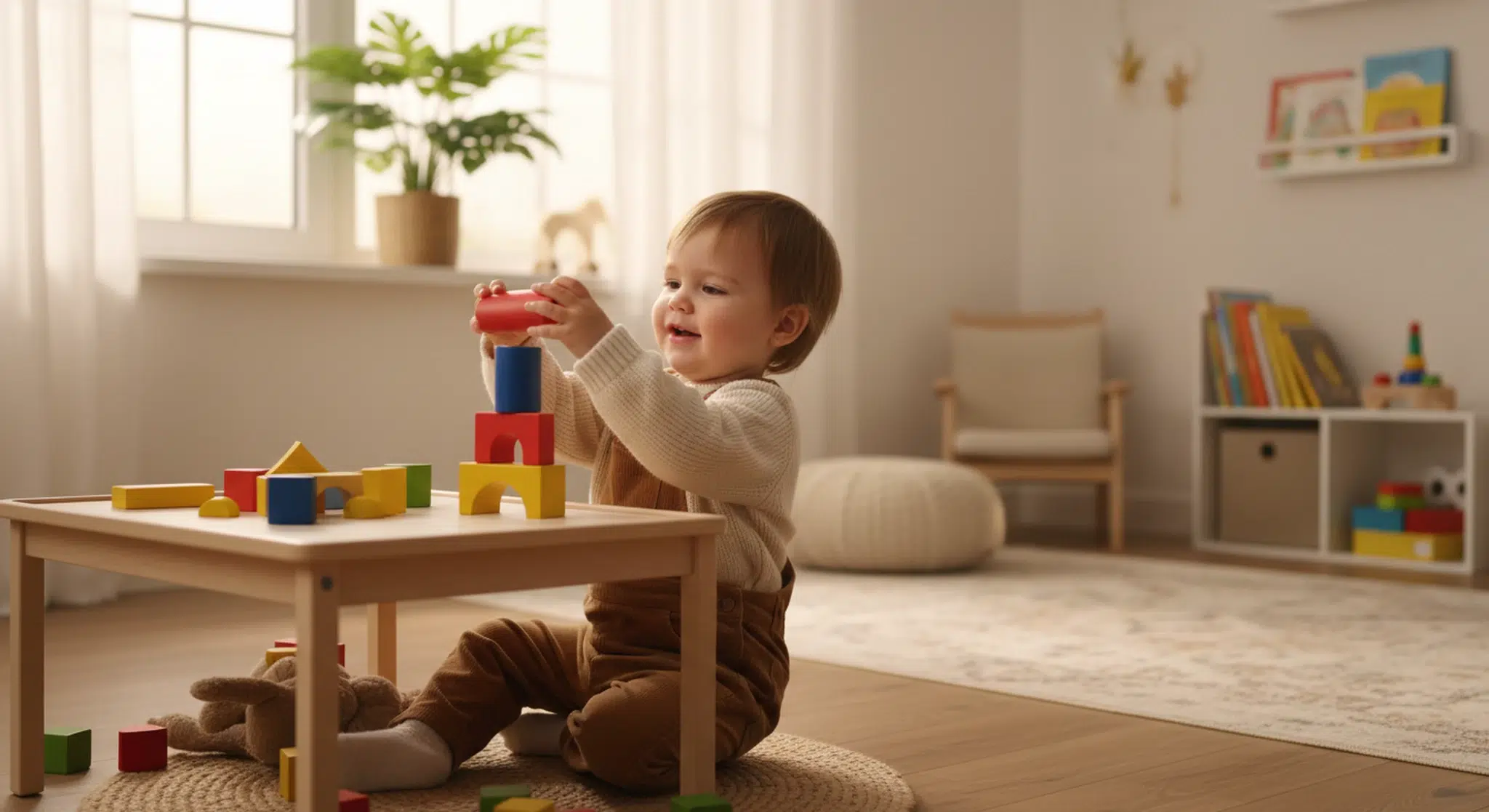
Hands are getting skilled too: scribbling spontaneously, stacking four or more blocks, turning board book pages one or two at a time, managing a spoon and an open cup with moderate spillage, and starting to help with dressing by pushing arms into sleeves. Climbing is the safety headline of this age; anchor the furniture, move the crib away from windows, and accept that the dining chairs have become base camp.
Language at 20 Months: The Word Spurt
Somewhere in the 18 to 24 month window, most toddlers hit a vocabulary spurt where new words arrive daily instead of monthly. A typical 20 month old says anywhere from 12 to 50 or more words, understands hundreds, follows one-step directions without gestures, points to a few body parts on request, and is beginning the two-word combinations (“more juice,” “mama up,” “no bed”) that mark the leap from labeling to sentences. Pronunciation is charmingly rough; if you can decode it and it is used consistently, it counts as a word.
The range at this age is enormous: some 20 month olds narrate their whole day while others coast toward the spurt with 15 words and excellent comprehension. The combination that warrants attention is few words plus limited understanding plus little pointing or gesturing. By the 2 year visit, pediatricians want to see at least 50 words and two-word phrases, so 20 months is a sensible moment to check trajectory. Keep reading, narrating, and expanding what your toddler says (“Truck!” “Yes, a big red truck!”); it is still the best language program ever devised.
Thinking, Pretend Play, and Social Skills
Pretend play blossoms now: feeding a doll, putting a stuffed bear to bed, cooking invisible soup, holding a block to their ear as a phone. Pretend play is a big cognitive milestone because it means your toddler can hold symbols in mind, one thing standing for another, which is the same machinery language runs on. You will also see sorting by shape and color beginning, favorite-toy loyalty, deliberate testing of every rule you have ever stated, and helpful imitation of chores done with total sincerity and moderate destruction.
Socially, 20 month olds play alongside other children more than with them; parallel play is the developmental norm until closer to age 3, so do not read solo play at daycare as a problem. Separation anxiety often resurfaces in this stretch, and tantrums are frequent because wants outrun words. Warm, consistent limits work better than either crackdowns or surrender; our overview of the types of parenting styles explains why the warm-and-firm middle keeps winning in the research.
Bedtime battles at 20 months?
New independence plus one big nap is a tricky sleep equation. Betteroo builds a plan around your toddler’s exact schedule.
Sleep and Eating at 20 Months
Expect 11 to 14 total hours: roughly 10 to 12 overnight plus one afternoon nap of 1.5 to 3 hours, with wake windows around 5 to 6 hours. Sleep disruptions at this age usually trace to the toddler trifecta of independence, separation anxiety, and molars; the 20 month sleep regression guide covers it, and the 21 month old sleep schedule shows where the day is headed. Resist dropping the nap; nearly all 20 month olds still need it, and most keep napping until at least age 3.
Eating stays toddler-typical: three meals, two snacks, 16 to 24 ounces of whole milk, strong opinions. Growth is slow now, so appetite is genuinely smaller and swings day to day. Serve one meal for the family (with something familiar on the plate), skip short-order cooking, and let the week average out. Spoon and fork skills improve fast with practice and tolerance for mess.
When to Talk to Your Pediatrician
Do not wait for the 2 year visit if your 20 month old:
- Is not walking steadily, or walks only on tiptoes all the time
- Says fewer than 6 words
- Does not point, wave, or use other gestures
- Does not follow simple one-step directions
- Does not notice or mind when a caregiver leaves or returns
- Shows no pretend play and does not copy others
- Has lost words or skills they previously had
These are drawn from the 18 month red flags, which a 20 month old should be safely past. Regression of any kind, especially losing words, warrants a prompt call. Early intervention evaluations are free in every US state, you do not need a doctor’s referral to request one, and acting at 20 months rather than 26 buys half a year of the highest-leverage help there is.
Frequently Asked Questions
What should a 20 month old be doing?
Typical 20 month skills include running, climbing on furniture, walking up stairs with help, saying roughly 12 to 50 words with two-word phrases emerging, following one-step directions, scribbling, stacking four blocks, using a spoon, helping with dressing, and simple pretend play like feeding a stuffed animal.
How many words should a 20 month old say?
Most 20 month olds say between 12 and 50 or more words, with rapid weekly growth during the second-year word spurt. Fewer than about 6 words at 20 months, especially combined with limited understanding or little pointing and gesturing, is worth discussing with your pediatrician rather than waiting for the 2 year checkup.
Should a 20 month old be talking in sentences?
Not full sentences. Two-word combinations like “more milk” or “daddy go” typically begin between 18 and 24 months, so a 20 month old may or may not be combining words yet, and both are normal. Three-word sentences generally arrive closer to age 2.5 to 3.
How much sleep does a 20 month old need?
About 11 to 14 hours total: 10 to 12 overnight plus one afternoon nap of 1.5 to 3 hours. Almost all 20 month olds still need the daily nap, and most children keep napping until at least age 3. Sudden bedtime resistance is usually a phase tied to independence and separation anxiety, not a sign the nap should go.
What are red flags for a 20 month old?
Not walking steadily, constant tiptoe walking, fewer than 6 words, no pointing or gestures, not following simple directions, no pretend play or imitation, indifference to caregivers coming and going, or losing previously mastered words or skills. Any regression should be evaluated promptly, and early intervention referrals are free to request in every US state.
Almost two. Time for sleep to grow up as well.
Betteroo builds a personalized toddler sleep plan around your 20 month old’s nap, bedtime, and brand-new opinions.
4 Sources
- CDC, “Important Milestones: Your Child by Eighteen Months”
https://www.cdc.gov/act-early/milestones/18-months.html - CDC, “Important Milestones: Your Child by Two Years”
https://www.cdc.gov/act-early/milestones/2-years.html - American Academy of Pediatrics, HealthyChildren.org, “Ages & Stages: Toddler”
https://www.healthychildren.org/English/ages-stages/toddler/Pages/default.aspx - American Academy of Sleep Medicine, “Recommended Amount of Sleep for Pediatric Populations”
https://aasm.org/resources/pdf/pediatricsleepdurationconsensus.pdf