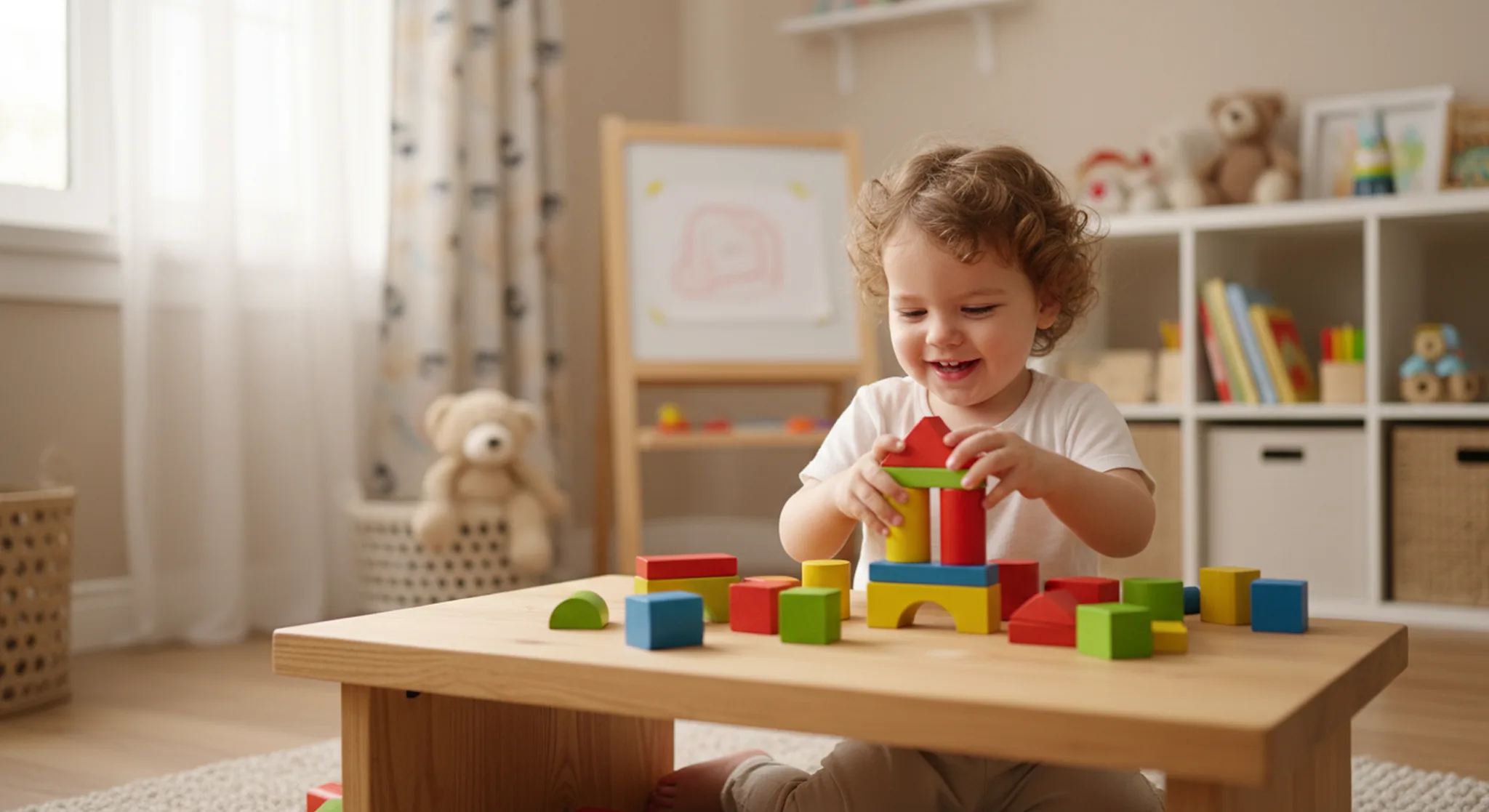
At 16 months, most toddlers walk confidently, climb whatever furniture allows it, say a handful of words alongside fluent pointing, copy your chores, and are settling into one glorious afternoon nap. Tantrums are arriving right on schedule too.
Sixteen months sits between the 15 and 18 month checkups, in the thick of early toddlerhood: mobility is expanding fast, language is quietly stockpiling, and independence is becoming a personality trait.
This guide covers the typical 16 month milestones across movement, language, thinking, and social development, plus sleep, eating, tantrums, and the signs worth flagging to your pediatrician before the 18 month screening visit.
Key Takeaways
Walking well is established; climbing, squatting, and stair practice are the new frontiers.
Expect roughly 3 to 20 words plus constant pointing and jargon; understanding runs far ahead.
Imitating chores and early pretend play show healthy social learning.
Most 16 month olds sleep 11 to 14 total hours with one afternoon nap.
Tantrums are a developmental feature of this age, not a warning sign.
Table of Contents
Movement Milestones at 16 Months
By 16 months, most toddlers are steady, confident walkers who barely remember their wobbly first steps. The new projects are vertical and technical: climbing onto the couch and (alarmingly) the kitchen chairs, squatting to inspect something on the floor and standing back up without hands, walking backward a few steps, and tackling stairs with a hand held or a rail. Some toddlers run a stiff, adorable sprint; many have not started running, and both are normal.
Fine motor control is advancing in parallel. A 16 month old typically stacks two or three blocks, scribbles when handed a crayon, turns board book pages a few at a time, and is getting genuinely functional with finger foods and increasingly with a spoon. Push toys, balls, and containers to fill and dump are the perfect toy shelf right now.
Walks well independently; may walk backward or start a stiff run.
Climbs onto furniture and manages stairs with help.
Squats to pick things up and stands without support.
Stacks 2 to 3 blocks, scribbles, and self feeds finger foods.
Language at 16 Months: The Quiet Stockpile
Expressive vocabulary at 16 months typically sits anywhere from 3 to 20 words, and the variation is enormous and mostly meaningless. The CDC checkpoints on either side are 1 to 2 words at 15 months and 3 or more at 18 months, so a 16 month old with a few reliable words plus rich pointing, gesturing, and expressive jargon is exactly on track. Meanwhile, comprehension is exploding: your toddler follows simple one step directions, points to familiar objects and a body part or two when asked, and clearly understands far more than they can say.
The most important language behaviors at this age are actually gestures. Pointing to show you something interesting, not just to request it, bringing you objects, and waving are the social communication signals pediatricians look for. Reading together daily, naming everything, and expanding your toddler’s words (dog! yes, a big brown dog) is the highest yield language work there is. Our babbling guide shows the road that led here.
Struggling with your baby’s sleep?
A personalized plan meets your baby where they are, at every age and stage.
Sixteen month olds learn by imitation and experiment. Expect your toddler to copy sweeping, phone calls, and stirring, to test cause and effect relentlessly, and to begin the first flickers of pretend play, feeding a stuffed animal or holding a block to their ear. Point at something across the room and your toddler should look where you point, an underrated milestone called joint attention.
Emotionally, this is the dawn of the tantrum era. Big desires plus minimal language plus zero impulse control equals meltdowns, sometimes spectacular ones, and they are developmentally expected rather than a discipline failure. Separation anxiety is often still strong, and clinginess around strangers is normal. Predictable routines, calm responses, and naming feelings (you are so frustrated) are the tools that actually work at this age.
Eating at 16 Months
Most 16 month olds eat three meals and two snacks, largely feeding themselves. Appetite is often erratic because second year growth is slower, so judge intake across the week, not the day. Keep whole milk to roughly 16 to 24 ounces daily so it does not displace iron rich foods, and keep offering rejected foods without pressure; it can take a dozen exposures before a new food is accepted. Our toddler meal ideas guide helps when the rotation gets stale.
Sleep at 16 Months
Toddlers aged 1 to 2 need 11 to 14 hours of sleep per 24 hours per the American Academy of Sleep Medicine. At 16 months that typically means 10 to 12 hours overnight plus one afternoon nap of 2 to 3 hours. The two to one nap transition usually completes between 15 and 18 months, so if your toddler is mid transition, short naps and cranky late afternoons are temporary and normal.
Sleep disruptions around this age usually trace to the nap transition, molars, separation anxiety, or newfound independence at bedtime. Our sleep regression ages guide maps the bumpy windows, and the sleep schedule by age guide shows what a realistic 16 month day looks like.
When to Talk to Your Pediatrician
Mention these at or before the 18 month visit, which includes formal developmental and autism screenings:
Not walking independently by 16 to 18 months.
No words at all, or no pointing, waving, or other gestures.
Does not follow simple directions or respond consistently to their name.
Little interest in other people, no shared smiles or showing you things.
Loss of any skills your toddler previously had.
Most single item delays are simply timeline variation, but gesture, language, and social connection differences are exactly what early screening catches best, and early support makes a measurable difference.
What Comes Next
Over the next two months, expect vocabulary to push toward the 18 month word burst, steadier climbing and running, and richer pretend play. Our 17 month milestones and 18 month milestones guides cover the road ahead, and 14 month milestones shows how far you have come.
Activities That Build 16 Month Skills
Everything a 16 month old needs to practice can be staged with household objects. For motor skills: cushions to climb, a low step to master with your hand nearby, balls to throw and chase, and push toys for steering practice. For fine motor: chunky crayons and big paper, stacking cups, board books with real page turning duty, and a spoon at every meal even though the floor pays the price. For thinking: containers to fill and dump, simple shape sorters, and hiding games with a toy under a cup.
For language, the highest value habits are free: narrate your day, label whatever your toddler points at within a second or two of the point, expand single words into short phrases, and read the same favorite books on repeat, repetition is a feature, not a rut. Real chores beat toys for engagement at this age, so hand over safe jobs: wiping the tray, carrying laundry, stirring with a dry spoon. Screens still add little before 18 to 24 months; your toddler’s best app remains you, the floor, and something to climb.
Frequently Asked Questions
What milestones should a 16 month old have?
Most 16 month olds walk well on their own, climb onto furniture, stack a couple of blocks, use 3 to 7 or more words, point to ask and to show, follow simple directions, imitate chores, and feed themselves finger foods while practicing with a spoon. Ranges are wide at this age.
How many words should a 16 month old say?
Typically somewhere between 3 and 20 words, with huge normal variation. The CDC checklist expects 1 to 2 words at 15 months and 3 or more at 18 months, so a 16 month old with a handful of words plus lots of pointing and jargon is on track. No words at all by 18 months deserves a pediatrician conversation.
Should a 16 month old be running?
Some 16 month olds run stiffly, many do not run at all yet, and both are normal. Running usually smooths out between 18 months and 2 years. Walking well independently is the expectation at this age.
How much sleep does a 16 month old need?
About 11 to 14 hours per 24 hours. Most 16 month olds have transitioned or are transitioning to a single afternoon nap of 2 to 3 hours, with 10 to 12 hours at night. The two to one nap transition typically completes between 15 and 18 months.
Are tantrums normal at 16 months?
Very. A 16 month old has strong desires, a growing sense of independence, and very little language or impulse control, which is the exact recipe for tantrums. Calm, consistent responses and predictable routines help; frequent tantrums at this age are developmentally expected, not a discipline problem.
Milestones and sleep in one plan
Get a personalized plan built around your toddler’s stage, naps, and temperament.
Paruthi S, et al. Recommended Amount of Sleep for Pediatric Populations: A Consensus Statement of the American Academy of Sleep Medicine. Journal of Clinical Sleep Medicine, 2016. https://jcsm.aasm.org/doi/10.5664/jcsm.5866