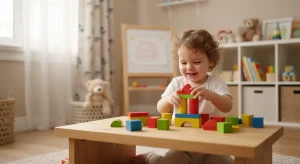
At 15 months, most toddlers take at least a few steps on their own, say one or two words beyond “mama” and “dada,” point to ask for help or show you something interesting, follow simple one-step directions, feed themselves with their fingers, clap when excited, and copy other children at play. The 15 month checkup uses these exact skills as its checklist.
Fifteen months is early toddlerhood in full color: new steps, first real words, strong opinions, and a growing drive to do it “myself.” It is also an official CDC milestone checkpoint and a scheduled well visit, which makes it a good moment to look at the whole picture.
Below are the typical 15 month old milestones across movement, language, thinking, and social-emotional development, plus what to expect with sleep, meals, and the earliest tantrums, and the specific signs worth raising with your pediatrician.
Key Takeaways
Independent steps are expected by 15 months, even if wobbly; confident walking and early running come over the next few months.
One or two words besides “mama” and “dada” plus lots of pointing is right on track for language.
Copying other children, showing you objects, and hugging stuffed animals mark healthy social growth.
Most 15 month olds sleep 11 to 14 total hours and are transitioning, or have transitioned, to one afternoon nap.
Not walking at all by 15 months, or having no words and no pointing, warrants a pediatrician conversation.
Table of Contents
Movement Milestones at 15 Months
The CDC checklist expects a 15 month old to take a few steps on their own, and most are well past that: walking is the main mode of transport by now, arms up for balance in the classic toddler high-guard. New projects include squatting to pick things up and standing back up, climbing onto low furniture, pushing wheeled toys, and carrying treasures around the house. Stiff-legged running attempts and stair obsession usually follow between 15 and 18 months.
A late walker at 15 months is common enough that pediatricians see it weekly: about 1 in 10 healthy toddlers is still not walking independently at this age. If your child is not yet taking any independent steps, the 15 month visit is exactly the time to discuss it, especially if they are also not pulling to stand or cruising. Fine motor skills are advancing in parallel: stacking two or three blocks, scribbling with a fisted crayon grip, using fingers to self-feed, and starting to manage a spoon (upside down half the time, but progress is progress).
Language and Communication at 15 Months
The official bar is modest: one or two words besides “mama” and “dada,” such as “ba” for ball or “da” for dog. Word approximations count. Many 15 month olds have three to ten words, and a few chatterboxes have more, but the range is huge and mostly meaningless for the long run. What predicts strong language is everything underneath the words: looking at a familiar object when you name it, following one-step directions paired with a gesture, pointing to ask for something or to share attention, and responding to their name instantly.
Feed the vocabulary machine the low-tech way: narrate, label, read the same board books on loop, and respond to points with words (“Yes! That is a garbage truck.”). Screen-free conversation is still the strongest language intervention known. If your toddler points at everything and understands plenty but says little, you are almost always watching a normal pattern; if there is no pointing, no gestures, and no understanding, that combination matters more than word count.
Social, Emotional, and Thinking Skills
The CDC’s 15 month social milestones are small and lovely: copying other children while playing, showing you an object they like, clapping when excited, hugging a stuffed animal or doll, and showing you affection with hugs, cuddles, and kisses. Cognitively, your toddler now tries to use objects the right way (phone to ear, brush to hair, cup to mouth) and stacks at least two small objects. Simple pretend play is sprouting, and imitation of your chores is constant: expect enthusiastic, chaotic help with sweeping and laundry.
The other new arrival: frustration tantrums. A 15 month old wants things their words cannot request and their motor skills cannot execute, and the gap comes out as meltdowns. This is developmentally right on time, not a discipline failure. Name the feeling, keep the boundary, and stay boring; the language explosion of the next six months will defuse a lot of it. Our guide to parenting styles covers where warm-and-firm fits in the research.
Nap transition wrecking bedtime?
Fifteen months is peak two-to-one nap chaos. Betteroo builds a day-by-day schedule matched to your toddler’s sleep needs.
Most 15 month olds need 11 to 14 hours of total sleep. This is the heart of the two-naps-to-one transition window (roughly 13 to 18 months), which means some days run on a generous morning nap, others on a single early-afternoon nap, and the mismatch produces overtired evenings. If nights suddenly crumble, the 15 month sleep regression guide covers the usual culprits, and our sample 14 month and 17 month schedules show what the before and after look like.
At the table, expect three meals and two snacks of table food, 16 to 24 ounces of whole milk in cups, and a newly picky appetite. Toddler growth slows sharply after the first year, so intake drops and gets erratic: a huge breakfast, an ignored lunch, a dinner of exactly four peas. Keep offering variety without pressure and judge nutrition by the week, not the meal.
When to Talk to Your Pediatrician
Bring it up at the 15 month visit, or call sooner, if your toddler:
Is not taking any steps on their own
Says no new words and has none besides “mama” or “dada”
Does not point to ask for something or to show you something
Does not look at familiar objects when you name them
Does not follow simple one-step directions with a gesture
Does not copy you or other children
Has lost any skill they previously had
The 15 month checkup is a designated screening visit, so the questionnaire will cover most of this; answer it honestly rather than generously. Any lost skill deserves prompt evaluation at any age, and if walking has not started, your pediatrician may simply recheck at 18 months or may refer for a free early intervention evaluation. Either way, asking early costs nothing and buys options.
Frequently Asked Questions
What milestones should a 15 month old be hitting?
Per the CDC checklist: taking a few independent steps, saying one or two words besides “mama” and “dada,” pointing to ask for or show things, looking at familiar objects when named, following one-step gestured directions, copying other children, showing affection, clapping when excited, using fingers to self-feed, and trying to use objects like cups and brushes correctly.
Is it normal for a 15 month old not to walk?
Roughly 1 in 10 healthy toddlers is not yet walking independently at 15 months, and most of them walk within the next couple of months without any help. That said, taking a few steps is the CDC milestone for this age, so no independent steps at 15 months is worth discussing at the checkup, especially if your child is also not cruising.
How many words should a 15 month old say?
The milestone is one or two words besides “mama” and “dada,” and word approximations like “ba” for ball count. Many 15 month olds say three to ten words. Understanding, pointing, and following simple directions are stronger indicators than raw word count, which varies enormously among typically developing toddlers.
How much sleep does a 15 month old need?
About 11 to 14 hours in 24, typically 10 to 12 hours overnight plus one or two naps. Fifteen months sits in the middle of the two-naps-to-one transition, so schedules are often messy: some days need two short naps, others one early-afternoon nap with an earlier bedtime to compensate.
Are tantrums normal at 15 months?
Yes. Tantrums typically begin between 12 and 18 months, driven by the gap between what toddlers want and what they can say or do. Short, frequent frustration meltdowns are developmentally expected. Stay calm, name the feeling, hold the boundary, and expect improvement as language takes off in the coming months.
Walking all day should mean sleeping all night.
Betteroo turns your 15 month old’s age and schedule into a personalized sleep plan, nap transition included.