When do babies start talking? Most babies say their first real word around 12 months, and many reach about 50 words by their second birthday.
Few moments feel as big as a baby’s first word. But talking does not start with that word. It starts with coos in the first weeks, grows through babbling and pointing, and then takes off in the second year.
This guide explains when babies start talking, what counts as a first word, a month-by-month timeline, how many words a 14 month old should say, simple ways to encourage talking, and the signs that mean it is time to ask about a speech or hearing check.
Key Takeaways
Most babies say a first real word around 12 months, with a normal range of about 10 to 15 months.
Cooing starts around 2 months, babbling around 4 to 6 months, and “mama” or “dada” with meaning around 9 to 12 months.
Many toddlers reach about 50 words and start two-word phrases by age 2.
Talking with, reading to, and singing with your baby every day is the best way to build language.
Ask for a hearing and speech check if there are no words by 15 to 18 months or no two-word phrases by 24 months.
Table of Contents
When Do Babies Start Talking?
Most babies say their first real word somewhere around 12 months, with a normal range of roughly 10 to 15 months. A “real” word is one your baby uses on purpose and consistently for the same thing, even if it does not sound like the adult version. “Ba” for ball counts if your baby says it every time the ball appears.
But talking starts long before that first word. From the newborn weeks, babies are learning the sounds, rhythm, and back-and-forth of conversation. Cooing, babbling, pointing, and waving are all steps on the same path, and they tell you a lot about how your baby’s language is developing.
Baby Talking Timeline: Month by Month
Age
What you might hear or see
0 to 2 months
Crying for different needs, small throaty sounds, calming to your voice. Social smiles appear around 6 to 8 weeks.
2 to 4 months
Cooing (“ooh,” “aah”), gurgling, and turning toward voices. Your baby may coo back when you talk.
4 to 6 months
Laughing, squealing, blowing raspberries, and early babbling with sounds like p, b, and m.
6 to 9 months
Repetitive babbling such as “bababa” and “dadada,” responding to their name, and understanding “no.”
9 to 12 months
Babbling that sounds like real speech, pointing, waving bye-bye, and “mama” or “dada” said to the right person.
12 to 15 months
First words, often one to a few. Understands simple directions like “give me the cup.”
15 to 18 months
A handful of words, more pointing to show you things, and lots of “jargon” (babble with sentence-like tones).
18 to 24 months
Rapid word growth. Many toddlers reach about 50 words by age 2 and begin two-word phrases like “more milk.”
2 to 3 years
Short sentences, questions, and speech that familiar adults understand most of the time.
Typical speech and language milestones. Ranges vary; this is a guide, not a test. Sources: AAP, CDC, ASHA.
Parents often wonder whether “dada” at 7 months was the first word. Usually it was babbling. Babies make those sounds for fun, long before they connect them to a person. It becomes a word when your baby says it to mean one specific thing, and says it again the next time. Early words tend to be:
People: mama, dada, a sibling’s or pet’s name
Favorite things: ball, dog, car, milk, and names for comfort objects
Social words: hi, bye, uh-oh, no, and more
Animal sounds and noises: moo, woof, vroom
Signs count too. If your baby uses a gesture or a sign for “more” or “all done” consistently, that is real communication. Using baby sign language does not delay speech; research suggests it may support it by reducing frustration while words catch up.
How Many Words Should a 14 Month Old Say?
There is no single right number. Many 14-month-olds say anywhere from one or two to about ten words, and some say none yet but understand a great deal and communicate well with gestures. Understanding usually runs well ahead of speaking at this age. Your toddler may follow simple directions and point to familiar objects long before saying their names.
The CDC’s milestones suggest that by 15 months most toddlers try to say one or two words besides “mama” or “dada,” and by 18 months they try to say three or more. For a full picture of this age, see our 14 month old milestones guide.
Tired nights don’t have to last forever.
Our free two-minute quiz builds a gentle, personalized sleep plan for your baby’s age and temperament.
Babies learn language through everyday conversation with the people who love them. You do not need flashcards or apps. These habits make the biggest difference:
Narrate your day: “Now we’re washing your hands. Warm water. Splash!” Hearing lots of words in context builds vocabulary.
Take turns: when your baby coos or babbles, pause and answer as if you are having a conversation. That back-and-forth is how babies learn talking is social.
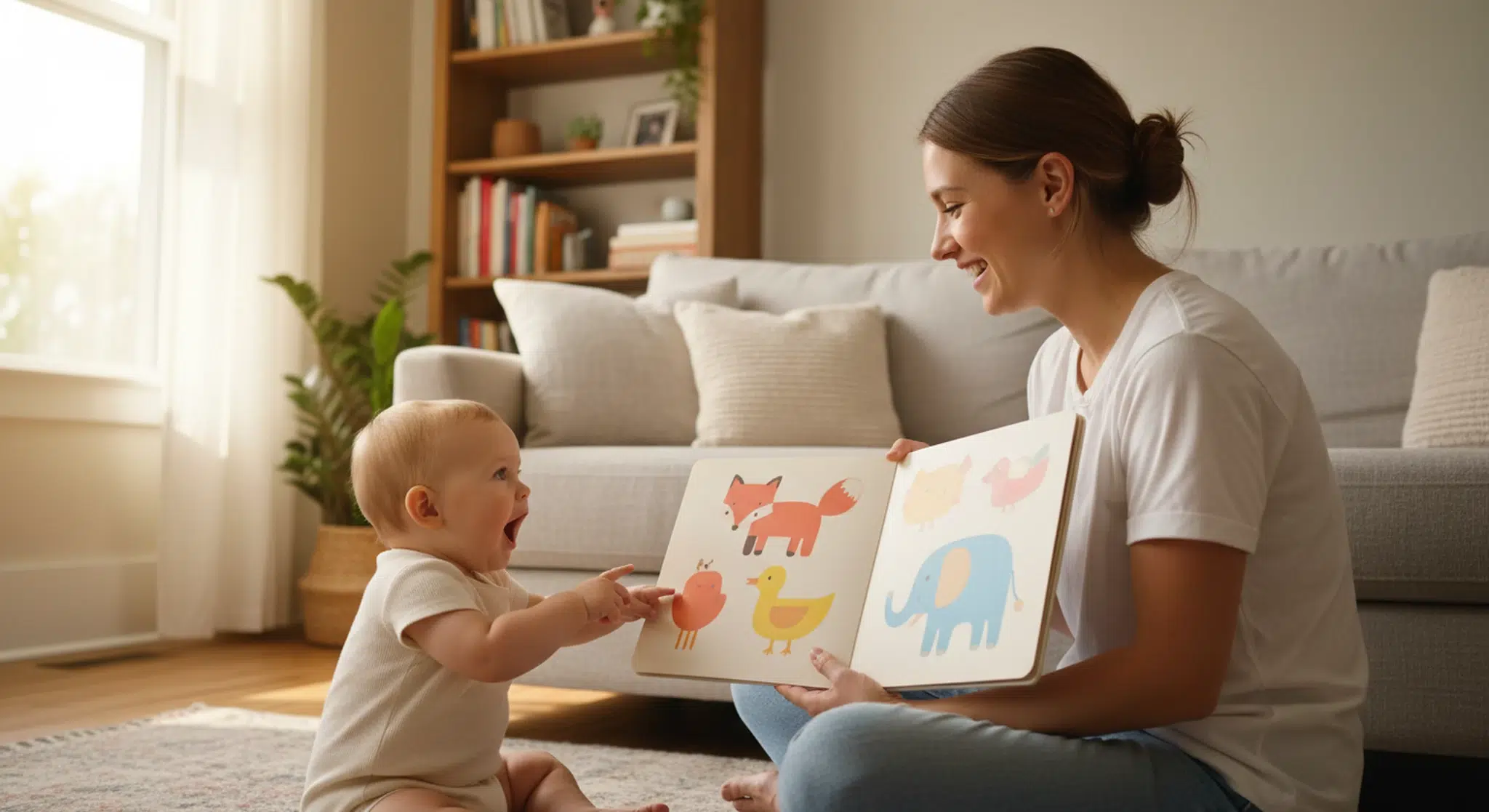
Read together every day: even for a few minutes. Name the pictures, make the animal sounds, and let your baby turn the pages.
Expand on what they say: if your toddler says “car,” you can say “Yes, a big red car!”
Sing songs and rhymes: repetition and rhythm help babies pick out words.
Offer choices: “Do you want the banana or the apple?” gives your toddler a reason to use words.
Limit background screens: TV playing in the background cuts down on the conversations babies need. The AAP recommends avoiding screen media other than video chatting for children younger than 18 to 24 months.
Get down to eye level: babies watch your mouth and face to learn how sounds are made.
Bilingual families can speak whichever languages feel natural. Children learning two languages reach first words on a similar timeline, and mixing languages is a normal part of learning both.
Late Talkers and Speech Delay
Some children start talking later than others and catch up on their own. Others benefit from early help. Early evaluation is free or low cost in the U.S. through your state’s Early Intervention program (for children under 3), and you can request one yourself without a doctor’s referral.
Talk to your pediatrician about a hearing check and a speech evaluation if your child:
Does not babble or make many sounds by about 9 months
Does not respond to their name or to sounds by about 9 to 12 months
Does not point, wave, or use other gestures by about 12 months
Says no words by 15 to 18 months
Is not combining two words by 24 months
Loses words or skills they used to have, at any age
Hearing problems are a common and very treatable cause of speech delay, so a hearing test is usually one of the first steps. Chronic ear infections with fluid can also muffle sound for weeks at a time.
Talking, Sleep, and Busy Brains
Language bursts often come with busy nights. Around 12 to 18 months, many toddlers practice words in the crib, wake more easily, or fight naps as their brains race ahead. A steady bedtime routine with a book, a song, and a few quiet minutes of talking about the day can support both language and sleep.
Bring up speech at every well-child visit, where your pediatrician will ask about sounds, gestures, and words. Ask sooner if you notice any of the red flags above, if your baby does not seem to hear well, or if something just feels off. You know your child best, and early support works best when it starts early.
Frequently Asked Questions
When do babies start talking?
Most babies start talking with a first real word around 12 months, and the normal range is about 10 to 15 months. Cooing, babbling, and gestures come first and are important early steps toward talking.
What age do babies say mama and dada?
Babies often babble “mama” and “dada” between 6 and 9 months, but usually say them with meaning, to the right parent, between about 9 and 12 months.
How many words should a 14 month old say?
Many 14 month olds say between one and about ten words, and some say none yet but understand a lot and use gestures. By 18 months, most toddlers try to say three or more words besides mama and dada.
Is it normal for a 1 year old not to talk?
Yes, many 1 year olds are not talking yet. What matters more at 12 months is babbling, responding to their name, pointing, and waving. If there are no words by 15 to 18 months, talk to your pediatrician.
Do boys talk later than girls?
On average, girls tend to say their first words and build vocabulary slightly earlier than boys, but the difference is small and falls within the normal range. A boy who is not talking by 18 months should still be checked.
Calmer days, better nights.
Betteroo builds a personalized sleep plan for your baby. Take the free two-minute quiz to get started tonight.