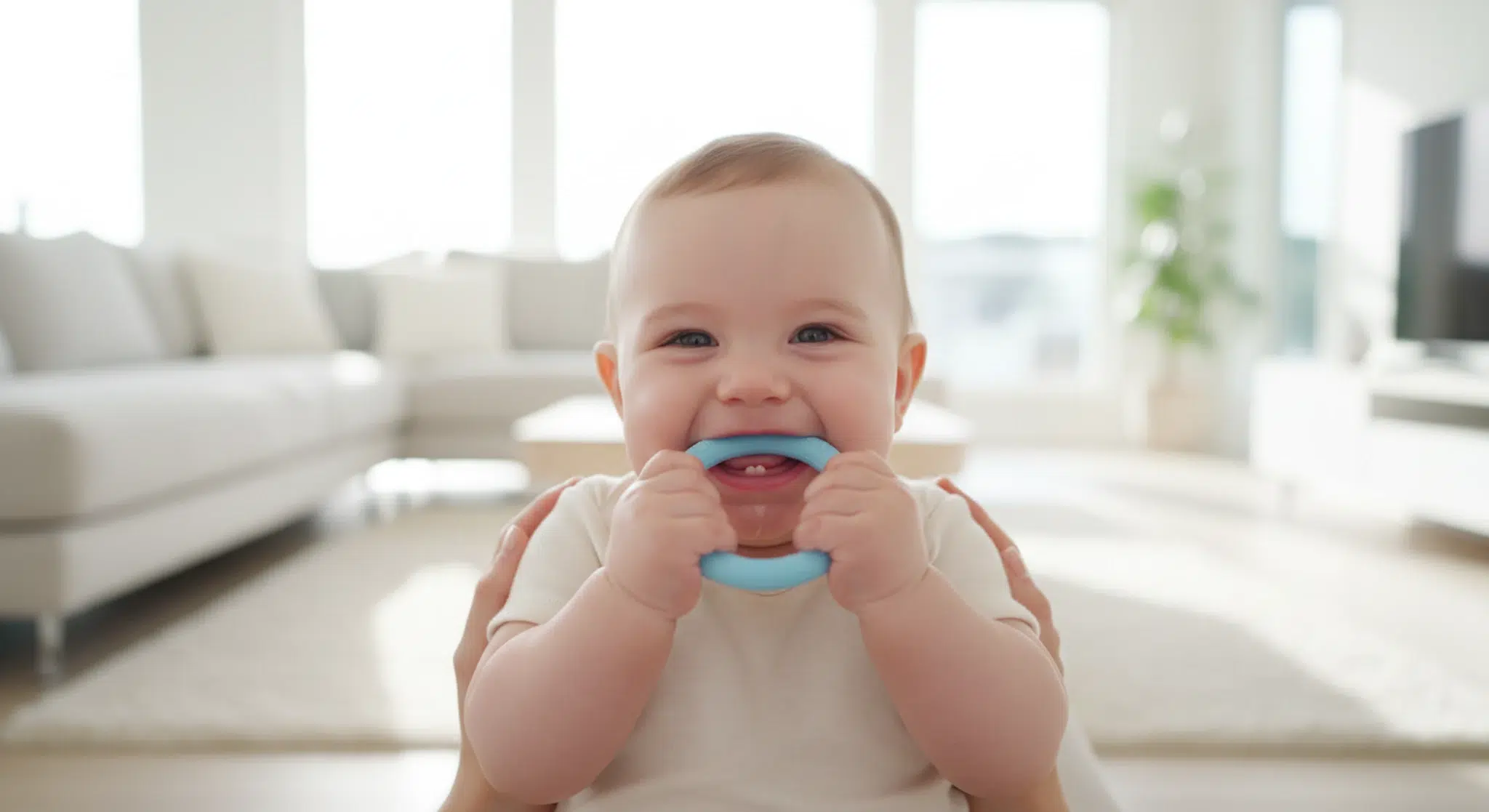
When do babies start teething? Most babies get their first tooth around 6 months old, but anywhere from about 4 to 12 months is normal.
Teething is one of those milestones parents feel before they see: the drool, the chewing, the fussy evenings. Then one morning there is a tiny white edge on the bottom gum and it all makes sense.
This guide covers when babies start teething, the usual order teeth come in (with a baby teeth chart), the real teething symptoms, the symptoms teething does not cause, safe ways to soothe sore gums, products to avoid, and when to call your pediatrician. Everything here follows guidance from the American Academy of Pediatrics, the American Dental Association, and the FDA.
Key Takeaways
Most babies start teething around 6 months, with a normal range of roughly 4 to 12 months.
The bottom front teeth usually come first; all 20 baby teeth are typically in by about age 3.
Common teething symptoms: drooling, chewing, tender gums, fussiness, and a slight temperature rise (not over 101°F).
Teething does not cause high fever, diarrhea, vomiting, or a runny nose. Call your pediatrician for those.
Skip numbing gels, homeopathic tablets, and amber necklaces. Use gum massage and a chilled (not frozen) teether instead.
Table of Contents
When Do Babies Start Teething?
Most babies start teething around 6 months old, but the normal range is wide. The American Academy of Pediatrics (AAP) notes that the first tooth can show up anywhere from about 3 or 4 months to after the first birthday, and a few babies are even born with a tooth. If your baby is 9 or 10 months old with a gummy grin, that is usually still normal.
Teething is also not a single event. Many babies show signs (drooling, chewing, fussing) weeks before a tooth actually breaks through the gum. Then the process repeats, on and off, until all 20 baby teeth are in, usually by around age 3.
A few things can shift the timing. Teething often runs in families, so if you or your partner got teeth late, your baby may too. Premature babies tend to follow their adjusted age rather than their birth date. And babies who are otherwise healthy and growing well can simply be early or late without anything being wrong.
Baby Teeth Chart: The Usual Order
Teeth tend to arrive in a predictable order, even if the timing varies. The ranges below follow the American Dental Association’s eruption chart. Treat them as rough windows, not deadlines.
Tooth
Usual age it appears
Lower central incisors (bottom front two)
6 to 10 months
Upper central incisors (top front two)
8 to 12 months
Upper lateral incisors
9 to 13 months
Lower lateral incisors
10 to 16 months
First molars (upper and lower)
13 to 19 months
Canines (upper and lower)
16 to 23 months
Second molars (upper and lower)
23 to 33 months
Approximate baby tooth eruption ages. Source: American Dental Association (MouthHealthy).
Girls often get teeth slightly earlier than boys, and the bottom front teeth are almost always first. The molars, which are bigger and flatter, are the ones many parents remember as the hardest, both because they are large and because toddlers can tell you loudly that their mouth hurts.
Teething Symptoms: What Is Normal
Teething symptoms are usually mild. The most common signs include:
Drooling: often a lot, sometimes with a mild rash on the chin or cheeks from the constant wetness.
Chewing and gnawing: on hands, toys, the crib rail, or your shoulder.
Swollen or tender gums: you may see a small bump, a white edge, or a bluish blister where a tooth is coming in.
Irritability: especially in the days just before a tooth breaks through.
Rubbing the face or pulling at the ear: on the same side as the sore gum.
Changes in sleep or feeding: a few restless nights or a baby who pulls off the breast or bottle because sucking hurts.
A slight rise in temperature: the AAP says teething may cause a small bump in temperature, but not over 101°F (38.3°C).
Symptoms usually cluster in the few days before and after a tooth erupts, so a baby who is miserable for a week and then fine again fits the typical pattern.
What Teething Does Not Cause
This part matters, because blaming teething can mean missing an illness. According to the AAP and major children’s hospitals, teething does not cause:
A true fever higher than 101°F (38.3°C)
Diarrhea, vomiting, or a runny nose
A body-wide rash
Days of refusing to eat or drink, or signs of dehydration
If your baby has any of these, treat it as a separate problem and call your pediatrician. For babies under 3 months, any fever of 100.4°F (38°C) or higher needs a call to the doctor right away.
Tired nights don’t have to last forever.
Our free two-minute quiz builds a gentle, personalized sleep plan for your baby’s age and temperament.
Most teething discomfort responds to simple, drug-free comfort:
Gum massage: wash your hands and gently rub your baby’s gums with a clean finger for a minute or two. The pressure often feels good.
A firm rubber teething ring: solid (not liquid-filled) and chilled in the refrigerator, not the freezer. The AAP warns that frozen teethers can get too hard and hurt the gums.
A cold, damp washcloth: twisted and chilled, for supervised chewing.
Cold foods, if your baby eats solids: chilled purees or yogurt can soothe. Avoid hard foods like raw carrots or frozen bagels, which are choking risks.
Wipe away drool: and use a gentle barrier cream on the chin to prevent drool rash.
Extra comfort: cuddles, rocking, and a little patience at bedtime. A consistent routine helps babies settle even on rough nights.
If your baby is still very uncomfortable, ask your pediatrician about pain relief. Acetaminophen may be appropriate for babies over 2 to 3 months, and ibuprofen only for babies 6 months and older, always dosed by weight with the device that comes with the medicine.
Teething Products to Avoid
Several popular teething remedies are not safe, according to the FDA and AAP:
Benzocaine or lidocaine gels: the FDA warns against numbing gels for teething because they can cause methemoglobinemia, a rare but serious condition that reduces the blood’s ability to carry oxygen, and they wash away within minutes anyway.
Homeopathic teething tablets and gels: they have no proven benefit, and some have been found to contain inconsistent amounts of belladonna.
Amber teething necklaces, bracelets, and anklets: they do nothing to relieve pain and have caused choking and strangulation. Never leave anything around a baby’s neck or wrist during sleep or naps.
Frozen solid or liquid-filled teethers: too hard, and liquid-filled rings can leak or break.
Teething and Sleep
Teething can disrupt sleep for a night or two around each tooth, but it rarely explains weeks of night waking. If your baby’s sleep fell apart and stayed that way, look at other causes too, such as a sleep regression, a nap transition, or new skills like crawling. Our guide to teething and sleep covers how to comfort your baby at night without creating new habits you will need to undo later.
Caring for Your Baby’s First Teeth
As soon as the first tooth appears, start brushing twice a day with a soft infant toothbrush and a smear of fluoride toothpaste about the size of a grain of rice. The AAP recommends a first dental visit within 6 months of the first tooth, and no later than the first birthday.
Do not put your baby to bed with a bottle of milk or juice. Milk pooling around teeth overnight can lead to decay.
Wipe gums with a clean, damp cloth after feeds, even before teeth arrive.
Ask your pediatrician about fluoride varnish at well-child visits, and whether your tap water contains fluoride.
Early and Late Teething
Early teething: Some babies cut a tooth at 3 or 4 months. That is usually just variation. A baby born with a tooth (a natal tooth) should be checked by the pediatrician, since some are loose and may need removal to prevent choking.
Late teething: No teeth by the first birthday is common and usually harmless. Most pediatricians and pediatric dentists want to take a closer look if there are still no teeth by around 18 months, to rule out rare causes. Bring it up at a well visit and they can guide you.
Call your baby’s doctor if your baby has a fever over 101°F, diarrhea, vomiting, a rash on the body, signs of dehydration (fewer wet diapers, no tears, dry mouth), is unusually sleepy or inconsolable, or if you are worried for any reason. Also check in if a gum blister looks large or dark, if a tooth looks chipped or discolored, or if your baby has no teeth by about 18 months. When in doubt, call. Pediatric nurses field teething questions every day.
Frequently Asked Questions
When do babies start teething?
Most babies start teething around 6 months old. The normal range is wide, from about 4 months to after the first birthday, and signs like drooling and chewing can start weeks before the first tooth appears.
What are the first signs of teething?
The first signs of teething are usually extra drooling, chewing on hands and toys, swollen or tender gums, and more fussiness than usual. Some babies also rub their face or pull at their ear on the sore side.
Can a 3 month old be teething?
Yes, some babies start teething at 3 or 4 months, although it is less common. Babies this age also drool and mouth their hands as a normal part of development, so drooling alone does not always mean a tooth is on the way.
Does teething cause a fever?
Teething can cause a slight rise in temperature, but not a true fever. The AAP says a temperature above 101°F (38.3°C) is probably not from teething, so check with your pediatrician.
What are the worst months for teething?
Many parents find the first teeth (around 6 to 10 months) and the first molars (around 13 to 19 months) the hardest. Every baby is different, and some barely seem to notice teething at all.
Calmer days, better nights.
Betteroo builds a personalized sleep plan for your baby. Take the free two-minute quiz to get started tonight.