Teething pain relief starts with the simplest tools: massage your baby’s gums with a clean finger, offer a firm rubber teething ring chilled in the fridge, and ask your pediatrician about acetaminophen if your baby is still very uncomfortable.
Teething can turn a happy baby into a drooly, gnawing, unhappy one overnight, and the shelf of teething products at the store does not make it easier to know what is safe.
This guide covers teething pain relief that works, what the American Academy of Pediatrics (AAP) and FDA warn against, cold foods by age, medicine safety and new-tooth care. Every recommendation comes from the AAP, FDA, Mayo Clinic or the American Dental Association (ADA).
Key Takeaways
Gum massage and a firm rubber teething ring chilled in the fridge, not frozen, are the first things to try.
Ask your pediatrician about acetaminophen; ibuprofen is only for babies 6 months and older (AAP).
Avoid benzocaine or lidocaine gels, homeopathic teething tablets and teething necklaces or bracelets (FDA, AAP).
Teething does not cause a true fever or diarrhea, so call your pediatrician if you see them (AAP).
Brush new teeth twice a day with a rice-grain smear of fluoride toothpaste and see a dentist by age 1.
Table of Contents
Teething Pain Relief: The Short Answer
Quick Answer
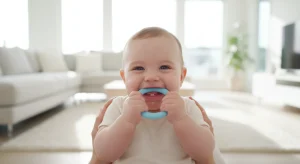
The safest teething pain relief is simple: massage your baby’s gums with a clean finger and offer a firm, solid rubber teething ring that is chilled in the fridge, never frozen hard. If your baby is still very uncomfortable, ask your pediatrician about acetaminophen; ibuprofen is an option only after 6 months (AAP). Skip numbing gels with benzocaine or lidocaine, homeopathic teething tablets and teething necklaces or bracelets, which the FDA and AAP warn can cause serious harm.
On timing, the short version: the AAP says teething typically starts around 4 to 7 months, and most children have all 20 baby teeth by age 3. For the full tooth-by-tooth timeline, see our guide to when babies start teething.
Signs Your Baby Is Teething (and What Teething Does Not Cause)
The AAP lists the common signs of teething as fussiness, drooling, chewing on objects, a rash around the mouth and swollen, tender gums. Mayo Clinic notes that teething often causes no symptoms at all.
Drooling and chewing: constant drool can irritate the chin and cheeks; our teething rash guide covers that skin care in detail.
Crankiness: especially as a tooth is close to the surface. For other causes, see our guide to a fussy baby.
A slight rise in temperature: the AAP says teething may cause a slight rise, but not above 101 F (38.3 C). Its first-tooth page says a true fever, over 100.4 F (38 C), is not associated with teething and may signal an illness or infection.
Just as important is what teething does not cause. The AAP’s teething pain page says teething does not cause fever, diarrhea, excess crying, diaper rash (other than possibly around the mouth) or a weaker resistance to colds and flu. Blaming teeth can delay care for an illness that needs a doctor. If your baby has a fever or diarrhea, treat it as a separate problem and call your pediatrician.
Teething Remedies That Work: How to Help a Teething Baby
Remedy
How to use it
Age
Safety note
Gum massage
Wash your hands, then rub the sore spot with a fingertip or knuckle (AAP). Mayo Clinic suggests a clean finger or wet gauze for about two minutes, as often as needed.
Any age
Letting your baby gnaw on your clean finger can help too (AAP).
Firm rubber teething ring
Offer a solid ring or rubber toy to chew. Chill it in the refrigerator if your baby likes cold.
Any age
Must not be frozen, because a very hard object can hurt the gums (FDA). Choose one that is not liquid filled (FDA, AAP). Supervise for choking (FDA).
Cold, wet washcloth
Twist a damp washcloth, tie a knot in one end and chill it; let your baby chew the knot (AAP).
Any age
The AAP says never to let a baby chew on anything frozen solid. Do not dip it in anything sweet (Mayo Clinic).
Cold water in a cup
Offer a few sips of cold water in a sippy or straw cup (AAP).
Over 6 months
Water is not needed before 6 months; see our water guide.
Chilled soft foods
Chilled soft fruit, such as banana, or chilled berries in a small mesh teether (Mayo Clinic).
Over 1 year, per Mayo Clinic
Avoid hard foods that can break off and cause choking (Mayo Clinic).
Pain reliever, if needed
Ask your pediatrician about acetaminophen; ibuprofen only after 6 months (AAP).
See next sections
Get a dose in milliliters based on your baby’s age and weight (AAP). Never guess.
Teething remedies that work. Sources: AAP HealthyChildren.org, FDA and Mayo Clinic.
A fridge-cold ring is the sweet spot: chilled, never frozen hard. Check teethers for cracks or splits before each use.
Big days go better with a good night of sleep.
Got a little one at home too? Our free two-minute quiz builds a gentle, personalized sleep plan for babies and toddlers.
Cold Foods and Drinks for Teething Babies on Solids
Babies over 6 months: the AAP suggests cold water in a sippy cup once your child is over 6 months. If you are just starting out, our starting solids guide and baby-led weaning guide explain which textures fit which stage.
Babies over 1 year: Mayo Clinic suggests chilled soft fruit, such as banana, or chilled berries in a small mesh teether, and rubbing the gums with ice wrapped in a wet cloth for babies over 1.
Teething biscuits: the AAP says to watch your baby closely, because chunks can break off and cause choking.
Ice and frozen pops: Mayo Clinic says to avoid them, because they can cause frostbite of the gums. Hard raw foods are also a choking risk.
Always feed your baby sitting upright and stay within arm’s reach.
Teething Pain Medicine: Acetaminophen, Ibuprofen and Dosing Safety
Acetaminophen: the AAP says to ask your pediatrician about acetaminophen if your baby seems very uncomfortable. It calls moderate use safe and notes that a nighttime dose may help a fussy child sleep.
Ibuprofen: the AAP says ibuprofen is an option only after 6 months of age.
Getting the dose right: the AAP says to get the dose in milliliters (mL) based on your child’s age and weight. Ask your pediatrician or pharmacist, and use only an infant or children’s product, never an adult one (Mayo Clinic refers to infants’ or children’s formulas).
How long: Mayo Clinic advises stopping after 1 to 2 days, because longer use can damage the liver or kidneys. If your baby still needs pain medicine after that, call the pediatrician, since something other than teething may be going on.
We do not print a dosing chart on purpose. The AAP ties the dose to your baby’s age and weight, so the safest number is the one your pediatrician or pharmacist gives you for your child.
Teething Remedies to Avoid and Why
Numbing gels with benzocaine: the FDA says benzocaine products should not be used for teething pain in children. Benzocaine can cause methemoglobinemia, a serious and sometimes fatal condition that sharply reduces the amount of oxygen the blood can carry (FDA, AAP). The AAP adds that drool quickly washes gels away.
Lidocaine: the FDA says prescription viscous lidocaine should not be used for teething in infants and young children; it can cause heart problems, severe brain injury and death, and seizures if too much is applied or swallowed.
Homeopathic teething tablets and gels: the AAP says they have no proven benefit and may contain harmful substances. Mayo Clinic notes that some have contained more belladonna than labeled, which can cause seizures and breathing trouble.
Teething necklaces, bracelets and anklets: the FDA has received reports of death and serious injury, including strangulation and choking, from teething jewelry such as amber necklaces. Mayo Clinic lists necklaces, bracelets and anklets as risks for choking, strangling, mouth injury and infection, and the AAP says nothing should ever be around a baby’s neck. The AAP includes amber, wood, marble and silicone versions.
Liquid-filled teething toys: the AAP says they can tear or leak; the FDA advises a firm teether that is not liquid filled.
Anything frozen solid: the AAP and FDA warn that rock-hard frozen teethers can hurt the gums.
Alcohol on the gums: the AAP says not to rub any alcohol, drinkable or rubbing, on a baby’s gums.
Teething Relief by Stage: Front Teeth, Molars and Canines
Not every tooth feels the same. The AAP says the two front teeth usually come first, then the opposite pair of front teeth, then the first molars, then the canines. The American Dental Association (ADA) publishes typical age ranges for each tooth:
Teeth
Typical eruption age (ADA)
Lower central incisors
6 to 10 months
Upper central incisors
8 to 12 months
Lateral incisors
9 to 13 months (upper), 10 to 16 months (lower)
First molars
13 to 19 months (upper), 14 to 18 months (lower)
Canines
16 to 22 months (upper), 17 to 23 months (lower)
Second molars
23 to 31 months (lower), 25 to 33 months (upper)
Primary teeth eruption ages. Source: American Dental Association. Ranges vary a lot from child to child.
For back molars, a teether that reaches the back gums helps, and once your child is over 1, Mayo Clinic’s chilled soft foods in a mesh teether are an option. Timing varies widely; the AAP says later teething is not necessarily a problem. For what else is happening around these ages, see our 6 month old milestones and 18 month old milestones.
Teething at Night and During Feeds
For nights, the AAP suggests a soothing bath, a bedtime massage or low white noise, and for night waking, gentle pressure on the gums or a cold teething cloth. Remove teethers before you lay your baby down: babies under 12 months sleep alone, on their back, on a firm, flat, bare surface. Our teething and sleep guide covers nights in depth; if a cold is in the mix, see baby sleep when sick.
Some babies pull away from the breast or bottle when their gums hurt. Mayo Clinic suggests that if a breastfed baby refuses to nurse because of pain, you can offer breast milk by cup, spoon or syringe for short periods. If your baby is refusing feeds for more than a short stretch or seems to be drinking much less, call your pediatrician.
Caring for New Teeth From Day One
Before teeth: Mayo Clinic suggests wiping your baby’s gums with a soft, clean cloth twice a day, after the morning feeding and before bed.
Brush twice a day: once the first tooth appears, use a soft child’s toothbrush and a smear of fluoride toothpaste about the size of a grain of rice (AAP), especially after the last drink or food of the day. The AAP says to switch to a pea-sized amount after age 3.
No bottle in bed: the AAP warns that putting your baby to bed with a bottle can cause tooth decay, because milk pools around the teeth.
First dental visit: the AAP says to see a dentist within 6 months after the first tooth appears and no later than 12 months of age, whichever comes first. The AAP and the American Academy of Pediatric Dentistry recommend a “dental home” by age one.
A Simple Teething Comfort Plan You Can Follow
An order that follows the AAP, FDA and Mayo Clinic guidance above:
Check that it is really teething. No fever over 100.4 F, no diarrhea, eating and drinking reasonably (AAP).
Start with your hands. Wash them and massage the sore gum for a couple of minutes.
Offer something cold to chew. A fridge-chilled solid rubber ring or knotted damp washcloth.
Use food if your baby is old enough. Cold water in a cup after 6 months; chilled soft fruit in a mesh teether after 1 year.
If needed, call about medicine. Ask your pediatrician or pharmacist about acetaminophen (or ibuprofen after 6 months) and the right dose for your baby’s weight.
Reassess after a day or two. If your baby still needs medicine or seems sicker, call the pediatrician (Mayo Clinic).
Call 911 if your baby has trouble breathing, turns blue or pale gray, cannot be woken, or has a seizure.
Call your pediatrician right away if:
Your baby is under 3 months with a fever: a temperature of 100.4 F (38.0 C) or higher (AAP).
A fever at any age goes above 104 F repeatedly: or your child looks very ill, is unusually drowsy or is very fussy (AAP).
Your baby is not drinking well: or has repeated vomiting or diarrhea (AAP).
Call the office if:
Your baby has a fever: the AAP and Mayo Clinic say fever is not a teething symptom. The AAP also says to call if a fever lasts more than 24 hours in a child under 2.
Diarrhea lasts more than a day: (AAP).
Crying is more frequent or intense than usual: or your baby seems especially miserable (AAP).
Your baby has trouble eating, drinking or sleeping: or symptoms are getting worse (Mayo Clinic).
You need pain medicine for more than a day or two: or you are unsure of the dose (Mayo Clinic, AAP).
You never need a perfect reason to call. This article is general education, not medical advice.
Frequently Asked Questions
What is the best teething pain relief for babies?
The American Academy of Pediatrics recommends rubbing your baby’s gums with a clean finger and offering a firm rubber teething ring. Chill the ring in the refrigerator rather than the freezer. If your baby is still very uncomfortable, ask your pediatrician about acetaminophen, or ibuprofen if your baby is at least 6 months old.
Can I give my baby acetaminophen or ibuprofen for teething?
Ask your pediatrician first. The American Academy of Pediatrics says acetaminophen can help a very uncomfortable baby and that ibuprofen is an option only after 6 months. Get the dose in milliliters based on your baby’s age and weight. Mayo Clinic advises using pain relievers for only a day or two.
Are teething gels safe for babies?
No. The FDA says benzocaine products should not be used for teething pain in children because they can cause methemoglobinemia, a serious and sometimes fatal blood condition. Prescription lidocaine is also unsafe for teething. The American Academy of Pediatrics adds that drool washes gels away quickly, so they rarely help much.
Should teething rings be frozen?
No. The FDA and the American Academy of Pediatrics say teething rings should not be frozen, because a very hard teether can hurt your baby’s gums. Mayo Clinic suggests refrigerating rings and washcloths instead. Choose a solid rubber ring that is not liquid filled, and supervise your baby while they chew.
Does teething cause a fever?
Not a true fever. The American Academy of Pediatrics says teething may cause a slight temperature rise, but a temperature over 100.4 F is not associated with teething and may signal an illness. Call your pediatrician about any fever, and right away for a baby under 3 months with 100.4 F or higher.
Are amber teething necklaces safe?
No. The FDA has received reports of death and serious injury, including strangulation and choking, from teething jewelry such as amber necklaces. The American Academy of Pediatrics says there is no research showing they work and that nothing should ever be around a baby’s neck. Mayo Clinic also warns against teething bracelets and anklets.
Gentle changes, peaceful nights.
Betteroo builds a personalized sleep plan for your baby or toddler. Take the free two-minute quiz to get started.