When can babies have juice? Not before 12 months, according to the American Academy of Pediatrics; after the first birthday, juice is optional, and toddlers 1 to 3 years old should have no more than 4 ounces of 100% juice a day.
Juice seems like a natural next step after milk, and it is everywhere: daycare menus, birthday parties, kids’ meals. But pediatricians now advise waiting longer than many parents expect, and even then keeping the amounts small.
Below: why the AAP says no juice in the first year, daily limits by age, what to drink instead, safe serving after age 1, and juice for constipation.
Key Takeaways
The AAP recommends no fruit juice at all before 12 months.
Ages 1 to 3: at most 4 oz of 100% juice a day. Ages 4 to 6: 4 to 6 oz. Ages 7 to 18: 8 oz (AAP).
Milk and water are all a toddler needs to drink; juice is optional and whole fruit is better.
Serve juice in an open cup with a meal, never in a bottle, sippy cup or at bedtime.
Choose 100% pasteurized juice only, and ask your pediatrician before using juice for constipation.
As an Amazon Associate, Betteroo earns from qualifying purchases.
Table of Contents
When Can Babies Have Juice? The Short Answer
Quick Answer
Not before 12 months. The American Academy of Pediatrics (AAP) says fruit juice offers no nutritional benefit to babies under 1 and should not be part of their diet. After the first birthday juice is optional, never required. If you do offer it, the AAP’s limits for 100% juice are: at most 4 ounces a day for ages 1 to 3, 4 to 6 ounces a day for ages 4 to 6, and 8 ounces (1 cup) a day for ages 7 to 18. Serve it in an open cup with a meal, never in a bottle or at bedtime, and choose whole fruit whenever you can.
These numbers come from the AAP policy statement “Fruit Juice in Infants, Children, and Adolescents: Current Recommendations” (Pediatrics, 2017), the AAP’s first change to its juice advice since 2001. It extended the old “no juice under 6 months” advice to the entire first year (AAP HealthyChildren.org).
A 2019 consensus statement from the AAP, the American Heart Association, the Academy of Nutrition and Dietetics and the American Academy of Pediatric Dentistry, “Healthy Beverage Consumption in Early Childhood,” also lists juice as not recommended from birth to 12 months.
Why Babies Under 12 Months Should Not Have Juice
The AAP policy statement gives several reasons:
It can replace breast milk or formula: the AAP warns that juice risks replacing human milk or infant formula in the diet. The 2019 consensus statement adds that early juice can raise the risk of nutrient deficiencies such as anemia.
No nutritional benefit: the AAP says juice offers no nutritional benefit to children under age 1.
Tooth decay: the AAP calls prolonged exposure of the teeth to the sugars in juice a major contributing factor to cavities.
Diarrhea and tummy trouble: the AAP notes that babies and young children do not fully absorb some of the sugars in juice (fructose and sorbitol are the most common culprits). When juice is consumed in excessive amounts, that can lead to chronic diarrhea.
A taste for sweet drinks: AAP HealthyChildren.org notes that juice can build a preference for sweet flavors, and that once children are used to the sweet taste of juice they may resist plain water.
Juice Limits by Age: How Much Juice Is OK
After 12 months, juice is allowed but not needed. The AAP says children can get everything they need to drink from milk and water, and from 1 to 3 years most children need about 4 cups of total fluids a day, including water and milk (AAP HealthyChildren.org). If you choose to offer juice, keep it at or under these daily limits:
Age
AAP limit for 100% juice (2017)
2019 consensus limit (ages 0 to 5)
Birth to 12 months
None
Not recommended
12 to 24 months
At most 4 oz (1/2 cup) a day
Up to 4 oz (1/2 cup) a day
2 to 3 years
At most 4 oz a day
Up to 4 oz a day
4 to 6 years
4 to 6 oz a day
Up to 4 to 6 oz (1/2 to 3/4 cup) a day for ages 4 to 5
7 to 18 years
8 oz (1 cup) a day
Not covered
Daily 100% juice limits by age. Sources: AAP policy statement (2017) and the AAP, AHA, AND and AAPD consensus statement (2019).
These are upper limits, not targets: the consensus statement says whole fruit is preferred. Compare the serving size on the label with your child’s limit: one container can hold more than a toddler’s 4 ounces.
For older kids, HealthyChildren.org suggests juice only when whole fruit is not available.
Feeding and sleep go hand in hand.
Our free two-minute quiz builds a gentle, personalized sleep plan around your baby’s feeds.
What Should Babies and Toddlers Drink Instead? (Drinks by Age)
If juice is out for the first year, what is in? The AAP says breast milk and/or infant formula are enough to meet a baby’s fluid needs, and low-fat or nonfat milk and water are enough for older children. The 2019 consensus statement spells out amounts:
Age
Main drinks
Water
Milk
100% juice
0 to 6 months
Breast milk and/or formula
None needed
Cow’s milk not recommended
Not recommended
6 to 12 months
Breast milk and/or formula
4 to 8 oz a day, in a cup at meals
Cow’s milk not recommended
Not recommended
12 to 24 months
Whole milk and water
8 to 32 oz (1 to 4 cups) a day
16 to 24 oz (2 to 3 cups) whole milk a day
Up to 4 oz a day
2 to 3 years
Milk and water
8 to 32 oz (1 to 4 cups) a day
Up to 16 oz (2 cups) skim or 1% a day
Up to 4 oz a day
4 to 5 years
Milk and water
12 to 40 oz (1 1/2 to 5 cups) a day
Up to 20 oz (2 1/2 cups) skim or 1% a day
Up to 4 to 6 oz a day
Recommended drinks for children ages 0 to 5. Source: Healthy Beverage Consumption in Early Childhood (AAP, AHA, AND, AAPD, 2019).
Water needs depend on how much milk and juice a child drinks, so the ranges are wide on purpose (consensus statement).
The AAP says children should be encouraged to eat whole fruit to meet their recommended daily fruit intake. The 2019 consensus statement agrees, while noting that dietary guidelines count 100% juice as part of the fruit group, so a small amount within the limits is not harmful for a child over 1.
Need ideas? Our toddler snacks guide lists fruit-based snacks with choking-safe prep.
How to Give Juice to a Toddler (If You Choose To)
If you offer juice after the first birthday, these habits follow AAP guidance:
Choose 100% juice: with no added sugars or artificial ingredients (consensus statement).
Only pasteurized juice: the AAP says unpasteurized juice should be strongly discouraged for children of all ages (details below).
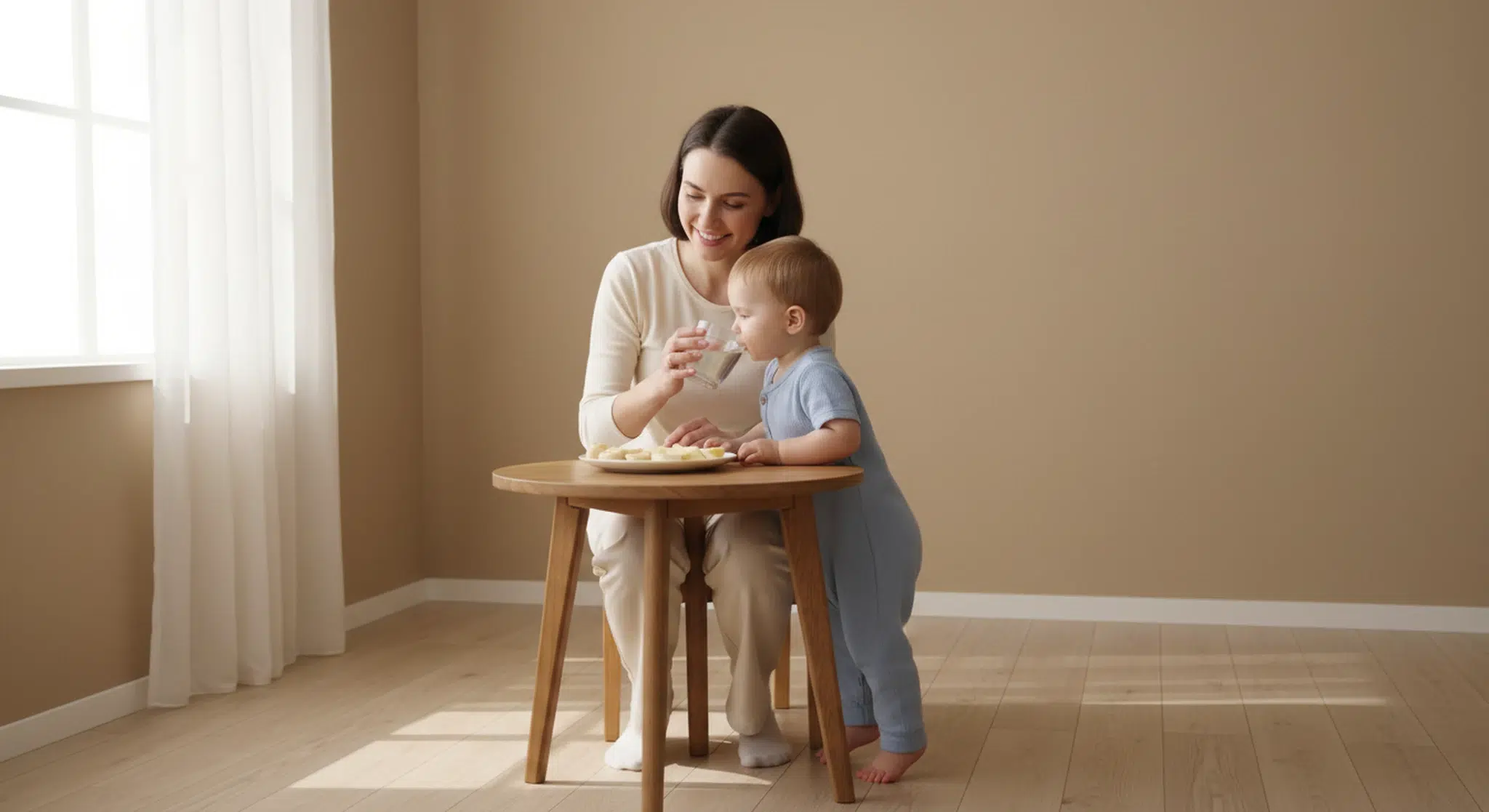
Use an open cup, not a bottle: the AAP says toddlers should not be given juice from bottles or covered “sippy cups” that let them drink easily throughout the day.
Serve it with a meal or snack: rather than a drink carried around all day (AAP).
Never at bedtime: the AAP says infants and toddlers should not be given juice at bedtime, when sugar sits on the teeth overnight.
Skip grapefruit juice with certain medicines: the AAP says children taking specific medications should not be given grapefruit juice, because it can interfere with how those medicines work. Ask your pharmacist.
Should you water it down? The 2019 consensus statement says you can dilute 100% juice at home if you want, with the daily limit still applying. The 2017 AAP policy statement cautions that dilution does not necessarily lower the risk to teeth.
Juice vs Fruit Drinks: Read the Label
Many drinks with fruit on the label are not juice. The 2019 consensus statement lists fruit drinks, fruit-flavored drinks and “fruitades” among the sugar-sweetened beverages it does not recommend for any child from birth to age 5. It also does not recommend drinks with low-calorie sweeteners for this age group.
The consensus statement warns that these products can be hard to tell apart from 100% juice. When you shop:
Look for the words “100% juice” on the package.
Check the ingredients list for added sugars or sweeteners.
If the front of the package says “drink” or “beverage” instead of juice, read the label closely.
The consensus statement also does not recommend flavored milk or toddler milks for children under 5.
Unpasteurized Juice: A Real Safety Risk
The AAP strongly discourages unpasteurized juice at every age. The U.S. Food and Drug Administration (FDA) says untreated juice can contain harmful bacteria, and children are among the people at greatest risk of serious illness.
Most U.S. juice is pasteurized, but not all (FDA). To spot untreated juice:
Look for the warning label: packaged untreated juice must carry a warning that begins “This product has not been pasteurized and therefore may contain harmful bacteria.”
Check the refrigerated case: the FDA says untreated juice is most likely to be found in the refrigerated section of a grocery store.
Ask at the counter: juice or cider sold by the glass at juice bars, orchards, farmers’ markets or some restaurants does not need a warning label, so ask whether it has been pasteurized or treated.
Juice for Baby Constipation: Only If Your Pediatrician Suggests It
This is the one situation where a pediatrician may suggest juice for a baby under 1. The AAP policy statement notes that the sorbitol and other carbohydrates in some juices can be used to help manage constipation, and AAP HealthyChildren.org describes small amounts of apple or pear juice for constipated babies who are at least a month old, while repeating that juice is not otherwise recommended under a year.
Ask your pediatrician before giving any juice for constipation, and ask how much and for how long. For babies who already eat solids, HealthyChildren.org suggests trying vegetables and fruits first, “especially that old standby, prunes.”
Juice is not for diarrhea or dehydration. The AAP says juice is not appropriate to treat dehydration or manage diarrhea.
Juice, Bottles and Tooth Decay
Juice habits matter from the very first tooth (see when babies start teething). The American Academy of Pediatric Dentistry (AAPD) policy on early childhood caries recommends:
Avoiding all juice for babies 6 to 12 months old.
Limiting 100% juice to no more than 4 ounces a day for children 1 to 3 years old.
Avoiding on-demand and nighttime bottle-feeding and breastfeeding after 12 months of age.
Avoiding foods and drinks with added sugars for children under 2.
Setting up a dental home within 6 months of the first tooth coming in, and no later than 12 months of age.
The AAP’s concern is prolonged exposure: a bottle or covered cup of juice sipped all day, or taken to bed, keeps sugar on the teeth.
Ask your pediatrician before giving juice to a baby under 12 months for any reason, including constipation. Also check in if:
Your child drinks a lot of juice: or refuses water and milk.
Your child has ongoing loose stools: the AAP notes that too much juice can cause chronic diarrhea in young children.
Constipation does not improve: HealthyChildren.org says to call if dietary changes do not help, or if your baby strains for more than 10 minutes without success or has blood with hard stools.
Your child has not seen a dentist yet: the AAPD recommends a dental home within 6 months of the first tooth and no later than 12 months of age.
Call your pediatrician right away if your child has diarrhea or vomiting and you are worried about dehydration, and ask about an oral rehydration solution. Do not use juice to treat dehydration (AAP). Call 911 for any emergency, such as trouble breathing.
This article is general education, not medical advice.
Frequently Asked Questions
When can babies have juice?
The American Academy of Pediatrics says babies should not have fruit juice before 12 months of age. After the first birthday, juice is optional. If you offer it, choose pasteurized 100% juice, no more than 4 ounces a day for ages 1 to 3, in an open cup.
Can a 6 month old have apple juice?
Not as a regular drink. The AAP recommends no juice before 12 months because it can replace breast milk or formula, offers no nutritional benefit and can contribute to tooth decay and diarrhea. The exception is constipation: a pediatrician may suggest a small amount of apple or pear juice, so ask before giving any.
Can I give my baby watered down juice?
Diluting juice does not make it recommended before 12 months, so the AAP advice is still no juice in the first year. For toddlers, the 2019 consensus statement says you may dilute 100% juice at home if you want, but the daily limit still applies and the AAP notes dilution may not protect teeth.
How much juice can a 1 year old have?
A 1 year old can have up to 4 ounces, or half a cup, of 100% juice a day, according to the AAP and the 2019 consensus statement. That is a maximum, not a goal. Milk and water are the main drinks, and whole fruit beats juice.
Is prune juice good for a constipated baby?
Some juices contain sugars such as sorbitol that help soften stool, so a pediatrician may suggest a small amount of juice for a constipated baby. HealthyChildren.org mentions apple or pear juice for young babies and prunes as food once solids start. Ask your pediatrician first about the type and amount.
Should toddlers drink juice from a sippy cup?
The AAP says toddlers should not be given juice from bottles or covered sippy cups that let them sip easily throughout the day, because constant contact with sugar can cause tooth decay. Use an open cup with a meal, never at bedtime.
Calmer days, better nights.
Betteroo builds a personalized sleep plan for your baby. Take the free two-minute quiz and have it ready before the newborn weeks.