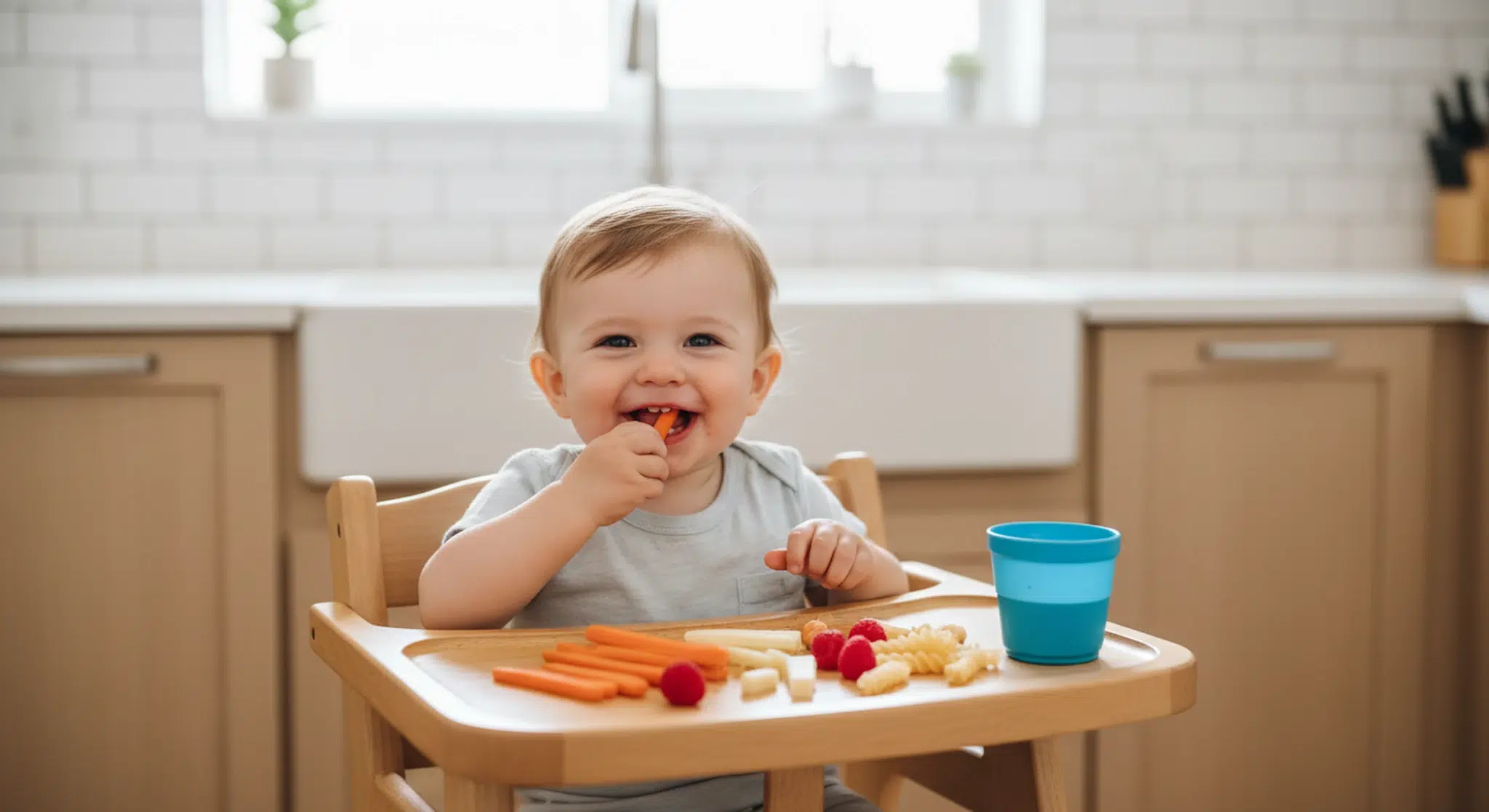
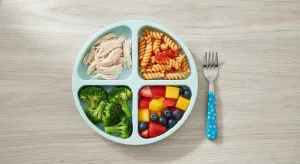
At twelve months the shape of the day changes: three meals, two snacks, and milk as a drink alongside food rather than the main source of calories.
It is one of the bigger shifts of the first two years, and it usually arrives at the same moment as dropping to one nap, giving up bottles, and a sudden and alarming drop in appetite. All of those are normal, and all of them happening at once is why twelve months feels harder than it looks on paper.
This guide covers a sample 1 year old feeding schedule, how much whole milk a day and why there is a ceiling, portion sizes that make sense for a stomach the size of a fist, what to serve, the choking hazards that matter at this age, and what to do when a toddler who ate everything last month suddenly eats nothing.
Key Takeaways
Three meals and two snacks, spaced two to three hours apart, with only water in between. Grazing is the main cause of meal refusal.
16 to 24 oz of whole milk a day, in a cup, with or after meals. More than that risks iron deficiency because milk both displaces and blocks iron.
Switch to whole cow’s milk at twelve months and retire bottles. Never send milk to bed, which drives early tooth decay.
Start with about one tablespoon of each food per year of age. A toddler’s stomach is roughly the size of their fist.
Appetite normally drops sharply after the first birthday because growth slows. Judge intake over a week, not a meal.
Quarter grapes and cherry tomatoes lengthwise, cut hot dogs lengthwise not into coins, and skip popcorn, whole nuts, and raw hard vegetables.
Table of Contents
A Sample 1 Year Old Feeding Schedule
At twelve months, the structure of the day changes more than the food does. Milk stops being the main event and becomes a drink alongside meals, and your child moves onto three meals and two snacks, eaten at roughly the same times each day.
Time
What
Rough amounts
7:00 am
Wake and breakfast
Whole milk in a cup, plus a carbohydrate, a protein, and a fruit
9:30 am
Morning snack
A small snack and water
12:00 pm
Lunch
A protein, a vegetable, a grain, plus milk or water
12:45 pm
Nap
One nap, roughly 1.5 to 3 hours
3:30 pm
Afternoon snack
A small snack and water
5:30 pm
Dinner
A protein, two vegetables or a vegetable and a fruit, a grain, plus milk or water
6:45 pm
Bedtime milk, then teeth
Offered in a cup, at the start of the routine, not in bed
7:15 pm
Bed
A sample feeding schedule for a 1 year old. Shift the whole thing earlier or later to fit your household.
The exact clock times matter far less than the spacing. Meals and snacks roughly every two to three hours, with nothing but water in between, is what produces a toddler who arrives at the table hungry. Constant grazing is the most common reason a one year old refuses meals, and it is entirely fixable.
How Much Milk, and What Kind
At twelve months, most children switch from formula or breast milk to whole cow’s milk, though continuing to breastfeed alongside solid food is perfectly appropriate for as long as you both want to.
Amount: about 16 to 24 ounces of whole milk a day, which is two to three cups. This is a ceiling as much as a target.
Type: whole milk, not reduced-fat, until age two. Toddlers need the fat for brain development. Your pediatrician may advise otherwise if there is a family history of obesity or high cholesterol.
Vessel: an open cup or a straw cup. Twelve months is the point pediatric dentists recommend retiring bottles entirely.
Timing: with or after meals rather than before them. Milk before a meal fills a small stomach and kills the appetite for everything else.
Never in bed. Milk pooling around teeth overnight is the main driver of early childhood tooth decay.
The reason for the 24 ounce ceiling is iron. Cow’s milk is low in iron, it interferes with iron absorption, and in large volumes it displaces iron-rich food. A toddler drinking 40 ounces of milk a day is at real risk of iron deficiency anemia, which is one of the most common nutritional problems in this age group and often presents simply as a pale, tired, fussy child. If your child is drinking far more than three cups, that is worth raising with your pediatrician. Our guide to transitioning from formula to milk covers how to make the switch without a battle.
Juice deserves a mention because it is so common. The AAP recommends no more than four ounces a day of 100 percent juice for one to three year olds, and none at all is better. Water and milk are the drinks. Everything else is optional.
Portion Sizes That Actually Make Sense
Toddler portions look absurdly small to an adult eye, and serving adult-sized plates to a one year old is a reliable way to generate anxiety about how little they ate.
The tablespoon rule. A rough starting portion is one tablespoon of each food per year of age. For a one year old, that is one tablespoon of chicken, one of rice, one of broccoli. Offer more if they ask.
A toddler’s stomach is about the size of their fist. Compare that to what you were about to put on the plate.
Daily calories run around 1,000 for most one year olds, spread across five eating occasions. That averages to roughly 200 calories each.
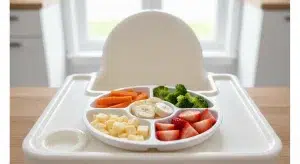
Offer three components per meal, always including at least one thing you know they will eat. This is the quietest, most effective anti-battle strategy there is.
Expect appetite to drop noticeably around the first birthday. It is not a phase to fix. A baby triples their birth weight in the first year and then growth slows sharply, so the same child genuinely needs proportionally less food at fourteen months than at ten months. Appetite also swings wildly day to day. Look at the week, not the meal.
Big transitions go better on a full night of sleep.
If bedtime or naps are a struggle, our free two-minute quiz builds a gentle, personalized plan.
By twelve months your child can eat nearly everything the rest of the family eats, prepared safely. The practical approach is to cook one meal and adapt it, rather than running a separate toddler kitchen.
Protein: shredded chicken, flaked fish with bones removed, well-cooked beans and lentils, scrambled or hard-boiled egg, tofu, finely chopped meat, smooth nut butter spread thinly.
Grains: pasta, rice, oats, soft bread, couscous, tortilla strips. Whole grains where they will take them.
Fruit and vegetables: soft-cooked or ripe and cut small. Steamed carrot sticks, roasted sweet potato, banana, berries quartered, soft pear.
Dairy: full-fat plain yogurt, cheese cut into strips, cottage cheese.
Fats: avocado, olive oil on vegetables, full-fat dairy. Toddlers need a higher proportion of fat than adults do.
Iron-rich foods daily: red meat, beans, lentils, fortified cereal, and pair them with a vitamin C food to help absorption.
Salt is the main thing to keep low, since a toddler’s kidneys handle it poorly. Season your own portion at the table rather than the pot. Added sugar is best kept minimal, and honey is now safe after twelve months, though it remains a sugar. For meal inspiration, our toddler meal ideas and toddler dinner ideas lists are built around exactly this age.
Choking Hazards to Keep Off the Plate
Choking is the one genuine safety issue at this age, and the list of high-risk foods is short and specific. A one year old has few or no molars and cannot grind.
Whole grapes, cherry tomatoes, and berries unless quartered lengthwise.
Whole nuts and chunks of nut butter. Spread thinly instead.
Popcorn, hard candy, marshmallows, and chewing gum.
Hot dogs and sausages cut into coins. Quarter them lengthwise instead.
Raw hard vegetables, including raw carrot and celery sticks.
Large chunks of meat or cheese.
Whole apple pieces with skin. Grate or cook them.
Alongside the food list, the habits matter as much: always seated, never in a moving car or stroller, never running or lying down, and always supervised. Most choking incidents in toddlers involve movement rather than the food alone.
When Feeding Goes Sideways
Almost every one year old goes through a stretch of throwing food, refusing a vegetable they ate happily last week, or eating only beige things for four days. Nearly all of it is developmental rather than a problem with your cooking.
Keep your job and their job separate. You decide what is offered, when, and where. They decide whether to eat and how much. This division, sometimes called the division of responsibility, prevents most mealtime power struggles.
Do not become a short-order cook. Offering an alternative when the meal is rejected teaches that rejection produces a better option.
Keep offering rejected foods without pressure. It routinely takes ten to fifteen neutral exposures before a toddler accepts a new food, and pressure makes acceptance less likely, not more.
Stop the grazing. Water only between meals and snacks. This is the highest-impact single change for a child who will not eat at mealtimes.
Eat with them where you can. Modelling does more than encouragement.
Keep it short. Twenty minutes is plenty. Ending the meal calmly when they lose interest is better than a drawn-out negotiation.
Talk to your pediatrician if your child is losing weight or has fallen off their growth curve, gags or chokes frequently, eats fewer than about ten foods in total, refuses whole food groups for weeks, or if mealtimes have become genuinely distressing. Those can point to a feeding difficulty or a sensory issue that responds well to early help.
Twelve months is also when most children consolidate to a single nap, and the two changes interact. A toddler who drops to one nap too abruptly gets overtired by late afternoon, and an overtired toddler eats badly at dinner, which then affects the night. Feeding problems at one year are surprisingly often sleep problems wearing a disguise.
A few things reliably help. Keep dinner early enough that it is not competing with tiredness, usually about ninety minutes before bed. Offer the bedtime milk at the start of the routine rather than the end, so teeth get brushed afterwards and milk is not the thing that puts them to sleep. And keep the nap consistent even on days it looks unnecessary, because the 2 to 1 nap transition takes several weeks to settle.
If bedtime or night waking has become the hard part of your day, our free two-minute quiz builds a gentle plan around your child’s age and temperament.
Frequently Asked Questions
What does a 1 year old feeding schedule look like?
Three meals and two snacks, spaced roughly two to three hours apart, with water in between. A typical day is breakfast around 7am, a snack at 9:30, lunch at noon, a nap, a snack at 3:30, dinner at 5:30, and bedtime milk at the start of the bedtime routine. The spacing matters far more than the exact clock times.
How much milk should a 1 year old drink a day?
About 16 to 24 ounces of whole milk a day, which is two to three cups, offered in an open or straw cup with or after meals. Treat that as a ceiling rather than a target. Cow’s milk is low in iron and interferes with iron absorption, so toddlers drinking much more than three cups a day are at real risk of iron deficiency anemia.
How much should a 1 year old eat at each meal?
A useful starting portion is one tablespoon of each food per year of age, so about one tablespoon each of a protein, a grain, and a vegetable for a one year old, with more offered if they want it. Most one year olds need around 1,000 calories a day spread across three meals and two snacks, which is roughly 200 calories per eating occasion.
Why has my 1 year old stopped eating?
Appetite almost always drops around the first birthday, because growth slows sharply after a year in which your child tripled their birth weight. The same child genuinely needs proportionally less food at fourteen months than at ten. Constant grazing and drinking too much milk are the other two common causes, and both are fixable by tightening the meal and snack schedule.
Can a 1 year old still have formula or breast milk?
Yes. There is no requirement to stop breastfeeding at twelve months, and continuing alongside solid food is well supported for as long as you both want to. Formula is usually swapped for whole cow’s milk at twelve months, but your pediatrician may advise staying on formula longer if there are growth concerns or a cow’s milk protein allergy.
Calmer bedtimes, better nights.
Betteroo builds a personalized sleep plan for your child. Take the free two-minute quiz to get started tonight.
Related reading: Meals only make sense inside the shape of the whole day, and if you are also sorting out naps and wake windows at twelve months, this walkthrough of a full twelve month old daily schedule.