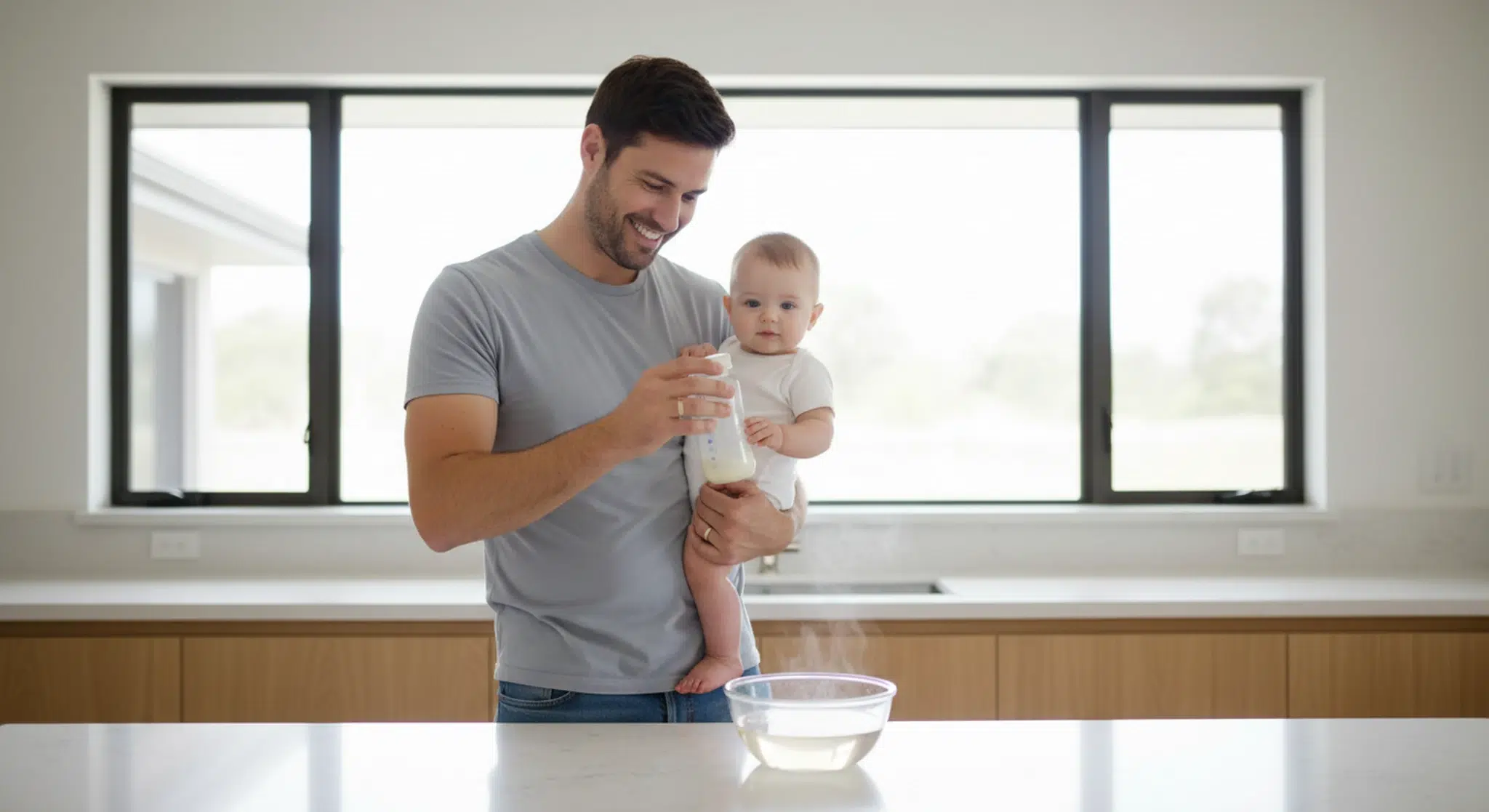


Can you reheat formula? Not once your baby has drunk from the bottle: throw leftovers away within 1 hour, and only warm a fresh or refrigerated bottle once, in warm water or a bottle warmer, never in the microwave.
Can you reheat formula? It is one of the most common bottle questions, usually asked at 3 a.m. with a half-finished bottle in hand. The short version: warming a fresh or refrigerated bottle once is fine, but reheating leftovers is not.
This guide explains why, lists the time limits that apply to warmed bottles, shows the safe ways to warm formula and why the microwave is off limits, and covers extra steps for newborns and preemies. Every rule comes from the CDC, the American Academy of Pediatrics, Mayo Clinic or the NHS.
Key Takeaways
- Do not reheat or save formula your baby has drunk from. Throw it out.
- The CDC says to use prepared formula within 1 hour from the start of a feed and within 2 hours of preparing it.
- Untouched prepared formula can go in the fridge right away and be used within 24 hours.
- Warm bottles in warm water or a bottle warmer, never in a microwave, and test on your wrist.
- Formula does not have to be warmed. Room temperature is fine if your baby takes it.
Table of Contents
Can You Reheat Formula? The Short Answer
Quick Answer
The word “reheat” covers a few different situations, and the answer depends on which one you mean. Warming a bottle you prepared and refrigerated earlier is normal and safe. Rewarming a half-finished bottle so your baby can have the rest later is not. The table below sorts out the common cases.
| Situation | Can you warm or reheat it? | Why |
|---|---|---|
| Leftover formula after a feed | No. Throw it out | CDC: formula plus saliva can grow bacteria; use within 1 hour from the start of the feed |
| Freshly mixed bottle | Warming is optional | CDC: use within 2 hours of preparing |
| Prepared bottle from the fridge, untouched | Yes, warm once and feed | CDC: refrigerated formula is good for 24 hours |
| Bottle warmed, then not used | Do not save it for later | Treat it as prepared formula on the clock; use within the CDC’s limits or discard |
| Formula left in the fridge, unsure for how long | No | CDC: throw it out if you cannot remember how long it was refrigerated |
Why You Cannot Reheat Leftover Formula
Once your baby starts drinking from a bottle, saliva mixes with the formula. The CDC explains that “the combination of infant formula and your baby’s saliva can cause bacteria to grow,” and it tells parents to throw out any infant formula left in the bottle after feeding. Mayo Clinic adds that bacteria from your baby’s saliva can grow even if you put the bottle in the refrigerator.
Heating the bottle again does not undo that. Warmth actually works against you: the UK’s National Health Service (NHS) notes that bacteria multiply very fast at room temperature. A warm, partly finished bottle sitting on the counter is exactly the setting you want to avoid.
That is why the CDC says “don’t refrigerate leftover formula to save it for later.” The leftovers rule is the same whether the formula was powdered, liquid concentrate or ready-to-feed.
If your baby regularly leaves a lot in the bottle, it is a sign to make smaller bottles, not to save the extra. Our formula feeding chart gives typical amounts by age, and paced bottle feeding can help your baby take feeds at a comfortable rhythm.
Formula Time Limits That Apply to Warmed Bottles
This page focuses on warming and reheating. For the full storage timeline, see our guides on how long formula can sit out and how long formula lasts. Here are the limits that matter when a warm bottle is involved, as the CDC and the AAP state them:
| Formula | Time limit | Source |
|---|---|---|
| Prepared formula, feeding has started | Use within 1 hour from the start of the feed, then discard | CDC |
| Prepared formula, not yet used | Use within 2 hours of preparing, or refrigerate right away | CDC |
| Prepared formula in the refrigerator | Use within 24 hours | CDC, AAP |
| Prepared formula in the freezer | Do not freeze | AAP |
| Opened liquid concentrate | Refrigerate and use within 48 hours of opening | AAP |
| Opened ready-to-feed container | Cover and refrigerate; discard after 24 hours in the fridge, or sooner if the label says so | Mayo Clinic |
| Opened can of powder | Store in a cool, dry place with the lid closed, not in the fridge; most need to be used within 1 month of opening | CDC |
A warm bottle does not get extra time. Warming starts no new clock: the 2-hour limit from preparation and the 1-hour limit from the first sip still apply. If you are unsure how long a bottle has been out, the safest choice is to pour it out.
Feeding and sleep go hand in hand.
Our free two-minute quiz builds a gentle, personalized sleep plan around your baby’s feeds.
Do You Need to Warm Formula at All?
Not for safety. The CDC says infant formula does not need to be warmed before feeding, and Mayo Clinic notes that room temperature or even cold formula is fine if your baby will take it.
The AAP adds some nuance. Its pediatricians say it is best to warm formula for infants under 6 months, because they are not yet able to regulate their body temperature well, while older babies may have no preference and take room temperature formula just fine.
If your baby happily drinks room temperature or cold formula, there is a practical upside: no warming step at 3 a.m., and no hot bottle to test. If you are getting ready for daycare or a babysitter, it can help to practice with the temperature your caregiver will use. See how to bottle feed a newborn for more on bottle basics.
How to Warm Formula Safely
Warming a bottle once, right before a feed, is fine. These are the methods the CDC and the AAP describe:
- Warm running water: the CDC says to hold the bottle under running warm water, and to keep water from getting into the bottle or on the nipple.
- A bowl of warm water: the AAP says you can place the bottle in a container of warm water for 5 to 10 minutes.
- A bottle warmer: the AAP lists a bottle warmer as an option. Follow the warmer’s instructions and still test the temperature.
Then do two things every time:
- Swirl or shake: mix the formula so the temperature is even before you test it.
- Test on your wrist: the CDC says to put a couple of drops on your wrist; the formula should feel warm, not hot. The NHS describes the goal as body temperature: it should feel warm or cool, but not hot.
Warm only the amount your baby is likely to drink. If you are preparing bottles ahead for the night, refrigerate them right after mixing, label them, and warm one at a time when your baby wakes. A dream feed goes more smoothly when the bottle is ready in the fridge.
Why You Should Never Microwave Formula
Every source we checked says the same thing: no microwave.
- CDC: microwaves heat milk and food unevenly, resulting in hot spots that can burn your baby’s mouth and throat.
- AAP: never microwave formula; microwaving can affect ingredients in formula and cause hot spots that can burn your baby’s mouth.
- NHS: never warm up formula in a microwave, as it may heat the feed unevenly and burn your baby’s mouth.
The danger is that the outside of the bottle can feel fine while a pocket of liquid inside is much hotter. The AAP also warns against using a stovetop to warm breast milk, for the same reason: it is hard to control. Warm water or a bottle warmer is slower but much safer.
Powdered, Concentrate or Ready-to-Feed: Does It Change the Rules?
The warming and leftover rules are the same for every type of formula: warm gently, test, feed within the time limit and discard leftovers. What changes is how the formula starts out.
- Ready-to-feed and liquid concentrate: the CDC says liquid infant formula is made to be sterile (without germs). Once opened, it still needs refrigeration and has a time limit, as shown in the table above.
- Powdered formula: the CDC says powdered infant formula is not sterile and might have germs in it. That is one reason the CDC suggests considering liquid, ready-to-feed formula when possible for higher-risk babies.
Mix powdered formula exactly as the label says. Our newborn feeding schedule can help you plan how many bottles to prepare in a day.
Cronobacter and Higher-Risk Babies
Cronobacter is a germ that can be found in powdered formula. The CDC says Cronobacter infections are rare but serious in infants, and it recommends extra preparation steps for babies younger than 2 months, babies born before 37 weeks, and babies with a weakened immune system.
For these babies, the CDC says very hot water, around 158°F (70°C), is needed to kill germs in powdered formula. It advises boiling the water, waiting about 5 minutes (and no longer), then mixing in the formula. The bottle will be too hot to feed at that point, so cool it to body temperature under cool running water or in an ice bath, keeping the cooling water out of the bottle and off the nipple, then test it on your wrist.
Notice that this step is about cooling a hot bottle, not reheating a cold one. If your baby was born early or has a medical condition, ask your pediatrician which formula type and preparation method they recommend.
Night Feeds, Bottles in Bed and Other Practical Tips
- Do not let your baby fall asleep with a bottle: the AAP says putting your child to sleep with a bottle allows the sugars in formula to linger on the teeth, setting the stage for tooth decay. Feed, then put your baby down on their back in a bare crib or bassinet.
- Make smaller bottles: if your baby often leaves formula behind, prepare less and offer more if your baby is still hungry.
- Label prepared bottles: Mayo Clinic suggests labeling pre-made bottles with the date and time and throwing out any that have been refrigerated for more than 24 hours.
- Clean, do not top up: the CDC says germs can grow quickly if you add formula to a partially used bottle or only rinse a used bottle rather than clean it.
- Store powder properly: the CDC says not to store unopened containers in vehicles, garages or outdoors, and never to use formula after the use-by date.
As your baby gets older and holds the bottle on their own, the same rules apply. Our guide to when babies hold their own bottle covers that stage.
Related Betteroo Guides
- How Long Can Formula Sit Out
- How Long Does Formula Last
- How to Bottle Feed a Newborn
- Paced Bottle Feeding
- Formula-Fed Baby Poop
- Newborn Feeding Schedule
When to Talk to Your Pediatrician
Call 911 or go to the emergency room if your baby has trouble breathing or swallowing after a feed, or is limp or hard to wake.
Call your pediatrician’s office if your baby has vomiting or diarrhea after a bottle you are not sure about, refuses feeds, seems to have mouth blisters or redness after a too-hot bottle, or if your baby was born early or has a weakened immune system and you have questions about safe formula preparation. Your pediatrician can also help if your baby often leaves bottles unfinished or seems uncomfortable during feeds.
If you are ever unsure whether a bottle is still safe, pour it out and make a fresh one. Mayo Clinic gives the same advice: if you are unsure whether formula is safe, throw it out.
Frequently Asked Questions
Can you reheat formula after baby drinks from it?
No. The CDC says to throw out any formula left in the bottle after a feed, because formula mixed with your baby’s saliva can grow bacteria. Use the bottle within 1 hour from when the feed started, then discard what is left. Refrigerating or reheating the leftovers does not make them safe to use again later.
Can you warm up formula that was in the fridge?
Yes. Prepared formula that your baby has not touched can be refrigerated right after mixing and used within 24 hours, according to the CDC. Warm it once right before the feed in warm running water, a bowl of warm water or a bottle warmer, test a few drops on your wrist, and throw out anything left after the feed.
How long is formula good for after warming?
Warming does not add time. The CDC says to use prepared formula within 2 hours of preparing it and within 1 hour from when your baby starts feeding. If a warmed bottle sits unused, it is still on that clock. Do not put a warmed, partly used bottle back in the fridge for later.
Can I heat formula in the microwave?
No. The CDC, the American Academy of Pediatrics and the NHS all say never to microwave formula. Microwaves heat unevenly and create hot spots that can burn your baby’s mouth and throat, even when the outside of the bottle feels fine. Use warm water or a bottle warmer instead.
Do babies need warm formula?
Not for safety. The CDC says formula does not need to be warmed, and Mayo Clinic says room temperature or cold formula is fine. The AAP says it is best to warm formula for babies under 6 months because they cannot regulate body temperature well, while older babies often take room temperature formula.
Can you leave warmed formula out and use it later?
Only within the CDC limits. Prepared formula should be used within 2 hours of preparing it, and once your baby starts drinking, within 1 hour. After that, throw it out. If you will not use a freshly made bottle soon, put it in the refrigerator right away instead of leaving it out.
Calmer days, better nights.
Betteroo builds a personalized sleep plan for your baby. Take the free two-minute quiz and have it ready before the newborn weeks.
7 Sources
- Centers for Disease Control and Prevention. Infant Formula Preparation and Storage.
https://cdc.gov/infant-toddler-nutrition/formula-feeding/preparation-and-storage.html - Centers for Disease Control and Prevention. Preventing Cronobacter Infection.
https://www.cdc.gov/cronobacter/prevention/index.html - American Academy of Pediatrics (HealthyChildren.org). How do I mix and serve infant formula for my baby?
https://www.healthychildren.org/English/tips-tools/ask-the-pediatrician/Pages/How-do-I-mix-and-serve-infant-formula-for-my-baby.aspx - American Academy of Pediatrics (HealthyChildren.org). How long can baby bottles sit at room temperature?
https://www.healthychildren.org/English/tips-tools/ask-the-pediatrician/Pages/how-long-can-baby-bottles-sit-at-room-temperature.aspx - American Academy of Pediatrics (HealthyChildren.org). How to Prevent Tooth Decay in Your Baby.
https://www.healthychildren.org/English/ages-stages/baby/teething-tooth-care/Pages/How-to-Prevent-Tooth-Decay-in-Your-Baby.aspx - Mayo Clinic. Infant formula: 7 steps to prepare it safely.
https://www.mayoclinic.org/healthy-lifestyle/infant-and-toddler-health/in-depth/art-20045791?pg=2 - National Health Service (NHS). How to make up baby formula.
https://www.nhs.uk/conditions/baby/breastfeeding-and-bottle-feeding/bottle-feeding/making-up-baby-formula/