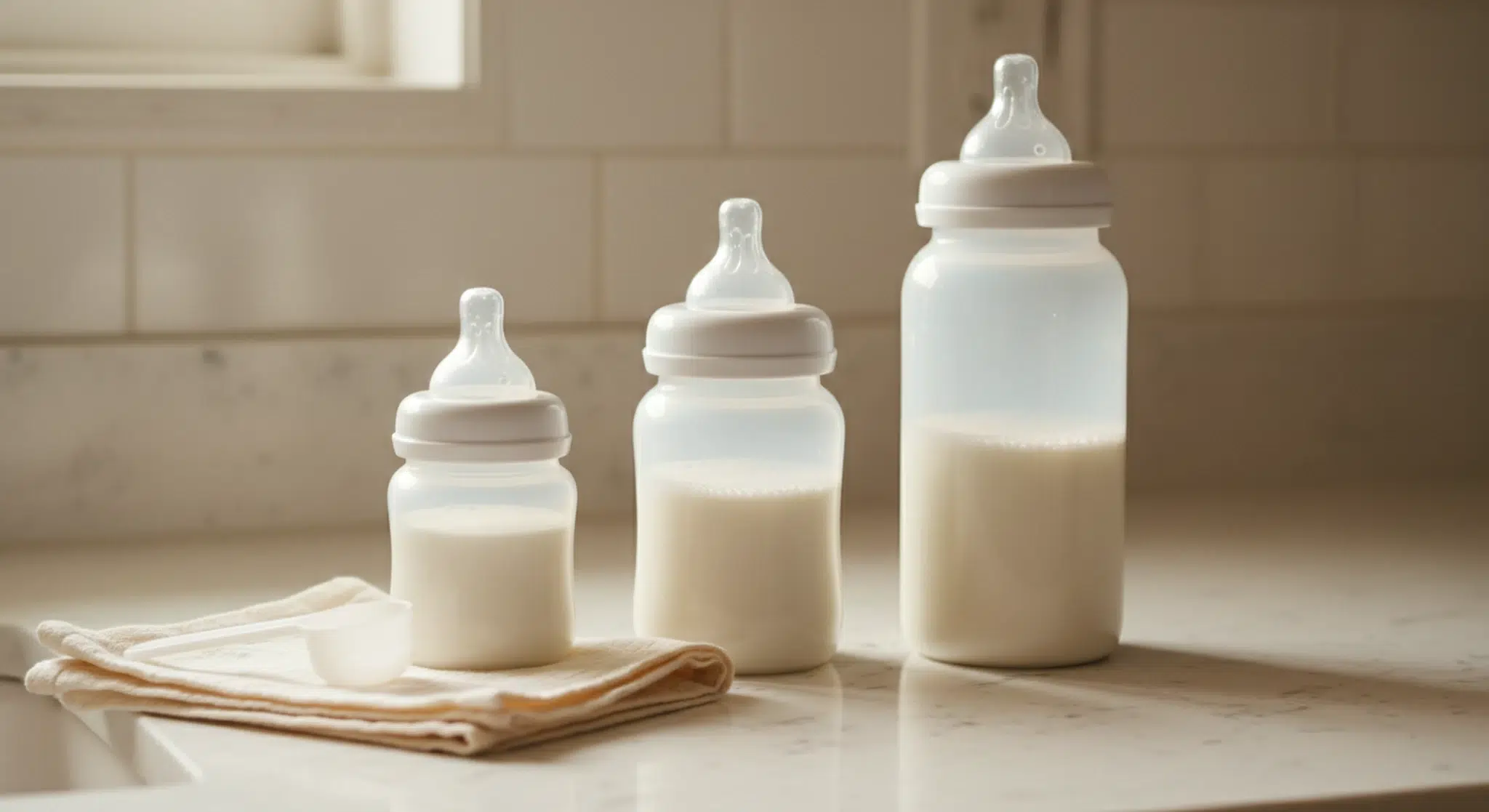


Formula-fed babies typically take 2 to 3 ounces per feed in the first weeks, 4 to 6 ounces by 2 to 4 months, and 6 to 8 ounces by 6 months, roughly every 3 to 4 hours. Total daily intake usually peaks around 24 to 32 ounces before solids start trimming it back.
Formula feeding comes with a gift and a curse: you can see exactly how much your baby ate. The gift is reassurance. The curse is that every unfinished half ounce becomes a data point to worry over, and every finished bottle raises the question of whether it should have been bigger.
This chart-first guide covers how much formula babies need at every age from birth to 12 months, how often to feed, how to tell hunger from habit, the signs of overfeeding, and how solids change the math in the second half of the year.
Key Takeaways
- A rough rule for the early months: about 2.5 ounces of formula per pound of body weight per day, capped near 32 ounces.
- Newborns start with 1 to 2 ounces per feed, reaching 3 to 4 ounces by one month.
- From 6 months, expect 6 to 8 ounce bottles, 4 to 5 times a day, decreasing as solids ramp up.
- Daily totals above about 32 ounces are a flag to check in with your pediatrician.
- Feed to your baby’s cues, not to the bottle: pausing, paced feeding, and stopping at fullness prevent overfeeding.
- Never dilute formula or stretch it with extra water, and follow mixing instructions exactly.
Table of Contents
Formula Feeding Chart by Age
Here is the whole first year at a glance. Amounts are typical ranges, not targets: a healthy baby may sit at the bottom of every range or the top, and individual feeds vary day to day.
| Age | Per feed | Feeds per day | Typical daily total |
|---|---|---|---|
| 0–2 weeks | 1–2 oz | 8–12 | 16–22 oz |
| 2–4 weeks | 2–3 oz | 8–10 | 18–24 oz |
| 1–2 months | 3–4 oz | 7–8 | 22–28 oz |
| 2–4 months | 4–6 oz | 6–7 | 24–32 oz |
| 4–6 months | 5–7 oz | 5–6 | 24–32 oz |
| 6–9 months | 6–8 oz | 4–5 | 24–30 oz (solids started) |
| 9–12 months | 6–8 oz | 3–4 | 16–24 oz |
Quick Answer
Formula digests more slowly than breast milk, so formula-fed babies typically go 3 to 4 hours between feeds where a breastfed newborn goes 2 to 3. The feeds-per-day column shrinks across the year while the per-feed column grows: fewer, bigger meals is the whole developmental arc of the first year.
The Newborn Weeks: Small Stomach, Small Bottles
A day-old baby’s stomach holds surprisingly little, which is why the first days run on 1 to 2 ounce feeds. Offering a newborn a 4 ounce bottle mostly produces spit-up and a false alarm about appetite. Increase the bottle size when your baby consistently drains bottles and still shows hunger cues afterward, in half ounce steps.
In the first two weeks, wake a baby who sleeps more than about 4 hours to feed, until they are back above birth weight and your pediatrician clears longer stretches. After that, sleep becomes the one thing you never interrupt for the schedule’s sake.
Worried you might be feeding too much or too little? The output test settles most cases: from about day 5, at least 6 wet diapers a day, regular stools, and steady weight gain mean intake is right, whatever the bottle count says. Our guide to how much a newborn should eat goes deeper on the early weeks.
Hunger, Fullness, and Paced Bottle Feeding
Bottles make overfeeding structurally easy: milk flows whether or not the baby is actively hungry, and an emptying bottle invites topping off. The counterweight is feeding to cues and pacing the feed.
- Hunger cues: rooting, hands to mouth, lip smacking, restlessness. Crying is the last cue, not the first.
- Fullness cues: slowing down, releasing the nipple, turning the head, splayed relaxed fingers, dozing off satisfied.
- Paced feeding: hold baby semi-upright, keep the bottle closer to horizontal, let the nipple fill partway, and take short breaks every ounce or so. The feed should take 15 to 20 minutes, not 5.
- Respect the leftover. A baby who leaves an ounce is done. Finishing the bottle is a parental habit, not a nutritional need.
Paced feeding matters most for younger babies and for babies who switch between breast and bottle. Full technique in our paced bottle feeding guide, and if your baby routinely spits up large amounts after big feeds, see can you overfeed a newborn.
Bottles by day, battles by night?
Feeding and sleep run on the same rhythm. Betteroo builds your baby’s full day plan in about two minutes.
How Solids Change the Formula Math
From about 6 months, solids enter and formula begins a slow handoff. The totals drop gently at first, then faster: a baby drinking 28 to 32 ounces at 5 months may be at 24 to 30 ounces at 7 months, and 16 to 24 ounces by 11 months as three solid meals take over.
Keep formula as the primary drink all the way to 12 months. Cow’s milk as a main drink starts at one year, not before, though small amounts in cooking are fine from 6 months. Juice is unnecessary in the first year, and water stays modest: a few ounces a day with meals from 6 months, mainly for cup practice.
If bottles are crowding out meals in the second half of the year (a common pattern: a 32 ounce habit plus three meals is a lot of stomach), trim the mid-day bottles first and keep the morning and bedtime feeds, which tend to matter most to babies. At 12 months, the switch to whole milk in a cup usually goes smoother than parents expect; the steps are in our formula to milk guide.
Mixing, Storage, and Safety Rules
The chart only works if the formula in the bottle is mixed and stored right. The rules are few but firm.
- Mix exactly to instructions. Never dilute formula with extra water to stretch it; diluted formula can cause dangerous sodium imbalance and poor growth. Never concentrate it either.
- Use safe water per your pediatrician’s advice, and for babies under 2 to 3 months or premature babies, ask about using boiled-then-cooled water with powdered formula.
- Prepared formula keeps 24 hours in the fridge. At room temperature, use within 2 hours of preparation, or within 1 hour once the feed has started.
- Discard what is left in the bottle after a feed. Backwash bacteria multiply; saving a half-finished bottle for later is not worth the risk.
- Warm gently if desired: warm water bath, never the microwave, which heats unevenly.
Full storage timings, including opened cans and ready-to-feed cartons, are in our guide to how long formula can sit out.
When to Talk to Your Pediatrician
The chart covers typical babies; your pediatrician covers yours. Check in if any of these show up.
- Your baby consistently takes more than about 32 ounces a day, or seems frantically hungry despite full feeds.
- Consistently poor intake: bottles regularly unfinished by wide margins, feeds refused, or fewer than 6 wet diapers a day.
- Weight gain that stalls or drops across percentile lines, or very rapid gain your pediatrician has flagged.
- Frequent forceful vomiting, blood in stool, persistent rash or wheeze that could suggest cow’s milk protein allergy.
- You are considering switching formula types. Most fussiness is not the formula, and serial switching muddies the picture.
- Any question about specialty formulas, thickened feeds, or reflux management. These are prescription-level decisions.
Bring two or three days of feeding notes. Totals across days are far more informative than the worst single bottle.
Frequently Asked Questions
How much formula should my baby eat per day?
A common early rule is about 2.5 ounces per pound of body weight per 24 hours, so an 8 pound baby needs roughly 20 ounces and a 12 pound baby roughly 30. Daily intake typically peaks around 24 to 32 ounces between 2 and 6 months, then declines as solids take over. More than 32 ounces a day is worth a pediatrician check.
How many ounces of formula by age?
Typical per-feed amounts: 1 to 2 ounces in the first two weeks, 3 to 4 ounces by 1 month, 4 to 6 ounces from 2 to 4 months, 5 to 7 ounces at 4 to 6 months, and 6 to 8 ounces from 6 months on, with feeds spacing out from every 3 hours to 4 or 5 bottles a day.
How do I know if my baby is getting enough formula?
Watch output and growth: at least 6 wet diapers a day after the first week, regular stools, general contentment after feeds, and steady weight gain along their growth curve. Those signs together are more reliable than ounce counts, since healthy babies vary widely in intake.
Can you overfeed a formula-fed baby?
Yes, it is easier with bottles than at the breast because milk flows regardless of effort. Signs include frequent large spit-ups, discomfort after feeds, and very rapid weight gain. Paced bottle feeding, honoring fullness cues, and not pushing the last ounce prevent most of it. Occasional big feeds are normal.
When do babies stop drinking formula?
At 12 months, formula can be replaced with whole cow’s milk, about 16 to 24 ounces a day served in a cup with meals. There is no need for toddler formula for typically developing children. Make the switch gradually over a week or two if your baby resists the change in taste.
Get the whole day working together
Feeds, naps, and bedtime are one system. Betteroo turns your baby’s age and rhythm into a step-by-step plan in about two minutes.
Related Betteroo Guides
4 Sources
- American Academy of Pediatrics, HealthyChildren.org: Amount and Schedule of Formula Feedings
https://www.healthychildren.org/English/ages-stages/baby/formula-feeding/Pages/amount-and-schedule-of-formula-feedings.aspx - Centers for Disease Control and Prevention: Formula Feeding FAQs
https://www.cdc.gov/infant-toddler-nutrition/formula-feeding/index.html - Centers for Disease Control and Prevention: How Much and How Often to Feed Infant Formula
https://www.cdc.gov/infant-toddler-nutrition/formula-feeding/how-much-how-often.html - Nemours KidsHealth: Formula Feeding FAQs: How Much and How Often
https://kidshealth.org/en/parents/formulafeed-often.html