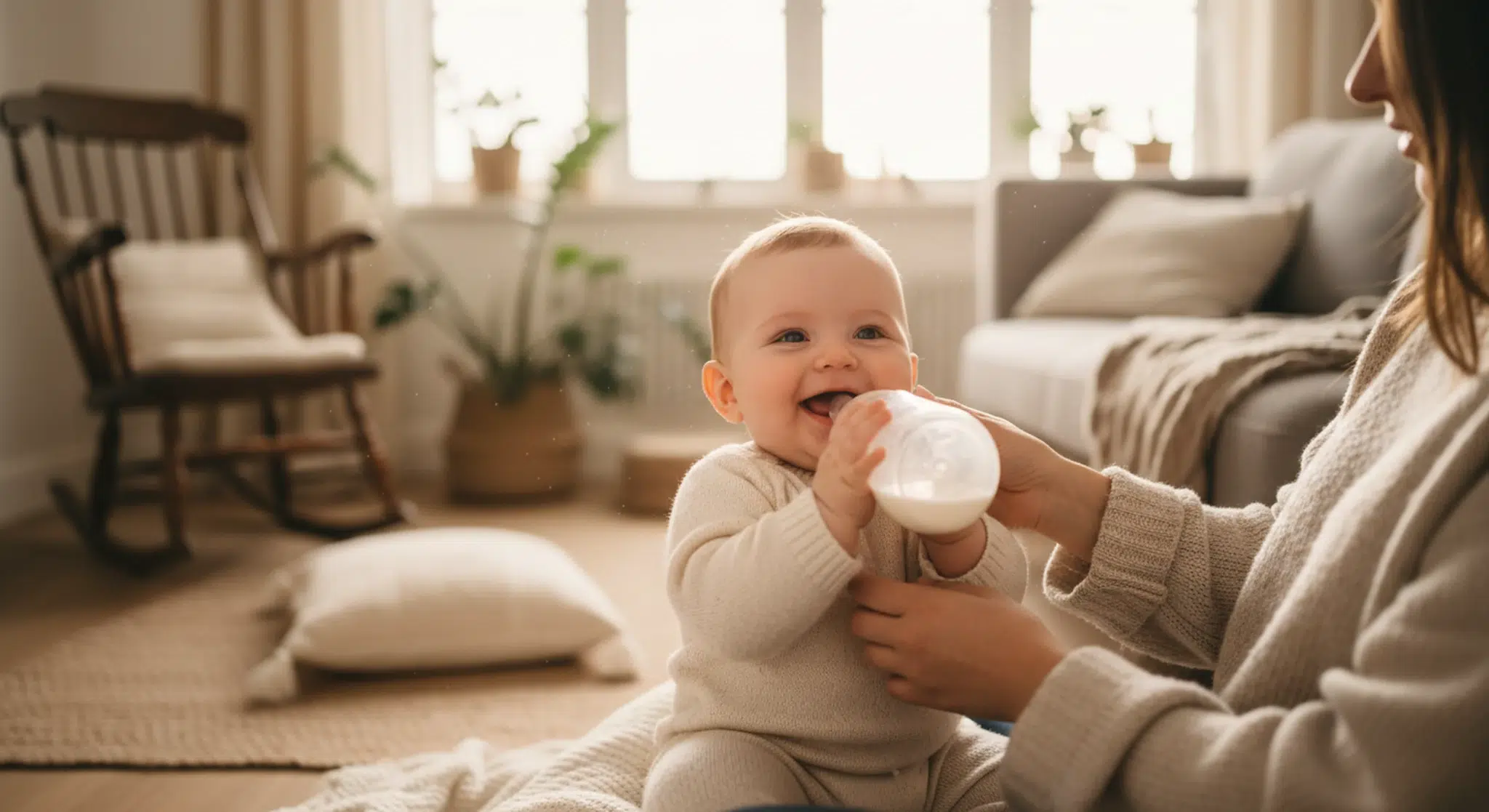
Most babies start holding their own bottle between 6 and 10 months of age, often with a wobbly two-handed grip around 8 to 9 months. This guide covers the milestones that lead up to it, how to safely encourage it, and the one safety rule every parent needs to know: never prop the bottle.
Watching your baby reach up and hold their own bottle for the first time is a proud little moment and a real sign of growing independence. Like all milestones, it arrives on a range rather than a fixed date, and it depends on several motor skills coming together at once.
Below we cover exactly when most babies hold their own bottle, the earlier milestones that build up to it, how to encourage the skill without pushing, the critical safety reason never to prop a bottle, and when to start thinking about weaning off the bottle entirely.
Key Takeaways
Most babies hold their own bottle between 6 and 10 months, often around 8 to 9 months.
The skill depends on hand strength, coordination, and sitting up, which develop gradually.
Never prop a bottle: it raises the risk of choking, ear infections, and tooth decay.
A baby holding their own bottle should still always be supervised and held upright.
Introduce a cup around 6 months and aim to be off the bottle by 12 to 18 months.
Table of Contents
When Do Babies Start Holding Their Own Bottle?
Most babies begin to hold their own bottle somewhere between 6 and 10 months of age, with many managing a wobbly two-handed grip around 8 to 9 months. Like every milestone, the range is wide. Some babies bat at and grasp the bottle as early as 6 months, while others are not steady until closer to their first birthday, and all of that is perfectly normal.
Holding a bottle is not a single skill but a small stack of them arriving together. Your baby needs enough hand and arm strength to lift the bottle, the coordination to bring it to their mouth and tip it at the right angle, and the trunk control to sit upright enough to drink safely. Those pieces develop gradually, which is why you will often see a baby hold the bottle for a few sips, lose the angle, and need your help again for weeks before they truly master it.
The Milestones That Lead Up to It
Bottle holding sits on top of earlier motor milestones, so watching those gives you a good sense of when it is coming. A baby who can bring their hands to the middle of their body, grab and hold a toy, and sit with support is building exactly the strength and coordination the bottle requires.
Around 3 to 4 months: brings hands together and to the mouth, bats at objects
Around 4 to 6 months: reaches for and grasps toys, brings them to the mouth
Around 6 months: begins to hold objects with both hands and sits with support
Around 6 to 9 months: transfers objects hand to hand and sits without support
Around 8 to 10 months: coordinates a two-handed grip well enough to hold a bottle
There is one safety rule that pediatricians, dentists, and speech experts all agree on, and it is worth stating plainly: never prop a bottle against a pillow, a blanket, or a seat and walk away, even once your baby can hold it themselves. A propped bottle is genuinely dangerous, and a baby holding their own bottle should still always be supervised.
Propping raises the risk of choking and gagging because milk keeps flowing whether or not the baby is ready to swallow. It is linked to a higher rate of ear infections, because lying flat while drinking lets fluid pool near the eustachian tubes. Over time it also contributes to tooth decay, since milk pooling against emerging teeth feeds cavity-causing bacteria. And it removes the close, face-to-face contact of feeding that supports bonding and lets you read your baby’s fullness cues. Let your baby hold the bottle, but stay right there, holding them or sitting with them, every time.
How to Encourage Your Baby to Hold the Bottle
You cannot rush the underlying strength and coordination, but you can give your baby plenty of low-pressure chances to practice. The goal is opportunity, never force.
Offer lightweight, easy-to-grip bottles, and start when the bottle is lighter near the end of a feed
Gently guide their hands onto the bottle during feeds so they feel the position
Give lots of supervised tummy time and floor play to build arm, hand, and core strength
Let them practice grasping and holding toys, teethers, and soft blocks between feeds
Hold your baby semi-upright rather than flat so drinking and holding are easier and safer
It can feel like a contradiction, but right around the time many babies master holding a bottle, experts start pointing toward the plan to give it up. The American Academy of Pediatrics recommends introducing an open or straw cup around 6 months and aiming to have children fully off the bottle between 12 and 18 months. The reason is the same tooth-and-ear logic as above: prolonged bottle use, especially carrying a bottle around or falling asleep with one, is linked to cavities and can affect how the mouth develops.
So the arc looks like this: encourage the holding skill for independence and motor development, keep every feed supervised and upright, introduce a cup around the half-year mark, and begin phasing the bottle out after the first birthday. Holding the bottle is a lovely sign of growing independence, and it is also a step on the path toward the cup, not a permanent arrangement.
When to Talk to Your Pediatrician
Because the range is so wide, there is rarely cause for worry if your baby is simply taking their time. That said, milestones are most useful as a set, so mention it to your doctor if by around 9 to 12 months your baby is not reaching for or grasping objects at all, cannot bring toys or hands to their mouth, or seems to have very floppy or very stiff muscle tone. Those broader motor concerns, not the bottle by itself, are what a pediatrician wants to know about.
The Development Behind the Milestone
Holding a bottle is a small but real marker of your baby’s growing fine motor control and body awareness. It draws on hand-eye coordination, bilateral coordination using both hands together, and the postural strength to sit upright, all of which also underpin skills like self-feeding with fingers and, later, using a spoon and cup. This is why pediatric and occupational therapists look at bottle and cup handling as part of a bigger feeding-and-motor picture rather than a box to tick on a certain date.
As with every stage in the first year, sleep quietly supports all of this. Babies do the work of consolidating new motor skills during rest, and a well-rested baby is more alert, more motivated to reach and practice, and easier to feed on a predictable rhythm. If feeds and naps feel chaotic, steadying the daily routine often helps both feeding and development settle into place.
Frequently Asked Questions
At what age do babies hold their own bottle?
Most babies begin to hold their own bottle between 6 and 10 months of age, with many managing a steady two-handed grip around 8 to 9 months. The range is wide and normal. Some babies grasp the bottle as early as 6 months, while others are not reliably steady until closer to 12 months, because the skill depends on hand strength, coordination, and sitting up all developing together.
Is it bad to let a baby hold their own bottle?
It is fine and good for development to let your baby hold their own bottle, as long as you stay right there and supervise every feed. What is not safe is propping the bottle and walking away, or letting a baby drink lying flat and unattended. Supervised bottle holding builds independence and motor skills; an unsupervised or propped bottle raises the risk of choking, ear infections, and tooth decay.
Why should you never prop a baby’s bottle?
Propping a bottle is dangerous because milk keeps flowing whether or not your baby is ready to swallow, which raises the choking risk. It is also linked to more ear infections, since lying flat while drinking lets fluid pool near the ear, and to tooth decay from milk pooling against the teeth. Propping also removes the close contact that helps you read your baby’s fullness cues. Always hold the bottle or hold your baby during feeds.
How can I help my baby hold their own bottle?
Give plenty of low-pressure practice. Offer a lightweight bottle, gently guide their hands onto it during feeds, and hold your baby semi-upright rather than flat. Between feeds, lots of supervised tummy time, floor play, and practice grasping toys build the arm, hand, and core strength the skill requires. Never force it; simply create opportunities and let the underlying strength and coordination catch up.
When should a baby stop using a bottle?
The American Academy of Pediatrics recommends introducing an open or straw cup around 6 months and having children fully off the bottle between 12 and 18 months. Prolonged bottle use, especially carrying a bottle or falling asleep with one, is linked to cavities and can affect mouth development. So encourage bottle holding for independence, but begin transitioning to a cup after the first birthday.
Better feeds, better nights.
Betteroo builds a personalized sleep plan for your baby. Take the free two-minute quiz to get started tonight.