Most babies start clapping around 9 months, waving between 9 and 12 months, and pointing by 12 to 14 months. These early gestures are not just adorable party tricks: they are some of the clearest signs that your baby’s social communication is developing right on track.
Clapping, waving, and pointing tend to arrive in a cluster in the second half of the first year, and they feel like a turning point for good reason. Before these gestures, your baby communicated mostly by crying, cooing, and reaching. With them, your baby starts to share attention, respond to you socially, and deliberately influence the people around them. That shift matters more developmentally than the gestures themselves.
This guide covers the typical age for each milestone, what usually comes first, how to gently encourage them, and the specific gesture delays that are worth mentioning to your pediatrician. The ages here are averages, so treat them as a general map rather than a deadline.
Key Takeaways
Clapping usually appears around 9 months, often first as bringing hands together, then real clapping by about 12 months.
Waving bye-bye typically emerges between 9 and 12 months, driven mostly by social motivation.
Pointing often starts around 9 to 12 months and becomes a clear index-finger point by 12 to 14 months.
These are social-communication gestures: they show your baby is sharing attention, not just moving their hands.
Every baby is different. A gap of a couple of months on either side of these averages is normal.
The AAP and CDC flag no gestures like waving by 12 months, and no pointing by 18 months, as reasons to check in with your pediatrician.
Table of Contents
When Do Babies Start Clapping?
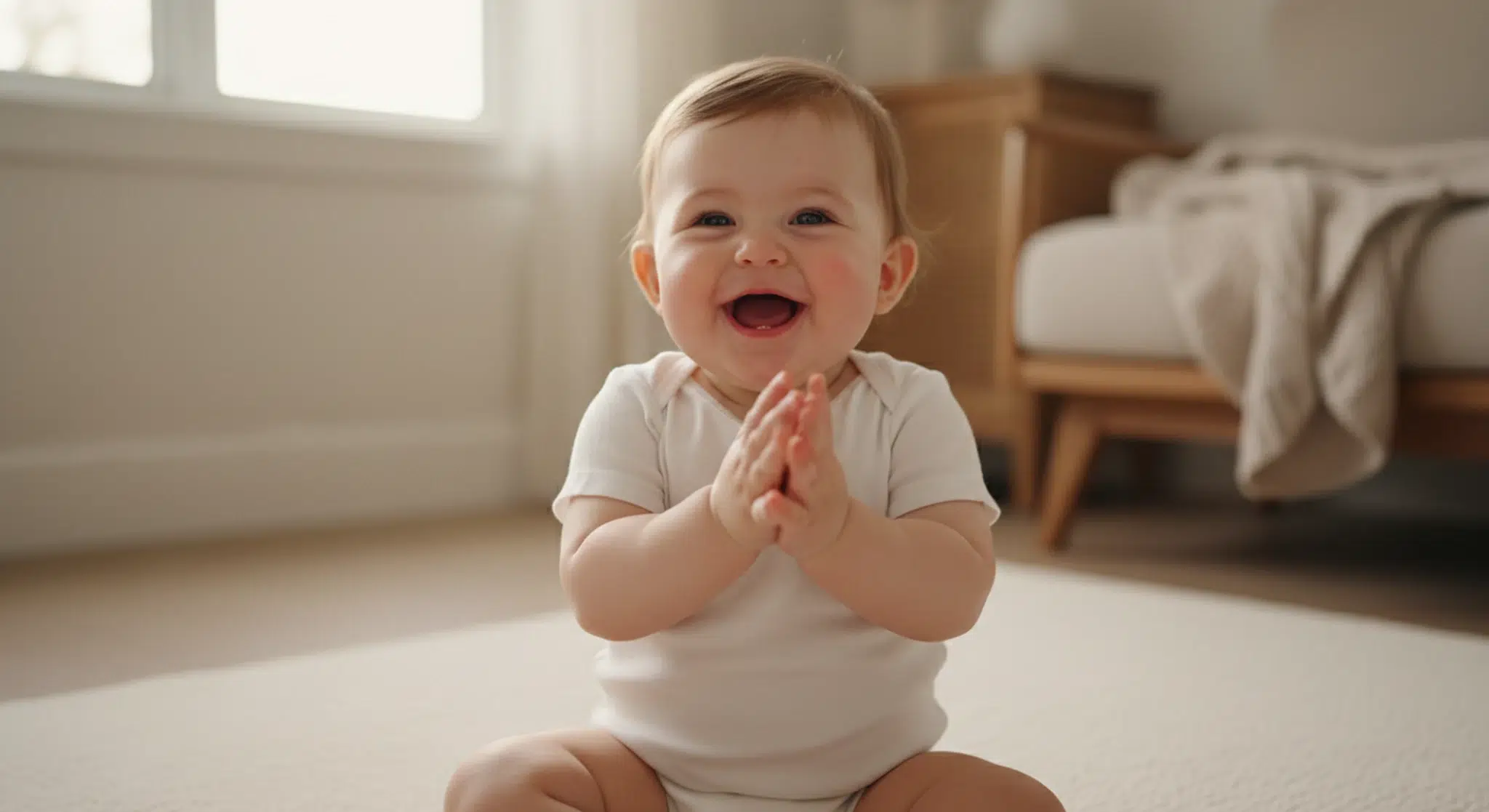
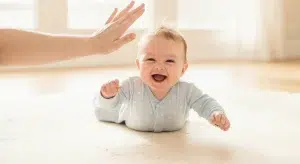
Most babies start clapping around 9 months, though the earliest version looks more like bringing both hands together at the midline than a crisp clap. That midline coordination, hands meeting in front of the body, usually shows up between 6 and 9 months. Recognizable, purposeful clapping, often paired with excitement or a song, tends to land closer to 12 months, and by around 15 months most toddlers clap spontaneously when they are pleased with themselves.
Clapping is partly a motor skill and partly imitation. Your baby has to have the shoulder and hand control to bring both palms together on purpose, and the social interest to copy you doing it. That is why clapping so often blooms during games like pat-a-cake: the song gives a reason, and your hands give a model.
Quick Answer
Babies typically begin bringing their hands together around 6 to 9 months and clap on purpose by about 9 to 12 months. Purposeful, excited clapping is usually solid by 12 to 15 months.
When Do Babies Start Waving?
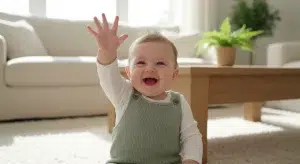
Waving bye-bye usually emerges between 9 and 12 months. Some babies attempt a wave as early as 7 or 8 months, and plenty are not consistent wavers until well after their first birthday. Waving is one of the most social of the early gestures, so it often shows up first in situations with a strong social pull: a grandparent leaving, a sibling walking out the door, the end of a video call.
Early waves can look nothing like an adult wave. A baby might open and close a whole hand, flap an arm, or wave at the wrong moment entirely (hello when someone arrives, bye long after they have gone). All of that is normal and shows your baby is grasping the idea that a gesture carries meaning, even before the timing and form are polished.
You can gently support it by waving and saying bye every single time someone leaves, keeping it warm and repetitive. Gestures like this are learned through hundreds of low-key repetitions, not drilling.
When Do Babies Start Pointing?
Pointing often begins around 9 to 12 months and becomes a clear index-finger point by roughly 12 to 14 months. Pointing actually comes in two flavors, and the difference matters. First is imperative pointing: your baby points because they want something, like the cup on the counter. A bit later comes declarative pointing: your baby points simply to show you something and share the moment, like spotting a dog and looking back at your face to make sure you saw it too.
That second kind, pointing to share, is a big deal developmentally. It reflects joint attention, the ability to coordinate attention with another person around a third thing. Joint attention is one of the strongest early foundations for language, because it is how babies link words to the world: you point, you name, they connect. By 18 to 24 months, most toddlers can also point to objects and body parts you name.
Great days start with good sleep
A well-rested baby is a more curious, more social baby. Betteroo builds a personalized sleep plan around your child’s age and temperament in about two minutes.
There is no fixed order, and the range overlaps heavily. That said, a common pattern is that reaching and hands-to-midline come first, then clapping and waving arrive close together in the 9 to 12 month window, with a clear index-finger point often following soon after. Some babies wave before they clap; some point before they wave. Temperament plays a role too, as very physically driven babies sometimes prioritize crawling and pulling up over gestures for a stretch, then catch up quickly.
Gesture
Typical age it appears
What it shows
Hands to midline
6–9 months
Motor control, the precursor to clapping
Clapping
9–12 months
Imitation and coordination
Waving bye-bye
9–12 months
Social communication and routines
Pointing (to request)
9–12 months
Intentional communication
Pointing (to share)
12–16 months
Joint attention, a key language foundation
Typical gesture timeline in the second half of the first year.
How to Encourage Gestures
You do not need flashcards or drills. Babies learn gestures by watching the people they love use them, over and over, in real situations. The most effective thing you can do is narrate and model naturally throughout the day.
Wave every time someone comes or goes, and say hello or bye as you do it.
Play clapping games like pat-a-cake and clap during songs, celebrations, and reading.
Point at things and name them: that is the dog, look at the moon. Following your point teaches your baby to make their own.
Respond enthusiastically when your baby tries a gesture, even a messy one. The social payoff is what makes them do it again.
Add baby sign language if you enjoy it. Simple signs like more, milk, and all done ride on the same gesture system. See our guide to baby sign language.
Floor play and face-to-face time build the muscles and the motivation behind gestures. Our roundup of infant activities by age and our guide to tummy time by age are good places to start.
Gesture Delays: What Is Worth Watching
Gestures are part of routine developmental screening precisely because they are such reliable early markers of social communication. A short delay in any single gesture is common and usually nothing. What draws more attention is a pattern: several gestures missing together, or a gesture that was present and then faded.
The American Academy of Pediatrics and the CDC highlight a few specific checkpoints. No gestures such as waving bye-bye by around 12 months, and no pointing by 18 months, are reasons to talk with your pediatrician. So is a loss of gestures, babble, or social skills a child previously had, at any age. The absence of pointing to share interest is one of the more consistent early signs clinicians look for when screening for autism spectrum disorder, which is why all children are screened at the 18 and 24 month visits.
None of this is something to diagnose at home, and a single missed milestone is not a verdict. But you know your baby best. If something feels off, an early conversation and, if needed, an early-intervention evaluation are low-cost and genuinely helpful, because support started early tends to work best.
When to Talk to Your Pediatrician
Bring gestures up at a well visit, or sooner, if you notice any of the following.
No gestures like waving or reaching to be picked up by about 12 months.
No pointing to objects or people by 18 months.
Little interest in sharing attention, such as looking back at you to show you something.
Loss of gestures, words, or social skills your child used to have.
Limited eye contact, response to their name, or back-and-forth social play alongside the gesture delay.
Your pediatrician can screen your child’s development and, if it is helpful, connect you with a free early-intervention evaluation. Trust your instincts: parents are usually the first to notice.
Frequently Asked Questions
At what age do babies start clapping?
Most babies start clapping around 9 months, beginning with bringing both hands to the midline and progressing to purposeful, excited clapping by about 12 months. By roughly 15 months, most toddlers clap spontaneously when they are pleased. A range of a couple of months on either side is normal.
When should a baby wave bye-bye?
Waving typically appears between 9 and 12 months, though some babies try it earlier and others a bit later. Because waving is highly social, it often shows up first when someone your baby loves is coming or going. If there are no gestures like waving by 12 months, mention it to your pediatrician.
Why is pointing an important milestone?
Pointing, especially pointing just to show you something, reflects joint attention: your baby coordinating their attention with yours around the same object. Joint attention is a major foundation for language and social development, which is why clinicians pay close attention to whether a child points by 18 months.
What if my 12 month old is not clapping, waving, or pointing yet?
One missing gesture at 12 months is often just a timing difference, particularly if your baby is busy with big motor skills like crawling or cruising. What matters more is the overall picture. If several gestures are missing together, or your baby shows little interest in sharing attention, check in with your pediatrician rather than waiting.
How can I help my baby learn to wave, clap, and point?
Model the gestures naturally and often: wave every time someone leaves, clap during songs and celebrations, and point at things while naming them. Respond warmly when your baby tries, even imperfectly. Babies learn gestures through many everyday repetitions, not drilling, so keep it playful.
A rested baby is a curious baby
Sleep fuels the social play where gestures are learned. Betteroo turns your child’s age, temperament, and schedule into a step-by-step sleep plan in about two minutes.