The best infant activities are absurdly simple: faces, voices, floor time, and everyday objects. A baby’s first-year curriculum is talking, singing, reading, tummy time, and letting them handle safe things, repeated daily. No subscription box required.
Somewhere between the black-and-white flashcards and the developmental toy subscriptions, a simple truth gets buried: for the first year, you are the activity. Faces, voices, laps, and floors build more brain than any product, and the research on early development says the magic ingredient is back-and-forth interaction, not equipment.
That said, knowing what to actually do with a 7 week old at 3:00 pm is a real question. Here are infant activities organized by age and stage across the first year, what each one builds, and how to keep play going without turning your living room into a program.
Key Takeaways
Back-and-forth interaction (talking, singing, imitating, responding) is the single most development-rich activity at every age.
Daily tummy time from the first weeks builds the muscles behind rolling, sitting, and crawling.
Reading to your baby from birth is linked with stronger language outcomes; board books count fully.
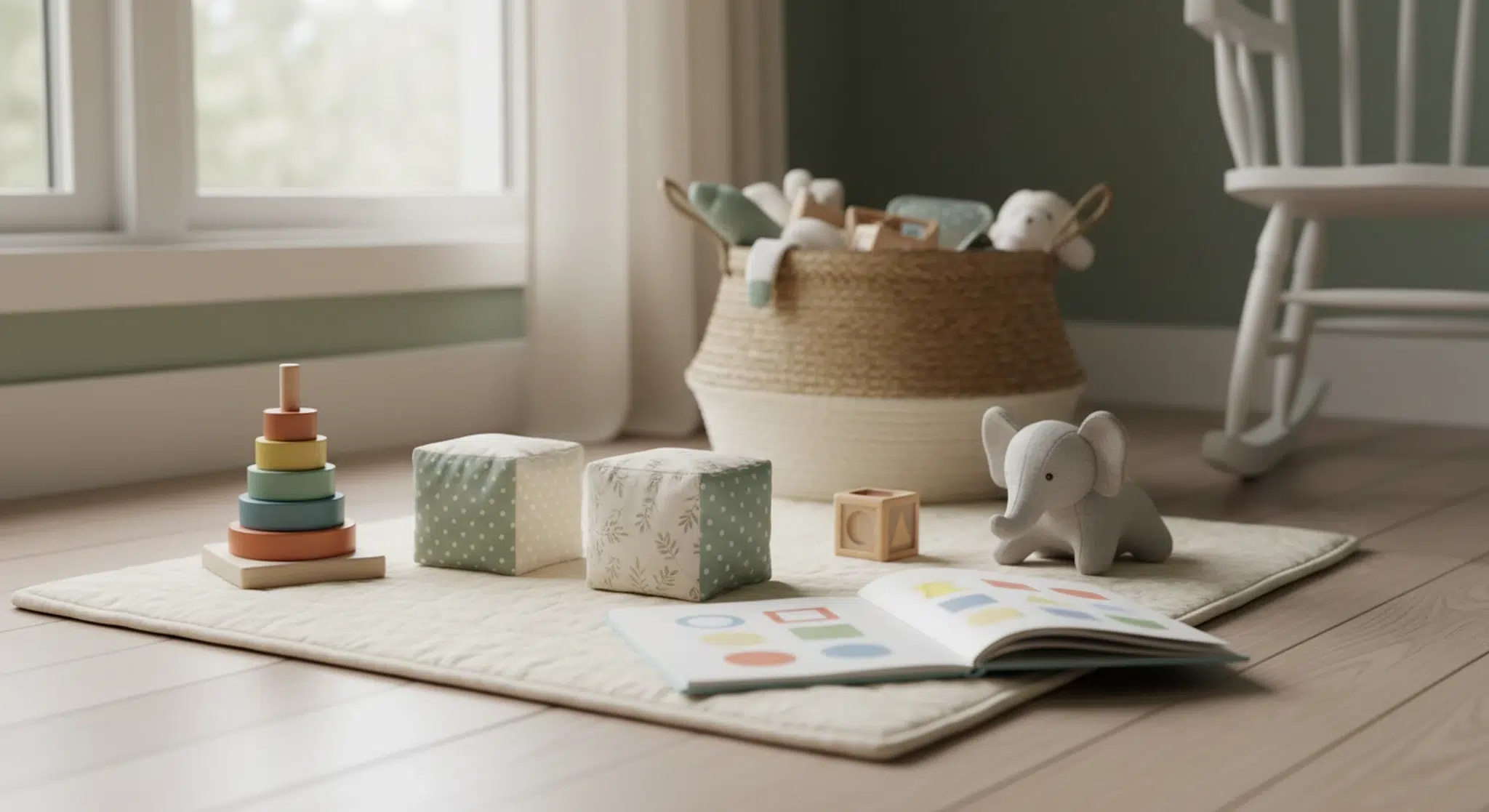
Rotate a few simple toys rather than offering many at once. Novelty beats quantity.
Follow your baby’s lead: engaged means keep going, looking away means break time.
Screen time is not recommended under 18 months apart from video chat. The first year runs on faces and objects.
As an Amazon Associate, Betteroo earns from qualifying purchases.
Table of Contents
0 to 3 Months: Faces, Voices, and Floor Time
A newborn’s job list is short: study faces, find your voice, and slowly win the fight against gravity. Activities at this age are measured in minutes, and drowsy is the default state, so think tiny sessions sprinkled through wake windows.
Face time at 8 to 12 inches. That is a newborn’s focal distance. Slow exaggerated expressions, and by 6 to 8 weeks you will start getting smiles back.
Narrate everything. Diaper changes, laundry, coffee. The word count babies hear in year one predicts language later, and it does not need to be clever.
Sing, badly if necessary. Babies prefer your voice to any recording, and melody holds attention longer than speech.
Tummy time in short reps. Two to three minutes, a few times a day, from the first weeks, building toward 15 to 30 total minutes daily. Our tummy time guide covers the how.
High-contrast images and slow-moving objects to track. A slowly waved wooden spoon works as well as a flashcard.
Gentle bicycle legs and baby massage after diaper changes: body awareness plus gas relief in one move.
Reading starts now too, not later. A newborn gets nothing from the plot and everything from the rhythm of your voice and the closeness. One board book a day is a wonderful habit to install early.
3 to 6 Months: Reaching, Rolling, and Cause and Effect
Around 3 to 4 months, hands come online and the world becomes grabbable. This stretch is about reaching, batting, mouthing, and the first thrilling discovery that actions cause reactions.
Play gym or DIY version: baby on their back swatting at dangling safe objects. Rotate what hangs there weekly.
Offer one graspable object at a time:rattle, silicone ring, crinkle toy, muslin square. Everything goes in the mouth; that is the point, it is how babies explore texture.
Mirror play. Babies love the baby in the mirror long before they know who it is. A locked-down unbreakable mirror at floor level upgrades tummy time.
Peekaboo, early edition: hide your face behind your hands or a cloth. You are laying the groundwork for object permanence.
Sound games: imitate their coos back at them, then wait. That pause teaches conversational turn-taking months before words. See when babies start cooing.
Rolling practice: place toys just out of reach to the side during floor time.
Sessions stretch to 10 or 15 minutes now, but watch for the overstimulation signals: looking away, arching, fussing, hiccups. Those mean the activity worked and is now over.
6 to 9 Months: Sitting, Banging, and Object Permanence
A sitting baby has two free hands and a new worldview. Play gets louder, more repetitive, and much funnier. Repetition is not boredom at this age; it is the curriculum.
Container play: putting things in, dumping things out, forever. A muffin tin and some large silicone blocks outperform most toys.
Banging and stacking: two blocks, a wooden spoon and a pot. Cause and effect with a percussion section.
Hide the toy under a cup or cloth and let them find it: object permanence in action, and the reason peekaboo is suddenly hilarious.
Texture tours: carpet, cold floor, grass, sand in a tray. Supervised food play at meals counts double; see our baby led weaning guide.
Name everything they point at or grab. Labeling in the moment is the highest-value language input there is.
Gesture games: pat-a-cake, waving, arms up. Gestures predict and pull along first words. More in when babies start waving.
Great days start with decent nights
Play fuels development; sleep locks it in. Betteroo builds a nap and night plan for your baby’s exact age in about two minutes.
9 to 12 Months: Crawling, Cruising, and Pretend Beginnings
Mobility changes everything: your baby now commutes to their activities. The best play in this stretch uses movement itself, plus the first hints of imitation and pretend.
Obstacle course: couch cushions to climb, a tunnel of chairs, you as the mountain. Gross motor gold.
Cruising stations: sturdy furniture arranged so baby can shuffle between handholds. This is the runway for walking; see when babies start walking.
Push toys and laundry baskets to shove around the floor for the pre-walker who wants to go.
Imitation games: stir with a spoon, brush hair, pretend-drink from a cup, wipe the table. Baby copies you; pretend play is booting up.
Simple sorting and stacking: ring stackers, big blocks, shape sorters with help.
Point-and-name walks indoors or out: follow their pointing finger and name what they found. Pointing at 9 to 12 months is a major communication milestone.
Songs with actions: wheels on the bus, itsy bitsy spider. Motion plus melody plus anticipation.
This is also the age of the fierce independent streak and its twin, separation anxiety. Games of chase, peekaboo around corners, and reliable comings-and-goings all quietly rehearse the idea that you leave and come back.
The Habits That Matter More Than Any Activity
Zoom out from the activity lists and the first-year evidence points at a handful of daily habits rather than any specific game.
Serve and return. When your baby babbles, gestures, or looks at something, respond. These loops are the core mechanism of early brain development.
Read every day. Ten minutes, any book, repeated favorites welcome.
Prioritize floor freedom. Time in containers (seats, bouncers, jumpers) is time not spent building movement skills. Containers are for parents’ showers, not the default habitat.
Rotate toys weekly. Three toys out, the rest hidden, swap on laundry day. Old toys return as new toys.
Let boredom happen. A baby staring at dust in a sunbeam is doing science. You do not need to program every wake window.
Skip screens under 18 months apart from video chatting with family, per AAP guidance.
And calibrate to your actual baby: activity guides describe averages, but interest and stamina vary wildly and normally. Track your own child’s trajectory against our milestones by month guide rather than against the neighbor’s baby.
When to Talk to Your Pediatrician
Play is also how development shows itself, which makes it a good early warning system. Mention it at a checkup if you notice any of these.
Little interest in faces or eye contact, or no social smiling by around 3 months.
Not reaching for objects by 6 months, or hands staying persistently fisted.
Not sitting with support by 9 months, or strongly preferring one side of the body.
No babbling by 9 months, or no gestures like pointing or waving by 12 months.
Loss of any skill your baby previously had, at any age. This one always warrants a prompt call.
Your gut says something about play or engagement feels off. Parental instinct is legitimate screening data.
Early intervention services exist precisely for maybes, and acting on a maybe early beats waiting for certainty.
Frequently Asked Questions
What activities should I do with my infant?
The highest-value infant activities are free: talking and singing to your baby, reading daily, tummy time from the first weeks, offering safe objects to grasp and mouth, and responsive back-and-forth games like peekaboo and imitating their sounds. Match the specifics to their stage, from face-tracking as a newborn to obstacle crawling near age one.
How much playtime does a baby need each day?
There is no required dose; think little and often across every wake window rather than sessions. Newborns manage a few minutes at a time, while older infants may play 15 to 30 minutes per stretch. Aim for daily tummy time building to 15 to 30 total minutes in the early months, plenty of free floor time, and at least one book.
When do babies start playing with toys?
Babies begin batting at objects around 3 months and grasping them by 4 months, but they interact from birth through faces, voices, and tracking objects. Before 3 months, you are the toy. Simple high-contrast images, rattles held for them, and your expressions are the age-appropriate versions of play.
Do educational toys make babies smarter?
No toy has been shown to outperform ordinary responsive interaction. The strongest evidence in early development is for serve-and-return exchanges with caregivers, daily reading, and free movement. Simple open-ended toys, blocks, containers, stackers, books, support that; electronic educational toys tend to reduce the parent talk that actually drives learning.
How much tummy time does my baby need?
Start with 2 to 3 minutes a few times daily in the first weeks and build toward 15 to 30 total minutes a day by around 2 months, always awake and supervised. If your baby protests, use short reps, chest-to-chest tummy time, or a rolled towel under the chest, and try right after naps rather than after feeds.
Play hard, sleep well
Betteroo turns your baby’s age and temperament into a personalized nap and night plan, so the fun parts of the day get the energy they deserve.