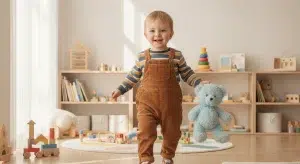
Most babies take their first independent steps somewhere between 9 and 18 months, and the average is right around their first birthday. Walking earlier or later than that is often still perfectly normal.
Few milestones feel as momentous as watching your baby let go of the couch and toddle toward you. It is also one of the milestones parents worry about most, usually because a cousin or a friend’s baby walked at ten months and yours is happily cruising at fourteen. The truth is that the normal window for walking is wide, and the age of first steps says very little about how coordinated or bright a child will be later on.
This guide walks through when babies start walking, the steady sequence of skills that leads up to it, the signs your baby is getting close, simple ways to help without rushing, and the specific ages at which it is worth mentioning slow progress to your pediatrician.
Key Takeaways
Most babies start walking between 9 and 18 months, with first steps commonly around 12 months.
Walking follows a sequence: sitting, crawling, pulling to stand, cruising, then standing alone, then steps.
Cruising along furniture is the biggest sign that independent walking is weeks to a couple of months away.
Early walkers and late walkers are usually both normal; the age of first steps does not predict later ability.
Bring it up with your pediatrician if your baby is not walking at all by 18 months, or loses skills at any age.
Table of Contents
When Do Babies Start Walking on Average?
Independent walking, meaning several steps without holding on, most often appears between 9 and 18 months. The average first step lands close to 12 months, but a very large share of healthy babies walk a few months on either side of that. The CDC’s milestone checklists list walking without holding on as a skill most children have by 18 months, which is why 18 months is the age professionals watch rather than 12.1
Age
What most babies are doing
9 to 11 months
Pulling to stand and starting to cruise along furniture
12 months
Cruising confidently; some take first independent steps
13 to 15 months
Many babies begin walking independently in this stretch
16 to 18 months
The large majority are walking; walking well is expected by 18 months
Typical walking timeline. Ranges are averages, not deadlines.
Because the window is so wide, comparing your baby to another the same age is rarely useful. What matters more than the calendar is that your baby keeps making steady forward progress through the sequence of skills that leads to walking.
The Steps That Come Before Walking
Walking is the last stop on a longer road. Each earlier skill builds the strength, balance, and confidence for the next. Most babies move through this order, though the timing varies:
Sitting without support, which builds core strength.
Crawling or scooting, which develops coordination between both sides of the body. See our guide to when babies start crawling.
Pulling to stand at the couch or a low table.
Cruising, which means stepping sideways while holding onto furniture.
Standing alone for a few seconds without holding on.
First independent steps, then walking with a wide, arms-up stance.
Some babies skip or shorten a stage. A baby who never really crawls but scoots on their bottom and then pulls up and cruises is usually right on track. The stages matter as a general direction of travel, not a checklist that must be completed in exact order.
Signs Your Baby Is About to Walk
A few reliable signals tell you first steps are close. The strongest is confident cruising, especially when your baby starts to let go of the furniture with one hand or reaches across a gap between two pieces of furniture.
Cruising quickly and letting go briefly with one or both hands.
Standing alone in the middle of the room, sometimes without noticing.
Bending to pick up a toy from standing and getting back up.
Pushing a sturdy toy or laundry basket across the floor while walking behind it.
Climbing onto low furniture and generally becoming more daring.
Once you see standing without support and one-handed cruising, independent walking is usually a matter of weeks to a couple of months. Confidence is often the last piece; plenty of babies are physically able to walk before they are brave enough to let go.
How to Help Your Baby Learn to Walk
You cannot make a baby walk before their body and confidence are ready, but you can create a setup that invites practice. The most effective help is simple: floor time, bare feet, and safe things to pull up on.
Give plenty of supervised floor play so your baby can pull up, cruise, and fall safely.
Let your baby go barefoot indoors when it is safe. Bare feet help balance and foot strength more than shoes.
Arrange stable furniture so your baby can cruise between pieces with small gaps to cross.
Offer a sturdy push toy that will not tip, and skip seated baby walkers.
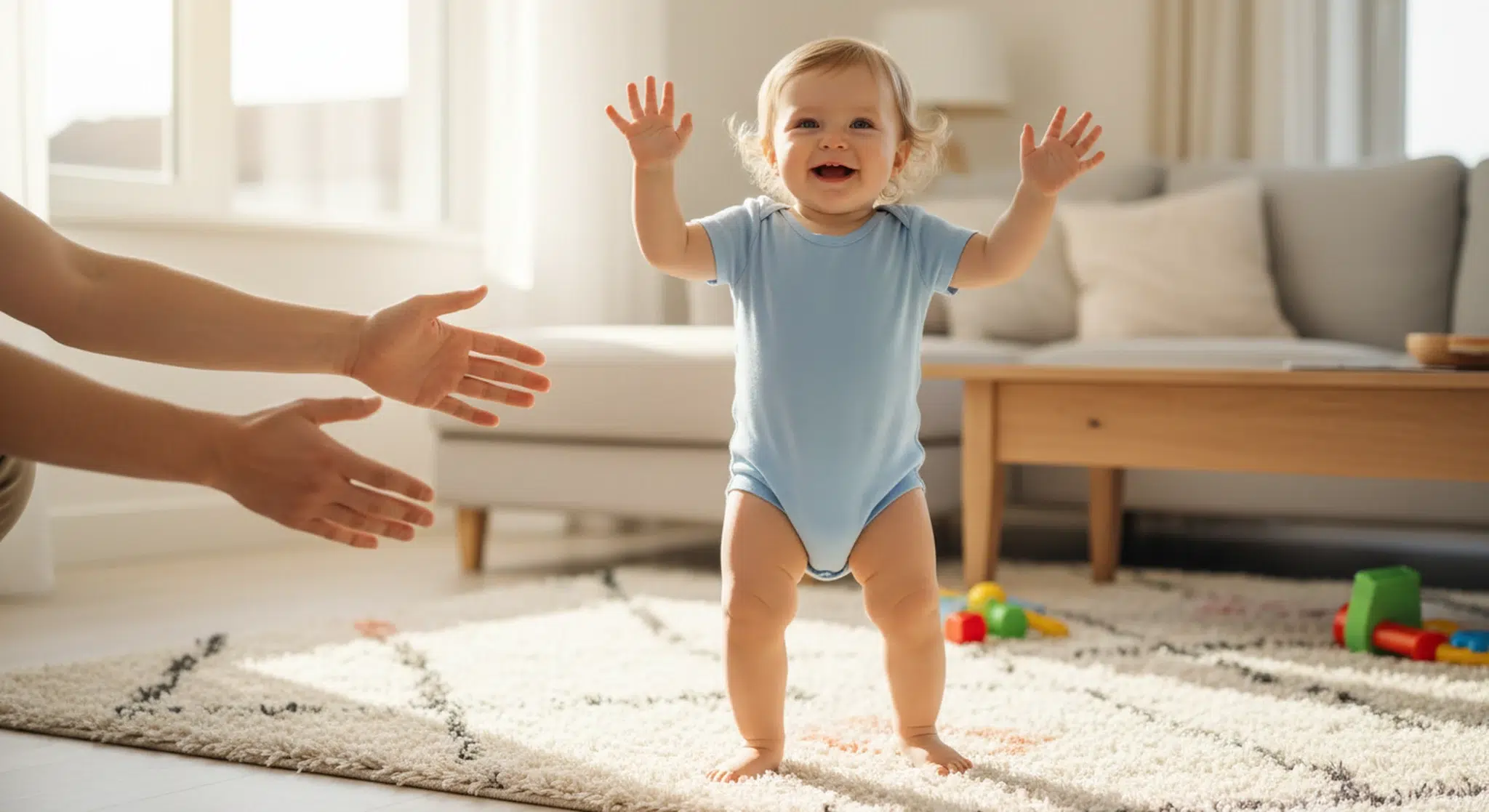
Cheer and hold out your hands a step or two away to motivate those first tries.
One important safety note: the American Academy of Pediatrics recommends against mobile seated baby walkers, the kind with wheels and a seat. They are linked to injuries and do not help babies learn to walk any faster. A stationary activity center or a push-behind toy is a better choice.2
Milestones throwing off sleep?
Growth leaps like learning to walk often shake up naps and nights. A short, personalized plan can help you ride them out.
It is natural to read a lot into an early or late walker, but the research is reassuring. The age a child first walks does not predict later coordination, athletic ability, or intelligence. A baby who walks at ten months and a baby who walks at sixteen months usually look no different on the playground a couple of years later.
Several harmless factors can nudge the timing. Bigger or more cautious babies sometimes take a little longer. Babies who spend a lot of time crawling and exploring may feel no rush to walk. Temperament plays a role too, since a careful baby may wait until they are certain before letting go. None of these are cause for concern on their own.
Do Babies Need Shoes to Learn to Walk?
Indoors, no. Babies learning to walk do best barefoot or in non-slip socks, because feeling the floor helps them balance and strengthens the small muscles of the foot. Shoes are for protection outside, not for support or for teaching walking.
When you do buy first shoes for outdoor use, look for a lightweight, flexible sole that bends easily and a snug but not tight fit. Stiff, heavy, or high-topped shoes are unnecessary for typical development and can make early walking harder rather than easier.
When to Talk to Your Pediatrician
Your baby is not walking at all by 18 months.
Your baby is not pulling to stand or bearing weight on their legs by about 12 months.
Your baby walks only on their toes almost all the time, or the legs seem very stiff or very floppy.
Your baby loses a skill they used to have, such as standing or cruising, at any age.
Walking is very lopsided, with one side of the body clearly weaker or favored.
Milestone timing is flexible, but losing skills or a persistent one-sided pattern is always worth a prompt conversation. Your pediatrician can check muscle tone, strength, and development, and reassure you or connect you with early intervention if it would help.
Frequently Asked Questions
At what age do most babies start walking?
Most babies take their first independent steps between 9 and 18 months, and the average is around 12 months. Walking without holding on is a skill professionals expect to see by 18 months, so earlier or later within that window is usually still normal.
Is it normal for a baby not to walk at 15 months?
Yes. Plenty of healthy babies are still cruising or just taking their first steps at 15 months. As long as your baby is pulling to stand, cruising, and making steady progress, 15 months is well within the normal range. If there is no walking at all by 18 months, mention it to your pediatrician.
Does walking early mean my baby is advanced?
Not really. The age a baby first walks does not predict later intelligence, coordination, or athletic ability. Early walkers and late walkers usually look no different a couple of years down the road.
How can I encourage my baby to walk?
Offer lots of supervised floor time, let your baby go barefoot indoors, arrange stable furniture to cruise along, and provide a sturdy push toy. Hold out your hands a step or two away to motivate first steps, and skip mobile seated walkers.
Are baby walkers good for helping babies walk?
No. The American Academy of Pediatrics recommends against mobile seated baby walkers with wheels because they are linked to injuries and do not help babies walk any sooner. A stationary activity center or a push-behind toy is a safer choice.
Should my baby wear shoes to learn to walk?
Indoors, babies learn best barefoot or in non-slip socks because feeling the floor helps balance and foot strength. Save shoes for outdoor protection, and choose lightweight, flexible ones.
Big milestones, rough nights?
Learning to walk can scramble sleep for a week or two. Get a gentle, personalized plan to help your family through the leap.