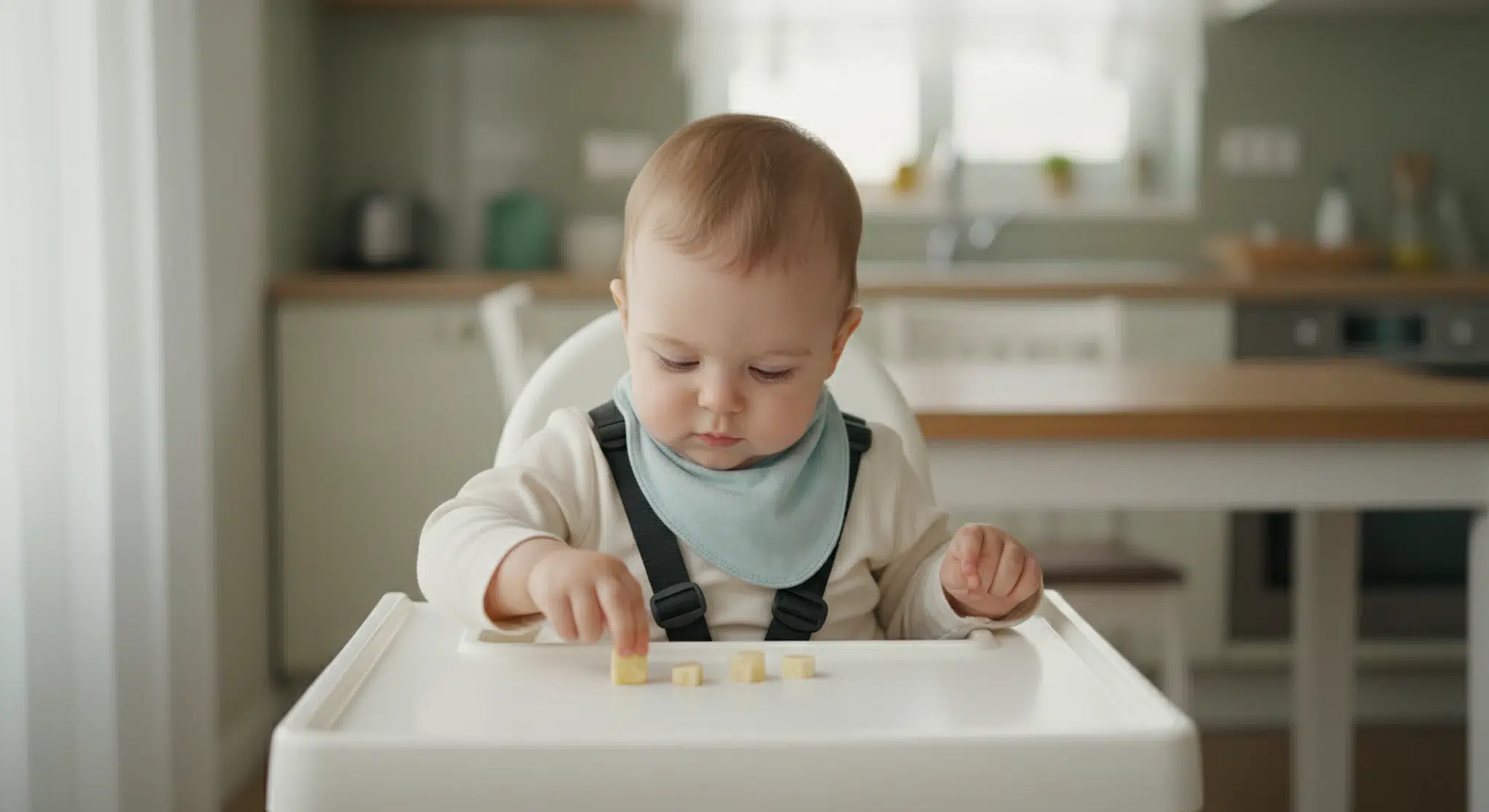


The pincer grasp, picking up a small object between the thumb and index finger, usually develops between about 9 and 12 months, and the CDC says most babies can do it by their first birthday.
One week your baby is sweeping peas off the tray with a whole fist. A few weeks later, one pea gets pinched between two tiny fingers. That shift is the pincer grasp, one of the most useful fine motor skills of the first year.
This guide covers when babies develop it, the stages before it, inferior vs superior pincer grasp, 15 safe ways to practice and when to call. Every age comes from the Centers for Disease Control and Prevention (CDC), the American Academy of Pediatrics (AAP) or a pediatric hospital, named in the sentence.
Key Takeaways
- The pincer grasp is picking up a small object between the thumb and index finger.
- The CDC lists it as a 12 month milestone. Pediatric hospital charts show it emerging from about 9 months.
- The usual order: reflexive grasp, palmar grasp, raking, inferior pincer (finger pads), superior pincer (fingertips).
- Practice with soft finger foods cut no larger than one-half inch, blocks, containers and board books, always supervised.
- Talk with your pediatrician if your baby is not pinching by 12 months, has lost a skill, or you have any concern.
As an Amazon Associate, Betteroo earns from qualifying purchases.
Table of Contents
What Is the Pincer Grasp?
Quick Answer
Before this, babies scoop and sweep with the whole hand. A hand skills handout from NEO Kids Children’s Treatment Centre at Health Sciences North, a hospital in Ontario, Canada, calls the pincer grasp essential for picking up small pieces of food or toys and a foundation for later skills like holding a pencil or using scissors. It gets daily practice once your baby moves from starting solids to finger foods.
When Do Babies Develop the Pincer Grasp?
There is no single pincer grasp age. Trusted sources give a range, and they measure slightly different things.
| Source | What it describes | Age |
|---|---|---|
| CDC milestone checklist | Uses fingers to “rake” food towards himself | By 9 months |
| CDC milestone checklist | Picks things up between thumb and pointer finger, like small bits of food | By 12 months |
| CHOC (Children’s Hospital of Orange County) | Uses thumb and index finger (pincer grasp) to pick up small objects | 9 months |
| Nicklaus Children’s Hospital | Pincer grasp (thumb and finger grasp) and finger feeding | 10 to 12 months |
The gap is not a contradiction. The hospital charts describe when the skill typically emerges. The CDC defines a milestone as something most children (75% or more) can do by a certain age, so its 12 month line means “most babies have it by now,” not an average.
The AAP describes the same arc on HealthyChildren.org: in the months when babies learn to crawl, stand and walk, they start out clumsily “raking” things toward themselves and end up grasping accurately with the thumb and first or second finger.
If your baby was born early, ask your pediatrician which age to use with milestone charts. For the bigger picture, see baby milestones by month and 9 month old milestones.
Grasp Stages by Age: From Palmar to Pincer
Grasping develops from the whole hand toward the fingertips. The ages below are typical ranges, not deadlines.
| Stage | What it looks like | Typical age (source) |
|---|---|---|
| Reflexive palmar grasp | Fingers close around your finger when it touches the palm. A reflex, not a choice. | 0 to 3 months (Nicklaus Children’s) |
| Palmar grasp | Holds a rattle in the whole hand, reaches for toys, passes them hand to hand. | 4 to 6 months (Nicklaus Children’s) |
| Raking grasp | All the fingers sweep a small object toward the palm at once. | About 6 months (CHOC); most babies rake food by 9 months (CDC) |
| Radial palmar grasp | The thumb and first two fingers do more of the work. | 7 to 9 months (Nicklaus Children’s) |
| Inferior (crude) pincer | Pads of the thumb and index finger, or the thumb against the side of the index finger. | 7 to 8 months (CHOC); around 8 to 9 months (NEO Kids) |
| Superior (neat or fine) pincer | Tips of the thumb and index finger pick up tiny objects. | 9 months (CHOC); around 10 to 12 months (NEO Kids, Nicklaus Children’s); by 12 months for most babies (CDC) |
Stages overlap. A baby who can pinch a piece of banana may still rake at a pile of peas, especially when tired or hungry.
Inferior vs Superior Pincer Grasp
The difference is where the object sits on the fingers.
| Inferior pincer grasp | Superior pincer grasp | |
|---|---|---|
| Also called | Crude pincer | Neat, fine or refined pincer |
| Contact point | Pads of the thumb and index finger (CHOC), or thumb against the side of the index finger (NEO Kids) | Tips of the thumb and index finger (NEO Kids) |
| Typical age | 7 to 8 months (CHOC); around 8 to 9 months (NEO Kids) | Around 10 to 12 months (NEO Kids) |
NEO Kids notes that by around 12 months most children use a refined or neat pincer grasp. You do not need to coach the switch from pads to tips. It tends to come with practice.
Tired nights don’t have to last forever.
Our free two-minute quiz builds a gentle, personalized sleep plan for your baby’s age and temperament.
15 Pincer Grasp Activities to Try at Home
The best pincer grasp activities are ordinary play and meals, repeated often. Stay within arm’s reach: NEO Kids notes that supervision is required because children may mouth what they practice with. The CDC’s tips for this age also say to limit screen time to video calls with loved ones.
Build the foundation (about 6 to 8 months)
- 1. Reach and grab: hold a toy just within reach during floor play so your baby has to stretch and open the hand.
- 2. Hand to hand: offer a second toy while one hand is full. Moving things from hand to hand is on the CDC’s 9 month checklist.
- 3. Bang and shake: offer two blocks or a rattle. Banging two things together is also a CDC 9 month milestone.
- 4. Pass it back: the CDC suggests a “my turn, your turn” game with a toy.
Practice pinching (about 8 to 10 months)
- 5. Two pieces on the tray: put only two or three soft, small pieces of food on the high chair tray. A big pile invites raking.
- 6. Muffin tin snack: drop one soft piece into each cup of a muffin tin. The walls make sweeping harder.
- 7. Poke and press: the AAP notes babies love holes they can poke fingers into and toys with wheels, levers and hinges.
- 8. Blocks in, blocks out: the CDC suggests dumping blocks from a container and putting them back in together.
- 9. The drop game: when your baby drops a toy, hand it back so they can do it again. The CDC recommends making it a game.
- 10. Edible finger painting: smear plain yogurt or fruit puree on the tray and let your baby draw with one finger.
Refine the grip (about 10 to 12 months and up)
- 11. Board book pages: sturdy pages give thumbs and fingers something to separate and turn.
- 12. Scarves in a box: let your baby pull large fabric squares from an empty tissue box, then put them away.
- 13. Chunky knob puzzles: choose knobs too large to fit in the mouth, with no loose parts.
- 14. Pots, pans and lids: the CDC’s 12 month tips suggest pots and pans. Lifting a lid by its knob is pincer work.
- 15. Stack and topple: the AAP says that toward the end of the first year your child may stack one block on another.
Skip activities built around beads, buttons, coins, dry beans or pom-poms. They appear in preschool fine motor lists but are not safe for babies. For gear, see toys for 6 month olds and toys for 1 year olds.
Finger Foods for Pincer Practice (and How to Cut Them)
Mealtime is the easiest practice session. The CDC’s tips at 9 months: let your baby practice feeding himself with his fingers, sit next to him, and expect spills.
Every food offered for pinching should be soft enough to mash easily and cut small. The AAP says to cut food for infants and young children into pieces no larger than one-half inch. Ideas that fit:
- Ripe banana or ripe avocado, cut small
- Well-cooked pasta, cut into short bits
- Sweet potato or carrot cooked until very soft, then diced
- Scrambled egg, broken into small pieces
- Cooked peas, flattened with a fork
- Blueberries cut into quarters
- Moist, well-cooked chicken, finely chopped
Seat your baby upright. The AAP says children should eat at the table or sitting down, never while they run, walk, play or lie down, and that mealtimes should be supervised. More ideas: 9 month old baby food and baby-led weaning.
Choking Hazards: What a Pinching Baby Should Not Reach
A new pincer grasp lets your baby pick up things you did not know were on the floor, and most go straight to the mouth. The AAP reports that most children who die from choking are under age 5, and two-thirds are babies under a year old.
Choking Hazards to Keep Away (AAP)
Small objects: coins, marbles, small balls, balloons, toys with small parts, toys that can be squeezed to fit entirely into a child’s mouth, pen or marker caps and medicine syringes.
Button batteries and lithium coin batteries: they can cause internal burns.
Magnets: swallowing more than one high-powered magnet can be life-threatening, because the magnets can pull together inside the digestive system.
The AAP’s advice: keep these items out of reach, follow the age recommendations on toy packages, and take a certified CPR and first aid course. Check under the couch, the high chair and older siblings’ play areas before your baby does.
What Comes Next: Letting Go, Pointing and First Tool Grips
- Letting go on purpose: CHOC lists releasing an object into an adult’s hand on request at about 10 months.
- Pointing and poking: CHOC lists poking with the index finger at about 8 months and pointing at objects at 12 to 14 months. See when babies clap, wave and point.
- Containers: the CDC’s 12 month checklist includes putting something in a container, like a block in a cup.
- First tool grips: Nicklaus Children’s lists a palmar supinate grasp, the whole-fist grip toddlers first use on a crayon, at 12 months.
Our 12 month old milestones guide covers what else to expect around the first birthday.
Related Betteroo Guides
- 9 month old milestones
- 12 month old milestones
- Baby milestones by month
- Starting solids
- Baby-led weaning
- When do babies clap, wave and point?
When to Call Your Pediatrician
The CDC’s advice is direct: “Don’t wait.” If your child is not meeting one or more milestones, has lost skills he or she once had, or you have other concerns, act early. For hand skills, talk with your pediatrician if:
- By 9 months: your baby is not using fingers to rake food toward themselves or not moving things from one hand to the other (CDC 9 month milestones).
- By 12 months: your baby is not picking things up between thumb and pointer finger (CDC 12 month milestone).
- At any age: your baby has lost a skill, or you have a concern that is not on any checklist. The CDC reminds parents that you know your child best.
The CDC says to share your concerns with your child’s doctor and ask about developmental screening. If concerns remain, ask for a referral to a specialist and call your state or territory’s early intervention program to find out if your child can get services. The CDC lists each state’s number at cdc.gov/FindEI.
Get emergency help right away: call 911 if your baby is choking. If you think your baby has swallowed a button battery or a magnet, go to the nearest emergency department immediately, even if your baby seems fine. For a swallowed magnet, the AAP says to contact your pediatrician or the closest emergency department right away.
This article is general education, not medical advice.
Frequently Asked Questions
When do babies develop pincer grasp?
Most babies develop the pincer grasp between about 9 and 12 months. The CDC lists picking things up between thumb and pointer finger as a milestone most babies (75% or more) reach by 12 months. Children’s hospital therapy charts show it emerging from about 9 months.
What is the difference between an inferior and superior pincer grasp?
In an inferior pincer grasp, a baby holds a small object with the pads of the thumb and index finger. In a superior pincer grasp, the fingertips do the work. Hospital therapy charts place the first at about 7 to 9 months and the second at about 10 to 12 months.
What are the best pincer grasp activities for babies?
Simple, supervised ones. Offer two or three soft pieces of finger food on the tray, play with blocks and containers, turn board book pages, and hand dropped toys back so your baby can let go again. Avoid beads, buttons, coins and other small objects.
What foods are good for practicing the pincer grasp?
Choose foods soft enough to mash easily, such as ripe banana, ripe avocado, well-cooked pasta, soft cooked sweet potato, scrambled egg and quartered blueberries. The American Academy of Pediatrics says to cut food for infants into pieces no larger than one-half inch.
Is it normal for a 9 month old not to have a pincer grasp?
It can be. The CDC’s 9 month checklist expects raking food with the fingers and moving things from hand to hand, and lists the thumb and pointer finger pincer at 12 months. If you have any concern, talk with your pediatrician.
When should I worry about my baby’s pincer grasp?
Talk with your pediatrician if your baby is not picking things up between thumb and pointer finger by 12 months, has lost a skill, or you have any other concern. The CDC says not to wait: ask about developmental screening and early intervention.
Calmer days, better nights.
Betteroo builds a personalized sleep plan for your baby. Take the free two-minute quiz to get started tonight.
8 Sources
-
Centers for Disease Control and Prevention. Learn the Signs. Act Early. Milestones by 9 Months.
https://www.cdc.gov/act-early/milestones/9-months.html -
Centers for Disease Control and Prevention. Learn the Signs. Act Early. Milestones by 1 Year.
https://www.cdc.gov/act-early/milestones/1-year.html -
American Academy of Pediatrics (HealthyChildren.org). Hand and Finger Skills.
https://www.healthychildren.org/English/ages-stages/baby/Pages/Hand-and-Finger-Skills.aspx -
CHOC (Children’s Hospital of Orange County) Rehabilitation Services. Developmental Milestones: Fine Motor Skills and Visual Motor Skills.
https://www.choc.org/userfiles/file/Rehab-Developmental%20Milestones%20final.pdf -
Nicklaus Children’s Hospital. Rehab: Grasping and Hand Skills.
https://nicklauschildrens.org/discharge-instructions/rehab-grasping-hand-skills -
NEO Kids and Family Children’s Treatment Centre, Health Sciences North. Hand Skills.
https://hsnsudbury.ca/Portals/1/Services/Newborn_and_Childrens_Care/CTC%20Documents/PRESCHOOL/Hand%20Skills-NEO%20Kids_Daycare%20Information%20Handout.pdf -
American Academy of Pediatrics (HealthyChildren.org). Choking Prevention for Babies and Children.
https://www.healthychildren.org/English/health-issues/injuries-emergencies/Pages/Choking-Prevention.aspx -
American Academy of Pediatrics (HealthyChildren.org). How High-Powered Magnetic Toys Can Harm Children.
https://www.healthychildren.org/English/safety-prevention/at-home/Pages/Dangers-of-Magnetic-Toys-and-Fake-Piercings.aspx