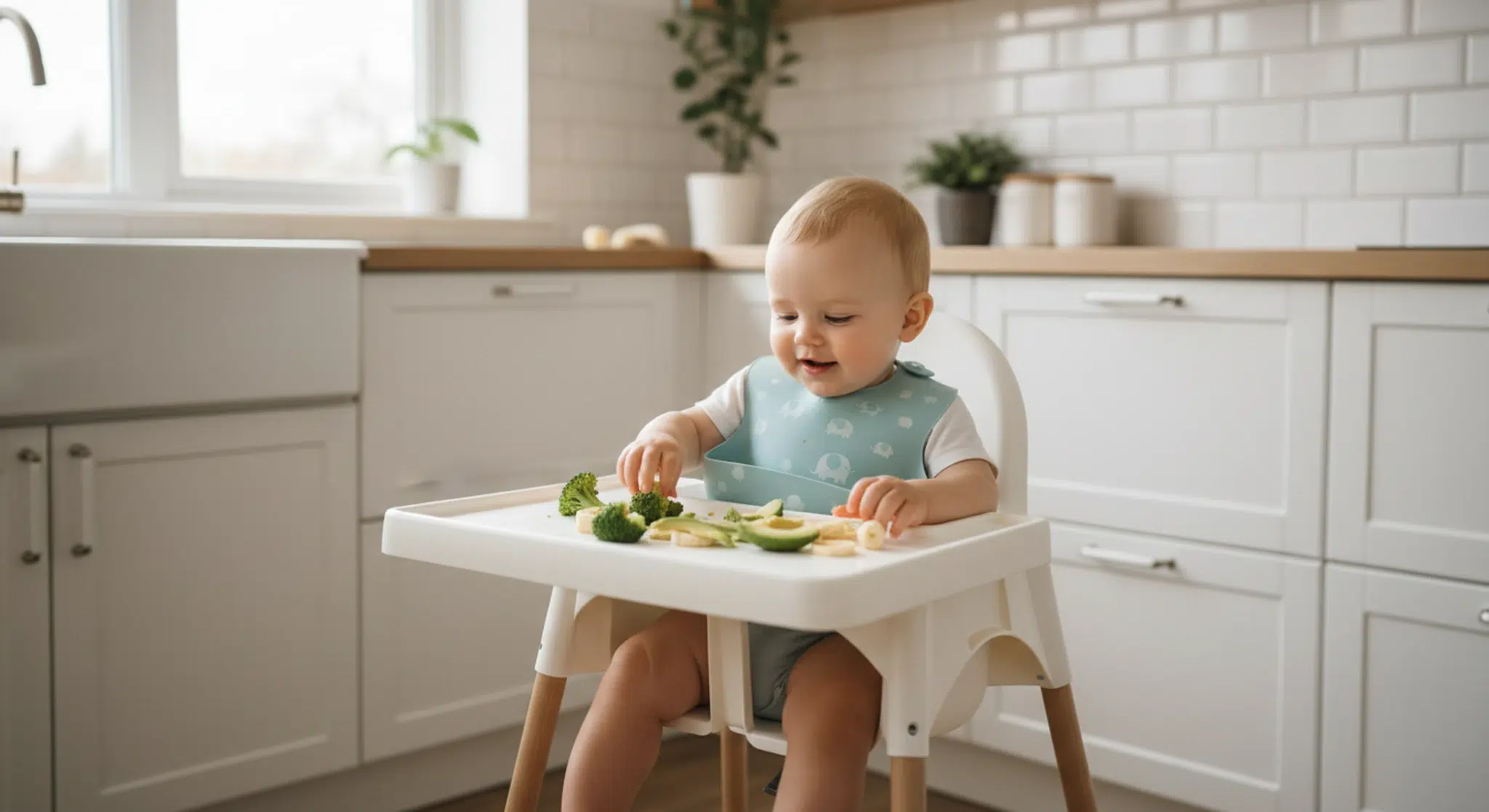
At 9 months, baby food means three real meals a day: soft finger foods the size of your pinky, lumpier mashes, iron-rich proteins, and a front-row seat at the family table, all alongside 24 to 32 ounces of breast milk or formula. The pincer grasp is arriving, and with it, the era of self-feeding.
Nine months is a turning point at the high chair. The tentative taster of month six is becoming an opinionated self-feeder who wants what is on your plate, and solids shift from practice to genuine nutrition, especially for iron and zinc.
This guide covers exactly what to feed a 9 month old, how much and how often, safe food sizes and textures, a realistic sample menu, foods to avoid, allergen strategy, and how milk feeds fit around it all. For where your baby came from, see the 8 month old guide; for the skills side of this age, our 9-month-old milestones guide pairs perfectly.
Key Takeaways
Aim for 3 meals a day plus 24 to 32 oz of breast milk or formula; solids are now nutritionally important, not just practice.
Offer textures on purpose: thick and lumpy mashes, soft finger foods in pinky-sized strips, and let the emerging pincer grasp work on small soft pieces.
Iron matters most: meats, beans, lentils, eggs, tofu, and iron-fortified cereal should appear daily.
Keep serving allergens (peanut, egg, dairy, and others) regularly; introduced does not mean done.
Never: honey before 12 months, cow’s milk as the main drink, whole grapes or nuts, hot dog rounds, hard raw vegetables, added salt or sugar, and juice.
Table of Contents
What Feeding Looks Like at 9 Months
By 9 months most babies sit steadily in the high chair, rake and increasingly pincer-grasp food, pass items hand to hand, chew with gums in a diagonal munching pattern, and drink from an open or straw cup with help. Those skills define the menu: this is the age to move decisively past thin purees into lumps, mashes, and soft pieces your baby feeds themselves.
A common and important myth to skip: waiting on textures does not make eating safer. Babies who stay on smooth purees too long often resist lumps later, and the 6-to-10-month window is prime time for learning to manage texture. Gagging (noisy, red-faced, quickly resolved) is a normal, protective part of that learning; choking (silent, unable to cry or cough) is what the safety rules below prevent.
Whether you started with purees, baby-led weaning, or a mix, menus converge at this age: nearly every family lands on mashes plus finger foods by 9 months. If you are mid-transition from smooth spoonfuls, our baby purees guide covers stage 2 to 3 progression.
How Much Should a 9 Month Old Eat?
Milk first, but barely: 24 to 32 ounces of breast milk or formula across the day (roughly 3 to 4 milk feeds), with solids at 3 meals and an optional small snack. Many babies naturally drop a milk feed around now as meals grow. Cow’s milk stays off the menu as a drink until 12 months, though yogurt and cheese are welcome.
Portion truth: babies self-regulate, and appetite swings wildly day to day. Offer, do not push. A rough starting frame per meal: 2 to 4 tablespoons each of a protein, a grain or starch, and a fruit or vegetable, refilled if your baby keeps eating eagerly. Your job is what, when, and where; your baby’s job is whether and how much. That division of responsibility, kept intact now, is the single best picky-eating vaccine available.
Feeding
What it looks like at 9 months
Milk feeds
3–4 per day, 24–32 oz total breast milk or formula
Meals
3 per day, at family mealtimes when possible
Snack
0–1 small, optional
Water
Small sips from an open or straw cup with meals, a few ounces total
A day of eating at 9 months. Milk still leads nutrition, but solids are closing the gap fast.
The Best Foods for a 9 Month Old
Iron-rich anchors (daily): shredded or minced beef, chicken, and turkey; flaked cooked salmon and low-mercury fish; well-cooked eggs; mashed beans and lentils; tofu strips; iron-fortified infant cereal or oatmeal.
Fruits and vegetables: soft-cooked carrot, sweet potato, broccoli, zucchini, and green beans; ripe banana, avocado, peach, pear, mango, and melon; quartered berries. Soft enough to squish between your fingers is the universal test.
Grains and starches: oatmeal, well-cooked pasta, rice, quinoa, strips of toast, low-sodium bread, and pancakes made without added sugar.
Dairy: plain whole-milk yogurt and shredded or thin-sliced cheese. Save honey-sweetened and added-sugar yogurts for later; sweetness preferences are being calibrated right now.
Sizes and shapes: pinky-finger strips a baby can hold with a fist, plus small soft pea-sized pieces for pincer practice. Slippery foods (avocado, banana) grip better with a dusting of infant cereal.
Meals sorted, but nights still rough?
Feeding and sleep are deeply linked at 9 months. Take Betteroo’s free quiz and get a personalized sleep plan for this exact age.
Sample 9 month old feeding schedule on two naps. Shift times to fit your baby’s schedule.
Two practical notes: separate the final milk feed slightly from sleep so feeding-to-sleep does not deepen as an association, and serve meals when your baby is hungry but not starving or exhausted; the 30-minutes-post-nap slot is usually the sweet spot.
Foods to Avoid and Safety Rules
Honey in any form before 12 months, including baked goods, due to infant botulism risk; the full story is in why babies can’t have honey.
Cow’s milk as a drink until 12 months; it displaces iron-rich nutrition and is hard on young kidneys. Yogurt and cheese are fine.
Choking-hazard shapes: whole grapes and cherry tomatoes (quarter lengthwise), hot dog rounds, whole nuts, spoonfuls of nut butter (thin it), popcorn, marshmallows, chunks of raw apple or carrot, and anything hard, round, and coin-sized.
Added salt and sugar: season with herbs, spices, garlic, and lemon instead; baby kidneys and taste preferences both thank you.
Juice and sweet drinks: not recommended before 12 months; water and milk feeds only.
Unpasteurized foods and undercooked eggs or meat, same as the rest of the family but stricter.
Always: baby seated upright in the high chair, adult within arm’s reach, no eating in car seats or while crawling.
Allergens at 9 Months: Keep Them Coming
By 9 months, ideally all major allergens are in rotation: peanut, egg, cow’s milk products, tree nuts, soy, wheat, fish, shellfish, and sesame. Early, regular exposure is the evidence-backed strategy for reducing food allergy risk, and the operative word is regular: serve introduced allergens about twice a week to maintain tolerance.
If peanut or egg has not happened yet, start now with our step-by-step guides to introducing peanut butter and introducing eggs: one new allergen at a time, early in the day, at home, with two hours of watching. Babies with severe eczema or an existing food allergy need a pediatrician’s guidance on timing and possibly testing first.
When to Talk to Your Pediatrician
Check in if your baby refuses nearly all solids or textures by 9 to 10 months, gags to the point of vomiting at most meals, is not gaining weight along their curve, shows allergy signs after eating (hives, swelling, widespread rash, vomiting; call 911 for breathing trouble or floppiness), or has ongoing constipation as solids ramp up. Also ask about vitamin D and iron: exclusively breastfed babies need vitamin D supplementation, and the 9 or 12 month visit typically includes an anemia screen.
Frequently Asked Questions
What food should a 9 month old be eating?
Three meals a day built from iron-rich proteins (meat, beans, eggs, tofu, fish), soft-cooked vegetables and ripe fruits, grains, and plain whole-milk dairy, served as thick mashes and pinky-sized soft finger foods, alongside 24 to 32 ounces of breast milk or formula.
How much should a 9 month old eat at each meal?
A rough starting point is 2 to 4 tablespoons each of a protein, a starch, and a fruit or vegetable, offering more if your baby eats eagerly. Appetites vary widely by day; let your baby decide how much while you decide what and when.
Can a 9 month old eat eggs and peanut butter?
Yes, and they should if there is no diagnosed allergy: well-cooked eggs and thinned smooth peanut butter are recommended from around 6 months, and regular ongoing servings, about twice a week, help maintain tolerance. Introduce any brand-new allergen one at a time, at home, early in the day.
What can babies not eat at 9 months?
No honey in any form, no cow’s milk as a main drink, no whole grapes, whole nuts, hot dog rounds, popcorn, globs of nut butter, hard raw vegetables, or other round firm choking hazards, and skip added salt, added sugar, juice, and unpasteurized foods.
How many bottles should a 9 month old have with 3 meals?
Typically 3 to 4 milk feeds totaling 24 to 32 ounces. Many babies drop to 3 feeds during this stretch as meals do more nutritional work. Keep milk with wake-ups, between meals, and bedtime rather than right before food, so hunger arrives at the high chair.
Great eaters need great sleepers
Betteroo’s free quiz builds a personalized sleep plan for your 9 month old, naps, night feeds, and all.