At 9 months, most babies sit steadily without support, get in and out of sitting on their own, pass toys from hand to hand, rake food toward themselves, babble strings like “mamama” and “babababa,” respond to their own name, and play a delighted round of peekaboo. Many are crawling, and some are starting to pull up on furniture.
Nine months is one of the big checkup ages. Your pediatrician will run a formal developmental screening at this visit, which makes it a natural moment to take stock: what is typical, what varies wildly from baby to baby, and what is actually worth flagging.
This guide covers 9 month old milestones across movement, hands, language, thinking, and social development, based on the CDC and AAP checklists, plus what is happening with sleep, feeding, and that brand-new separation anxiety.
Key Takeaways
Sitting without support and getting into a sitting position independently are core 9 month milestones.
Babbling with consonant strings, responding to their name, and playing peekaboo show language and social skills on track.
Crawling is common but not required; some healthy babies scoot, roll, or skip crawling entirely.
Separation anxiety and stranger wariness are healthy 9 month developments, not regressions in personality.
Tell your pediatrician if your baby cannot sit with support, does not babble, or does not respond to their name.
Table of Contents
Movement Milestones at 9 Months
The signature skill of this age is independent sitting. By 9 months, most babies sit without any support, use both hands to play while sitting, and can get themselves into and out of the position, which transforms sitting from a place you put them into a place they choose. Watch a 9 month old pivot on their bottom to reach a toy behind them and you are watching core strength, balance, and motor planning all working together.
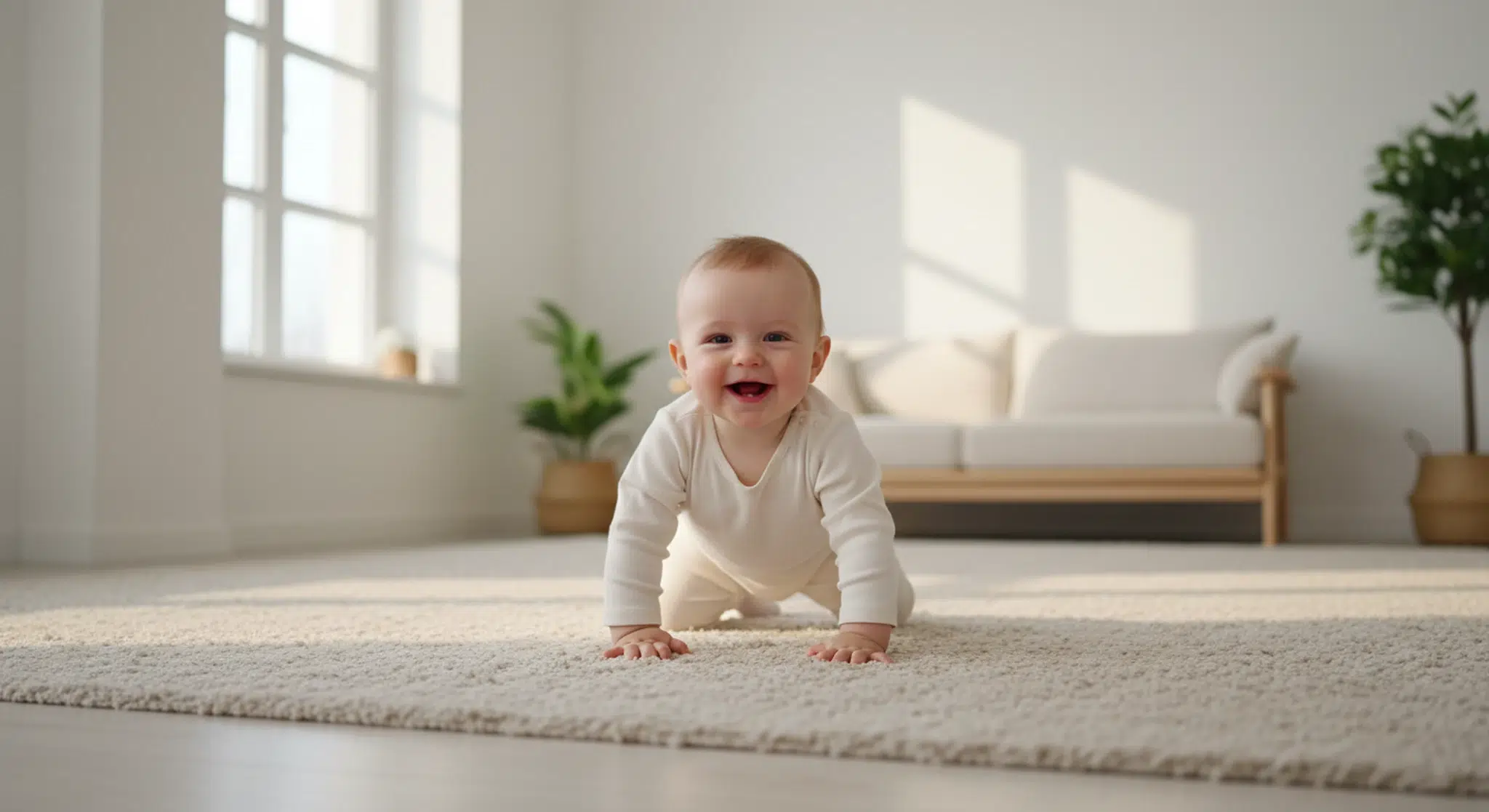
Crawling usually shows up somewhere between 7 and 10 months, so plenty of 9 month olds are motoring across the room while others are still rocking on hands and knees or army-crawling on their bellies. Some babies skip crawling altogether and go straight to pulling up and cruising, and that is a normal variation, not a delay, as long as they are finding some way to move and using both sides of the body equally. A few ambitious babies are already pulling to stand on the couch by 9 months; if yours is, it is time to drop the crib mattress if you have not already. Our guide to when babies start crawling covers the styles and the timeline in detail.
Hand and Finger Skills
Nine month old hands are busy hands. Expect your baby to move objects smoothly from one hand to the other, bang two blocks together like tiny cymbals, and use a raking grasp, sweeping all four fingers like a little garden rake, to drag a puff or piece of banana toward their palm. The refined pincer grasp, thumb and forefinger picking up a crumb with surgical precision, is just beginning for some babies and typically solidifies closer to 10 to 12 months.
This is also the age of the dropped-spoon game. Your baby lets go of something, watches it fall, and looks for it, which is object permanence in action. Exhausting at dinner, but it is genuine cognitive work.
Language and Communication at 9 Months
The soundtrack of 9 months is reduplicated babbling: long strings of repeated syllables like “mamamama,” “dadadada,” and “babababa.” These are not usually true words yet, though “mama” and “dada” start attaching to the right person for some babies over the next couple of months. Your baby should also turn when you call their name, lift their arms to be picked up, and understand your tone well enough to pause (briefly) at a firm “no.”
You can feed this growth without flashcards. Narrate what you are doing, name what your baby is looking at, read board books with real enthusiasm, and answer their babble as if it were conversation, because to them it is. Around this age many families also start baby sign language for words like “milk” and “more,” which gives pre-verbal babies a way to talk to you months before speech.
Social, Emotional, and Thinking Skills
Nine months is peak peekaboo. Your baby now holds the idea of you in mind when you disappear behind your hands, which is why the reveal is so thrilling. The same cognitive leap has a harder edge: separation anxiety. Many 9 month olds who happily went to anyone at 6 months now cling, cry at daycare drop-off, and treat Grandma like a suspicious stranger. This is healthy attachment doing exactly what it should, and it typically peaks between 9 and 18 months before easing. Our guide to separation anxiety and baby sleep has scripts for the hard goodbyes and the midnight wake-ups it causes.
Other social and cognitive milestones to watch for: reacting when you leave the room, smiling and laughing during games, looking for objects they watched you hide, and showing clear preferences for favorite people and toys. Some babies this age start clapping or waving, though both commonly arrive closer to 10 to 12 months.
Is 9 month sleep falling apart too?
New motor skills and separation anxiety are classic sleep wreckers at this age. Betteroo builds a personalized plan around your baby’s exact stage.
Most 9 month olds need about 12 to 16 total hours of sleep in 24 hours, usually split between 10 to 12 hours at night and two daytime naps. Wake windows run roughly 2.5 to 3.5 hours. If nights suddenly fall apart, you are not imagining it: the combination of crawling practice, pulling to stand, and separation anxiety makes this one of the most common sleep regression ages. Our 9 month old sleep schedule lays out sample days that actually work.
At the table, 9 month olds typically eat three small meals of solids plus snacks alongside 24 to 32 ounces of breast milk or formula. The raking grasp means self-feeding is messy but real: soft finger foods like banana pieces, well-cooked pasta, shredded chicken, and avocado strips build the skills that the pincer grasp will soon refine. Keep pieces soft and small, and skip round, firm choking hazards like whole grapes and hot dog coins.
When to Talk to Your Pediatrician
Development has a wide normal range, and single missing skills are rarely alarming. That said, the CDC and AAP suggest discussing it with your pediatrician if by 9 months your baby:
Cannot sit, even with support
Does not babble (“mama,” “baba,” “dada” sounds)
Does not respond to their own name
Does not look where you point
Does not transfer objects from one hand to the other
Does not bear weight on their legs when supported
Does not smile, laugh, or engage in back-and-forth games like peekaboo
Uses one side of the body noticeably more than the other
The 9 month visit includes a standardized developmental screen, so write your observations down beforehand. If anything is off track, early intervention services are free or low cost in every US state, and acting early genuinely changes outcomes. Trust your gut: you watch this baby all day, and your observations are data.
Frequently Asked Questions
What milestones should a 9 month old be doing?
By 9 months, most babies sit without support, get into a sitting position on their own, transfer objects hand to hand, rake food toward themselves, babble consonant strings like “mamama,” respond to their name, react when you leave, and enjoy peekaboo. Many crawl and some begin pulling to stand, though both have wide normal ranges.
Is it normal for a 9 month old not to crawl?
Yes. Crawling typically emerges between 7 and 10 months, and some healthy babies scoot on their bottoms, roll to get places, or skip crawling entirely and move straight to pulling up and cruising. What matters is that your baby has some way of moving, uses both sides of the body equally, and is progressing month over month.
How many words should a 9 month old say?
Usually none yet, and that is completely normal. At 9 months the expected skill is babbling, long repeated strings like “bababa” and “dadada,” plus responding to their name and understanding tone. First true words most often arrive around 12 months, with anywhere from 9 to 14 months in the normal range.
Why is my 9 month old suddenly clingy?
Separation anxiety typically emerges around 9 months as babies develop object permanence: they now know you still exist when you leave, and they mind. Clinginess, crying at drop-off, and stranger wariness are signs of healthy attachment. Short, confident goodbyes and consistent reunions help it ease over the following months.
When should I worry about my 9 month old’s development?
Talk to your pediatrician if your baby cannot sit even with support, does not babble, does not respond to their name, does not transfer objects between hands, does not bear weight on their legs, or strongly favors one side of the body. The 9 month checkup includes a formal developmental screening, so bring your specific observations to that visit.
Nine months of growing deserves better nights.
Betteroo turns your baby’s age, temperament, and current schedule into a step-by-step sleep plan that fits this exact stage.