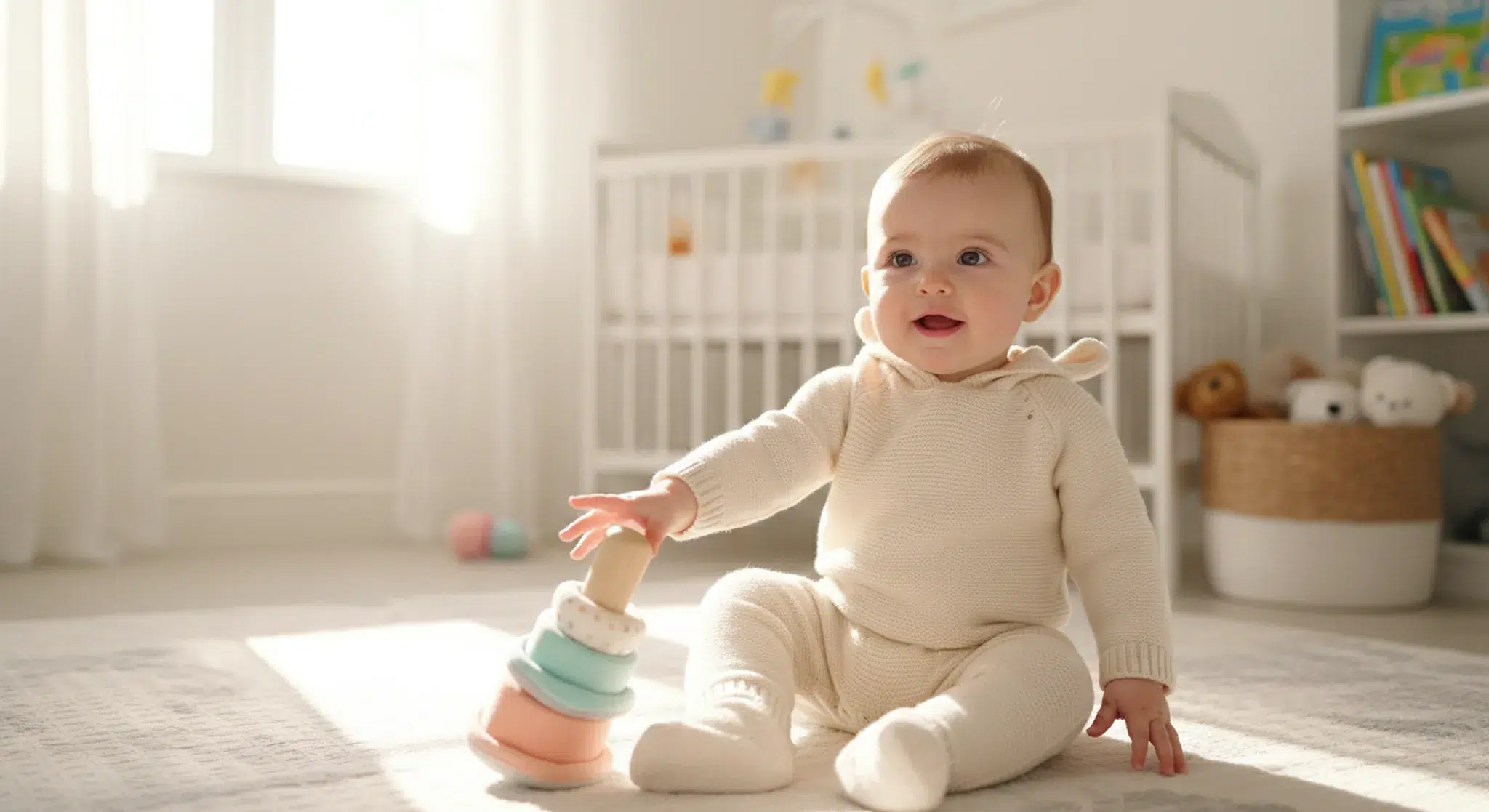
At 7 months, most babies sit with minimal support, roll both ways with ease, grab everything within reach, babble consonants like ba and da, and know their own name. Crawling is on the horizon but not expected yet, and solids are becoming a genuinely fun part of the day.
Month seven is a bridge: your baby has left the newborn stage decisively behind but has not yet launched into the crawling, cruising chaos of the last quarter of the year. It is a month of consolidation, sitting gets solid, babble gets talkative, and personality gets loud.
Here is what is typical at 7 months across movement, hands, language, social development, feeding, and sleep, plus what deserves a mention at your next checkup.
Key Takeaways
Sitting with little or no support is the headline motor skill at 7 months.
Consonant babble (ba, da, ma) ramps up; responding to their name is expected now.
Crawling is not expected yet; scooting and rocking on all fours are the warmups.
Most 7 month olds sleep 12 to 16 total hours across a night and 2 to 3 naps.
Solids are ramping up alongside breast milk or formula, with iron the key nutrient.
Table of Contents
Movement Milestones at 7 Months
Sitting is the big one. Around 6 to 8 months, babies move from tripod sitting (propped on their own hands) to sitting tall with hands free for play, and by 7 months many can catch themselves with a protective arm when they tip. Rolling is now a transportation strategy in both directions, and plenty of 7 month olds get up on hands and knees and rock, the classic pre crawling move. Our when babies sit up guide covers the whole sitting timeline.
Held upright, your baby probably loves to stand and bounce, taking real weight on their legs. This strengthens exactly the muscles crawling and walking will need. Give lots of floor time on a safe surface; container time in seats and bouncers is the thing to ration, not floor freedom.
Sits with little support, and increasingly with none.
Rolls both directions and uses rolling to travel.
Rocks on hands and knees or scoots; crawling itself is usually still ahead.
Bears weight on legs and bounces when held standing.
Hands and Fine Motor Skills
Seven month olds reach with intent, rake small objects toward themselves, and transfer toys from hand to hand, a skill worth noticing because it shows both hands and both sides of the brain cooperating. Everything still goes straight to the mouth, which is normal exploration, so keep small choking hazards out of range. The refined pincer grasp with thumb and fingertip typically arrives closer to 9 to 12 months.
Language and Social Development
Babble is turning structurally speech-like. Expect strings of consonant vowel syllables, ba ba, da da, ma ma, delivered with conversational intonation, plus squeals, raspberries, and belly laughs. Your baby recognizes their own name, turns to your voice, and reads your tone: a cheerful voice gets smiles, a sharp one can bring tears. Our babbling guide and cooing guide map the whole sound timeline.
Socially, 7 month olds are keen students of faces and emotions. Peekaboo starts landing because object permanence is emerging, and you may see the first hints of stranger wariness and separation protest, which typically build over the next two months. Back and forth games, imitation, and narrating your day are the best language curriculum there is.
Struggling with your baby’s sleep?
A personalized plan meets your baby where they are, at every age and stage.
By 7 months most babies have a few weeks of solids experience and are eating once or twice a day, alongside breast milk or formula, which still supplies most of their nutrition until age 1. This is a great month to advance: thicker purees, mashed table foods, and soft graspable pieces if you are doing baby led weaning. Iron rich foods, meat, beans, lentils, eggs, and fortified oat cereal, deserve daily attention because babies’ iron stores from birth are running down now.
Introduce allergens like peanut and egg early and keep them in the rotation; early introduction is protective. Skip honey until 1, and skip juice. Our purees guide, baby led weaning guide, and egg introduction guide cover the details.
Sleep at 7 Months
Most 7 month olds need 12 to 16 hours of sleep per 24 hours, per the American Academy of Sleep Medicine consensus, usually as 10 to 12 hours at night plus two or three naps. Many babies drop the late day catnap between 6 and 8 months, landing on a two nap rhythm with wake windows around 2.5 to 3 hours.
If sleep wobbles this month, the usual suspects are new motor skills (sitting up in the crib is a favorite party trick), early separation anxiety, and teething. Our 7 month sleep regression guide covers the disruption playbook, and the sleep schedule by age guide shows what realistic days look like.
When to Talk to Your Pediatrician
Cannot sit even with support, or feels notably stiff or floppy.
Does not reach for objects or bring things to their mouth.
No babbling sounds, or no response to name, voices, or nearby sounds.
Does not roll in either direction.
Shows no warmth or joy with familiar people, or has lost skills they had.
One missing skill is usually just a timeline difference, and the 9 month visit includes a formal developmental screening that will look at all of this systematically. Raising a concern early costs nothing and buys peace of mind.
What Comes Next
Month eight typically brings solid independent sitting, real mobility experiments, louder babble, and the arrival of separation anxiety as object permanence clicks in. Our 8 month milestones guide picks up there, and when babies crawl previews the big locomotion leap.
Play Ideas for 7 Month Olds
Play at 7 months should reward reaching, sitting, and making things happen. Sit your baby in a boppy or on the floor with toys arranged just slightly out of easy reach to encourage leaning and recovering balance. Offer two toys at once to practice holding one in each hand, and a third to force the fascinating problem of what to do with full hands. Cause and effect toys, buttons that light up, cups that stack and crash, spoons that bang, are the current obsession because your baby is discovering they can make the world respond.
Mirror play earns its reputation: babies this age adore the baby in the mirror, and it builds social attention. Simple turn taking games, you babble, pause, and let them answer, are literal conversation practice, and singing the same few songs daily gives your baby patterns to anticipate. None of this needs to be scheduled or lengthy; a few engaged minutes sprinkled through the day, plus generous free floor time, is exactly the dose that fuels 7 month old development.
A realistic 7 month day, for reference: wake around 7, milk feeds every 3 to 4 hours, solids once or twice, two or three naps adding up to about 3 hours, and bedtime between 7 and 8. If your day looks different but your baby is content and growing, your day is also right.
Frequently Asked Questions
What milestones should a 7 month old have?
Most 7 month olds sit with little or no support, roll both directions, reach for and rake objects, pass toys between hands, babble consonant sounds, respond to their own name, and show clear emotions like joy and frustration. Many are starting to scoot or get up on hands and knees.
Should a 7 month old be crawling?
No, crawling is not expected at 7 months. Crawling typically emerges between 6 and 10 months, and some healthy babies never crawl at all, moving by scooting or rolling before pulling to stand. Rocking on hands and knees at 7 months is right on track.
What sounds should a 7 month old make?
Expect lots of vocal play: squeals, raspberries, laughter, and increasingly consonant babble like ba, da, and ma, often in repeated strings. Babble has no specific meaning yet. If your baby is quiet, makes no consonant sounds, or does not react to sounds around them, mention it to your pediatrician.
How much should a 7 month old sleep?
Most 7 month olds need 12 to 16 hours of sleep in 24 hours, usually 10 to 12 hours at night plus 2 to 3 naps totaling 2 to 3.5 hours. Many babies are settling into a predictable two or three nap rhythm by this age.
How much solid food should a 7 month old eat?
At 7 months most babies eat solids once or twice a day, a few tablespoons at a time, alongside their usual breast milk or formula, which still provides most nutrition. Focus on iron rich foods and progressing textures rather than volume; appetite varies widely from baby to baby.
Milestones and sleep in one plan
Get a personalized plan built around your baby’s stage, naps, and temperament.
Paruthi S, et al. Recommended Amount of Sleep for Pediatric Populations: A Consensus Statement of the American Academy of Sleep Medicine. Journal of Clinical Sleep Medicine, 2016. https://jcsm.aasm.org/doi/10.5664/jcsm.5866