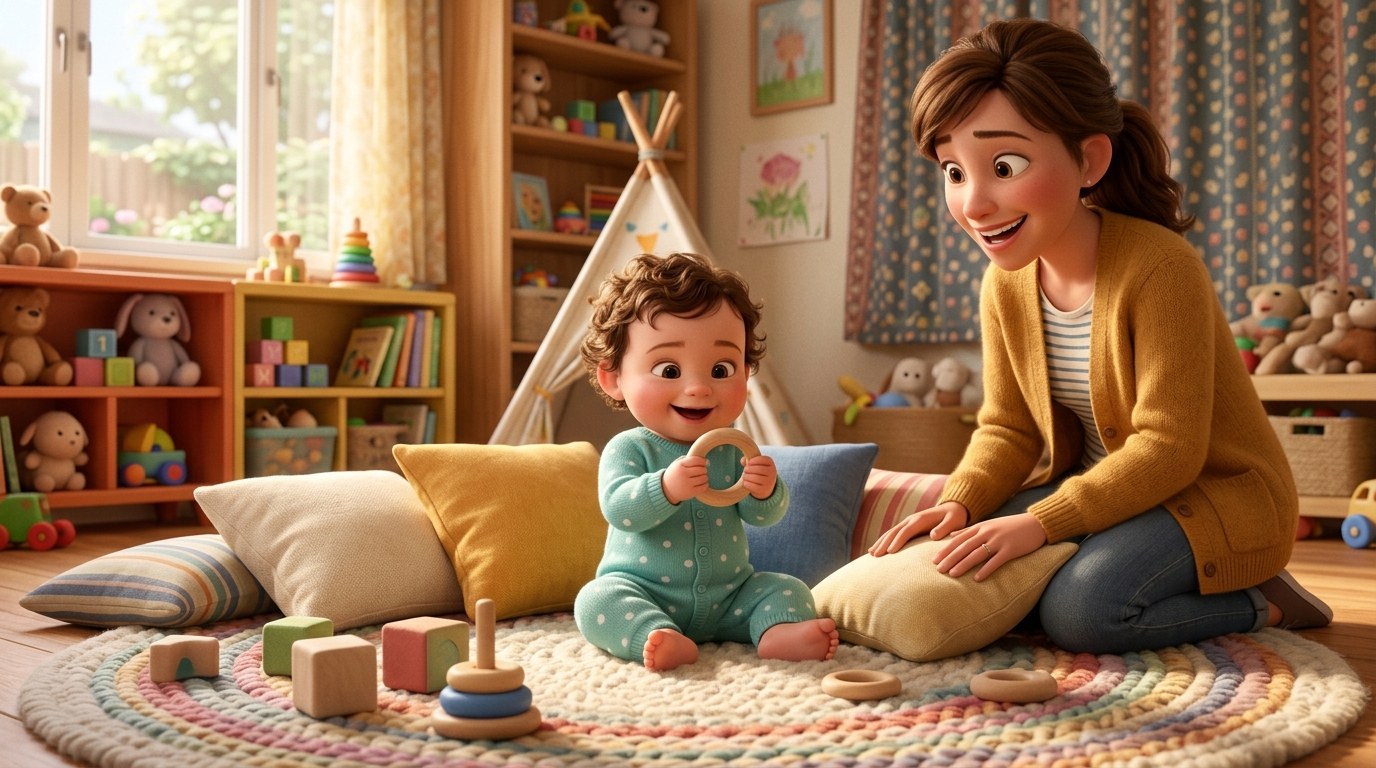
Most babies can sit propped up with support around 4 to 6 months and sit steadily on their own between about 6 and 9 months. Sitting is a big one for parents because it changes how a baby sees the world and frees their hands to play.
Like every motor skill, it arrives in stages: first with help, then with hands planted on the floor for balance, then hands-free. And like every milestone, the age range is wider than most charts suggest.
Here is when sitting typically develops, how to support it safely, and the specific signs that are worth a conversation with your pediatrician.
Propped sitting often starts around 4 to 6 months. Independent sitting usually lands between 6 and 9 months.
Even the most predictable milestone, sitting, spans nearly half a year of normal variation in the WHO data.
Tummy time builds the trunk strength sitting needs. It is the single most useful thing you can do.
Sit-me-up seats and rings are not shown to help a baby sit sooner, and propping before the trunk is ready is generally discouraged.
Talk to your pediatrician if your baby is not sitting with support by 6 months or without support by 9 months.
How Sitting Develops
Quick Answer
Most babies sit propped with support around 4 to 6 months and sit independently between about 6 and 9 months.1 It progresses from supported sitting, to tripod sitting with hands on the floor for balance, to sitting with hands free to play. Tummy time is what builds the trunk strength it takes.
Sitting needs core and trunk stability to stay upright against gravity, plus protective reactions, the instinct to throw out an arm to catch themselves. Those develop through the same awake floor time that drives rolling and crawling.
The World Health Organization, tracking healthy babies across six countries, found sitting without support had the narrowest window of all the major motor milestones, and even that ran from about 3 and a half to 9 months.1 The most predictable milestone still spans nearly half a year of normal variation.
When Do Babies Sit Up? The Age Range
Sitting comes in steps. This is the typical progression, framed as common rather than required.
Age
What often happens
Stage
3 to 4 months
Holds head steady, pushes up on forearms in tummy time
Building blocks
4 to 6 months
Sits propped against you or a cushion, briefly
Supported
6 months
Tripod sit, leaning on both hands for balance
Transitional
6 to 9 months
Sits without support, hands free to play
Independent
8 to 9 months
Gets into a sitting position on their own
Self-directed
Typical sitting progression. Wide individual variation is normal.
The CDC lists “leans on hands to support himself while sitting” at 6 months and both “sits without support” and “gets to a sitting position” at 9 months.34 Notably, the CDC moved the get-to-sitting item earlier, from 12 months to 9, in its 2022 update, a reminder that even the official age is an evolving read of the evidence, not a fixed fact.2
Sitting Up and the Night-Waking Peak
Independent sitting develops across the same months night waking peaks. In our State of Baby Sleep 2026 report, drawn from 74,379 parents across 112 countries, the high point of night waking lands squarely in the sitting window.
Night waking peaks at 66.7 percent at 7 to 9 months. If your new sitter is waking more, the milestone and the sleep dip are traveling together, and both are normal.
How to Help Your Baby Sit Up
Supporting sitting, safely
Strength first, props last
1
Prioritize tummy time
Trunk and neck strength from awake floor time is what sitting is built on.
2
Practice supported sitting
Sit your baby in your lap or between your legs so they feel upright with your support.
3
Encourage the tripod
On the floor, let them lean on their own hands. Cushions around them soften the tip-overs.
4
Dangle toys at eye level
Reaching while seated strengthens balance and rotation.
5
Supervise every time
New sitters topple. Stay within arm’s reach, off any raised surface.
The floor and your lap are the tools. Props are not required.
Floor seats, inflatable rings, and sit-me-up chairs are marketed as helping babies sit earlier. Here is the honest read: there is no published evidence that these products make a baby sit sooner, and propping a baby upright before their trunk is ready is generally discouraged, because it does the balancing work their own muscles need to do.
This is a softer claim than the one about walkers, which pediatricians actively oppose and where the evidence of harm is robust.5 With sitting seats it is more an evidence gap than a proven problem. Used briefly and supervised they are unlikely to hurt, but they will not replace floor time, and floor time is what builds the skill.
None of these seats are safe for sleep. All sleep stays on the back, on a firm, flat, bare surface.5
When to Talk to Your Pediatrician
Sitting has a formal milestone anchor, so the flags are clearer here than for crawling. Raise it at a visit if your baby:6
Is not sitting with support by around 6 months.3
Is not sitting without support by around 9 months.4
Cannot hold their head steady, or seems very stiff or very floppy.
Strongly favors one side of the body when reaching or moving.
Has lost a skill they previously had.6
A lost skill at any age is a reason to be seen promptly rather than to wait and watch.6 Premature babies are usually assessed by their adjusted age.
Frequently Asked Questions
At what age do babies sit up?
Most babies can sit propped up with support around 4 to 6 months and sit independently, with hands free, somewhere between 6 and 9 months. The WHO found the window for sitting without support ran from about 3 and a half to 9 months in healthy babies, so there is a lot of normal range on both ends.
What is tripod sitting?
Tripod sitting is the in-between stage where a baby sits upright but leans forward on both hands for balance, making a tripod shape. It usually appears around 6 months and is a normal step between supported sitting and full hands-free sitting. Cushions around your baby help soften the inevitable tip-overs.
How can I help my baby learn to sit up?
Lots of awake tummy time is the main thing, because it builds the trunk and neck strength sitting depends on. Practice supported sitting in your lap, let your baby lean on their own hands on the floor, and hold toys at eye level to encourage reaching and balance. Always supervise a new sitter and stay off raised surfaces.
Are sit-me-up seats good for babies?
There is no evidence that floor seats or sitting rings help a baby sit sooner, and propping a baby up before their trunk is strong enough is generally discouraged. Used briefly and supervised they are unlikely to cause harm, but they do not replace floor time, which is what actually builds the skill. None are safe for sleep.
My baby is 7 months and not sitting yet. Is that normal?
Often, yes, especially if your baby is sitting with support and meeting other milestones like holding their head steady and pushing up in tummy time. Independent sitting can normally arrive as late as 9 months. Talk to your pediatrician if your baby is not sitting with support by 6 months, seems very stiff or floppy, or has lost a skill.
Does sitting up come before or after crawling?
Sitting usually comes first. Independent sitting typically develops between 6 and 9 months, while crawling more often appears between 6 and 10 months, and the trunk strength and balance a baby builds while learning to sit feed directly into crawling. That said, the two overlap, and some babies do them close together.
Want a plan that keeps up with your baby?
Get a personalized routine that adapts as your baby grows stronger.
WHO Multicentre Growth Reference Study Group. WHO Motor Development Study: windows of achievement for six gross motor development milestones. Acta Paediatr Suppl. 2006;450:86-95. https://pubmed.ncbi.nlm.nih.gov/16817682/
Zubler JM, Wiggins LD, Macias MM, et al. Evidence-Informed Milestones for Developmental Surveillance Tools. Pediatrics. 2022;149(3):e2021052138. https://pubmed.ncbi.nlm.nih.gov/35132439/
American Academy of Pediatrics, Committee on Injury and Poison Prevention. Injuries associated with infant walkers. Pediatrics. 2001;108(3):790-2. https://pubmed.ncbi.nlm.nih.gov/11533353/