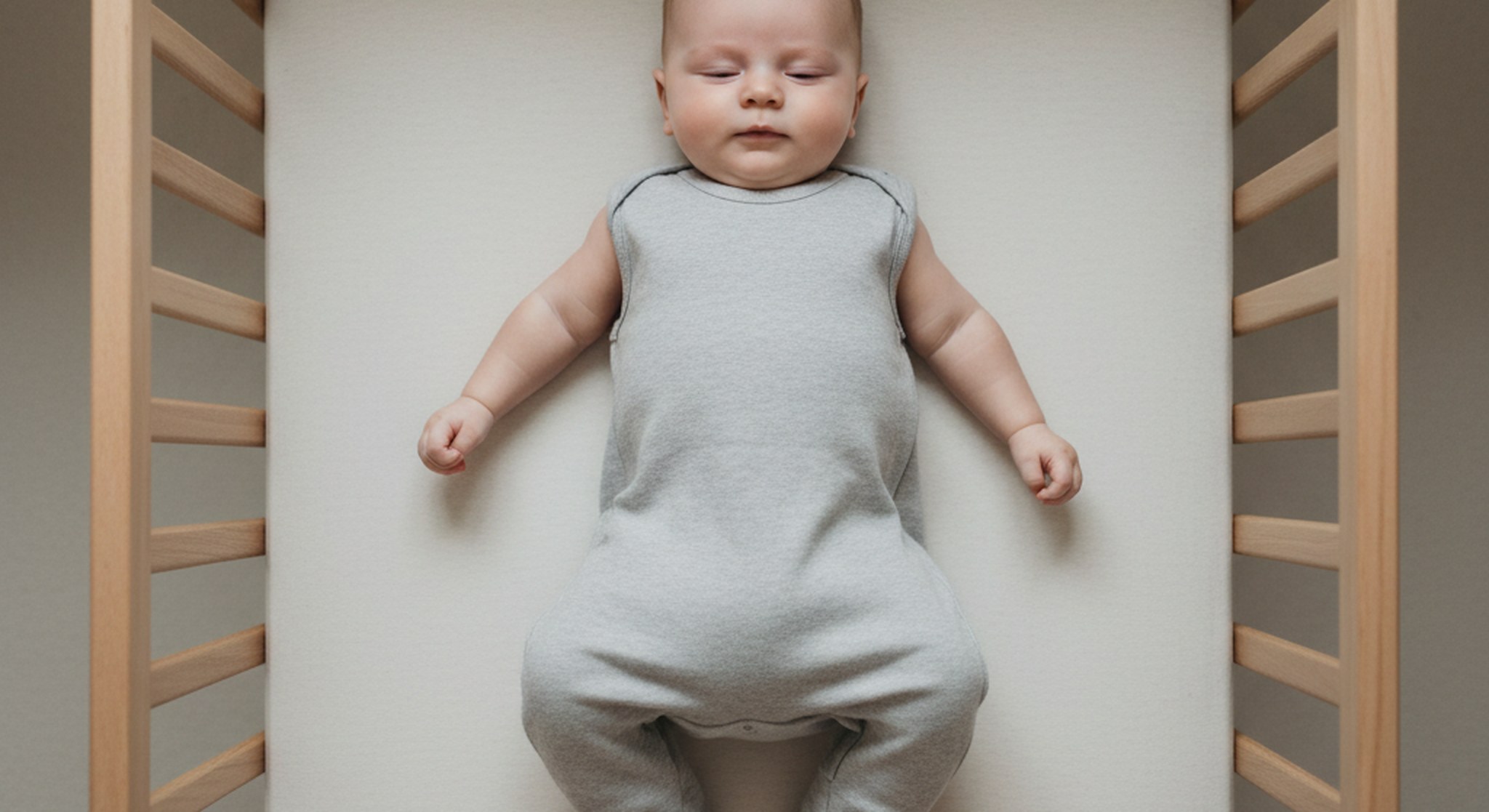
Seven months is a turning point you can feel. Your baby sits without toppling, maybe rocks on hands and knees or scoots toward a toy, and suddenly wants to be part of everything. All that new ability is exciting by day and inconvenient by night. Parents searching for a 7 month old sleep schedule are usually chasing one of three things: naps that no longer fit the old three-nap day, a baby who fights sleep as separation awareness kicks in, or night waking that seems to have gotten worse instead of better.
Here is the honest truth about this age: night waking is at its statistical peak right now. If you feel like you are up more than any of your friends, the data says you might be. The reassuring part is that seven months also sits at the top of the curve, which means the trend from here is downhill. A steadier schedule, built around the shift from three naps to two, is the single best tool you have.
This guide covers how much sleep a seven month old needs, a sample two-nap day, what our survey of tens of thousands of parents reveals about night waking at this age, and how to ride out the 3-to-2 nap transition and the so-called six or seven month regression without losing your footing.
Table of Contents
At a Glance: 7 Month Sleep Expectations
At seven months, most babies sleep 12 to 15 total hours per day: roughly 10 to 12 hours overnight plus 2.5 to 3.5 hours across 2 to 3 naps that are usually consolidating toward two. Wake windows run 2.5 to 3 hours, and bedtime typically falls between 6:30 and 7:30 p.m.
Here is some perspective from Betteroo’s State of Baby Sleep survey: night waking peaks at 7 to 9 months, when 67.3% of babies wake three or more times a night (n=5,002). That is the highest of any age band we measured. If your seven month old is waking often, you are squarely in the majority, and the numbers only improve from here.
How Much Should a 7 Month Old Sleep?
The American Academy of Sleep Medicine recommends 12 to 16 hours per 24 hours for infants aged 4 to 12 months, naps included 1. Most seven month olds land in the 12 to 15 hour range, and reference studies of infant sleep show broad, healthy variation around those numbers 2.
Sleep Type
Typical Range at 7 Months
Total Sleep
12–15 hours
Night Sleep
10–12 hours
Naps
2–3 per day (2.5–3.5 hours total)
Wake Windows
2.5–3 hours
Seven months sits right in the middle of the nap transition. Some babies still take a short third catnap; many are settling into two longer naps. In our data, 65% of babies aged 7 to 11 months are on 2 naps, so if your seven month old is drifting that way, they are moving with the crowd. A short third nap is fine as a bridge while the main naps lengthen. It becomes a problem only when it pushes bedtime late.
A Sample 7 Month Old Sleep Schedule (An Example, Not a Rule)
A two-nap day is the target most families settle into around this age. Here is one common shape:
7:00 a.m. – Wake
9:30–10:45 a.m. – Nap 1
1:45–3:00 p.m. – Nap 2
7:00 p.m. – Bedtime
If your baby is still on three naps, the day looks a little different: three shorter sleeps with wake windows closer to 2 to 2.5 hours and a slightly later bedtime. Both are normal at seven months. The thing to protect is the last wake window before bed, roughly 3 to 3.5 hours on two naps. If the afternoon nap runs short, move bedtime earlier rather than adding a late catnap, which at this age tends to fragment the night.
An early bedtime helps more than almost anything else at seven months, especially while your baby is overtired mid-transition. In our survey, 39% of all babies have a bedtime between 7:00 and 7:59 p.m., the single most common window, and many seven month olds do best on the earlier edge of that range. A consistent bedtime anchored by a predictable routine is one of the most evidence-backed sleep tools you have 3.
Why 7 Month Old Sleep Gets Bumpy
If sleep has gone sideways lately, the cause is almost always development, not a broken schedule:
New motor skills. Sitting is solid and crawling is coming online. Babies practice these skills the moment you set them down, including in the crib at 3 a.m.
The 3-to-2 nap transition. Dropping to two naps stretches wake windows and, for a few weeks, can leave your baby slightly overtired while their body recalibrates.
Separation awareness. Object permanence is starting to click. Your baby is beginning to understand that you still exist when you leave the room, and bedtime protest can climb as a result.
The six or seven month regression. Many families hit a rough patch right around now, a mix of all the above landing at once. It is real, and it is temporary.
Whatever you call it, the pattern is the same: a temporary disruption stacked on top of a schedule that is actually fine. Our 8 month sleep regression guide covers the stretch just ahead of this one, and the wake windows guide shows how the day expands as your baby grows.
From Betteroo’s State of Baby Sleep
Night waking by age, share of babies waking 3+ times: 4–6 months 65.6%, 7–9 months 67.3% (the peak), 10–12 months 60.5%, 13–18 months 53.5%. Seven months sits at the very top of the curve. If your baby is waking often right now, that is the statistical norm, and the only direction from here is down. Explore the full data →
Helping Your 7 Month Old Sleep Better
A few high-leverage moves while you build your 7 month sleep schedule:
Give new skills daytime reps. The more sitting, rocking, and crawling practice happens on the floor at 10 a.m., the less novelty there is to rehearse at 2 a.m.
Ease into two naps. If the third nap is falling apart, gently stretch the morning wake window and let the two remaining naps grow. Our baby sleep schedule by age guide maps how nap counts shift month to month.
Keep night responses calm and brief. With separation awareness rising, a quick reassuring presence works better than a long intervention that becomes the new expectation.
Protect an early bedtime. During the transition, an overtired baby sleeps worse. Pulling bedtime earlier on rough days often buys back a smoother night.
Consider gentle structure if independent sleep is a struggle. Seven months is a workable age for consistency. For structured approaches, see common sleep training methods.
Research shows that a nightly bedtime routine alone significantly reduces night wakings, even without any other changes 3. That makes a simple, repeatable wind-down one of the best investments you can make during a peak-waking stretch.
When to Talk to a Pediatrician
Reach out if your baby consistently sleeps well under 12 total hours, snores or has breathing pauses, wakes screaming inconsolably most nights, or if feeding and growth are a concern. And now that sitting and pulling to stand are close, keep the crib bare and lower the mattress, in line with AAP safe sleep guidance 4.
7 Month Old Sleep Schedule FAQ
What are wake windows for a 7 month old?
Typically 2.5 to 3 hours: shortest before the morning nap and longest before bedtime. Babies still on three naps often run a little shorter, closer to 2 to 2.5 hours. If bedtime battles appear, the last wake window is usually the one to adjust first.
How many naps should a 7 month old take?
Two to three, consolidating toward two, for 2.5 to 3.5 hours total. In Betteroo’s State of Baby Sleep survey, 65% of babies aged 7 to 11 months were on a two-nap day. A short third catnap is a normal bridge while the main naps lengthen.
Is there a 7 month sleep regression?
Many families hit a rough patch around six or seven months, driven by sitting and crawling, the move to two naps, and the start of separation awareness. It is temporary. Keeping the schedule steady and responses brief usually resolves it within a few weeks.
Why is my 7 month old waking up so much at night?
Seven months is the statistical peak for night waking: 67.3% of babies this age wake three or more times a night in our survey. New motor skills, the nap transition, and separation awareness all land at once. The trend improves steadily from here.
Should my 7 month old still feed at night?
Many seven month olds still take one or two night feeds, and that is developmentally normal. If weight gain is on track and your pediatrician agrees, you can gradually reduce them; if a brief feed works for your family, there is no rush.
Peak night waking, a nap transition, and new skills all at once
Get a personalized sleep plan built around your baby’s age, temperament, and your family’s needs.
Seven month old sleep is a story of a solid schedule colliding with a burst of development at the exact moment night waking peaks. That timing is hard, but it is not a sign anything is wrong. Move toward two naps as your baby is ready, give new skills plenty of daylight to burn off, respond at night with calm brevity, and protect an early bedtime. From this peak, the curve bends steadily in your favor.
Paruthi, S., et al. (2016). Recommended Amount of Sleep for Pediatric Populations: A Consensus Statement of the American Academy of Sleep Medicine. Journal of Clinical Sleep Medicine, 12(6), 785–786.https://pmc.ncbi.nlm.nih.gov/articles/PMC4877308/
Iglowstein, I., Jenni, O.G., Molinari, L., & Largo, R.H. (2003). Sleep duration from infancy to adolescence: Reference values and generational trends. Pediatrics, 111(2), 302–307.https://pubmed.ncbi.nlm.nih.gov/12563055/
Mindell, J.A., Telofski, L.S., Wiegand, B., & Kurtz, E.S. (2009). A Nightly Bedtime Routine: Impact on Sleep in Young Children and Maternal Mood. Sleep, 32(5), 599–606.https://pubmed.ncbi.nlm.nih.gov/19480226/
American Academy of Pediatrics. (2022). Sleep-Related Infant Deaths: Updated 2022 Recommendations for Reducing Infant Deaths in the Sleep Environment.https://pubmed.ncbi.nlm.nih.gov/35726558/