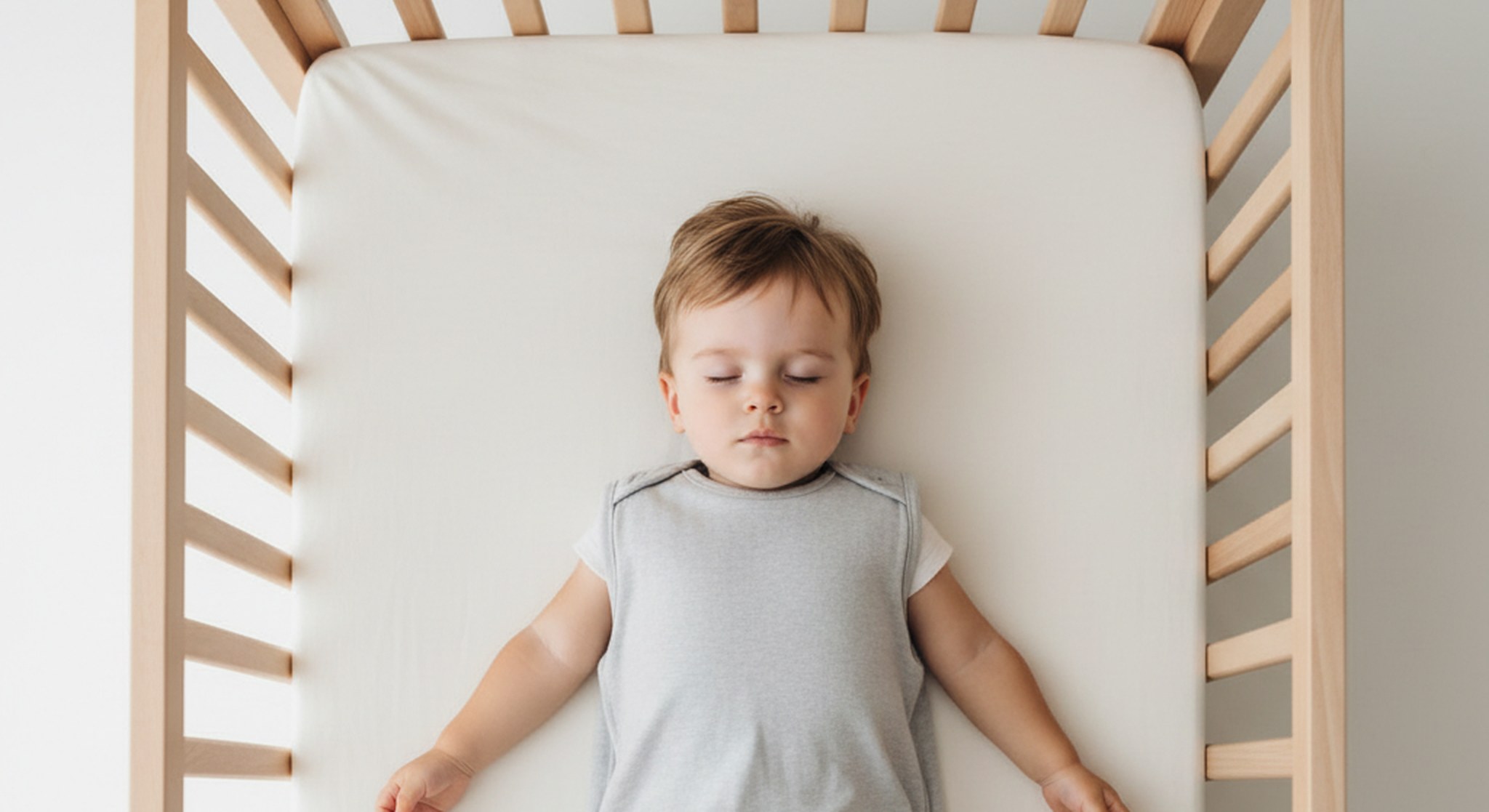
Nineteen months is a talkative age. New words arrive almost daily, opinions come with them, and a lot of that new personality shows up right at bedtime. Parents searching for a 19 month old sleep schedule are usually chasing one of a few things: a toddler who narrates from the crib long after lights out, an afternoon nap that suddenly feels like a negotiation, or a small person who has learned bedtime rules can be tested.
Here is the reassuring part: by nineteen months, most toddlers have a stable, single-nap rhythm. Nights are long and mostly consolidated, and the bumps at this age are usually about development and boundaries rather than a broken schedule.
This guide covers how much sleep a nineteen month old needs, a sample one-nap day, why crib chatter and nap resistance spike now, and how to hold a calm bedtime while your toddler tests its edges.
Table of Contents
At a Glance: 19 Month Sleep Expectations
At nineteen months, most toddlers sleep 11 to 14 total hours per day: roughly 10 to 12 hours overnight plus a single midday nap of about 1.5 to 3 hours. Wake windows now run long, around 5 to 5.5 hours, and bedtime typically falls between 7:00 and 8:00 p.m.
A little perspective from Betteroo’s State of Baby Sleep survey: night waking peaks in the 7 to 9 month range, then falls steadily, and past eighteen months that decline keeps going. If your nineteen month old still surfaces some nights, you are on the gentler side of the curve.
How Much Should a 19 Month Old Sleep?
The American Academy of Sleep Medicine recommends 11 to 14 hours per 24 hours for toddlers aged 1 to 2 years, naps included 1. Most nineteen month olds land squarely in that range, and reference studies show broad, healthy variation around those averages 2.
Sleep Type
Typical Range at 19 Months
Total Sleep
11–14 hours
Night Sleep
10–12 hours
Naps
1 per day (1.5–3 hours)
Wake Windows
5–5.5 hours
The single nap is firmly the norm by now. Most toddlers make the 2-to-1 nap transition between 14 and 18 months, so by nineteen months that one midday sleep is usually well established. If it runs short, the fix is almost always in the wake windows around it, not a second nap.
A Sample 19 Month Old Sleep Schedule (An Example, Not a Rule)
7:00 a.m. – Wake
12:30–2:30 p.m. – Nap
7:30 p.m. – Bedtime
Notice the shape of this 19 month sleep schedule: a long morning stretch of about 5.5 hours before the nap, then roughly 5 hours between the nap and bedtime. Those long wake windows are what a single nap needs. If it runs short, protect the night by pulling bedtime a little earlier.
Bedtime between 7:00 and 8:00 p.m. is where most families settle. In our survey, 39% of all babies have a bedtime between 7:00 and 7:59 p.m., the single most common window. A consistent bedtime anchored by a predictable routine is one of the most evidence-backed sleep tools you have 3.
Why 19 Month Old Sleep Gets Bumpy
If sleep wobbled recently, the cause is usually developmental and social, not a sign the schedule is failing:
Language explosion. Nineteen months is peak new-word season, and all that fresh vocabulary gets rehearsed out loud, which is why so many toddlers lie in the crib narrating well past lights out.
Nap resistance and nap strikes. A more alert, more opinionated toddler may fight the nap or skip it for a day or two. A single skipped nap is not the two-to-one transition arriving; it usually resolves on its own.
Testing bedtime limits. Independence is blooming, and bedtime is a natural stage for it: one more book, one more drink, one more call for you. This is boundary practice, not defiance.
Separation and big feelings. Toddlers this age hold you in mind vividly, so protest at the door can flare even when nothing is wrong.
Some parents call this a 19 or 20 month sleep regression. Whatever the label, the pattern is the same: a short, developmentally driven disruption on top of an otherwise solid schedule. Our 18 month old sleep schedule covers the run-up to this stage, and the wake windows guide shows how the day keeps stretching.
From Betteroo’s State of Baby Sleep
Night waking peaks at 7 to 9 months, then declines through the first and second years. By the 13 to 18 month band, the share of toddlers waking frequently has already dropped well below the infant peak, and that trend continues past eighteen months. If your nineteen month old still wakes at night, it is increasingly the exception, and the trend is firmly in your favor. Explore the full data →
Helping Your 19 Month Old Sleep Better
A few high-leverage moves at this age:
Let the talking run out during the day. Plenty of naming, singing, and chatter at 10 a.m. means less new material to rehearse at 8 p.m. Crib chatter is normal and rarely needs a response.
Hold the bedtime boundary warmly. Decide the number of books and drinks in advance, say it out loud, and keep the routine identical each night. Toddlers push hardest against rules that move.
Protect the single nap. One short or skipped nap is not a reason to overhaul the day. Keep offering it at the same time and ride out the occasional strike.
Keep night responses calm and brief. A quiet word and a quick tuck-in beats a long negotiation, which tends to become the new expectation.
Watch wake windows, not just the clock. With one nap, the roughly 5 to 5.5 hour windows on either side do most of the work. Our wake windows guide shows how to tune them.
If falling asleep independently is still a struggle, nineteen months is a very workable age for gentle change. Toddlers respond quickly to consistency, and research shows a steady bedtime routine alone significantly reduces night wakings 3. That, more than any single technique, is what turns this stage around.
When to Talk to a Pediatrician
Reach out if your toddler consistently sleeps well under 11 total hours, snores or has breathing pauses, wakes screaming inconsolably most nights, or if you have concerns about development or growth. And now that climbing is in play, keep the crib mattress at its lowest setting and the sleep space bare, following AAP safe sleep guidance 4.
19 Month Old Sleep Schedule FAQ
What are wake windows for a 19 month old?
On a single nap, wake windows run about 5 to 5.5 hours: one long stretch before the nap and another of similar length between the nap and bedtime. If bedtime battles appear, the afternoon window is usually the first to adjust.
How many naps should a 19 month old take?
One nap, typically 1.5 to 3 hours in the early afternoon. Most toddlers make the 2-to-1 transition between 14 and 18 months, so by nineteen months it is usually well established.
Is there a 19 month sleep regression?
Many families hit a rough patch around this age, driven by the language explosion, nap resistance, and testing of bedtime limits. It is temporary. Steady schedules and calm, brief responses usually settle it within a couple of weeks.
Why does my 19 month old talk in the crib instead of sleeping?
Nineteen months is peak new-word season, and the crib is quiet time to rehearse all of it. Crib chatter is normal and rarely needs a response. Give plenty of talking and singing during the day, then let the narrating wind down at night.
My 19 month old is fighting the nap. Are they ready to drop it?
Almost certainly not. A day or two of nap resistance at this age is usually a burst of independence, not the end of napping. Most toddlers keep a single nap until around age three. Keep offering it at the same time and ride out the occasional strike.
New words, new opinions, new bedtime tests: 19 months is a lot
Get a personalized sleep plan built around your toddler’s age, temperament, and your family’s needs.
Nineteen month old sleep is mostly a story of a good schedule meeting a big personality. The one nap and the long night are steady; what changes is a toddler who now has words, opinions, and the urge to test the edges. Hold the single-nap frame, keep bedtime boundaries warm and consistent, and the bumps smooth out. Night waking keeps declining through toddlerhood, and calm consistency is what carries you there.
Paruthi, S., et al. (2016). Recommended Amount of Sleep for Pediatric Populations: A Consensus Statement of the American Academy of Sleep Medicine. Journal of Clinical Sleep Medicine, 12(6), 785–786.https://pmc.ncbi.nlm.nih.gov/articles/PMC4877308/
Iglowstein, I., Jenni, O.G., Molinari, L., & Largo, R.H. (2003). Sleep duration from infancy to adolescence: Reference values and generational trends. Pediatrics, 111(2), 302–307.https://pubmed.ncbi.nlm.nih.gov/12563055/
Mindell, J.A., Telofski, L.S., Wiegand, B., & Kurtz, E.S. (2009). A Nightly Bedtime Routine: Impact on Sleep in Young Children and Maternal Mood. Sleep, 32(5), 599–606.https://pubmed.ncbi.nlm.nih.gov/19480226/
American Academy of Pediatrics. (2022). Sleep-Related Infant Deaths: Updated 2022 Recommendations for Reducing Infant Deaths in the Sleep Environment.https://pubmed.ncbi.nlm.nih.gov/35726558/