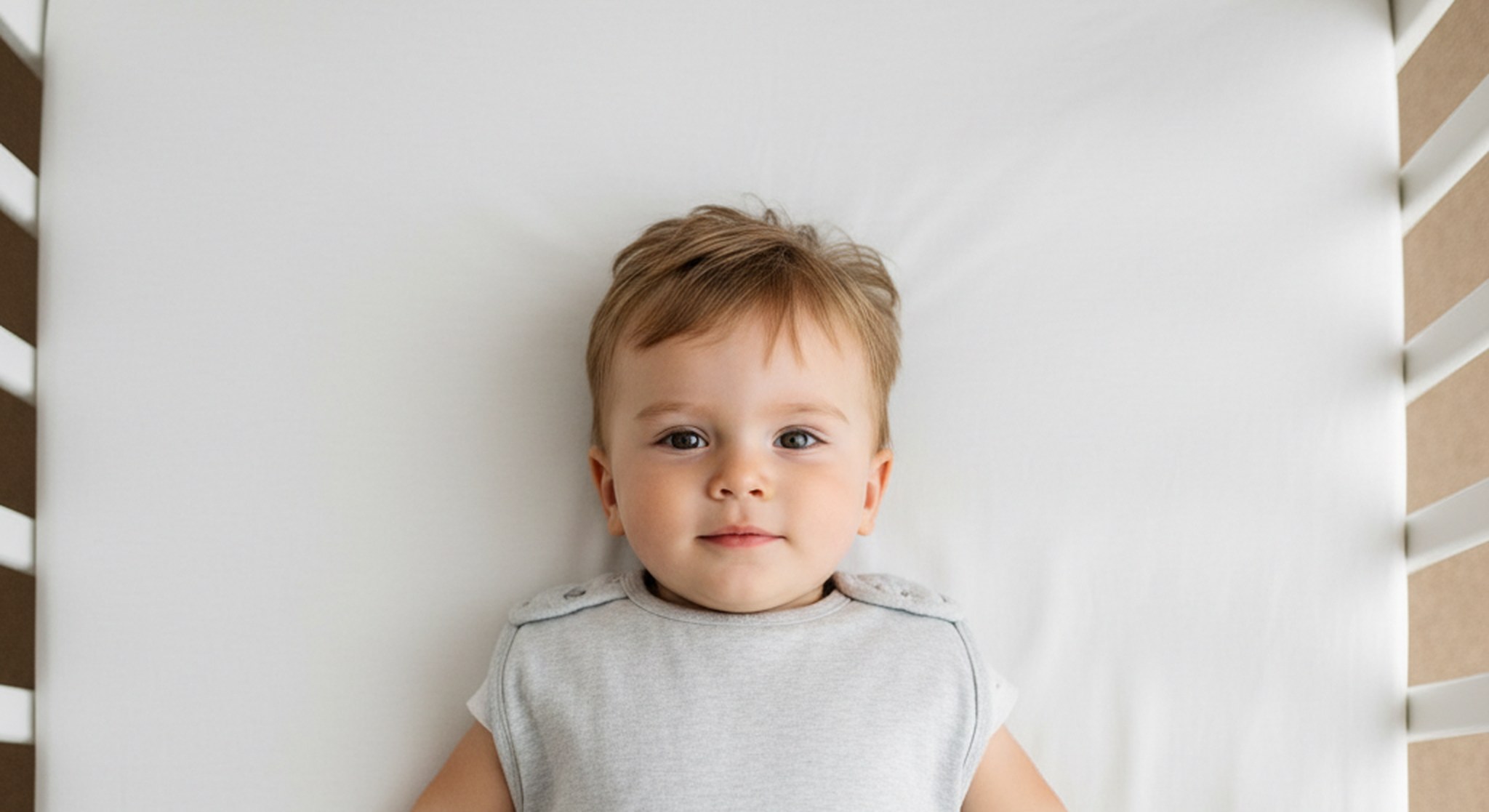
Seventeen months is a chatty, opinionated, wonderfully busy age. Your toddler is stringing together words, testing limits, and discovering exactly how much they can protest before you cave. All of that shows up at sleep time. Parents searching for a 17 month old sleep schedule are usually wrestling with one of three things: a nap that suddenly gets refused, bedtime that turns into a negotiation, or a crib that has become a stage for practicing new words at 6 a.m.
The reassuring news: by seventeen months, your toddler almost certainly has a solid, single-nap rhythm to build on. One good midday nap, a long stretch of overnight sleep, and a consistent bedtime are all well within reach. The bumps at this age are usually developmental and temporary, not a sign that your schedule has broken.
This guide walks through how much sleep a seventeen month old needs, a sample one-nap day, what our survey of tens of thousands of parents shows about toddler night waking, and how to hold a steady schedule through the language burst and the bedtime testing that define this age.
Table of Contents
At a Glance: 17 Month Sleep Expectations
At seventeen months, most toddlers sleep 11 to 14 total hours per day: roughly 10 to 12 hours overnight plus 1.5 to 3 hours in a single midday nap. Wake windows run about 5 to 5.5 hours, and bedtime typically falls between 7:00 and 8:00 p.m.
Here is some perspective from Betteroo’s State of Baby Sleep survey: night waking peaks at 7 to 9 months, when 67.3% of babies wake three or more times a night. By 13 to 18 months that share drops to 53.5% (n=5,002). So if your seventeen month old still wakes at night, you are in the majority, and the trend keeps bending in your favor.
How Much Should a 17 Month Old Sleep?
The American Academy of Sleep Medicine recommends 11 to 14 hours per 24 hours for toddlers aged 1 to 2 years, naps included 1. Most seventeen month olds land squarely in that range, and reference studies of early-childhood sleep show broad, healthy variation around those numbers 2.
Sleep Type
Typical Range at 17 Months
Total Sleep
11–14 hours
Night Sleep
10–12 hours
Naps
1 per day (1.5–3 hours)
Wake Windows
5–5.5 hours
The single midday nap is the norm now. Most toddlers make the two-to-one nap transition somewhere between 14 and 18 months, so by seventeen months your child has likely settled into one longer nap. If you still see occasional two-nap days, that is fine, but the direction of travel is one solid nap anchoring the middle of the day.
A Sample 17 Month Old Sleep Schedule (An Example, Not a Rule)
7:00 a.m. – Wake
12:30–2:30 p.m. – Nap (about 2 hours)
7:30 p.m. – Bedtime
Notice the shape of this 17 month sleep schedule: roughly 5.5 hours awake before the nap, and about 5 hours between the end of the nap and bedtime. Those long wake windows are exactly why a single nap works now. If the nap runs short or gets refused entirely, protect the night by moving bedtime earlier rather than letting your toddler power through on too little daytime sleep.
Bedtime between 7:00 and 8:00 p.m. is where most families land. In our survey, 39% of all babies have a bedtime between 7:00 and 7:59 p.m., the single most common window. A consistent bedtime anchored by a predictable routine is one of the most evidence-backed sleep tools you have 3, and it matters even more now that your toddler is old enough to stall.
Why 17 Month Old Sleep Gets Bumpy
If sleep wobbled recently, the culprit is usually development, not a schedule that has stopped working:
The language explosion. Seventeen months is often peak new-word season, and toddlers practice in the crib. You may hear your child chatting, naming things, or repeating words for twenty minutes at bedtime or before dawn. This is a good sign for development even when it delays sleep.
Nap resistance. A newly verbal, newly independent toddler may fight the nap they clearly still need. One or two skipped naps do not mean it is time to drop the nap.
Testing bedtime. Your toddler is learning cause and effect, and bedtime is a natural place to experiment. Requests for one more book, one more sip, one more anything are developmentally right on schedule.
Separation and independence. Big feelings about being apart from you can spike again around this age, layered on top of molars and the run-up to the 18 month regression.
Many parents feel the first tremors of what comes next around now. Our 18 month sleep regression guide maps that phase in detail, and the wake windows guide shows how the day stretches as your toddler grows. Whatever the label, the pattern is the same: a temporary disruption sitting on top of an otherwise stable schedule.
From Betteroo’s State of Baby Sleep
Night waking by age, share of children waking 3+ times: 4–6 months 65.6%, 7–9 months 67.3% (the peak), 10–12 months 60.5%, 13–18 months 53.5%. If your seventeen month old still wakes at night, that is the statistical norm for this band, and the overall trend keeps heading down. Explore the full data →
Helping Your 17 Month Old Sleep Better
A few high-leverage moves at this age:
Let the talking run its course. If your toddler chatters happily in the crib, leave them to it. Practicing words at bedtime is not a problem to solve, and going in usually turns a solo monologue into a social event.
Protect the one nap. Most toddlers need a nap until at least age three. On a refused-nap day, offer quiet crib time and bring bedtime forward 30 to 45 minutes rather than dropping the nap for good.
Hold the bedtime line kindly. Decide the routine in advance, say yes inside it and a calm no outside it. Consistency is what makes the testing fade.
Audit the sleep environment. Darkness and steady white noise matter more now that your toddler is alert, verbal, and easily lured by early light. A dark room buys back early mornings.
Watch wake windows, not just the clock. With 5 to 5.5 hours between sleeps, a nap that starts too early or too late can knock the whole day off. Our wake windows guide shows how to time them.
If falling asleep independently is still a struggle, seventeen months is a very workable age for gentle change. Toddlers this age respond quickly to consistency, and research shows a steady bedtime routine alone significantly reduces night wakings 3. For a wider view of how sleep evolves, see our baby sleep schedule by age guide.
When to Talk to a Pediatrician
Reach out if your toddler consistently sleeps well under 11 total hours, snores or has breathing pauses, wakes screaming inconsolably most nights, or if you have concerns about growth or development. And keep the sleep space bare and safe, with the crib mattress at its lowest setting now that climbing is a real possibility, in line with AAP safe sleep guidance 4.
17 Month Old Sleep Schedule FAQ
What are wake windows for a 17 month old?
About 5 to 5.5 hours between sleeps on a one-nap day: roughly 5.5 hours before the nap and around 5 hours from the end of the nap to bedtime. If bedtime battles appear, check whether the nap ran too late and shortened the final wake window.
How many naps should a 17 month old take?
One nap, lasting about 1.5 to 3 hours. Most toddlers make the two-to-one nap transition between 14 and 18 months, so by seventeen months a single midday nap is the norm. Occasional two-nap days are fine but no longer typical.
Is there a 17 month sleep regression?
Seventeen months sits right before the well-known 18 month regression, so many families see early nap resistance and bedtime testing now. It is driven by the language burst, growing independence, and molars. Keeping the schedule steady and responses calm usually carries you through.
Why does my 17 month old talk in the crib instead of sleeping?
Language is developing fast at this age, and the crib is quiet time to rehearse new words. Chatting, naming, and repeating sounds at bedtime or before dawn is a healthy sign. If your toddler is content and safe, leave them to it rather than going in.
Why is my 17 month old suddenly fighting bedtime?
At this age toddlers are testing limits and learning that requests get a reaction, so bedtime becomes a natural place to negotiate. Decide your routine in advance, keep it warm but firm, and stay consistent. The testing fades fastest when the boundary does not move.
Talking, testing, and the nap that won’t stick: 17 months is a lot
Get a personalized sleep plan built around your toddler’s age, temperament, and your family’s needs.
Seventeen month old sleep is mostly a story of a good schedule meeting a burst of growth. The words, the opinions, the bedtime negotiations: none of it means your schedule is broken. Hold the one-nap frame, let the crib chatter run, respond to testing with calm consistency, and the curve keeps bending in your favor as your toddler heads toward two.
Paruthi, S., et al. (2016). Recommended Amount of Sleep for Pediatric Populations: A Consensus Statement of the American Academy of Sleep Medicine. Journal of Clinical Sleep Medicine, 12(6), 785–786.https://pmc.ncbi.nlm.nih.gov/articles/PMC4877308/
Iglowstein, I., Jenni, O.G., Molinari, L., & Largo, R.H. (2003). Sleep duration from infancy to adolescence: Reference values and generational trends. Pediatrics, 111(2), 302–307.https://pubmed.ncbi.nlm.nih.gov/12563055/
Mindell, J.A., Telofski, L.S., Wiegand, B., & Kurtz, E.S. (2009). A Nightly Bedtime Routine: Impact on Sleep in Young Children and Maternal Mood. Sleep, 32(5), 599–606.https://pubmed.ncbi.nlm.nih.gov/19480226/
American Academy of Pediatrics. (2022). Sleep-Related Infant Deaths: Updated 2022 Recommendations for Reducing Infant Deaths in the Sleep Environment.https://pubmed.ncbi.nlm.nih.gov/35726558/