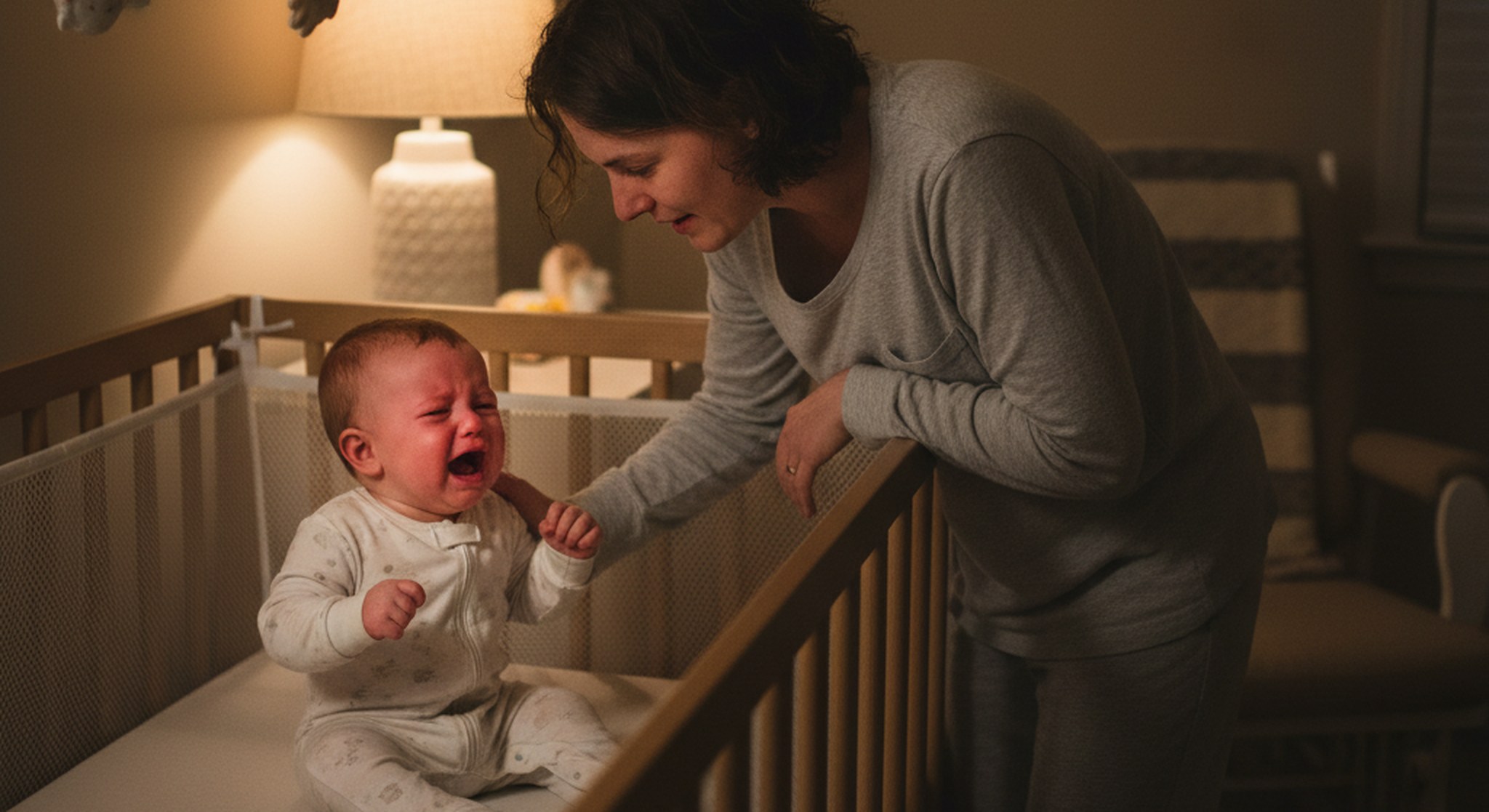
If your seven-month-old was sleeping through and is suddenly up multiple times a night, popping onto hands and knees in the crib, or refusing that third nap, you didn’t break anything. The 7 month sleep regression isn’t one of the textbook milestone regressions, but it is one of the most common disruptions parents ask us about, and in our State of Baby Sleep survey the 7 to 9 month window is the single peak for frequent night waking. The good news: at this age the cause is almost always something specific and passing.
Key Takeaways
The 7 month sleep regression is usually driven by a specific trigger: new motor skills (sitting, crawling), the beginning of separation awareness, teething, or the early 3-to-2 nap transition.
In our State of Baby Sleep survey (n=5,002), the 7 to 9 month band had the highest rate of frequent night waking of any age: 67.3% of babies woke three or more times a night.
Most 7-month disruptions settle in a few days to two weeks. Nap-transition-driven ones can run a little longer while the schedule resets.
Daytime practice for the new skill, protected wake windows, and holding two to three naps do more than any single sleep program this week.
Persistent breathing changes during sleep, dramatically below-range total daily sleep, or missed milestones are pediatrician conversations, not regression ones.
Before we go further, the question you came here to answer:
How long does the 7 month sleep regression last?
For most families, the 7 month sleep regression lasts a few days to two weeks. Because it is triggered by something specific rather than a permanent change in sleep architecture, it tends to fade once your baby masters the new skill or the trigger passes. The exception is when it’s driven by the 3-to-2 nap transition, which can stretch closer to two to four weeks while the daytime schedule resets. Protecting wake windows, holding naps, and keeping bedtime consistent are what shorten it.
Table of Contents
What is the 7 month sleep regression?
The 7 month sleep regression is a stretch of disrupted nights and shorter naps that shows up around seven months, usually because several developmental things are happening at once. Unlike the 4 month regression, it is not tied to a permanent rewiring of your baby’s sleep cycles. Those already matured months ago. This one is about what your baby is busy learning right now, and how that new work spills into the night.¹
“Regression” is a little misleading here too. Your baby isn’t going backward. They’re sitting up, maybe crawling, and starting to notice when you leave the room. All of that is progress. It just happens to land on sleep for a couple of weeks.
Why it happens
Four things tend to converge around seven months, and any one of them can fragment sleep on its own:
New motor skills. Sitting up unassisted and early crawling are landing right now. Babies practice new skills in their sleep, so you may find yours sitting or rocking on hands and knees in the crib at 2am, wide awake and pleased with themselves.
Separation awareness begins. Around this age babies start to register that you exist even when you’re out of sight, and that you can leave. That can turn a quiet night waking into a full protest for a familiar face.
The 3-to-2 nap transition. Many babies are outgrowing that third catnap around now. Caught mid-transition, days get overtired or undertired, and that wobble shows up at night.
Teething. First teeth often arrive in this window. Discomfort tends to be worse lying down, which is exactly when your baby is trying to settle.
None of these are problems. They’re signs your baby is developing on schedule. It also means the fix depends on the trigger, which is why a single generic “7 month schedule” rarely does the job.
WHY SLEEP FRAGMENTS AT 7 MONTHS
Four developmental drivers, all landing in the same few weeks
Signs your baby is in the 7 month sleep regression
In our family research, the signs that line up most consistently at this age are:
Night wakings increase in a baby who was previously doing longer stretches.
Your baby wakes up to practice: sitting, rocking on hands and knees, or pulling at the crib rail.
Bedtime or the third nap suddenly gets a fight, or that catnap disappears entirely.
More crying at handoffs and wakings, wanting to be held rather than resettled.
Drooling, chewing, or a flushed cheek pointing at teething.
Early morning wakings creep in, often between 5 and 6am.
You don’t need all of them. Two or three, showing up together around the right age, is usually enough.
The 7 to 9 month band was the peak for frequent night waking of any age group we measured: 67.3% of babies woke three or more times a night, higher than the 4 to 6 month band (65.6%) and well above 10 to 12 months (60.5%). If seven months feels like the hardest stretch yet, the data agrees with you.
Families who protected age-appropriate wake windows and held two to three naps reported faster resolution than families who let the schedule drift.
Most families who described this stretch as “never-ending” were still inside the typical resolution window when they said it. Sleep deprivation distorts time.
Families who tried to start formal sleep training in the middle of the disruption were more likely to report it “didn’t work” than families who waited until nights stabilized and then trained. Same methods, different outcomes by timing.
“Seven to nine months is the peak for night waking in our survey, and parents feel it. The thing that helps most isn’t a new program. It’s giving the baby daytime room to practice the skill that’s waking them, and protecting the nap schedule while they do.”
If you’re Googling “is this normal” at 2am, the honest answer from the data is: almost always yes. The internet has not been helping. AI-generated sleep advice often gets the basics wrong, and the “your baby’s sleep is broken” framing in most sleep app marketing is not what the data supports.
If you’d rather see where your specific family sits than read more general guidance, that’s what the Betteroo quiz was built for.
Stuck in the middle of the 7 month regression?
Take the free Betteroo quiz. Three minutes, built on data from thousands of families. We’ll tell you what we see and what to try first.
Five moves do more, in our data, than any single sleep program during this window. None of them are heroic. All of them are boring on purpose.
1. Protect the wake windows.
At 7 months, most babies handle roughly 2.5 to 3 hours of awake time between sleeps. Push past that and you get an overtired baby, who wakes more at night, not less. If you’re unsure where your child sits, the 7 month old sleep schedule guide breaks the day down hour by hour.
WAKE WINDOWS BY AGE (QUICK REFERENCE)
Typical awake-time tolerance between sleeps. The 7-month row is the one to memorize this week.
Age
Wake window
Typical naps
Total daily sleep
5 months
2 to 2.5 hours
3
13 to 15 hours
6 months
2 to 2.75 hours
2 to 3
13 to 15 hours
7 months ⭐
2.5 to 3 hours
2 to 3
12 to 15 hours
8 months
2.75 to 3.5 hours
2
12 to 15 hours
9 months
3 to 3.5 hours
2
12 to 15 hours
Ranges are typical; healthy babies vary. If your baby consistently sits at the high or low end, that’s usually fine. See the full wake windows by age guide for nuance.
2. Hold two to three naps.
Seven months is early for the 3-to-2 nap transition, and dropping that third nap too soon is one of the most common ways a short regression turns into a long one. Keep offering the catnap until it consistently fails for a week or more. When you do drop it, stretch the remaining wake windows gradually and move bedtime earlier to cover the gap. The 6 month sleep regression and 8 month sleep regression guides cover the nap changes on either side of this age.
3. Give daytime practice for the new skill.
If your baby is waking at night to sit up or crawl, the fastest way through is more supervised floor time during the day. Let them practice sitting down from standing, rocking, and moving until it’s automatic. A skill that’s mastered while awake stops interrupting sleep sooner. If they do sit up in the crib at night, calmly lay them back down without turning it into a party.
4. Offer brief reassurance for separation, not a new crutch.
Separation awareness makes wakings louder and more insistent. A familiar voice and a hand on the chest usually settles it. Keep the reassurance short and boring. The trap this week is inventing a brand-new habit under pressure, like a full feed back to sleep or an hour of rocking, and then having to unwind it in three weeks. If you start something, be prepared to keep it for a while.
5. One adult sleeps first.
If there are two adults in the house, take shifts. One person goes to bed early and handles the first half of the night, the other takes the early morning. The version of you who has slept four straight hours is a more competent parent than the version who is co-anxious from 11pm to 4am. This isn’t optimization, it’s recovery, and the loss compounds across weeks if one adult absorbs all of it.
What doesn’t help (and what to skip this week)
Equal time on the things that aren’t going to move the needle and might make it worse:
Dropping the third nap on the first bad day. One rough afternoon isn’t a transition. Pull the catnap too early and you trade a short regression for weeks of overtired nights.
Viral “perfect 7 month schedule” PDFs. The one you saved at 3am was written by someone who doesn’t know your baby. Your wake windows and your baby’s temperament matter more than any shareable graphic.
Changing five things at once. If you change the room, the sleep sack, bedtime, the feed schedule, and the settling routine in one week, you won’t know what helped or hurt. Pick one variable.
Assuming every night waking is teeth. Teething gets blamed for a lot. If your baby is otherwise well, it’s usually the skills and the schedule doing the disrupting, not a single tooth.
7-MONTH REGRESSION CHEAT SHEET
Five moves that actually help, and five that quietly waste your week.
DO THIS5 moves that help
Protect 2.5 to 3 hour wake windows. Overtired = worse sleep, not better.
Hold two to three naps. Don’t rush the 3-to-2 transition.
Give daytime skill practice. Floor time now means quieter nights sooner.
Reassure briefly for separation. Don’t invent a crutch you can’t keep.
Adults take shifts. Protect one solid stretch of sleep each.
SKIP THIS5 things to ignore
Dropping the catnap early. One bad day isn’t a nap transition.
Viral “perfect” schedules. Written by someone who doesn’t know your baby.
Changing 5 things in one week. You won’t know what helped or hurt.
Blaming every waking on teeth. Usually it’s skills and schedule.
Assuming it’ll last forever. Most families settle in a few days to two weeks.
Screenshot this for the 3am moment when you need a quick gut check.
When it’s NOT just the regression
The 7 month sleep regression is common, but it’s not the only thing that can disrupt sleep at this age. Talk to your pediatrician, not your sleep app, if any of the following are happening:
Persistent breathing changes during sleep, such as snoring with pauses, unusually heavy breathing, or mouth breathing that won’t resolve. AAP safe sleep guidance addresses this as a flag worth raising with a pediatrician.²
Total daily sleep dramatically below the AASM range (roughly 12 to 15 hours including naps at this age) across multiple weeks, not single bad nights.⁴
Ear-pulling with fever, or a cold that lingers. Ear infections often surface with night waking.
Missed developmental milestones alongside the sleep change, or a baby not yet attempting to sit.
A sudden change in alertness, tone, or temperature.
Outside of those, what you’re experiencing is almost certainly the regression. Tiring, but typical.
A note on sleep training during the regression
Unlike the 4 month regression, seven months is not too early for structured sleep training on its own. The major evidence base for behavioral methods looked at infants six months and older.³ The timing question here is different: training in the thick of a regression, when a new skill or teething is the real driver, tends to backfire. If nights are chaotic this week, give it seven to ten days to see whether the trigger passes on its own first.
If nights are still hard once the regression settles and you want to compare approaches, the common sleep training methods guide walks through what the research actually says about each one.
Frequently asked questions
Is the 7 month sleep regression real?
It’s real in the sense that lots of seven-month-olds hit a stretch of disrupted sleep, and in our State of Baby Sleep survey the 7 to 9 month band had the highest rate of frequent night waking of any age (67.3%). It isn’t a fixed milestone regression like the 4 month one. It’s the sum of new motor skills, separation awareness, teething, and the early nap transition all landing at once.
How long does the 7 month sleep regression last?
For most families, a few days to two weeks. Because it’s trigger-driven rather than a permanent change in sleep architecture, it fades once your baby masters the new skill or the trigger passes. If it’s mainly the 3-to-2 nap transition, it can run closer to two to four weeks while the daytime schedule resets.
Why is my 7-month-old suddenly waking every few hours?
Usually one or more of four things: your baby is practicing a new skill like sitting or crawling in the crib, they’re starting to notice when you leave the room, a first tooth is coming in, or they’re caught mid-way through dropping the third nap. In our survey, the 7 to 9 month band woke three or more times a night for 67.3% of babies, so frequent waking at this age is extremely common.
Should I drop the third nap during the 7 month regression?
Not on the first bad day. Seven months is early for the 3-to-2 transition, and dropping the catnap too soon is a common way a short regression becomes a long one. Keep offering it until it consistently fails for a week or more, then drop it and lengthen wake windows gradually while moving bedtime earlier.
Can I sleep train during the 7 month regression?
Seven months is old enough for structured methods, which were studied in babies six months and older. But training in the middle of an active regression, when a new skill or teething is the real driver, often backfires. Give it seven to ten days to see whether the trigger resolves on its own, then decide.
How do I know if it’s the regression or something else?
The regression usually shows up as more night wakings, crib practice, a fussy third nap, and teething signs, with no breathing concerns, no missed milestones, and total daily sleep still broadly inside the AASM range. Persistent breathing changes, dramatically low total sleep across weeks, ear-pulling with fever, or missed milestones warrant a pediatrician.
Key takeaway
The 7 month sleep regression isn’t a textbook milestone, but it’s one of the hardest stretches of the first year, and the data backs that up: seven to nine months is the peak for frequent night waking. It’s not a defect, you didn’t cause it, and it’s almost always driven by something specific and passing. Protect the wake windows, hold the naps, give daytime practice for the new skill, reassure without inventing a crutch, and take shifts. That’s most of what separates a few-day regression from a multi-week one.
You’re not behind. You’re in the peak-waking window, and it passes.
See where your family sits relative to thousands of others, and which move is likely to help yours fastest. Three minutes, free.
Want hands-on help near you? Betteroo maintains verified directories of baby sleep consultants in 11 US cities. Every listing is checked monthly against the consultant’s own site and certifying program, with transparent pricing. Browse sleep consultants by city or see what a sleep consultant costs.
Galland, B. C., Taylor, B. J., Elder, D. E., & Herbison, P. (2012). Normal sleep patterns in infants and children: a systematic review of observational studies. Sleep Medicine Reviews, 16(3), 213-222.https://pubmed.ncbi.nlm.nih.gov/21784676/
American Academy of Pediatrics Task Force on Sudden Infant Death Syndrome. (2022). Sleep-Related Infant Deaths: Updated 2022 Recommendations for Reducing Infant Deaths in the Sleep Environment. Pediatrics, 150(1).https://pubmed.ncbi.nlm.nih.gov/35726558/
Mindell, J. A., Kuhn, B., Lewin, D. S., Meltzer, L. J., & Sadeh, A. (2006). Behavioral treatment of bedtime problems and night wakings in infants and young children. Sleep, 29(10), 1263-1276.https://pubmed.ncbi.nlm.nih.gov/17068979/
Paruthi, S., Brooks, L. J., D’Ambrosio, C., et al. (2016). Recommended Amount of Sleep for Pediatric Populations: A Consensus Statement of the American Academy of Sleep Medicine. Journal of Clinical Sleep Medicine, 12(6), 785-786.https://pubmed.ncbi.nlm.nih.gov/27250809/