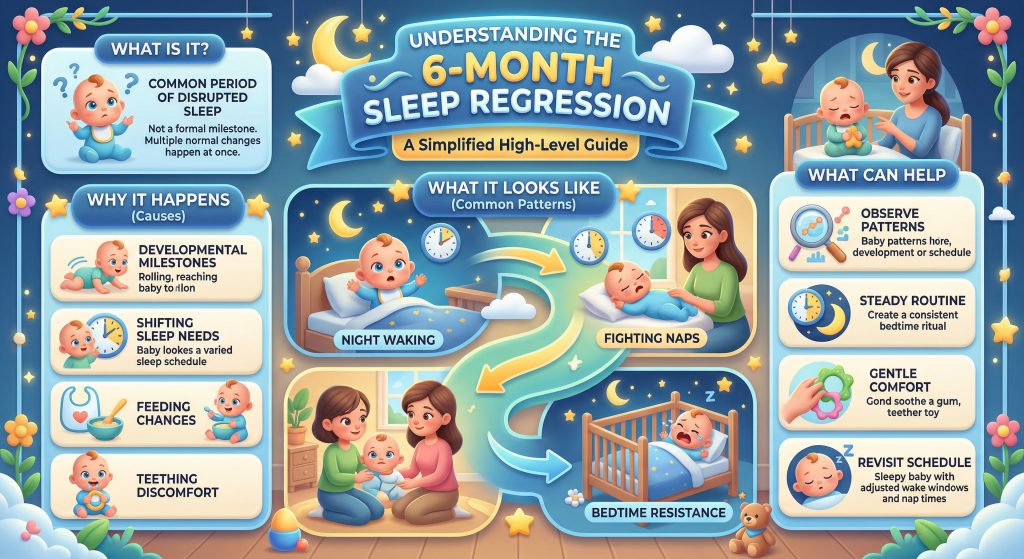
The 6 Month Sleep Regression is a common stretch of disrupted sleep around 6 months when a baby who had been sleeping more predictably may start waking more at night, fighting naps, or resisting bedtime, usually because several normal changes are happening at once, including development, shifting sleep needs, and sometimes feeding or teething changes. It is widely talked about, but it is not a formal, universal milestone that every baby goes through on schedule.
If your baby’s sleep suddenly feels harder right now, that does not automatically mean something is wrong, and it does not mean you caused it. Around this age, babies are becoming more aware of the world, often working on new motor skills, and moving into a stage where routines and sleep patterns can get bumpier for a while. Babies also vary a lot at 6 months: some have a rough stretch with sleep, while others barely seem affected if at all.
6 month sleep regression infographic
Table of Contents
What is the 6 month sleep regression?
The phrase usually refers to a temporary period of worse sleep around 6 months. Parents may notice more night waking, shorter naps, more fussiness around sleep, or a baby who suddenly needs more help settling. Unlike the 4-month sleep change, which is tied more directly to maturing sleep cycles, the 6-month version is better understood as a common pattern rather than a single defined biological event.
That distinction matters. Calling every rough week a “regression” can make sleep feel more mysterious than it is. In real life, 6-month sleep disruptions often reflect a mix of normal development, schedule shifts, hunger changes, teething discomfort, and sleep habits becoming more visible at night.
Is the 6 month sleep regression real?
Yes and no. It is real in the sense that many families notice a rough patch around this age. But it is not a guaranteed, official regression that appears right on cue for every baby. A more useful way to think about it is this: around 6 months, babies are often going through enough developmental and routine change that sleep can temporarily get messy. That is why the term sticks, even if the reality underneath it is less neat than the name suggests.
What causes sleep changes at 6 months?
At 6 months, babies are not only sleeping; they are also learning, moving, noticing, and adapting. Those changes can spill into sleep.
Developmental changes
By 6 months, many babies are working on milestones like rolling, reaching, transferring objects, showing stronger interest in familiar people, and becoming much more engaged with their environment. Some are beginning to sit with support or more steadily. When a baby’s brain and body are busy practicing new skills, sleep can get less settled for a while.
Shifting sleep organization
The American Academy of Pediatrics notes that babies do not have regular sleep cycles until about 6 months of age 1. That does not mean sleep becomes perfect at 6 months. It means sleep is maturing, and with that maturity, parents may notice wakings more clearly, especially if a baby now expects the same conditions to fall back asleep that they had at bedtime.
Changing sleep needs and schedule fit
Sleep needs still vary, but infants 4 to 12 months are generally recommended to get 12 to 16 hours of sleep in a 24-hour period, including naps 2. Around 6 months, some babies begin moving toward a more predictable rhythm, while others are between patterns. If wake windows, nap timing, or total daytime sleep no longer fit your baby well, bedtime and night sleep can get bumpier.
Feeding changes
Around 6 months, many babies are beginning solids, though breast milk or formula remains the main source of nutrition. That transition does not automatically cause bad sleep, but changes in feeding timing, digestion, or daytime intake can sometimes affect how settled sleep feels.
Teething or discomfort
Teething often starts around 4 to 7 months and can come with gum discomfort, extra drooling, a need to chew, and mild irritability. For some babies, that discomfort is enough to make sleep lighter or more fragmented for a few nights.
Growing awareness of separation
Full separation anxiety is usually more robust closer to 9 months, but some babies begin showing earlier signs of object permanence and protest when a parent leaves. That can make bedtime feel more relational and emotional than it did a month or two earlier.
What does the 6 month sleep regression look like?
It often looks like a baby who suddenly seems less settled than before. Common patterns include more night waking, shorter naps, taking longer to fall asleep, waking early in the morning, or needing more help to resettle. Parents sometimes describe it as, “Nothing changed, but sleep suddenly got harder.” That feeling is common, even when several small things have in fact changed at once.
It can also show up unevenly. Some babies mainly struggle with naps. Some wake more often overnight. Some seem fine at bedtime but pop up at 5 a.m. Others are perfectly happy during the day but suddenly cannot connect sleep cycles as smoothly. A rough patch does not always mean a major sleep problem. Sometimes it is a short developmental blip. Sometimes it is a sign that the schedule or routine needs a small adjustment.
Every baby’s sleep journey is different
Get a personalized plan that fits your baby’s age, sleep patterns, and schedule.
There is no single timeline, because the “6 month sleep regression” is not one single thing. If sleep is disrupted mostly by a developmental leap or a few uncomfortable teething nights, it may improve within days to a couple of weeks. If the issue is more about a schedule mismatch, fragmented daytime intake, or strong sleep associations, it can last longer until the pattern itself changes.
A useful question is not just “How long does it last?” but “What seems to be driving it?” Once you know that, the next step usually becomes much clearer.
Common 6-month sleep patterns and what they often mean
This table is not a diagnosis. It is simply a practical way to sort through a very common, very blurry season. The goal is not to label every waking perfectly. The goal is to understand what kind of pattern you are dealing with.
A simple way to understand what’s happening
When sleep gets harder around 6 months, it usually helps to think in one of three buckets.
1. Temporary developmental disruption
Your baby is learning something new, more physically active, or more mentally alert. Sleep gets messy for a bit, then settles again. This is the closest thing to what many parents mean by a regression.
2. Schedule mismatch
Your baby’s sleep needs have shifted, but the routine has not caught up yet. Wake windows may now be a little too short or too long, naps may be oddly timed, or daytime sleep may be working against nighttime sleep.
3. Sleep associations becoming more obvious
Your baby falls asleep one way at bedtime but cannot recreate those same conditions easily when they wake overnight. As sleep becomes more organized and parents notice wakeups more clearly, this pattern can suddenly feel much bigger.
Sometimes more than one bucket is true. That is why this stage can feel confusing. A baby may be teething, practicing rolling, and also ready for a routine shift. You do not need a perfect explanation before you respond, but it does help to avoid jumping straight to “everything is broken.”
What helps during the 6 month sleep regression?
What helps most depends on what seems to be driving the change. Still, a few basics tend to help across the board durng the 6 month sleep regression
Start with the pattern, not panic
Take a quick look at what changed in the past one to two weeks. Is your baby suddenly rolling and practicing in the crib? Did naps start getting shorter? Did solids begin? Is bedtime drifting later? Even one small clue can point you toward the most useful fix. This kind of calm observation is often more helpful than changing everything at once.
Protect a steady bedtime routine
A simple, repeatable wind-down routine can help signal sleep even when nights are bumpy. The AAP recommends calm, consistent bedtime habits, and that steadiness matters even more during a rough patch 1.
Revisit the schedule gently
At 6 months, some babies need a small shift in nap timing or wake windows. You do not need a perfect clock-based schedule, but it can help to notice whether your baby seems consistently under-tired or overtired at bedtime. Small changes are usually more useful than a major overhaul.
Keep feeding changes in perspective
If your baby is starting solids, keep expectations realistic. Solids are an addition at this age, not a magic fix for sleep. Breast milk or formula is still the main source of nutrition, and introducing solids does not guarantee longer stretches at night.
Offer comfort when needed, especially if discomfort is obvious
If teething seems to be part of the picture, simple comfort measures like gum rubbing or a firm teething ring may help. If your baby seems truly uncomfortable, check with your pediatrician about safe pain relief options.
Decide intentionally how you want to respond at night
Some families prefer to ride it out with extra support. Others decide this is a good time to work on more independent sleep habits. There is no single right answer for every family. If you use a sleep training approach, it does not have to be harsh to be consistent, and if you do not want to make changes during a developmental blip, that is a valid choice too. The helpful question is whether your current approach feels sustainable and whether your baby’s pattern seems temporary or entrenched.
What not to worry about during the 6 month sleep regression
A few rough nights do not mean you have created a long-term sleep problem. A baby who starts waking more at 6 months has not “failed” sleep, and you have not failed either. Sleep in the first year is developmental, variable, and often uneven. The AAP notes that even at 6 months, it is normal for a baby to wake during the night and go back to sleep after a few minutes 1.
It is also okay if your baby does not match someone else’s schedule, nap count, or “sleeping through the night” story. Some babies are naturally steadier sleepers. Some are more sensitive to developmental changes, teething, or routine disruption. Variation is part of infant sleep, not proof that something is wrong.
When to check with your pediatrician
Check in with your pediatrician if sleep changes come with poor feeding, vomiting, breathing concerns, snoring or noisy breathing, frequent discomfort, illness symptoms, poor growth, or a baby who seems much harder to console than usual. It is also worth checking in if teething symptoms seem severe, if your baby has a true fever, or if your gut is telling you this is more than a rough phase. Teething can cause mild irritability and gum discomfort, but higher fevers or more significant symptoms may point to something else.
You do not need to prove that something is seriously wrong before asking for help. Sometimes the best reason to call is simply that the pattern feels extreme, persistent, or out of character.
Bottom line on the 6 month sleep regression
The 6 month sleep regression is best understood as a common period of sleep disruption around 6 months, not a strict milestone that every baby hits. The most helpful next step is usually to look at what changed: development, schedule, feeding, discomfort, or sleep habits. Once you understand the pattern, the path forward tends to feel a lot less overwhelming.
FAQs about the 6 month sleep regression
How long does the 6 month sleep regression last?
There is no one standard duration, because the 6 month sleep regression is not one single biological event. A short stretch caused by a new motor skill, travel, illness recovery, or teething may pass within a few days to a couple of weeks. A longer stretch often means there is something more persistent in the mix, such as a schedule mismatch, changing daytime intake, or a sleep association that has become more obvious overnight.
A helpful way to approach it is to separate “temporary disruption” from “stable pattern.” If sleep was mostly fine, got messy for a week, and your baby is otherwise acting like themselves, it may simply need time and a steady routine. If your baby has been waking every couple of hours for weeks, naps are consistently off, and bedtime is difficult every night, it is less useful to keep waiting for the regression to pass on its own. That is usually the point to reassess schedule, bedtime routine, and how your baby is falling asleep at the start of the night. And if the sleep change is paired with feeding issues, unusual fussiness, or signs of illness, check with your pediatrician.
Why is my 6 month old suddenly waking every 2 hours?
Frequent waking at this age can happen for several reasons, and the answer is often not just “regression.” One possibility is developmental disruption: your baby may be more active, more alert, and more likely to rouse fully between sleep cycles. Another is discomfort, including teething. A third common reason is that your baby falls asleep with a lot of help at bedtime and then needs those same conditions repeated after each partial waking overnight. Because infant sleep is more organized by this age, those wakeups can feel very sharp and repetitive.
What to watch for is the context. If the every-2-hour waking started suddenly and your baby is also drooling, chewing, or working on a big new skill, it may improve fairly soon. If it has been going on for weeks, or only happens under certain settling conditions, it may point to a pattern that will not change much until bedtime or schedule changes. What to do next depends on your family. Some parents focus first on routine and timing. Some work gradually on helping baby fall asleep with less assistance. Some decide to wait it out if it feels clearly temporary. If wakings are paired with poor feeding, reflux-type discomfort, breathing concerns, or illness symptoms, involve your pediatrician.
How is the 6 month sleep regression different from the 4 month sleep regression?
The 4-month sleep regression is usually described as a more specific developmental shift because infant sleep cycles are maturing around that stage. The AAP notes that babies do not have regular sleep cycles until about 6 months 1, which helps explain why the 4-month period can feel like a major change in how sleep works. By contrast, the 6-month regression is less of a single sleep-science event and more of a catchall label for a rough patch that may be influenced by development, schedule, feeding changes, teething, or sleep habits.
In practical terms, 4 months often feels like “sleep changed.” Six months often feels more like “sleep got harder again.” That distinction matters because the solution may not be the same. At 4 months, parents are often adjusting to a baby whose sleep is newly maturing. At 6 months, parents may need to ask more specific questions: Is my baby under-tired? Overtired? Teething? Practicing rolling all night? Starting solids? Needing the same support between sleep cycles? That is why a good 6-month article should help with interpretation, not just offer generic tips.
Should I sleep train during the 6 month sleep regression?
It depends on what is happening and what feels workable for your family. There is no rule that says you must sleep train because your baby is 6 months old, and there is no rule that says you cannot make sleep changes during this phase. A more useful question is whether what you are seeing looks like a short-term blip or an ongoing pattern. If your baby is clearly teething, sick, or in the middle of a big developmental burst, some families prefer to offer extra support and wait. If nights have been unsustainable for a while and your baby seems healthy, this can also be a reasonable age to work on more consistent sleep habits.
Sleep training also is not one single thing. Some approaches are gradual and parent-present; others are more structured. You do not need to pick the most intensive method to create more consistency. What to watch for is whether your current bedtime pattern is helping or whether it is creating repeated night waking that feels hard on everyone. What to do next should fit your baby, your values, and your level of bandwidth. If you are unsure whether nighttime waking is developmental or medical, talk with your pediatrician before making a big plan.
Is this teething or the 6 month sleep regression?
Sometimes it is genuinely hard to tell, because teething and sleep disruption often overlap around the same age. Teething commonly begins around 4 to 7 months and can cause gum discomfort, drooling, chewing, and irritability. That can absolutely make sleep worse for a few nights. But teething usually does not explain every prolonged sleep problem. If your baby has been waking frequently for weeks, or the issue includes naps, bedtime resistance, and a broader schedule struggle, there may be more going on than teething alone.
A simple way to think about it: teething often creates a sharper, more discomfort-driven change. Regression-type sleep disruption often looks broader and more pattern-based. What to watch for is whether your baby seems physically uncomfortable or whether the sleep issue is mostly about settling and resettling. What to do next can be similarly simple. If your baby seems uncomfortable, use basic teething comfort measures and check with your pediatrician about pain relief if needed. If the pattern keeps going after the discomfort passes, look again at routine, schedule, and bedtime habits. Also remember that true fever or bigger illness symptoms should not automatically be blamed on teething.
Can starting solids cause sleep problems at 6 months?
Starting solids can change a baby’s day, but it is not usually the whole explanation for sleep suddenly falling apart. The AAP and CDC recommend beginning solids around 6 months, while continuing breast milk or formula as the primary source of nutrition 3,4. That means solids are developmentally appropriate at this age, but they are not meant to replace milk feeds right away or guarantee better sleep.
That said, feeding changes can affect sleep indirectly. Meal timing, slight digestion changes, constipation, excitement around eating, or lower daytime milk intake can all contribute to a baby feeling a bit different at night. What to watch for is not just that solids started, but whether your baby’s overall intake, comfort, or routine changed with them. What to do next is usually straightforward: keep solids low-pressure, continue prioritizing milk feeds, and avoid assuming that more solids automatically means longer sleep stretches. If your baby seems uncomfortable, has a big change in stooling, or is feeding poorly overall, check in with your pediatrician.
Is it normal for a 6 month old to wake at night?
Yes. Night waking can still be normal at 6 months. The AAP notes that it is normal for a 6-month-old to wake during the night and go back to sleep after a few minutes 1. Many babies are capable of longer stretches by this age, and some start sleeping five to six hours or more at a stretch, but normal does not mean identical. Some babies still wake to feed. Some wake briefly and resettle. Some are more sensitive sleepers overall.
The question is less “Does my baby ever wake?” and more “What happens after the waking?” Brief waking with easy resettling is very different from repeated full wakings that are escalating or unsustainable. What to watch for is the pattern over time, especially whether wakings are increasing, tied to discomfort, or coming with feeding or breathing concerns. What to do next depends on that pattern. If your baby wakes but generally resettles and is thriving, this may fall within normal variation. If the sleep is worsening, fragmented, and exhausting for everyone, it may be worth looking at schedule, bedtime habits, or checking in with your pediatrician.
How much sleep does a 6 month old need?
Most sleep guidance puts infants ages 4 to 12 months in the range of 12 to 16 hours of total sleep in 24 hours, including naps. That range comes from the American Academy of Sleep Medicine and is endorsed by the AAP 2. But a range is exactly that: a range. One baby may be happy and thriving on the lower end, another on the higher end. The bigger picture is whether your baby seems rested enough to eat, play, and move through the day reasonably well.
At 6 months, some babies are on two naps, some are still taking three, and many are in between. What to watch for is not whether your baby matches someone else’s sample schedule, but whether the current rhythm seems to support decent naps, a manageable bedtime, and nights that are not constantly unraveling. If your baby’s total sleep seems much lower than expected and they are fussy, overtired, or hard to settle, a schedule review can help. If sleep seems unusually poor despite strong routines, bring it up with your pediatrician.
Paruthi, S., Brooks, L.J., D’Ambrosio, C., et al. (2016). Consensus Statement of the American Academy of Sleep Medicine on the Recommended Amount of Sleep for Healthy Children: Methodology and Discussion. Journal of Clinical Sleep Medicine, 12(11), 1549–1561.https://pubmed.ncbi.nlm.nih.gov/27707447/