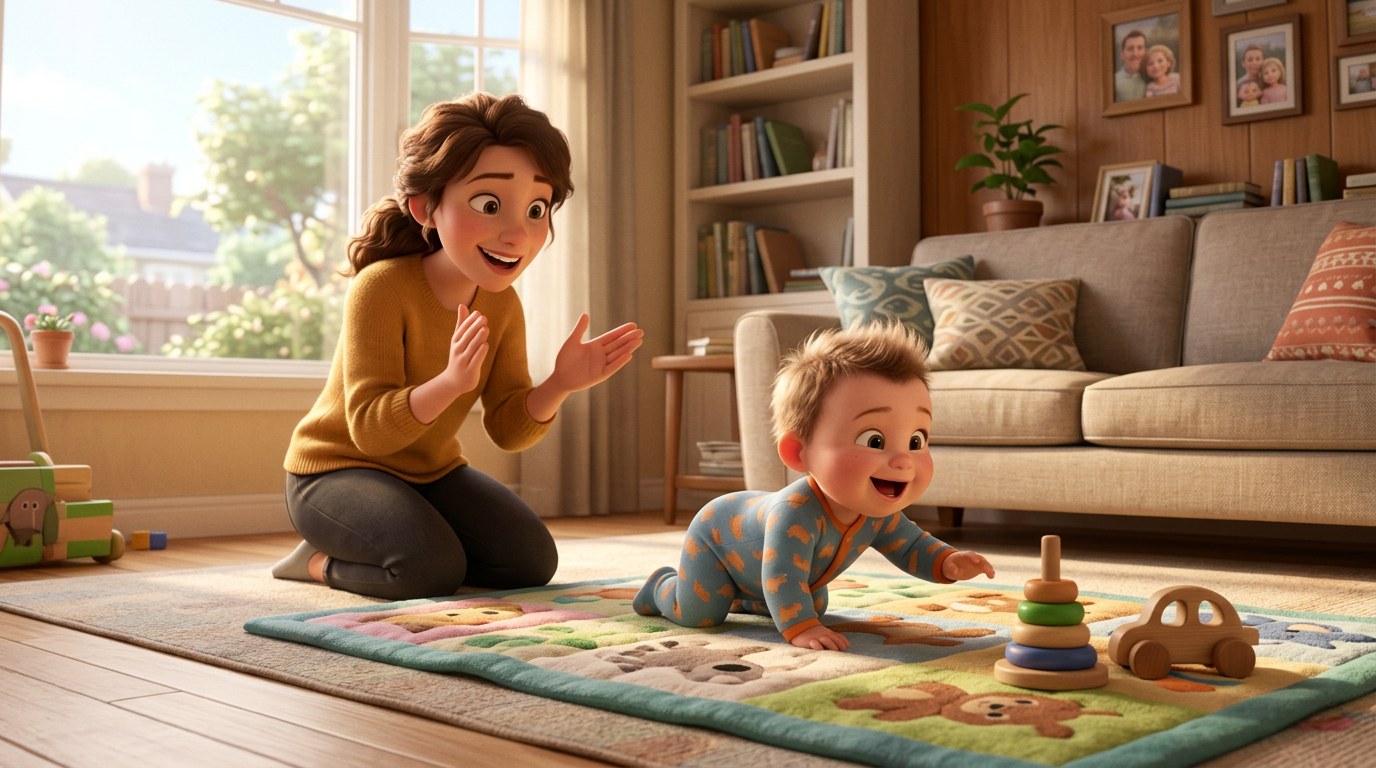
Most babies start crawling somewhere between 6 and 10 months, but crawling is the most variable of all the big motor milestones, and a healthy number of babies never crawl on hands and knees at all. If you are watching the calendar and waiting for it to happen, that is the first thing worth knowing.
Crawling is not one skill. It is a coordination problem: your baby has to hold their head up, push up on their arms, balance on all fours, and then move opposite arm and leg together. Those pieces come together on their own schedule, which is exactly why the range is so wide.
Here is what the milestone data actually says, what the different crawling styles look like, and the specific signs that are worth a conversation with your pediatrician.
Most babies crawl between 6 and 10 months, but the normal range is genuinely wide.
There is no single right style. Classic hands-and-knees, army crawl, scoot, and roll all count as getting around.
Crawling was removed from the official CDC milestone checklist in 2022 because it is so variable, and many babies skip it.
What pediatricians track instead is sitting and pulling to stand. If your baby is meeting those, skipping crawling is usually not a concern.
No device makes a baby crawl sooner. The AAP recommends against infant walkers, which delay rather than help movement.
How Crawling Develops
Quick Answer
Most babies begin crawling between 6 and 10 months. Some army-crawl or scoot first, some go straight from sitting to pulling up, and roughly 1 in 20 skip hands-and-knees crawling entirely.2 All of these are normal. Pediatricians track sitting and pulling to stand, not crawling itself.3
Movement develops head to toe and center to outward. First comes head and neck control, then trunk strength that lets a baby sit, then weight-bearing through the arms, and finally the cross-body coordination that crawling requires. A baby cannot skip ahead to the last step, which is why the ones before it matter more than the crawl itself.
The World Health Organization studied when healthy babies reach hands-and-knees crawling across six countries and found the window ran from about 5 to 13 and a half months, with roughly 4 percent of babies never crawling on hands and knees at all.2 That is not a small tail. It is a normal part of the picture.
When Do Babies Crawl? The Age Range
Crawling is a range, not a date. This table shows the typical progression, framed as what is common rather than what is required.
Age
What you often see
What it builds toward
4 to 6 months
Pushing up on arms during tummy time, rocking on hands and knees
Arm strength and weight-bearing
6 to 8 months
Army crawling, scooting, or rocking back and forth
Balance and forward momentum
7 to 10 months
Classic hands-and-knees crawling for many babies
Cross-body coordination
9 to 12 months
Some babies skip crawling and go to cruising and pulling up
Standing and first steps
Typical crawling progression. Wide individual variation is normal.
If your baby is on the later or earlier edge of this, that alone is not a problem. The World Health Organization window has healthy babies crawling as early as 5 months and as late as 13 and a half.2 Babies born prematurely are usually tracked by their adjusted age, not their calendar age.
Crawling and pulling up tend to arrive right as sleep gets harder, and that is not a coincidence. In our State of Baby Sleep 2026 report, a survey of 74,379 parents across 112 countries, night waking climbs through exactly the months babies become mobile.
Babies waking 3 or more times a night, by age
The rise tracks the months most babies start crawling
Night waking rises from 48.8 percent at 0 to 3 months to 64.7 percent at 4 to 6 months, and peaks at 66.7 percent at 7 to 9 months, the classic crawling window. If your newly mobile baby is suddenly up at night practicing their new trick, our data says you are in very normal company.
The Different Crawling Styles
Parents often worry their baby is “doing it wrong.” There is no wrong way to get across the floor. Common styles include:
Classic crawl. On hands and knees, moving opposite arm and leg.
Army or commando crawl. Belly on the floor, pulling forward with the arms.
Bear crawl. On hands and feet with legs straight.
Crab crawl. Pushing backward or sideways rather than forward.
Bottom scoot. Sitting upright and shuffling along on the bottom.
Rolling. Some babies simply roll to where they want to be.
What matters is not the form. It is that your baby has found a way to move toward something they want, which shows the strength, curiosity, and problem solving that crawling is really a marker of.
How to encourage crawling
Floor time and motivation, not gadgets
1
Tummy time, daily
Awake, supervised floor time builds the arm and trunk strength crawling needs.
2
Put toys just out of reach
A favorite toy a little way off gives your baby a reason to move.
3
Get down on the floor
Crawl alongside them. Babies copy what they see.
4
Clear a safe space
Open floor, hazards removed, so exploring is rewarded not blocked.
5
Skip the walker
Walkers keep a baby upright and off the floor, which is the opposite of what helps.
The floor is the tool. Everything else is motivation.
Crawling and suddenly waking all night?
New movement and sleep disruption often arrive together. Answer a few questions and get a plan built around your baby’s stage.
This is where a lot of popular advice overstates its case, so it is worth being precise. In 2022 the Centers for Disease Control and Prevention revised its developmental milestone checklists and removed “crawls” as a milestone entirely.1 Their own stated reason was that there was too little consistent data on when crawling should happen, precisely because so many babies do it late, differently, or not at all.
So the current CDC checklist has no crawling item at any age.3 What it tracks at 9 months is sitting without support and getting into a sitting position, and at 12 months, pulling to stand and cruising along furniture.4 If your baby is doing those, crawling is genuinely optional.
The milestone ages you see quoted are population percentiles, not deadlines. The CDC now lists the age by which about 75 percent of babies reach a skill, which by definition means a quarter of typically developing babies reach it later and are still fine.1
One honest footnote on the “back to sleep” era. Babies who sleep on their backs, which every baby should, get less accidental tummy time, and research from the 1990s found this modestly shifted some early motor milestones later. The same research found the difference had washed out by 18 months and was never a reason to change safe-sleep advice.6 The fix is not earlier sleep on the tummy. It is more awake tummy time.
When to Talk to Your Pediatrician
Because crawling itself is not a tracked milestone, the flags worth acting on are about overall movement, not the crawl specifically.9 Bring it up at a visit if, by around 9 months, your baby:
Is not sitting without support or getting into a sitting position.3
Is not bearing any weight on their legs when held to stand.
Does not reach for or move toward things they want.
Uses only one side of the body to move, dragging the other consistently.
Has lost a skill they previously had.9
Always act early on lost skills
A baby who loses a skill they used to have, at any age, should be seen promptly. The CDC “act early” guidance treats regression as a reason to ask for developmental screening rather than to wait and watch.9
A one-sided crawl or a strong preference for one hand this early can be worth mentioning too, since babies do not usually develop a dominant hand until after their first birthday.
A Word on Walkers and Gadgets
It is tempting to buy something that promises to help. The evidence points the other way. The American Academy of Pediatrics recommends against mobile infant walkers, stating plainly that they do not help a child learn to walk and can delay normal motor development.7 The AAP has called for a ban on their manufacture and sale.
Walkers are also a serious injury hazard. A national study counted more than 230,000 US children under 15 months treated in emergency rooms for walker-related injuries over a 25 year period, the large majority head and neck injuries.8 No crawling gadget has been shown to speed the milestone, and the one whole category marketed around movement is one pediatricians want off the market.
The thing that actually helps is free: an open, safe floor and time on it. For play ideas as your baby becomes mobile, see our guide to activities for a 1 year old.
Frequently Asked Questions
At what age do most babies start crawling?
Most babies crawl somewhere between 6 and 10 months, but the healthy range is wider than that on both ends. The World Health Organization found healthy babies reaching hands-and-knees crawling anywhere from about 5 to 13 and a half months. Earlier or later than the average is not automatically a concern, especially if your baby is meeting the sitting and standing milestones.
Is it normal for a baby to skip crawling?
Yes. Roughly 4 to 5 percent of babies never crawl on hands and knees, and many more scoot, roll, or army-crawl instead before pulling up to stand. This is common enough that the CDC removed crawling from its milestone checklist in 2022. If your baby finds their own way to get around and is pulling to stand on schedule, skipping the classic crawl is not a problem.
Why did the CDC remove crawling as a milestone?
In 2022 the CDC revised its milestone checklists to list only skills that at least 75 percent of babies reach by a given age. Crawling was removed because the data on when it happens is too inconsistent, which is a direct reflection of how much it varies from baby to baby. Pediatricians now track sitting and pulling to stand instead.
What comes before crawling?
Head control, rolling, sitting without support, and pushing up on the arms during tummy time all come first. Rolling typically appears around 4 to 6 months and independent sitting around 6 to 9 months. These build the trunk strength and balance that crawling depends on, which is why plenty of awake tummy time in the early months matters.
Do walkers help babies learn to crawl or walk?
No. The American Academy of Pediatrics recommends against mobile infant walkers and says they can delay motor development rather than help it. They also cause tens of thousands of injuries. The best thing for crawling is unstructured, supervised time on a safe open floor, with a motivating toy just out of reach.
When should I worry that my baby is not crawling?
Because crawling is not a formal milestone, focus on overall movement. Talk to your pediatrician if, by around 9 months, your baby is not sitting without support, not bearing weight on their legs, not reaching for things, moves only one side of the body, or has lost a skill they previously had. Any lost skill, at any age, is worth a prompt visit.
Not sure what is normal for your baby?
Get a personalized plan that adapts as your baby moves through each milestone and each sleep change.
Zubler JM, Wiggins LD, Macias MM, et al. Evidence-Informed Milestones for Developmental Surveillance Tools. Pediatrics. 2022;149(3):e2021052138. https://pubmed.ncbi.nlm.nih.gov/35132439/
WHO Multicentre Growth Reference Study Group. WHO Motor Development Study: windows of achievement for six gross motor development milestones. Acta Paediatr Suppl. 2006;450:86-95. https://pubmed.ncbi.nlm.nih.gov/16817682/
Davis BE, Moon RY, Sachs HC, Ottolini MC. Effects of Sleep Position on Infant Motor Development. Pediatrics. 1998;102(5):1135-40. https://pubmed.ncbi.nlm.nih.gov/9794945/
Dewey C, Fleming P, Golding J; ALSPAC Study Team. Does the supine sleeping position have any adverse effects on the child? II. Development in the first 18 months. Pediatrics. 1998;101(1):e5. https://pubmed.ncbi.nlm.nih.gov/9417169/
American Academy of Pediatrics, Committee on Injury and Poison Prevention. Injuries associated with infant walkers. Pediatrics. 2001;108(3):790-2. https://pubmed.ncbi.nlm.nih.gov/11533353/
Sims A, Chounthirath T, Yang J, et al. Infant Walker-Related Injuries in the United States. Pediatrics. 2018;142(4):e20174332. https://pubmed.ncbi.nlm.nih.gov/30224365/