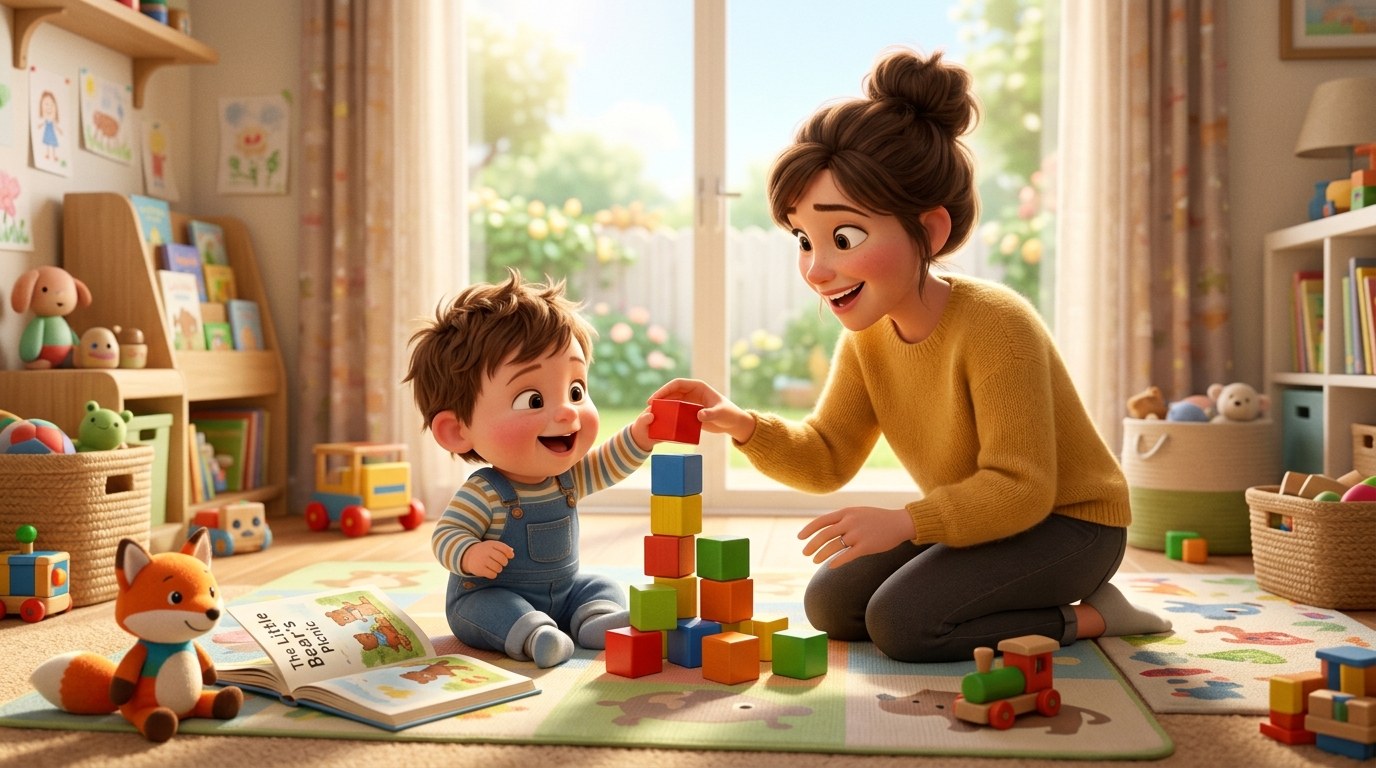
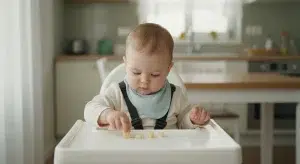
The best activities for a 1 year old are simple, unstructured, and involve you: stacking, dumping, naming, reading, and moving. At this age the science is reassuringly clear that responsive play with a caregiver beats any product marketed as educational.
A 12 to 18 month old is working on big things: walking, the pincer grasp, first words, and the dawning understanding that objects and people still exist when out of sight. The activities below are organized around those skills, so each one is doing more than passing time.
Every idea here comes from the CDC’s own developmental milestone activities and is tied to the skill it supports.
Unstructured, caregiver-led play is what the evidence supports at this age, not “educational” apps or DVDs.
Stacking, dumping, and container play build fine motor skills and early problem solving.
Reading and narrating your day are the strongest, best-supported things you can do for language.
The AAP and WHO both advise avoiding screens under 18 to 24 months, apart from video chatting.
Skip the baby walker. The AAP recommends against them, and open floor play is what builds movement.
What a 1 Year Old Is Working On
Quick Answer
Around their first birthday, babies are cruising and taking first steps, developing a pincer grasp, saying a first word or two, and learning object permanence.1 The best activities are simple and interactive: stacking and knocking down blocks, container play, reading together, and lots of naming. Skip screens and skip the walker.
The CDC’s milestone framework, revised in 2022 to list skills most children reach by a given age, gives a clear picture of the 12 to 15 month window.9 Physically, babies pull to stand, cruise, and start walking. With their hands, they master the pincer grasp and begin to stack. Cognitively, they look for hidden objects, use everyday things the right way, and start copying you.12
The activities that help are the ones that give your toddler a reason to practice these skills, with you close by.
Gross Motor Activities
For the toddler working on walking and balance:
Push toys and boxes. Let your toddler push a sturdy box, a weighted push toy, or a small chair across the floor to practice walking.1 The CDC specifically notes that baby walkers are not recommended.1
Cruise-and-reach. Set a favorite toy at the far end of the couch so your toddler cruises along the furniture to get it.
Hold-hands walking. Let them hold your hands or steady furniture and take steps. Low, soft obstacles to step over add a challenge.
Ball rolling. Sitting and rolling a ball back and forth builds coordination and turn-taking at once.
What Our Data Shows About Naps
A 1 year old’s day is shaped by naps that are starting to shift. Our State of Baby Sleep 2026 report, a survey of 74,379 parents across 112 countries, shows the nap structure underneath the toddler year.
Nap patterns by age
Share of children on the dominant nap pattern for their age band
Most 1 year olds have settled onto a single nap: 64 percent of 12 to 23 month olds are on one nap a day. Plan the day’s activities around protecting that nap, since an overtired toddler is a harder toddler.
Fine Motor and Problem-Solving Activities
Stack and topple. Stack a couple of blocks and let your toddler knock them down, then try stacking themselves. This maps directly onto the “stacks at least two small objects” milestone.2
Container play. Put objects into a cup or box and dump them out, over and over. It looks repetitive because it is practice, and it builds the pincer grasp and early cause-and-effect.1
Self-feeding. A lidless cup and a spoon, mess and all, build fine motor control.1
Pots, pans, and a wooden spoon. Free, endlessly interesting, and great for cause-and-effect and noise-making.1
Busy days, broken nights?
An active toddler still needs solid sleep. Get a plan built around your 1 year old.
Read together every day. Talk about the pictures, and choose sturdy books with flaps and textures.1 Reading aloud is one of the best-supported things you can do: the AAP links early shared reading to meaningful gains in expressive and receptive language.3
Narrate your day. Describe what you are doing as you do it. “Mommy is washing your hands.” A running commentary is powerful vocabulary input.1
Expand what they say. When your toddler says “ba,” answer “yes, ball,” so they hear the fuller word.2
Answer pointing with words. When they point, name it. “You want the cup? Here is the cup.” This supports the 15-month pointing milestone.1
Simple pretend and hide-and-seek. Hide behind a chair and let them find you, or “talk” for a stuffed animal, both early social and object-permanence play.2
What About Screens and Learning Apps?
This is where honest guidance matters, because a lot of products are sold on claims the evidence does not support. Both the AAP and WHO advise avoiding screen media under 18 to 24 months, apart from video chatting with family.46 The AAP explains that it takes around 18 months for a baby’s brain to connect a symbol on a screen with the real-world thing it represents.5
The famous claim that “baby videos cause language delay” deserves a careful footnote. It traces to a 2007 study that found more baby-video viewing linked to fewer words understood in infants.7 But a 2014 reanalysis of the exact same data found the effect sizes were negligible and flipped direction depending on the statistics used, concluding the data did not support strong claims either way.8 So the honest position is not “screens rot the brain,” it is that screens show no developmental benefit at this age and sometimes a small downside, while the thing that clearly helps is your attention.
What the evidence robustly supports, across the AAP, WHO, and CDC, is caregiver-interactive play: reading, naming, responsive talk, and physical play.6 No “educational” app has been shown to beat that for a child under two.
Keeping It Simple
You do not need a schedule of enrichment. A 1 year old learns through repetition, dumping the same bucket, reading the same book, climbing the same cushion, and through your responses to them. Follow their lead, name what they are interested in, and let play be unstructured.
Active days also support sleep. If naps are shifting as your toddler grows, our guide to when kids stop napping covers what to expect, and when babies crawl covers the mobility that comes just before all this walking.
Frequently Asked Questions
What activities are good for a 1 year old?
Simple, interactive ones: stacking and knocking down blocks, putting objects into containers and dumping them out, reading books together, rolling a ball back and forth, and lots of naming and narrating. Push toys support walking. The common thread is that you are involved and the play is unstructured, which is exactly what the evidence supports at this age.
How much screen time is okay for a 1 year old?
Both the AAP and WHO recommend avoiding screen media for children under 18 to 24 months, with the one exception of video chatting with family. The AAP notes it takes around 18 months before a baby can connect an on-screen symbol to the real thing. Interactive play and reading with a caregiver are what actually help learning at this age.
Do educational apps and baby videos help learning?
There is no good evidence they help children under two, and the famous claim that baby videos cause language delay is weaker than it is often presented. A reanalysis of the original data found the effect negligible and direction-dependent. What is consistently supported is caregiver-led play: reading, naming, and responsive talk, not any branded product.
What skills is a 1 year old developing?
A lot at once: pulling to stand, cruising, and first steps; the pincer grasp for picking up small things; first words and following simple directions; and object permanence, looking for things that are hidden. Good activities give your toddler a reason to practice these, with you nearby to respond.
Are baby walkers good for a 1 year old learning to walk?
No. The American Academy of Pediatrics recommends against mobile infant walkers, which can delay motor development and cause serious injuries. The CDC lists them as not recommended. Push toys, cruising along furniture, and hands-held walking on an open, safe floor are the better ways to support first steps.
How do I encourage my 1 year old to talk?
Read together every day and talk about the pictures, narrate what you are doing, expand on the sounds and words your toddler makes, and respond to their pointing by naming things. Shared reading in particular is strongly linked to language gains. Frequent, responsive back-and-forth is far more effective than any app.
Want a routine that fits your toddler?
Get a personalized, adaptive sleep and schedule plan.
Council on Early Childhood (High PC, Klass P). Literacy Promotion: An Essential Component of Primary Care Pediatric Practice. Pediatrics. 2014;134(2):404-9. https://pubmed.ncbi.nlm.nih.gov/24962987/
Zimmerman FJ, Christakis DA, Meltzoff AN. Associations Between Media Viewing and Language Development in Children Under Age 2 Years. J Pediatr. 2007;151(4):364-8. https://pubmed.ncbi.nlm.nih.gov/17889070/
Ferguson CJ, Donnellan MB. Is the Association Between Children’s Baby Video Viewing and Poor Language Development Robust? A Reanalysis. Dev Psychol. 2014;50(1):129-37. https://pubmed.ncbi.nlm.nih.gov/23855259/
Zubler JM, Wiggins LD, Macias MM, et al. Evidence-Informed Milestones for Developmental Surveillance Tools. Pediatrics. 2022;149(3):e2021052138. https://pubmed.ncbi.nlm.nih.gov/35132439/