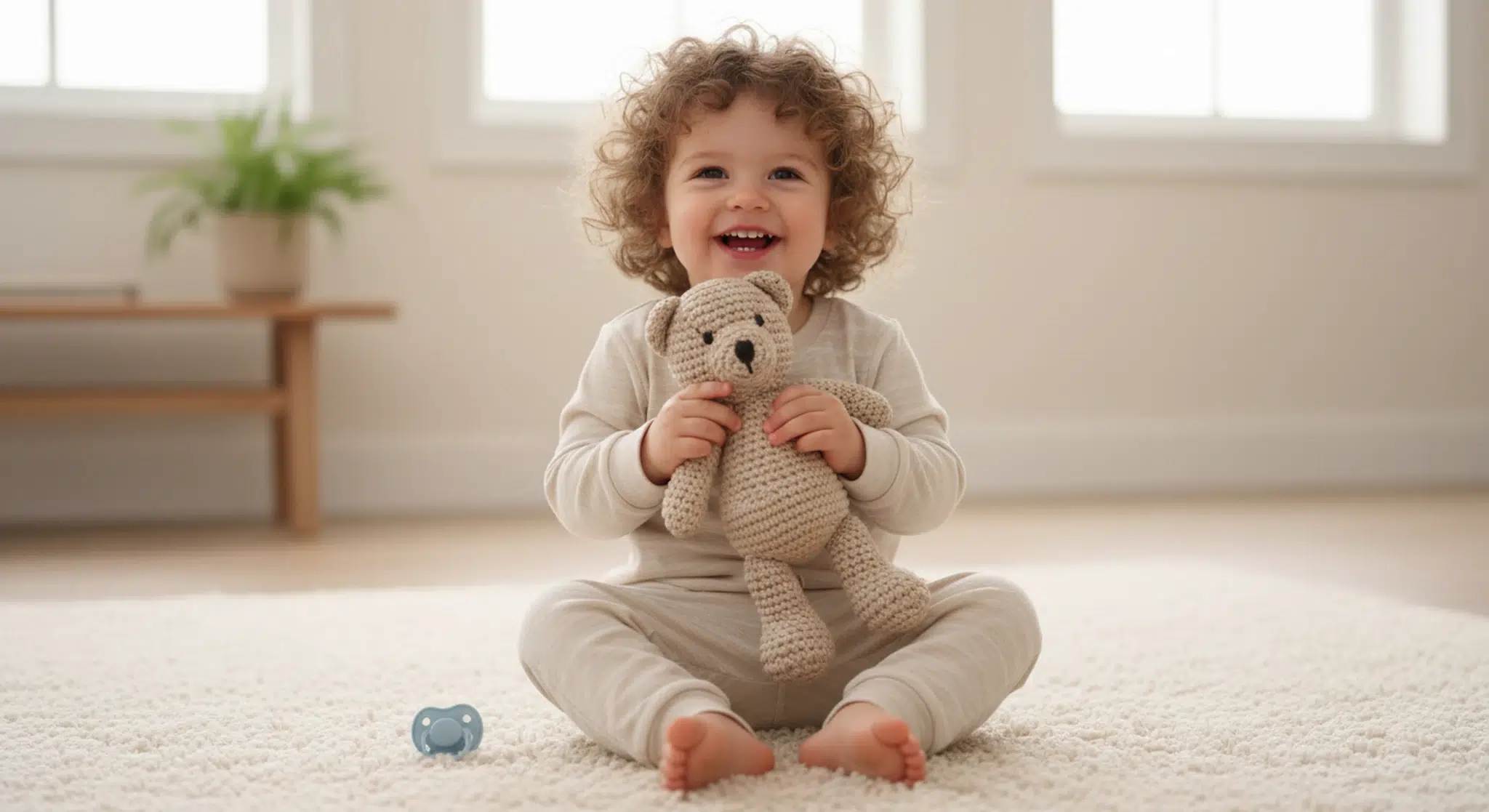
There is no single day a pacifier has to go, but there is a window where stopping is much easier than it will be later.
In the first year a pacifier is genuinely useful, and pediatric guidance actively recommends offering one at sleep. Somewhere in the second year the balance shifts, and by the preschool years the small costs to teeth and speech start to outweigh the comfort. Knowing where your child sits on that curve is more useful than any deadline.
This guide gives you an age-by-age timeline, the real risks of waiting too long and how big they actually are, the signs your child is ready, five weaning methods with the ages each one suits, and a plan for getting through the first few nights without wrecking sleep.
Key Takeaways
Do not wean in the first year: pacifier use at naps and bedtime is associated with a lower risk of SIDS.
Cut back to sleep-only between six and twelve months; this single change protects speech and daytime dental exposure.
Aim to stop completely between ages two and three; dental guidance flags sucking past age three as worth a conversation.
Intensity matters more than age: vigorous sucking carries more dental risk than a passively held pacifier.
Pick one weaning method and stay consistent; switching methods halfway is what makes weaning drag on.
Expect three to seven rough nights, and do not wean during a move, a new sibling, illness, or a daycare start.
Table of Contents
The Short Answer: When Should a Baby Stop Using a Pacifier?
Quick Answer
Most guidance points to starting to limit the pacifier between six and twelve months, aiming to stop fully between ages two and three, and treating continued sucking past age three or four as worth discussing with your dentist. Children very often give it up on their own somewhere in that window.
The reason the answer is a range rather than a date is that the pacifier does different jobs at different ages. In the first year it has a documented safety benefit at sleep. In the second year it is mostly comfort. By the third year it starts to carry small but real costs to teeth and speech. The goal is not to hit a deadline, it is to move through those stages without an abrupt, miserable cutoff.
Why You Should Not Rush to Take It Away in the First Year
The American Academy of Pediatrics recommends offering a pacifier at naps and bedtime during the first year as part of its safe sleep guidance, because pacifier use at sleep is associated with a reduced risk of sudden infant death syndrome. That is a strong reason not to wean a young baby off it just because you are tired of the 2am search for it under the crib.
A few practical points for the first year. If you are breastfeeding, most guidance suggests waiting until feeding is well established, often around three to four weeks, before introducing a pacifier. Never attach the pacifier to a cord, ribbon, or clip inside the crib, and never force it. If it falls out once your baby is asleep, you do not need to put it back in.
So the honest framing is: in the first year, the pacifier is on your side. It is in the second and third years that the calculation changes.
Pacifier Weaning Timeline by Age
Age
What is going on
What to do
0 to 6 months
Strong sucking reflex; pacifier at sleep is protective
Offer freely at naps and bedtime; do not attempt weaning
6 to 12 months
Reflex fading, habit forming
Start limiting to sleep and car rides only; keep it out of sight otherwise
12 to 18 months
Comfort object, strong attachment possible
Sleep only; introduce a lovey or comfort routine as a replacement
18 to 24 months
Language really taking off
Never during talking or play; many families stop fully here
2 to 3 years
Old enough to understand a plan
Pick a method and stop; most dental guidance points to being done by three
3 years and up
Dental effects more likely with intense sucking
Talk to your dentist or pediatrician about a plan
A gradual pacifier weaning timeline, from protective in infancy to worth stopping by the preschool years.
Notice that the biggest single step is the one at six to twelve months: going from all-day access to sleep-only. If you make that move early and hold it, the final goodbye at two is usually far less dramatic, because the pacifier never became a daytime companion.
What Happens If You Wait Too Long
The main concerns are dental and speech, and both are about duration and intensity rather than any single month.
Teeth and jaw. The American Dental Association notes that pacifiers can affect the teeth in essentially the same ways as thumb sucking, and that sucking may cause problems with the growth of the mouth and alignment of the teeth once permanent teeth come in, along with changes to the roof of the mouth. Intensity matters: a child who rests the pacifier passively in the mouth is less likely to have trouble than one who sucks vigorously. The American Academy of Pediatric Dentistry notes that these habits generally only become a problem if they go on a very long time, and that if a child is still sucking past age three, a mouth appliance may be recommended.
Speech. A pacifier in the mouth during waking hours physically limits babbling, imitation, and practice at exactly the age when a child is building those skills. This is one of the strongest arguments for the sleep-only rule from the second year onward, and it is a change you can make without giving anything up at bedtime.
Ear infections. Some research links frequent pacifier use in older infants and toddlers with a higher rate of middle ear infections, which is another reason to reduce daytime use after the first year.
None of this means a two-and-a-half-year-old with a bedtime pacifier is in trouble. It means the trend line matters, and reducing use is easier than reversing an effect later.
Signs Your Child Is Ready to Stop
They regularly go long stretches without asking for it, or forget it at nap.
They can fall asleep without it at least sometimes, including after a night waking.
They can understand and remember a simple plan, usually somewhere after two.
They have another comfort strategy: a lovey, a song, a predictable bedtime routine.
Nothing big is happening. No new sibling, no move, no starting daycare, no illness.
That last point matters more than any of the others. Pacifier weaning during a major transition tends to fail and then has to be repeated, which is harder the second time. If you have a stressful month coming, wait for a calm one.
Five Ways to Wean Off a Pacifier, and When Each Works
There is no single right method. Pick the one that matches your child’s age and temperament, then be consistent, because switching methods halfway is what makes weaning drag on for weeks.
Gradual reduction (any age, gentlest). Cut the contexts one at a time: first the car, then the stroller, then play, then naps, then finally bedtime. Slow, low-drama, and the method most families find easiest to stick to.
Cold turkey (2 years and up). Explain it once, gather every pacifier in the house, and stop. Expect two or three rough nights and then usually a fast adjustment. Works best for children who do better with a clean line than a fading one.
The pacifier fairy or gift swap (roughly 2.5 to 4). Your child puts the pacifiers in a bag and trades them for a chosen toy. It gives them agency, which is exactly what a three-year-old wants. Only use it once your child can genuinely follow the story.
The giving-away story (2.5 and up). Posting the pacifiers to a new baby, or leaving them for a favorite character, works on the same principle: it is a decision your child makes rather than a loss that happens to them.
Clipping or altering (use with caution). Some parents snip the tip so it no longer gives satisfying suction. Be aware that a damaged pacifier is a choking hazard, and many dentists advise against it for that reason. Discard the pacifier entirely rather than leaving a cut one in the crib.
Big transitions go better on a full night of sleep.
If bedtime or naps are a struggle, our free two-minute quiz builds a gentle, personalized plan.
The pacifier is usually doing a specific job at bedtime: it bridges the gap between lying down and falling asleep. Take it away and that gap is suddenly bare, so fill it with something else rather than leaving your child to face it alone.
Lengthen the wind-down slightly for a week: one extra book, a few extra minutes of quiet.
Introduce a lovey or small comfort object if your child is over twelve months and it is safe for their crib or bed.
Move bedtime earlier by fifteen to twenty minutes during the transition. An overtired child has fewer resources for coping with change.
Offer more physical comfort at the moment of settling: a hand on the back, quiet humming, sitting nearby.
Stay consistent about the answer. Reintroducing it on night three teaches that persistence brings it back, and makes night four worse.
Expect a few extra night wakings for roughly three to seven days, then steady improvement.
If your child was relying heavily on the pacifier to fall asleep, you are effectively changing a sleep association, so it can be worth reading our guide to common sleep training methods for gentle settling approaches that pair well with this transition.
Pacifier vs Thumb Sucking
Parents often ask whether they should worry about their child swapping one for the other. It is worth knowing that dental effects from thumb and finger sucking are broadly similar to those from pacifiers, but there is one practical difference: a pacifier is a habit you can physically end, and a thumb is always attached.
The ADA notes that children usually stop sucking their thumbs between ages two and four, or by the time the permanent front teeth are ready to come in. If your child moves to their thumb after pacifier weaning, that is worth watching but not usually a reason to give the pacifier back. Our guide to thumb sucking covers what helps.
When to Talk to a Professional
Your child is past age three or four and still sucking intensely during the day.
You can see changes to the front teeth, the bite, or the roof of the mouth.
Speech is noticeably delayed or unclear and the pacifier is in the mouth a lot of the day.
Your child has frequent ear infections.
Weaning attempts have caused weeks of severe distress rather than a few hard nights.
A pediatric dentist is the right first call for dental concerns; your pediatrician for speech, ears, or sleep that has fallen apart.
A Calm Way to Think About the Whole Thing
Almost every child gives up the pacifier eventually, and very few carry any lasting mark from having used one. What separates an easy wean from a hard one is rarely the method. It is timing, consistency, and whether the pacifier was already down to one job before you took it away.
If you do nothing else, make the sleep-only rule sometime in the second half of the first year and hold it. That single change protects speech and daytime dental exposure, and it turns the eventual goodbye into a small event instead of a large one.
Frequently Asked Questions
When should a baby stop using a pacifier?
Start limiting the pacifier to sleep and car rides between six and twelve months, and aim to stop completely between ages two and three. In the first year the American Academy of Pediatrics recommends offering a pacifier at naps and bedtime because it is associated with a reduced risk of SIDS, so there is no reason to wean early. Dental guidance suggests that sucking habits continuing past age three are worth discussing with a dentist.
Is it bad for a 3 year old to use a pacifier?
It is not an emergency, but three is the age at which most dental guidance suggests acting. The American Academy of Pediatric Dentistry notes that thumb and pacifier habits generally only become a problem if they continue a very long time, and that a child still sucking past age three may be recommended a mouth appliance. Intense, frequent sucking carries more risk than a passive pacifier at bedtime only.
How do I wean my baby off a pacifier at night?
Cut the daytime uses first so bedtime is the only remaining one, then choose a single approach and stay consistent. Lengthen the wind-down routine, move bedtime fifteen to twenty minutes earlier during the transition, offer a lovey if your child is over twelve months, and give more physical comfort at settling. Expect roughly three to seven nights of extra waking before things settle, and do not reintroduce the pacifier partway through.
Does a pacifier affect speech development?
It can if it is in the mouth during waking hours. A pacifier physically limits babbling, imitation and practice at exactly the age children are building speech, which is why most guidance recommends a sleep-only rule from around twelve months. A pacifier used only for naps and bedtime is far less likely to affect speech than one used through the day.
Is the pacifier or the thumb worse for teeth?
The American Dental Association notes that pacifiers can affect the teeth in essentially the same ways as sucking fingers and thumbs, and that the intensity of sucking matters more than the object. The practical difference is that a pacifier habit can be ended, while a thumb is always available. Children usually stop thumb sucking between ages two and four on their own.
Gentle changes, peaceful nights.
Betteroo builds a personalized sleep plan for your child. Take the free two-minute quiz to get started.
Related reading: The first few nights after the pacifier goes are usually the hardest part, and a stronger bedtime routine carries a lot of the load, as in these fifteen field-tested tips for toddler bedtime battles.