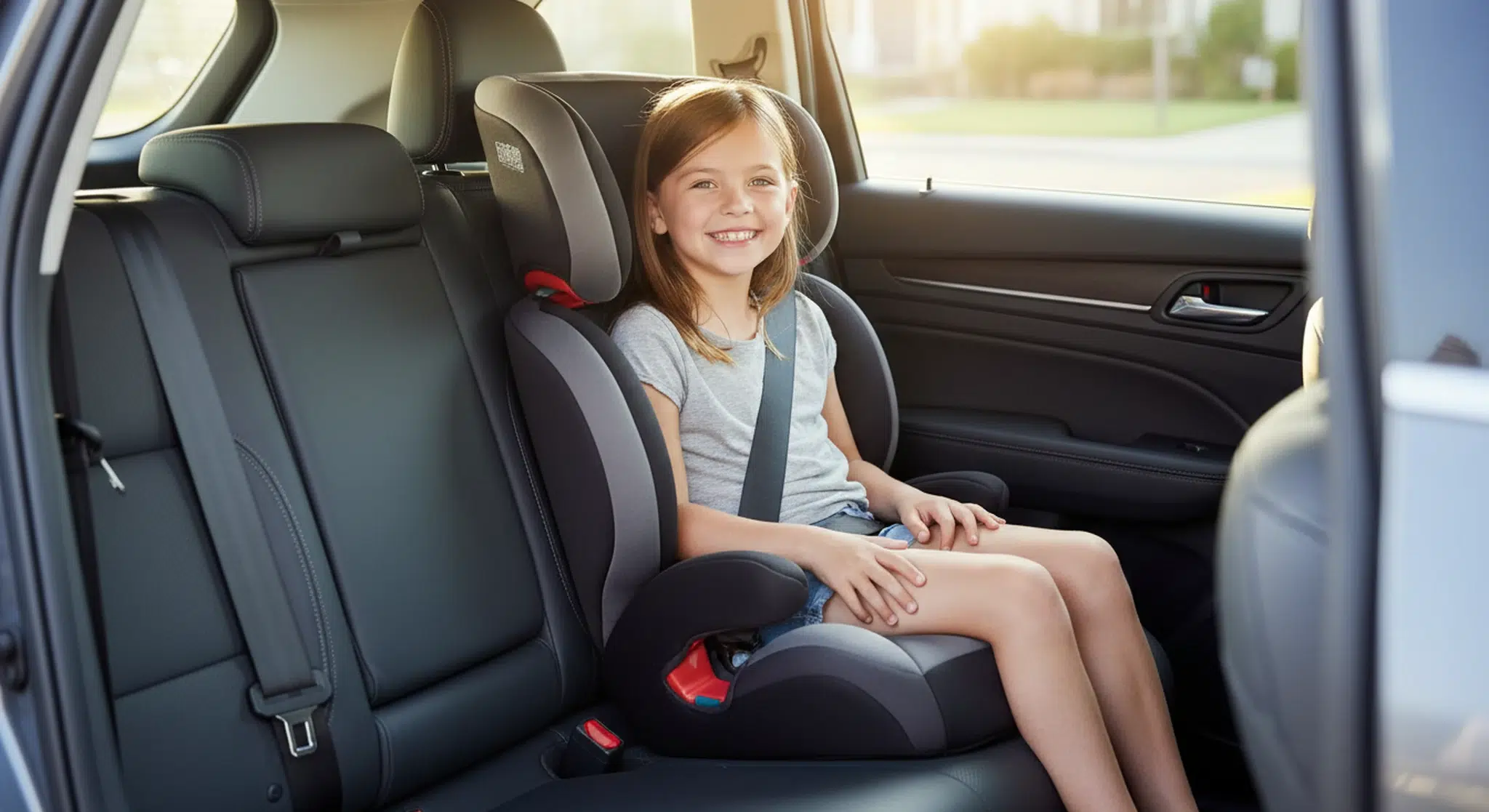
Most kids need a booster seat far longer than parents expect: usually until 10 to 12 years old.
Booster seat age is one of the most searched car seat questions, and one of the most misunderstood. Many parents move children into a booster at 3 or 4 and out of it at 7 or 8, but pediatric safety guidance points to a later start and a much later finish.
This guide explains when kids can start using a booster seat, when they can stop using a booster seat (with the 5-step seat belt fit test), why height matters more than age, how state laws fit in, and the most common mistakes to avoid. Every recommendation here follows the American Academy of Pediatrics and NHTSA.
Key Takeaways
Keep your child in a forward-facing 5-point harness as long as the seat allows, and at least to age 4, before moving to a booster.
Most children need a booster until they are about 4 feet 9 inches tall and 8 to 12 years old; many do not fit an adult belt until 10 to 12.
Use the 5-step test in every vehicle to decide when your child can stop using a booster seat.
State laws vary and are minimums; there is no single national legal age to stop using a booster.
All children younger than 13 should ride in the back seat.
Table of Contents
Booster Seat Age at a Glance
There is no single booster seat age that works for every child, because car seat stages are based on size, the limits of the seat you own, and maturity, not a birthday. Still, the American Academy of Pediatrics (AAP) and the National Highway Traffic Safety Administration (NHTSA) describe a typical path that most families follow:
Stage
Typical ages
Move on when
Rear-facing car seat
Birth to at least 2 years, often 3 to 4
Your child reaches the rear-facing weight or height limit of their convertible or all-in-one seat
Forward-facing seat with a 5-point harness
About 2 to 4 years and up, often to 5 or 6
Your child outgrows the harness weight or height limit (many seats go to 65 pounds), ideally not before age 4
Belt-positioning booster seat
Roughly 5 to 12 years
The adult seat belt fits correctly without a booster, usually at about 4 feet 9 inches and 8 to 12 years old
Seat belt alone, back seat
Usually 10 to 12 years and up
Keep kids in the back seat until age 13
Typical car seat stages. Always follow your seat’s labeled limits and your state’s law.
The AAP says children should use a belt-positioning booster seat until the vehicle seat belt fits properly, typically when they reach 4 feet 9 inches and are 8 to 12 years old, and that most children will not fit an adult seat belt without a booster until 10 to 12 years. That surprises a lot of parents, who expect booster seats to end around kindergarten.
When Can a Child Start Using a Booster Seat?
Moving into a booster is a step down in protection, not a promotion. A 5-point harness spreads crash forces across the strongest parts of a small body and holds a child in position even if they wiggle or fall asleep. A booster only lifts the child so the adult belt sits in the right place, and it relies on the child to sit correctly for the whole ride.
That is why the AAP recommends keeping children in a forward-facing seat with a harness for as long as possible, up to the highest weight or height the manufacturer allows, and at least to age 4. Your child is ready to start using a booster seat when all of these are true:
They have outgrown the forward-facing harness by weight or height (the shoulders are above the top harness slot, the tops of the ears are above the shell, or they are over the weight limit on the label).
They are at least 4 years old, and many child passenger safety technicians prefer age 5 or older.
They are mature enough to sit upright, with the belt in place, for every minute of every ride, including when they fall asleep.
They meet the minimum weight and height listed on the booster itself (often 40 pounds and 38 to 40 inches).
Maturity is the part parents most often skip. A 4-year-old who leans forward to grab a toy, slides the shoulder belt under an arm, or slumps sideways asleep is not getting the protection a booster promises. If your child has outgrown their harness before they are mature enough for a booster, look for a combination seat or harnessed seat with higher limits.
When Can Kids Stop Using a Booster Seat? The 5-Step Test
Age alone does not tell you when kids can stop using a booster seat. Seat belt fit does, and it varies by vehicle, since back seats differ in depth and belt geometry. Child passenger safety technicians use a simple 5-step test. Have your child sit in the back seat without a booster and check each point:
1. Back against the seat: Your child sits all the way back, with their back against the vehicle seat back.
2. Knees bend at the edge: Their knees bend naturally over the front edge of the seat, with feet on or toward the floor. If their legs stick straight out, they will slouch to get comfortable, which pulls the lap belt onto the belly.
3. Lap belt low on the thighs: The lap belt lies snugly across the upper thighs and hips, not the soft stomach.
4. Shoulder belt across the chest: The shoulder belt crosses the middle of the shoulder and chest, not the neck or face, and not falling off the arm.
5. Can stay that way the whole trip: They can sit like this for the entire ride, awake or asleep, without slouching, leaning, or moving the belt.
If the answer to any step is no, your child still needs a booster, even if they are 10 and their friends have stopped. Test again in every vehicle they ride in, including grandparents’ cars and carpools, because a child can pass in an SUV and fail in a compact car.
Why Height Matters More Than Age
Adult seat belts are designed for bodies roughly 4 feet 9 inches and taller. On a smaller child, the lap belt rides up over the abdomen and the shoulder belt cuts across the neck. In a crash, a lap belt on the belly can cause serious abdominal and spinal injuries, a pattern doctors call “seat belt syndrome.” Children who find the shoulder belt uncomfortable also tend to tuck it behind their back or under an arm, which removes upper-body protection entirely.
A booster fixes the geometry: it raises the child and uses guides to route the lap belt low over the hips and the shoulder belt across the collarbone. That is why the milestone to watch is fit, which usually lines up with about 57 inches of height, rather than a particular grade in school.
Big days go better with a good night of sleep.
Got a little one at home too? Our free two-minute quiz builds a gentle, personalized sleep plan for babies and toddlers.
State Booster Seat Laws: Why There Is No Single Legal Age
Every U.S. state has its own child passenger safety law, and the booster seat rules differ in the ages, heights, and weights they name. Some states set a minimum age such as 8, others add a height threshold, and a few have lower requirements. Because laws change and vary so much, we are not listing a single “legal age” here. Check your state’s current law through the Governors Highway Safety Association’s state law chart or your state highway safety office.
Keep in mind that state laws are minimums, not best practice. A child can be legally allowed out of a booster and still fail the 5-step test. The AAP and NHTSA recommendations above are built on crash science, and following them usually means keeping your child in a booster longer than the law requires.
High-Back vs Backless Booster Seats
Both types are belt-positioning boosters, and both can be safe when the seat belt fits correctly. The differences:
High-back booster
Backless booster
Best for
Younger or smaller booster riders, vehicles without headrests
Older kids who fit the belt well, carpools, travel
Head support
Yes, and side wings help sleeping kids stay positioned
None, relies on the vehicle headrest
Shoulder belt guide
Built in, adjusts with the headrest
Often a separate clip, or none
Portability
Bulkier
Light and easy to move between cars
Choose the booster that gives your child the best belt fit in your vehicle.
A high-back booster is the better starting point for most children moving out of a harness, and it is required if your vehicle seat has no headrest or a low seat back (the top of your child’s ears should not be above the vehicle seat back or headrest). Many combination seats convert from a harnessed seat to a high-back booster to a backless booster, which can cover several years.
Common Booster Seat Mistakes
Moving to a booster too early: Switching at 3 or 4 because a child “seems big” gives up the harness before it is outgrown.
Using a lap-only belt: Boosters must be used with a lap-and-shoulder belt. Never use a booster with a lap belt alone.
Shoulder belt behind the back or under the arm: This removes upper-body protection and can cause serious injury in a crash. If the belt bothers your child, the fit is wrong, so adjust the belt guide or try a different booster.
Leaving a backless booster unbuckled: An empty booster can become a projectile. Buckle it in when not in use, or use one with LATCH connectors (which attach the booster, not the child).
Letting the child ride in front: All children younger than 13 should ride in the back seat, away from front airbags.
Skipping the booster on short trips: Most crashes happen close to home. Use the booster every time.
Car Seat Stages Checklist for Parents
If your child is younger and you are planning ahead, here is the order of moves, each one made only after the previous seat is outgrown. For babies, see our guide to what car seat comes after the infant seat. For road trips, pack a car sickness kit and read how to clean vomit from a car and car seat, just in case.
Rear-facing as long as the seat allows. Most convertible seats let children ride rear-facing for 2 years or more.
Forward-facing with a harness until the harness limit, at least to age 4.
Belt-positioning booster until the adult belt passes the 5-step test.
Lap-and-shoulder belt alone, in the back seat until age 13.
A certified child passenger safety technician (CPST) can check your installation and fit for free in many communities. NHTSA and Safe Kids Worldwide both offer searchable inspection station directories.
Talk with your pediatrician or a certified child passenger safety technician if your child has outgrown their seat much earlier or later than expected, has a medical condition that affects posture or breathing, or cannot sit in a booster properly for a whole trip. Children with special health care needs may need specialized restraints, and the AAP publishes guidance for families. After any moderate or severe crash, replace the car seat or booster, and check your seat’s manual for the manufacturer’s rules on minor crashes.
Frequently Asked Questions
What is the booster seat age?
Most children start using a booster seat after outgrowing a forward-facing harness, at least age 4 and often 5 or older, and keep using it until the adult seat belt fits correctly, typically at about 4 feet 9 inches tall and between 8 and 12 years old.
When can kids stop using a booster seat?
Kids can stop using a booster seat when they pass the 5-step test: back against the seat, knees bent at the seat edge, lap belt low on the thighs, shoulder belt across the chest, and able to sit that way the whole trip. For most children this happens between 10 and 12 years old.
Can a 4 year old use a booster seat?
Only if they have outgrown their harnessed seat, meet the booster’s minimum size, and can sit properly for every ride. The AAP recommends keeping children in a harness as long as possible, and many 4-year-olds are safer staying harnessed.
Does my 7 year old still need a booster?
Almost certainly. Very few 7-year-olds are tall enough for an adult seat belt to fit correctly. Keep using the booster until your child passes the 5-step test in each vehicle.
What is the legal age to stop using a booster seat?
There is no single legal age in the U.S. Each state sets its own booster seat law using different ages, heights, and weights. Check your state’s current law, and remember laws are minimums; seat belt fit is the safer guide.
Gentle changes, peaceful nights.
Betteroo builds a personalized sleep plan for your baby or toddler. Take the free two-minute quiz to get started.