If your child just threw up in the car, you are not alone, and it is fixable.
Car sickness, a stomach bug or one too many snacks: sooner or later, most parents find themselves cleaning vomit out of a car. The right method gets rid of the mess and the smell, and it protects the parts of your child’s car seat that keep them safe.
This guide covers what to do in the first few minutes, how to clean vomit from car upholstery, carpet and leather, how to clean a car seat and harness without damaging it, how to get rid of the smell, how to prevent car sickness in kids, and what to keep in a car sickness kit.
Key Takeaways
Scoop solids, blot (do not scrub), cover with baking soda, then use an enzyme cleaner.
Follow your car seat’s manual: covers are often machine washable, but harness straps should only be surface cleaned.
Never submerge harness straps or use bleach, vinegar or harsh cleaners on them.
Air the car out fully so moisture does not leave a lingering smell.
Help prevent car sickness with a window view, fresh air, light snacks and no screens.
Table of Contents
First: Take Care of Your Child
Pull over when it is safe. Check that your child is okay, breathing comfortably and not choking, then get them out of the car seat and into fresh air. Wipe their face and hands, offer small sips of water once the nausea settles, and change their clothes if you can. Keeping a small car sickness kit in the trunk makes this step much faster (see the checklist below).
If your child is buckled in a car seat, do not just wipe around them and keep driving with a soaked harness if you can avoid it. Wet straps can loosen as you adjust them, and your child will be more comfortable in clean clothes. When you get home, clean the seat properly before the next ride.
How to Clean Vomit From a Car, Step by Step
1. Act fast: The sooner you clean, the less vomit soaks into foam and fibers, and the less smell you will fight later.
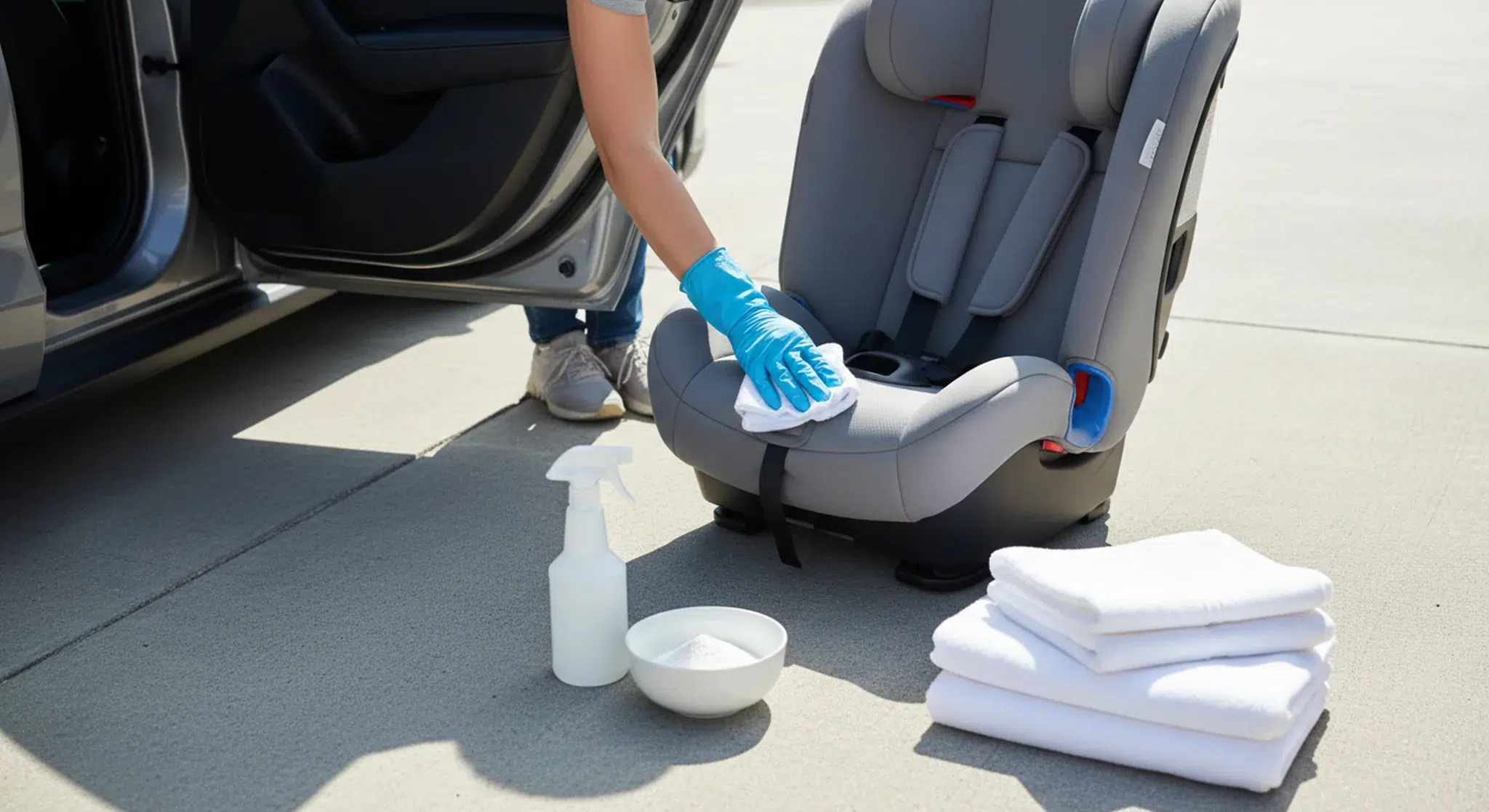
2. Remove the solids: Wearing gloves, scoop up solids with paper towels, a plastic scraper or an old gift card. Lift, do not smear.
3. Blot, do not scrub: Press paper towels or an old towel into the wet area to soak up as much liquid as possible. Scrubbing pushes it deeper.
4. Cover with baking soda: Sprinkle a generous layer of baking soda (or cornstarch) over upholstery and carpet. It absorbs moisture and odor. Leave it at least 30 minutes, or several hours if you can, then vacuum.
5. Clean with an enzyme cleaner: Enzyme cleaners break down the proteins in vomit that cause lingering smells. Test on a hidden spot first, follow the label, then blot with a clean damp cloth.
6. Treat hard surfaces: Wipe plastic, vinyl and seat belt buckles with warm soapy water, then dry. Use a disinfectant on hard surfaces if the vomit came from a stomach bug.
7. Leather seats: Wipe with a damp cloth and mild soap, dry right away, and finish with a leather conditioner. Avoid soaking leather.
8. Dry and air out: Open the doors or windows and let the car dry completely, in the sun if possible. Trapped moisture leads to mildew smells.
How to Clean Vomit From a Car Seat
Car seats need a little more care than regular upholstery, because using the wrong cleaning method can weaken parts that protect your child in a crash. Always check your car seat’s manual first. Most manufacturers give instructions along these lines:
Part
Usually safe
Usually not allowed
Fabric cover and pads
Remove and machine wash on a gentle, cold cycle with mild detergent, or hand wash; air dry
Bleach, harsh detergents, high-heat drying (check your manual)
Harness straps
Surface wash with a soft cloth, mild soap and water; air dry
Submerging, machine washing, bleach, vinegar, or household cleaners, which can weaken the webbing
Buckle
Some manuals allow rinsing or swishing in warm water; dry fully
Soap, lubricants or sprays inside the buckle
Plastic shell
Wipe with mild soap and warm water
Solvents and abrasive cleaners
General car seat cleaning guide. Your seat’s manual has the final word.
Take photos of how the cover and harness are threaded before you remove anything, so you can reassemble it correctly. After cleaning, re-thread the harness exactly as the manual shows, with no twists, and do the pinch test at the collarbone once your child is buckled in. If the harness straps cannot be cleaned or look damaged, contact the manufacturer for replacement straps rather than using a substitute.
Repeat the baking soda step overnight on the affected area, then vacuum.
Leave an open box of baking soda, a bowl of activated charcoal, or dry coffee grounds in the car for a day or two.
Air the car out with windows open on a dry, sunny day.
Check hidden spots: seat tracks, the gap between cushions, seat belt webbing, floor mats and the car seat base.
If the smell remains after a week, the vomit may have soaked into the seat foam. A professional interior detailer can deep clean with extraction equipment.
Air fresheners only cover the smell. Removing the source with enzyme cleaner is what actually gets rid of it.
Big days go better with a good night of sleep.
Got a little one at home too? Our free two-minute quiz builds a gentle, personalized sleep plan for babies and toddlers.
Motion sickness happens when the eyes and inner ear send the brain mixed signals about movement. It is uncommon in babies and most common in children from about age 2 through the preteen years. Some kids are simply more prone to it, but these tips help many:
Look outside: Encourage your child to look out the window at the horizon or distant objects, not down.
Skip screens and books: Reading or watching a tablet makes motion sickness worse for many kids. Audiobooks, music and I-spy games are better options.
Keep the air fresh and cool: Open a window a crack or aim a vent toward your child.
Eat light: Offer a small, bland snack before the trip, like crackers, and avoid heavy, greasy or large meals right before and during the drive.
Plan breaks: On longer trips, stop every hour or two for fresh air.
Time trips with sleep: Driving during naps can help, since sleeping children rarely get car sick.
Drive smoothly: Gentle braking and fewer sharp turns help.
Never turn a child forward-facing early, or move them to the front seat, to prevent car sickness. The safety cost is far greater than the benefit. Ask your pediatrician before giving any motion sickness medicine; some are not recommended for young children, and dosing depends on age and weight.
The Car Sickness Kit Every Parent Should Pack
Leak-proof sick bags or a small bucket with a lid
A roll of paper towels and a pack of wipes
Disposable gloves and plastic bags for soiled clothes
A full change of clothes for each child (and a spare shirt for you)
Car sickness should stop soon after the car does. Call your pediatrician if vomiting continues after you are out of the car, happens with fever, diarrhea, a stiff neck, severe belly pain, or a rash, or if your child shows signs of dehydration (fewer wet diapers or trips to the bathroom, dry mouth, no tears, unusual sleepiness). Get urgent care for vomiting after a head injury, green or bloody vomit, or a baby who vomits forcefully and repeatedly. Frequent car sickness, headaches or dizziness between trips are also worth mentioning at a checkup.
Frequently Asked Questions
How do you clean vomit out of a car?
Remove solids with paper towels or a scraper, blot the liquid, cover the area with baking soda for at least 30 minutes, vacuum, then treat with an enzyme cleaner and let the car dry completely with the windows open.
How do you clean throw up from a car seat?
Follow your car seat manual. Most covers can be removed and washed gently and air dried. Harness straps should be surface washed with mild soap and water only, never submerged or treated with bleach or vinegar.
How long does it take to get vomit smell out of a car?
If you remove the source quickly with baking soda and an enzyme cleaner, most smell is gone in a day or two once the car dries. If it lingers beyond a week, the vomit likely soaked into the foam and may need professional extraction.
Is it better to clean vomit wet or dry?
Remove as much as you can while it is fresh, blot up the liquid, and let baking soda absorb the rest before wet-cleaning. Letting vomit dry in place makes it harder to remove and increases odor.
How can I stop my child from getting car sick?
Have them look out the window, skip screens and books, keep the car cool with fresh air, offer a small bland snack before driving, take breaks, and drive smoothly. Talk to your pediatrician before using any medicine.
Gentle changes, peaceful nights.
Betteroo builds a personalized sleep plan for your baby or toddler. Take the free two-minute quiz to get started.