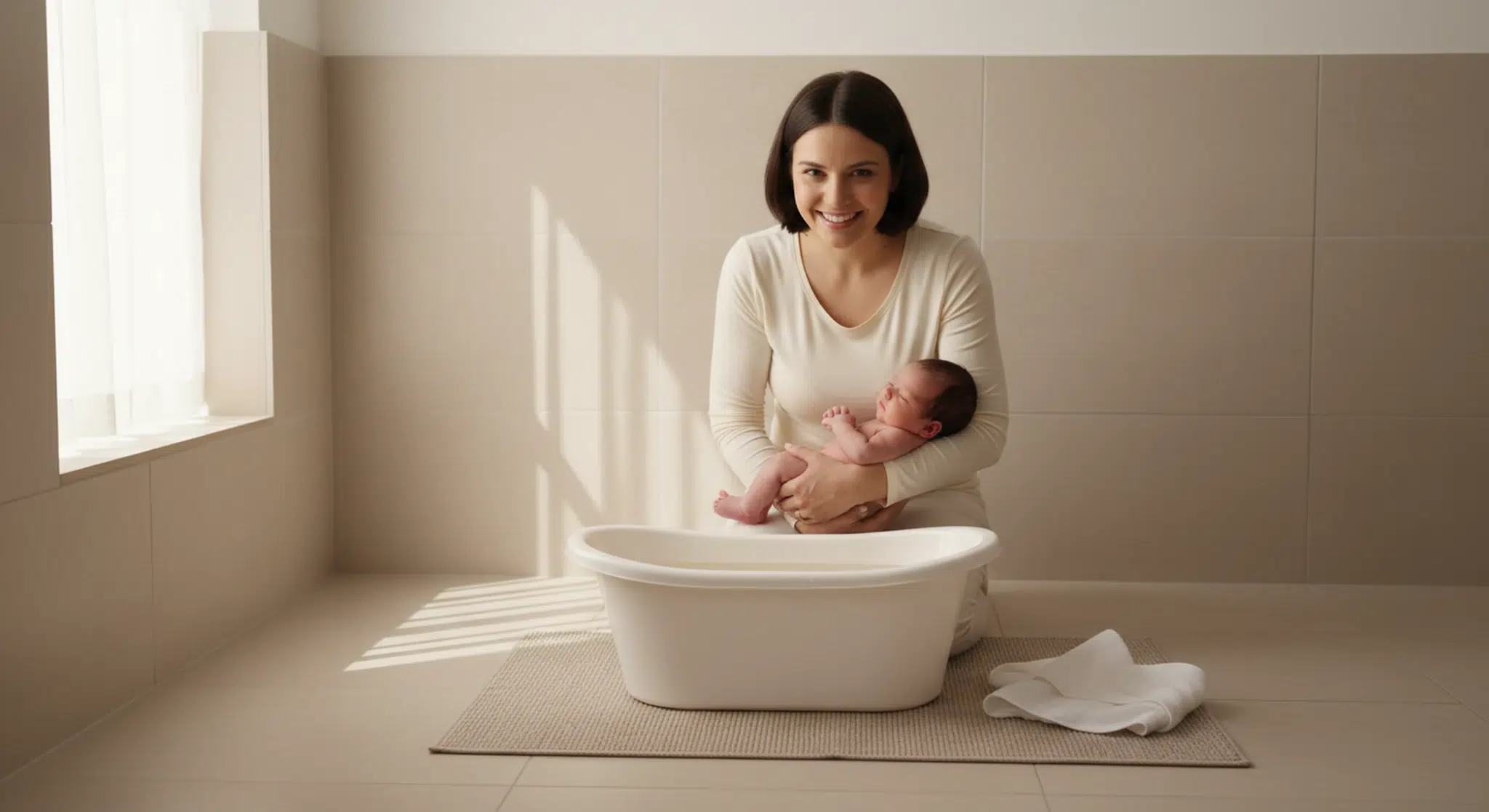
How to bathe a newborn: give sponge baths until the umbilical cord stump falls off, then switch to short tub baths in about 2 inches of warm water, about three times a week, with one hand on your baby the entire time.
The first bath at home can feel like a lot: a tiny, slippery baby, a cord stump you are afraid to touch, and water of uncertain temperature. Newborns need very little washing, and the method is simple once you have done it twice.
This guide covers how to bathe a newborn step by step, plus water temperature, frequency, cord and circumcision care and safety. Every number comes from the American Academy of Pediatrics (AAP) or Mayo Clinic.
Key Takeaways
Sponge bathe until the cord stump falls off, then switch to short tub baths.
Use about 2 inches of water around 100 F (Mayo Clinic) that feels warm, not hot, on your wrist or elbow (AAP).
About three baths a week is enough in the first year; more can dry out the skin (AAP).
Never leave your baby alone in water, even for an instant, and keep one hand on them at all times.
Call your pediatrician right away for a fever of 100.4 F or higher under 3 months, or signs of a cord infection.
Table of Contents
How to Bathe a Newborn: The Short Answer
Quick Answer
Give sponge baths until the umbilical cord stump falls off, then move to short tub baths in about 2 inches of warm water in a small infant tub or sink. The American Academy of Pediatrics (AAP) says newborns do not need a daily bath: about three baths a week in the first year may be enough. Test the water with your wrist or elbow, keep one hand on your baby the whole time, and never leave your baby alone in water, even for an instant.
The AAP notes that the World Health Organization (WHO) recommends delaying the first bath until 24 hours after birth, or at least 6 hours if a full day is not possible for cultural reasons. Waiting helps with body temperature, blood sugar, skin-to-skin contact and breastfeeding, and vernix, the waxy coating on newborn skin, is a natural moisturizer (AAP).
What You Need Before You Start (Checklist)
Mayo Clinic advises gathering all supplies first so you never have to step away:
A place to bathe: a flat, warm surface for a sponge bath, or a small infant tub or sink lined with a clean towel (Mayo Clinic).
Water: a basin of warm water for a sponge bath, or about 2 inches in the tub (AAP, Mayo Clinic).
A cup of rinse water: for rinsing hair and soap (Mayo Clinic).
Mild soap and shampoo: fragrance-free, used sparingly (AAP, Mayo Clinic).
A towel, ideally with a hood: to wrap your baby the moment they come out (Mayo Clinic, AAP).
A clean diaper and clothes: (Mayo Clinic).
Fragrance-free moisturizer: only if your baby’s skin is dry (AAP, Mayo Clinic).
Mayo Clinic also says to keep the room comfortably warm, because a wet baby chills easily (for overnight, see baby room temperature for sleep).
Deciding on a tub? Our baby bathtub guide covers when one is worth it. The AAP advises a hard plastic infant tub with a sloped, textured surface or a sling, made on or after October 2, 2017.
How to Give a Newborn a Sponge Bath, Step by Step
A sponge bath means washing your baby with a washcloth and basin instead of putting them in water. The AAP says to give only sponge baths until the cord stump falls off. The routine, from AAP and Mayo Clinic guidance:
Set up on a flat, warm surface. The AAP says never to leave a baby on a raised surface without a safety strap or one hand on them.
Fill a basin with water that feels warm, not hot, on your wrist or elbow (AAP).
Wrap your undressed baby in a dry towel and uncover only the part you are washing (AAP, Mayo Clinic).
Wash the face first with a plain, damp washcloth, wiping each eyelid from the inside corner out (Mayo Clinic) and keeping water out of the eyes and mouth (AAP).
Wash the scalp gently, without pressing on the soft spots (AAP).
Wash the body from the top down, paying attention to the armpits, behind the ears and the neck (AAP).
Wash the diaper area last (AAP, Mayo Clinic), keeping the cord stump dry.
Pat dry, every crease included, then diaper and dress.
Switch once the stump has fallen off and the area has healed. The AAP’s bathing page says the stump usually falls off by about one or two weeks of age; its cord care page says by about 3 weeks, and that a stump still attached after that needs a doctor’s visit.
Sponge bath
Tub bath
When
From birth until the cord stump falls off (AAP)
After the stump has fallen off and the area has healed
Where
Flat, warm surface
Small infant tub or sink (Mayo Clinic)
Water
A basin; baby stays out of it
About 2 inches (AAP, Mayo Clinic), around 100 F (Mayo Clinic)
Baby’s position
Lying on the back, wrapped in a towel
Lowered in feet first, head supported, most of the body above the water (AAP)
How long
A few minutes
Short; longer only if your baby enjoys it (AAP)
Cord stump
Keep it clean and dry (AAP)
Stump already gone
Sponge bath vs tub bath for a newborn. Sources: AAP HealthyChildren.org and Mayo Clinic.
There is no rush. If the tub upsets your baby, a sponge bath still gets them clean. For what changes week to week, see how long the newborn stage lasts.
How to Bathe a Newborn in a Tub: The First Tub Bath
Fill the tub first with about 2 inches of water, then turn the faucet off. The AAP says never to bathe a baby in running water or with a faucet sprayer.
Check the temperature with your wrist or elbow (AAP); about 100 F (Mayo Clinic).
Undress your baby and put them in right away so they do not get chilled (AAP).
Support the head and lower your baby in feet first, using your nondominant arm under the head and neck so your other hand is free (Mayo Clinic).
Keep most of the body above the water and pour warm water over your baby often so they stay warm (AAP).
Wash face and hair first, then the body top down, diaper area last (AAP, Mayo Clinic).
Rinse off any soap right away (AAP).
Lift your baby out and wrap them in a towel immediately (AAP).
Baby Bath Temperature: How Warm Should the Water Be?
Mayo Clinic says bath water should be around 100 F (38 C). The AAP does not give a single number for bath water; it says the water should feel warm, not hot, on the inside of your wrist or elbow.
The other number to know is your water heater setting. The AAP recommends that the hottest tap water at the faucet be no more than 120 F, and suggests adjusting your water heater to stay at or below that if you can. Mayo Clinic gives the same limit, 120 F (49 C). The AAP notes hot tap water is the top cause of burns in babies and young children.
How Often to Bathe a Newborn and the Best Time of Day
The AAP says newborns do not need a daily bath and that three baths a week during the first year may be enough, because bathing more often can dry out the skin. Mayo Clinic agrees on about three times a week.
Between baths, Mayo Clinic suggests checking the thighs, groin, armpits and chin between baths and cleaning them with a wet washcloth if needed.
As for timing, Mayo Clinic says it is up to you: some parents bathe in the morning when their baby is alert, others at bedtime. If you bathe after a feeding, Mayo Clinic suggests waiting for your baby’s tummy to settle first. Many families make a bath one calm step in the evening; see our newborn sleep routine guide. A routine works just as well on non-bath nights.
Cord Stump and Circumcision Care During Baths
The umbilical cord stump. The AAP says to keep it clean and dry, skip alcohol, and fold the diaper below the cord. If it gets wet, pat it dry. A few drops of blood around the time it falls off are normal, but if the cord actively bleeds, call your baby’s doctor immediately (AAP).
A circumcised penis. The AAP says a light dressing with petroleum jelly is usually placed over the head of the penis, and pediatricians differ on whether to keep one on until it heals, so follow yours. Keep the area clean and wipe off stool gently. Redness at the tip and a yellow secretion in the first days are normal signs of healing that fade within a week (AAP).
An uncircumcised penis. Clean it with the rest of the diaper area and do not retract or force back the foreskin (AAP).
Hair, Face, Skin Folds, Cradle Cap and Dry Skin
Hair: the AAP suggests two or three washes a week with a mild shampoo or body wash, massaging gently and avoiding pressure on the soft spots. When you rinse, cup your hand across the forehead so the suds run off to the sides.
Face: use a soft cloth without scrubbing or tugging (AAP). For small bumps, see our baby acne guide.
Skin folds: Mayo Clinic lists the neck, armpits, behind the ears, between fingers and toes, and the diaper area. Pat each fold dry.
Cradle cap: the AAP calls it a harmless condition with scaly scalp patches. Loosen the scales with a soft-bristled brush while shampooing, or leave them; babies typically outgrow it.
Dry skin: use soap sparingly, since it can dry the skin (AAP). Sources differ on lotion: the AAP suggests a little fragrance-free, hypoallergenic lotion after the bath to help prevent dry skin or eczema; Mayo Clinic says most newborns do not need lotion and to use unscented moisturizer only on dry areas. If dryness continues, your baby may be bathed too often (Mayo Clinic).
After the Bath: Drying, Dressing and Swaddling
Wrap your baby in the towel as soon as they come out of the water (AAP). Pat dry rather than rubbing, then diaper and dress.
If you swaddle for sleep, the AAP says: always place your baby on their back, keep the hips free and the wrap not too tight, avoid overheating, and stop as soon as your baby shows signs of trying to roll. Sleep should be on a firm, flat, bare surface with no pillows, blankets or bumpers. See how to swaddle a baby and swaddles for newborns.
The AAP says babies can drown in as little as 1 or 2 inches of water, that most child drownings inside the home happen in bathtubs, and that more than half of bathtub deaths involve children under 1 year old.
Never leave your baby alone in the water: not even for an instant (AAP, Mayo Clinic). If you must leave, take your baby with you (AAP).
Use touch supervision: keep one hand on your baby at all times, in the water and on any raised surface (AAP, Mayo Clinic).
Bath seats are not safety devices: the AAP advises avoiding bath seats because they can tip over and a child can slip out and drown in a few inches of water.
Skip the big tub for now: use a small infant tub or sink with you holding your baby, never an adult tub without support.
Getting help from a partner or older sibling. One adult holds and washes while the other hands over the towel and rinse cup.
Older siblings can pick the pajamas or sing, but an adult’s hand stays on the baby the whole time; never leave a child in charge of a baby in water.
Call 911 if your baby is not breathing, turns blue or cannot be woken, including after any slip under the water.
Call your pediatrician right away if:
Your baby has a fever: the AAP says to call right away if your baby is younger than 3 months (12 weeks) and has a temperature of 100.4 F (38.0 C) or higher.
The cord actively bleeds: the AAP says to call your baby’s doctor immediately.
The cord area looks infected: the AAP lists a foul-smelling yellowish discharge, red skin around the base of the cord, or crying when you touch the cord or the skin next to it.
Call the office if:
The stump is still attached: after about 3 weeks of age (AAP).
A circumcision is not healing as expected: redness that persists, swelling, or crusted yellow sores (AAP).
Skin changes worry you: a rash that spreads or blisters, or skin or color that does not look right to you.
You never need a perfect reason to call. This article is general education, not medical advice.
Frequently Asked Questions
How to bathe a newborn before the umbilical cord stump falls off?
Give sponge baths instead of tub baths. The American Academy of Pediatrics says to sponge bathe until the stump falls off and to keep the stump clean and dry. Wrap your baby in a towel, wash one area at a time with a damp washcloth, and gently pat the stump dry if it gets wet.
How often should you bathe a newborn?
Newborns do not need a daily bath. The American Academy of Pediatrics says about three baths a week during the first year may be enough, because bathing more often can dry out the skin. Between baths, clean the diaper area at every change and wipe milk from the neck folds.
What temperature should a newborn’s bath water be?
Mayo Clinic says bath water should be around 100 F (38 C). The American Academy of Pediatrics says it should feel warm, not hot, on the inside of your wrist or elbow, and recommends keeping the hottest tap water at or below 120 F to prevent scalds.
How long after birth can you give a baby a bath?
The American Academy of Pediatrics notes that the World Health Organization recommends waiting until 24 hours after birth, or at least 6 hours if a full day is not possible for cultural reasons. Waiting helps with body temperature, blood sugar, skin-to-skin contact and breastfeeding.
Should I bathe my newborn before or after a feeding?
Either works, but Mayo Clinic suggests waiting for your baby’s tummy to settle if you bathe after a feeding. Mayo Clinic says the time of day is up to you: some parents choose the morning when the baby is alert, and others make the bath part of bedtime.
Do you need soap to bathe a newborn?
Not much. The American Academy of Pediatrics says to use soap sparingly because it can dry out skin, and only a mild, neutral-pH soap without additives on heavily soiled areas, rinsed off right away. Plain water and a soft washcloth are enough for most of the face and body.
Gentle changes, peaceful nights.
Betteroo builds a personalized sleep plan for your baby or toddler. Take the free two-minute quiz to get started.