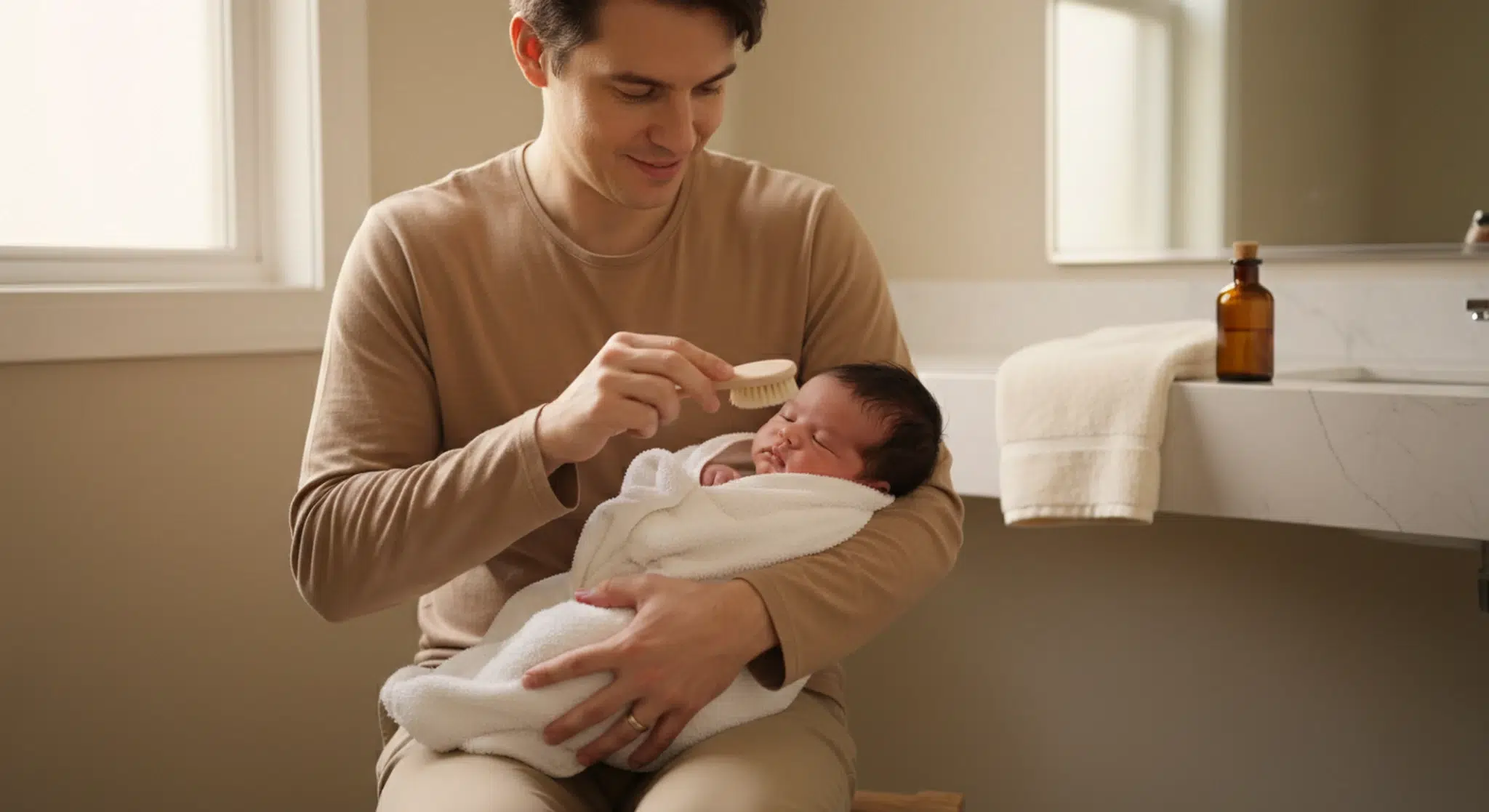


Cradle cap is a common, harmless rash of greasy yellow or white scales on a baby’s scalp that usually needs only gentle washing and soft brushing, and typically clears by the first birthday.
Crusty, flaky patches on your baby’s head are one of the most common skin conditions of early infancy. Cradle cap is the infant form of seborrheic dermatitis, it is not contagious, and it is not a sign that you have done anything wrong.
This guide covers what is and is not known about the cause, what it looks like on different skin tones, gentle care step by step, what to avoid, cradle cap vs eczema, how long it lasts and when to call.
Key Takeaways
- Cradle cap is infant seborrheic dermatitis: greasy, yellowish scales that are harmless, not contagious and not caused by poor hygiene.
- It usually starts 3 weeks to 2 months after birth and has typically cleared by age 1, per the AAP.
- Treatment is optional: mild baby shampoo, a soft brush, and oil or petroleum jelly before washing for stubborn scales.
- Do not pick the scales, skip olive and peanut oil, and avoid adult dandruff shampoos unless your pediatrician says otherwise.
- Call if it oozes, bleeds, smells, swells, spreads, itches, or comes with a fever.
Table of Contents
What Is Cradle Cap?
Quick Answer
Cleveland Clinic describes cradle cap as infantile seborrheic dermatitis limited to the scalp. When the same rash appears elsewhere (eyebrows, behind the ears, skin folds, diaper area), the AAP notes it is simply called seborrheic dermatitis.
The AAP says about 70% of three-month-olds have it. It looks worse than it feels: the NHS says it is not itchy or painful and does not bother the baby.
- Not contagious: Cleveland Clinic says babies with it can go to daycare and playdates.
- Not a hygiene problem: the AAP and MedlinePlus both say it is not caused by poor hygiene.
- Not an allergy or infection: per the AAP, though picking at it can lead to infection.
What Causes Cradle Cap? What Is and Is Not Known
The honest answer is that nobody knows for sure. The AAP, the NHS and MedlinePlus all say the exact cause is unknown or unclear. What the major sources describe are likely contributors:
- Extra oil from the scalp’s oil glands: MedlinePlus says providers think the oil glands in a baby’s scalp produce too much oil. The AAP and Cleveland Clinic both mention that hormones passed from the mother before birth may push those glands to overproduce.
- A common skin yeast: the AAP lists a reaction to a common skin yeast as one proposed explanation, and Cleveland Clinic names the yeast Malassezia as a likely factor.
Cleveland Clinic is direct that cradle cap is not caused by anything parents did, and the NHS says it cannot be caught from other babies.
What Cradle Cap Looks Like (Including on Darker Skin)
- Scales: the AAP describes thick, yellowish scales. MedlinePlus describes thick, crusty yellow or brown scales, and the NHS describes yellow or white greasy scales that form a crust and may flake off.
- Skin underneath: the NHS says it may look pink or red on white skin, and lighter or darker than the surrounding skin on brown or Black skin. The American Academy of Dermatology (AAD) notes seborrheic dermatitis can look red on lighter skin and like patches of darker skin on darker skin.
On brown and Black skin, redness can be hard to see, so go by the greasy scale and any change in color compared with nearby skin. Cleveland Clinic says the diagnosis is usually made by looking at the scalp, with no lab tests or biopsies needed.
A little hair may come away with the scales. The AAP and the NHS both say the hair grows back. If you are tracking head growth or the soft spot at checkups, our guide to baby head circumference explains what your pediatrician measures.
Big days go better with a good night of sleep.
Got a little one at home too? Our free two-minute quiz builds a gentle, personalized sleep plan for babies and toddlers.
Cradle Cap Treatment: Gentle At-Home Care, Step by Step
First, the reassuring part: treatment is optional. The AAP says, “You don’t need to treat cradle cap,” and the AAD says treatment is not necessary. If you want to loosen the scales, this routine combines what the AAP, AAD, NHS, Cleveland Clinic and MedlinePlus recommend:
- 1. Soften stubborn scales first: rub a little emollient into thick patches before washing. The AAP lists mineral oil, coconut oil or petroleum jelly left on overnight; Cleveland Clinic lists mineral oil, petroleum jelly or baby oil; the AAD suggests a non-food oil, such as baby oil.
- 2. Wash with a mild baby shampoo: the AAP and AAD both say shampooing about every other day helps loosen scale. The AAD recommends fragrance-free. MedlinePlus suggests daily washing while scales are present, then twice a week once they clear, rinsing thoroughly.
- 3. Brush gently: use a soft baby brush, baby comb or your fingertips to lift loose scales (AAP, AAD, NHS). Do not force off scales that are still stuck.
- 4. Repeat and be patient: thick patches can take several sessions. Wash the brush regularly (MedlinePlus). Stop and call your pediatrician if the skin looks raw, red, swollen or starts to ooze.
For very stubborn scales, MedlinePlus describes one more option: apply mineral oil and wrap warm, wet cloths around the head for up to an hour before shampooing. MedlinePlus cautions that babies lose heat through the scalp, so check that the cloths stay warm.
If you are new to bath time, our step-by-step guide on how to bathe a newborn covers the basics.
What NOT to Do for Cradle Cap
- Do not pick or scratch the scales: the AAP, AAD, NHS and Cleveland Clinic all warn that picking can irritate the skin, leave it raw and raise the risk of infection.
- Skip olive oil: the NHS and Cleveland Clinic both say olive oil may not be suitable for a baby’s skin, even though it is a common home remedy.
- Avoid peanut oil: the NHS and Cleveland Clinic list peanut oil as one to avoid because of allergy risk. The AAD goes further and advises against food-based oils in general.
- No adult dandruff shampoos without your pediatrician’s OK: the AAD says dandruff shampoo is not recommended for children, and Cleveland Clinic says adult or anti-dandruff shampoos are not recommended. The AAP says to check with your pediatrician before any medicated shampoo, which may irritate the skin.
- Skip soap and fragranced products: on affected skin (NHS).
- Do not start creams on your own: the AAP notes a pediatrician may prescribe an antifungal or hydrocortisone cream. That is a medical decision, not a home step.
A note on coconut oil: the sources do not fully agree. The AAP and the NHS list it as an option, while the AAD advises against food-based oils. If eczema or food allergies run in the family, ask your pediatrician. Mineral oil and petroleum jelly, both on the AAP list, avoid the question.
Cradle Cap vs Eczema vs Dandruff
Cradle cap is often confused with baby eczema (atopic dermatitis). Use this table to decide what to ask your pediatrician, not to diagnose.
| Cradle cap | Baby eczema (atopic dermatitis) | |
|---|---|---|
| What it is | Infant seborrheic dermatitis on the scalp (AAP, Cleveland Clinic) | A separate, common skin condition that can resemble cradle cap (AAD) |
| Itch | Rarely itchy (AAP); not itchy or painful (NHS) | Often itchy, with scratch marks; itch can disrupt sleep (AAD) |
| Look | Greasy yellow or white scales, sometimes crusted (AAP, NHS) | Dry or scaly skin, small bumps, sometimes leaking blisters and swelling (AAD) |
| Common spots | Scalp; also face, eyebrows, behind ears, skin folds, diaper area (AAP, Cleveland Clinic) | Cheeks and around the mouth, neck folds, scalp, trunk, outer arms and legs; typically not the diaper area (AAD) |
| Usual course | Clears in weeks to months, typically by age 1 (AAP) | Varies; ask your pediatrician |
What about dandruff? Cleveland Clinic explains that dandruff is the adult scalp form of seborrheic dermatitis, and cradle cap is the infant scalp version, so “baby dandruff” is not far off. The treatments are not interchangeable, though: the AAD says dandruff shampoo is not recommended for children.
Two clues separate cradle cap from eczema. Itch: cradle cap usually does not bother a baby, while eczema often makes babies scratch or rub their skin against things, according to the AAD. The diaper area: seborrheic dermatitis can appear there, but the AAD says baby eczema typically does not. Cleveland Clinic notes a doctor may need to rule out eczema or scabies.
Pimple-like spots on the cheeks may be baby acne. Red, irritated skin around the mouth and chin may be drool rash, and tiny red bumps in warm, covered areas may be heat rash.
Cradle Cap on Eyebrows, Behind the Ears and in the Diaper Area
The AAP lists the face, neck folds, behind the ears, the armpits and the diaper area. Cleveland Clinic adds the forehead, eyebrows and arm folds, and MedlinePlus mentions the eyelids and the skin around the nose. A rash outside the scalp is worth showing your pediatrician (AAP, Cleveland Clinic).
- Eyebrows and face: use the same gentle approach: a soft, damp cloth and a little emollient. Keep oil and shampoo out of your baby’s eyes, and do not pick flakes off the eyelids.
- Behind the ears and in skin folds: the NHS suggests bathing your baby regularly in water with an emollient instead of soap when scales appear outside the scalp.
- Diaper area: the NHS advises changing wet or dirty diapers promptly and using a barrier cream if the diaper area is affected. Refresher: how to change a diaper.
A diaper rash has several possible causes. If it is bright red, has spots around the edges or is not improving with barrier cream, read diaper rash vs yeast infection and check with your pediatrician.
Is Cradle Cap Itchy or Painful?
Usually not. The AAP says cradle cap is rarely itchy or uncomfortable, the NHS says it is not itchy or painful, and Cleveland Clinic describes the scales as usually painless and itch-free.
That makes itch a useful signal. MedlinePlus lists a child who seems uncomfortable or constantly scratches the scalp as a reason to contact a provider, and the AAD lists pain or disruptive itching as a reason to see a dermatologist. Itch may point to eczema or another condition.
When Does Cradle Cap Go Away?
For most babies, cradle cap fades in the first year without treatment. Sources give slightly different ranges:
| Source | What it says about timing |
|---|---|
| AAP (HealthyChildren) | Usually starts 3 weeks to 2 months after birth; goes away within weeks or months and has typically cleared by age 1. Some toddlers keep some flaky buildup. |
| AAD | Usually goes away on its own after a few months; most infants improve by 6 to 12 months of age. |
| Cleveland Clinic | Usually starts in the first three months; clears within weeks to months, sometimes by the first birthday. A few babies develop it at 1 or 2 years old. |
| MedlinePlus (NIH) | Often lasts a few months; in some children it can persist until age 2 or 3. |
| NHS | Usually clears up on its own within a few months. |
Scales can return after you clear them. The AAP suggests continuing frequent washing with a mild baby shampoo to prevent buildup.
See a doctor if it persists beyond a few months (Cleveland Clinic) or does not improve after a few weeks of treatment (NHS). For context on how long this early stage lasts in general, see how long the newborn stage lasts.
Related Betteroo Guides
When to Call Your Pediatrician
Cradle cap is harmless, but picked or scratched skin can become infected, and other conditions can look similar. Call your pediatrician’s office if:
- The patches are crusted, weepy or have pus bumps: the AAP lists these as reasons to see the pediatrician.
- Fluid or blood leaks from the scales: (AAP, NHS, Cleveland Clinic). The NHS says bleeding, leaking fluid or swelling may mean an infection or another condition, such as eczema or scabies.
- The skin looks swollen, very red, feels hot or smells bad: (AAP, AAD, NHS, Cleveland Clinic).
- It spreads beyond the scalp: especially if the rash is severe or covers much of the body (AAP, AAD, NHS).
- Your baby seems itchy, in pain or uncomfortable: or constantly scratches the scalp (AAP, AAD, MedlinePlus).
- It is not improving: after a few weeks of home care (NHS), or it persists beyond a few months (Cleveland Clinic).
- You notice hair loss: beyond strands lifting with the scales (AAD).
Call right away if your baby has a fever along with the rash. MedlinePlus says a fever may signal a worsening infection, and the AAP says any temperature of 100.4 F (38.0 C) or higher in a baby under 3 months old is a reason to call the pediatrician right away. Also call right away if your baby looks very ill, is unusually drowsy or is very fussy (AAP).
Call 911 or go to the nearest emergency room if your baby is having trouble breathing, is very hard to wake or seems seriously unwell and you cannot reach your pediatrician quickly.
Your pediatrician can confirm whether it is cradle cap and, if needed, prescribe a medicated shampoo or cream suited to your baby’s age. A mild rash can wait for a routine checkup; see our 2-month-old milestones guide for what else those visits cover. This article is general education, not medical advice.
Frequently Asked Questions
How do you get rid of cradle cap fast?
There is no instant fix, but gentle steps help scales lift. The AAP suggests washing about every other day with a mild baby shampoo, loosening scales with a soft brush, and for stubborn patches applying mineral oil or petroleum jelly overnight before washing. Never pick at the scales, since that raises the risk of infection.
What causes cradle cap in babies?
The exact cause is unknown. The AAP and Cleveland Clinic say likely factors include oil glands overproducing, possibly because of hormones from the mother before birth, and a reaction to a common skin yeast. It is not caused by poor hygiene, allergies or anything parents did, and it is not contagious.
Is cradle cap the same as dandruff?
They are related. Cleveland Clinic explains that both are forms of seborrheic dermatitis: in adults the scalp form is called dandruff, while in babies it is called cradle cap. That does not make adult dandruff shampoo safe for babies. The AAD says dandruff shampoo is not recommended for children.
Should I brush out cradle cap?
Yes, gently. The AAP, AAD and NHS recommend using a soft baby brush, baby comb or your fingertips to loosen scales, ideally during or right after a bath. Lift only scales that come away easily, and stop if the skin looks raw or red. Wash the brush regularly, as MedlinePlus advises.
Can I put coconut oil or olive oil on cradle cap?
The AAP and NHS list coconut oil as an option, but the AAD advises against food-based oils, so ask your pediatrician if eczema or food allergies run in the family. The NHS and Cleveland Clinic say to avoid olive oil and peanut oil. Mineral oil and petroleum jelly are on the AAP list.
Can cradle cap spread to the eyebrows and face?
Yes. The AAP says it can appear on the face, behind the ears, in neck folds, in the armpits and in the diaper area, and Cleveland Clinic includes the eyebrows. Outside the scalp it is called seborrheic dermatitis. A rash that spreads beyond the scalp is a reason to check in with your pediatrician.
Gentle changes, peaceful nights.
Betteroo builds a personalized sleep plan for your baby or toddler. Take the free two-minute quiz to get started.
7 Sources
- American Academy of Pediatrics, HealthyChildren.org. Cradle Cap.
https://www.healthychildren.org/English/ages-stages/baby/bathing-skin-care/Pages/Cradle-Cap.aspx - American Academy of Pediatrics, HealthyChildren.org. Fever: When to Call the Pediatrician.
https://www.healthychildren.org/English/health-issues/conditions/fever/pages/When-to-Call-the-Pediatrician.aspx - American Academy of Dermatology. How to treat cradle cap.
https://www.aad.org/public/everyday-care/hair-scalp-care/scalp/treat-cradle-cap - American Academy of Dermatology. Signs your baby has eczema and how to treat it.
https://www.aad.org/public/diseases/eczema/childhood/signs-your-baby-has-eczema-and-how-to-treat-it - Cleveland Clinic. Cradle Cap (Seborrheic Dermatitis in Infants).
https://my.clevelandclinic.org/health/diseases/15786-cradle-cap-seborrheic-dermatitis-in-infants - MedlinePlus (NIH). Cradle cap.
https://medlineplus.gov/ency/article/007582.htm - NHS. Cradle cap.
https://www.nhs.uk/conditions/cradle-cap/