Learning how to swaddle a baby takes about two minutes. Learning how to swaddle safely takes slightly longer, and it is the part that matters. A snug wrap can settle a newborn who startles themselves awake, and it gives you a way to calm a baby at 3am that does not involve pacing the hallway.
But swaddling has three rules that are easy to get wrong: how tight it is at the chest, how loose it is at the hips, and when to stop entirely. Get those right and swaddling is a genuinely useful tool. Get them wrong and it stops being safe.
Here is the technique, and the reasoning behind each step.
Key Takeaways
Swaddle snug across the chest, loose at the hips. You should fit two or three fingers between the swaddle and your baby’s chest.
Legs must be able to bend up and out. Straight, tightly bound legs raise the risk of hip dysplasia.
Always place a swaddled baby on their back, never the side or stomach.
Stop swaddling at the first sign your baby is trying to roll, which is often around 3 to 4 months but can be as early as 2 months.
Swaddling is a soothing tool, not a safety device. It has never been shown to reduce the risk of SIDS.
As an Amazon Associate, Betteroo earns from qualifying purchases.
Table of Contents
What Swaddling Actually Does
Quick Answer
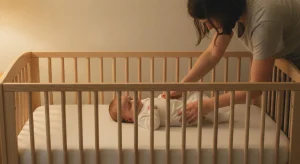
Lay your baby face up on a thin blanket folded into a diamond, with their shoulders below the folded corner. Wrap one side across and tuck it under, fold the bottom up loosely, then wrap the other side across. Snug at the chest, roomy at the hips. Fit two or three fingers between the swaddle and the chest.2
Newborns have a startle reflex, called the Moro reflex, that fires when they feel a sudden change in position. It is triggered by the suddenness of the movement rather than the distance, which is why a baby can jolt awake the moment you lower them into a crib. The reflex begins fading around 12 weeks and is usually gone by about 6 months.9
Swaddling limits those flailing arm movements, so a baby is less likely to startle themselves awake. Research does find that swaddled infants arouse less and sleep longer.5
That finding cuts both ways, and it is worth being straight about. Reduced arousal is exactly why swaddling helps babies settle, and it is also why the American Academy of Pediatrics treats it with caution rather than enthusiasm. The AAP is explicit: there is no evidence to recommend swaddling as a strategy to reduce the risk of SIDS.1 Swaddle because it soothes your baby, not because you think it makes sleep safer.
How to Swaddle a Baby: The Six Steps
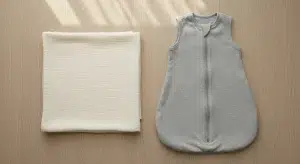
Use a thin blanket, a large muslin square, or a purpose-made swaddle wrap. Not a thick blanket, and never a weighted one.1
Lay the blanket flat and fold one corner down. Spread it in a diamond shape and fold the top corner down several inches.
Place your baby face up, shoulders below the fold. The folded edge should sit at shoulder level. Never swaddle above the shoulders, because loose fabric near the face is a suffocation risk.6
Wrap the first side across. Gently straighten one arm, bring that corner of the blanket across the body, and tuck it under the opposite side.
Fold the bottom up loosely. Fold or twist the bottom end and tuck it behind your baby. This is the step people rush. The legs need room to bend up and out.3
Wrap the second side across. Tuck the other arm down, bring the last corner across, and tuck it under the opposite side so nothing can work loose.
Check the chest and the hips. Two or three fingers should fit between the swaddle and your baby’s chest.2 The hips and knees should still move.
Arms in or arms out is your call. The AAP has looked at this and found no evidence that either position changes SIDS risk, so decide based on what settles your baby.1 Some newborns calm faster with arms tucked. Others want a hand near their face.
How Newborns Are Actually Sleeping
How to swaddle a baby, at a glance
Snug at the chest, loose at the hips, always on the back
1
Fold the corner down
Lay the blanket in a diamond and fold the top corner down.
2
Shoulders below the fold
Never swaddle above the shoulders.
3
Wrap the first side
Straighten one arm, wrap across, tuck under the opposite side.
4
Fold the bottom loosely
Leave room for the legs to bend up and out.
5
Wrap the second side
Tuck the other arm, wrap across, tuck under.
6
Check chest and hips
Two or three fingers at the chest. Hips and knees still move.
Stop swaddling at the first sign your baby is trying to roll.
It helps to know what you are actually working against. In our State of Baby Sleep 2026 report, drawn from 74,379 parents across 112 countries, 48.8 percent of babies aged 0 to 3 months woke three or more times a night (n=3,259). Swaddling can take the edge off the startle reflex, but it is not going to move a newborn out of that pattern, because the pattern is normal.
The same data found that 31 percent of newborns still had a bedtime after 9pm, which is a useful reminder that consolidated schedules do not usually arrive until later in the first year.
The Hip Rule Most Guides Skip
Swaddling with the legs pulled straight and bound together is the single most common technique error, and it has real consequences. Forcing an infant hip into extension and adduction interferes with normal joint development.
The International Hip Dysplasia Institute recommends the hips be positioned in slight flexion and abduction during swaddling, with the knees also slightly bent. In plain terms, the legs should be able to bend up and out.3
The historical evidence here is unusually clear. In Japan, infant hip dislocation ran as high as 3.5 percent before a national campaign in 1975 discouraged swaddling with the hips and knees extended. Afterward it dropped to under 0.2 percent.4 That is a large effect from one change in technique.
If you use a commercial swaddle product, look for a loose pouch or sack at the bottom rather than a design that tapers tightly around the thighs.3
Swaddled and still waking every hour?
Swaddling settles the startle reflex, but it will not fix timing. Answer a few questions and get a sleep plan built around your baby.
Swaddling adds a layer, and overheating is a recognized risk. Watch for sweating, damp hair, flushed cheeks, heat rash, or rapid breathing.2
Check temperature by feeling the chest or the back of the neck, not the hands and feet. Cool hands and feet are normal.7
Keep the room around 16 to 20C, roughly 61 to 68F.7
Use a thin muslin or a lightweight wrap, never a thick blanket.6
Never put extra bedding over a swaddled baby.6
No hats indoors.
On TOG ratings: you will see charts matching TOG numbers to room temperatures. Those are manufacturer conventions, not medical guidance. No health authority publishes a TOG standard, and the Lullaby Trust deliberately declines to name one, advising only that a lower rating reduces the overheating risk.6 Treat the charts as a rough starting point.
When Swaddling Is Not Safe
Do not swaddle in these situations
Once your baby shows any sign of trying to roll
If your baby will be placed anywhere other than flat on their back
While bed sharing
If your baby has a fever or an infection
Using a weighted swaddle, sack, or blanket of any kind
If the wrap can come loose in the crib
Position is the biggest one. A meta-analysis of swaddling and SIDS found the risk when a swaddled infant was placed prone carried an odds ratio of 12.99, and 3.16 on the side, compared with 1.93 supine.8 A swaddled baby who ends up face down cannot use their arms to lift or turn their head.
Weighted swaddles and weighted sleep sacks are separately prohibited by the AAP.1 An infant rib cage is not rigid, and pressure on the chest can impede breathing. Several major retailers stopped selling weighted infant products in 2024, but they still circulate secondhand.
One more that surprises parents: if your baby has not been swaddled routinely, starting at an older age carries its own risk. Babies unaccustomed to being swaddled react differently, and may have a harder time waking.2 This is part of why many child care centers do not swaddle at all.
When to Stop Swaddling
The trigger is behavioral, not a date on the calendar. Stop at the first sign your baby is attempting to roll. The AAP notes this usually happens around 3 to 4 months but may occur earlier,1 and HealthyChildren observes that some babies start working on rolling as early as 2 months.2
Do not wait for a successful roll. By then your baby has already had nights of practising the move while wrapped.
We cover the transition itself, including what the evidence does and does not support about weaning methods, in our guide to when to stop swaddling.
Snug across the chest and loose around the hips. The AAP guidance is that you should be able to fit at least two or three fingers between your baby’s chest and the swaddle. If you cannot get two fingers in, it is too tight. If the wrap shifts easily or the edges lift, it is too loose and could come undone in the crib.
Should my baby’s arms be in or out?
Either is fine. The AAP reviewed this specifically and found no evidence that arms in or arms out changes SIDS risk, so parents can decide based on their baby’s behavior. Some newborns settle better fully wrapped. Others fight it and do better with one or both arms free. Arms out is also a common first step when you start moving away from the swaddle.
Does swaddling prevent SIDS?
No, and this is worth being clear about because it is widely misunderstood. The AAP states plainly that there is no evidence to recommend swaddling as a strategy to reduce SIDS risk. Swaddling is a soothing technique. What actually reduces risk is a firm flat surface, back sleeping, no soft bedding, room sharing without bed sharing, and avoiding smoke exposure.
Can I swaddle my baby for every sleep?
You can, as long as your baby is always placed on their back, the room is not too warm, and you stop at the first sign of rolling attempts. Many families swaddle for night sleep and naps in the newborn weeks. There is no requirement to swaddle at all, and plenty of babies sleep perfectly well without it.
What if my baby fights the swaddle?
Some babies genuinely dislike being wrapped, and that is a legitimate preference rather than a problem to solve. Try one arm out first. If your baby still resists, skip swaddling and use a sleep sack that leaves the arms free. Fighting the swaddle is not a sign that anything is wrong.
Is it safe to swaddle a baby with a cold?
Not while they have a fever or an active infection. The Lullaby Trust advises against swaddling in both situations, largely because of the overheating risk. A congested baby should still sleep flat on their back. Never elevate the mattress or use a wedge to help with congestion.
Still guessing at what your baby needs?
Get a personalized sleep plan that adapts as your baby grows, including when to move on from the swaddle.
van Sleuwen BE, Engelberts AC, Boere-Boonekamp MM, et al. Swaddling: a systematic review. Pediatrics. 2007;120(4):e1097-106. https://pubmed.ncbi.nlm.nih.gov/17908730/
Pease AS, Fleming PJ, Hauck FR, et al. Swaddling and the Risk of Sudden Infant Death Syndrome: A Meta-analysis. Pediatrics. 2016;137(6):e20153275. https://pubmed.ncbi.nlm.nih.gov/27244847/