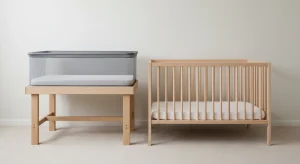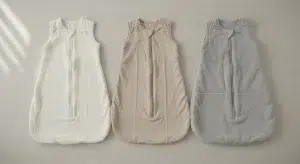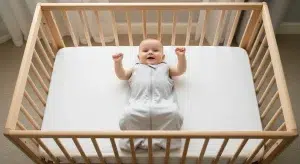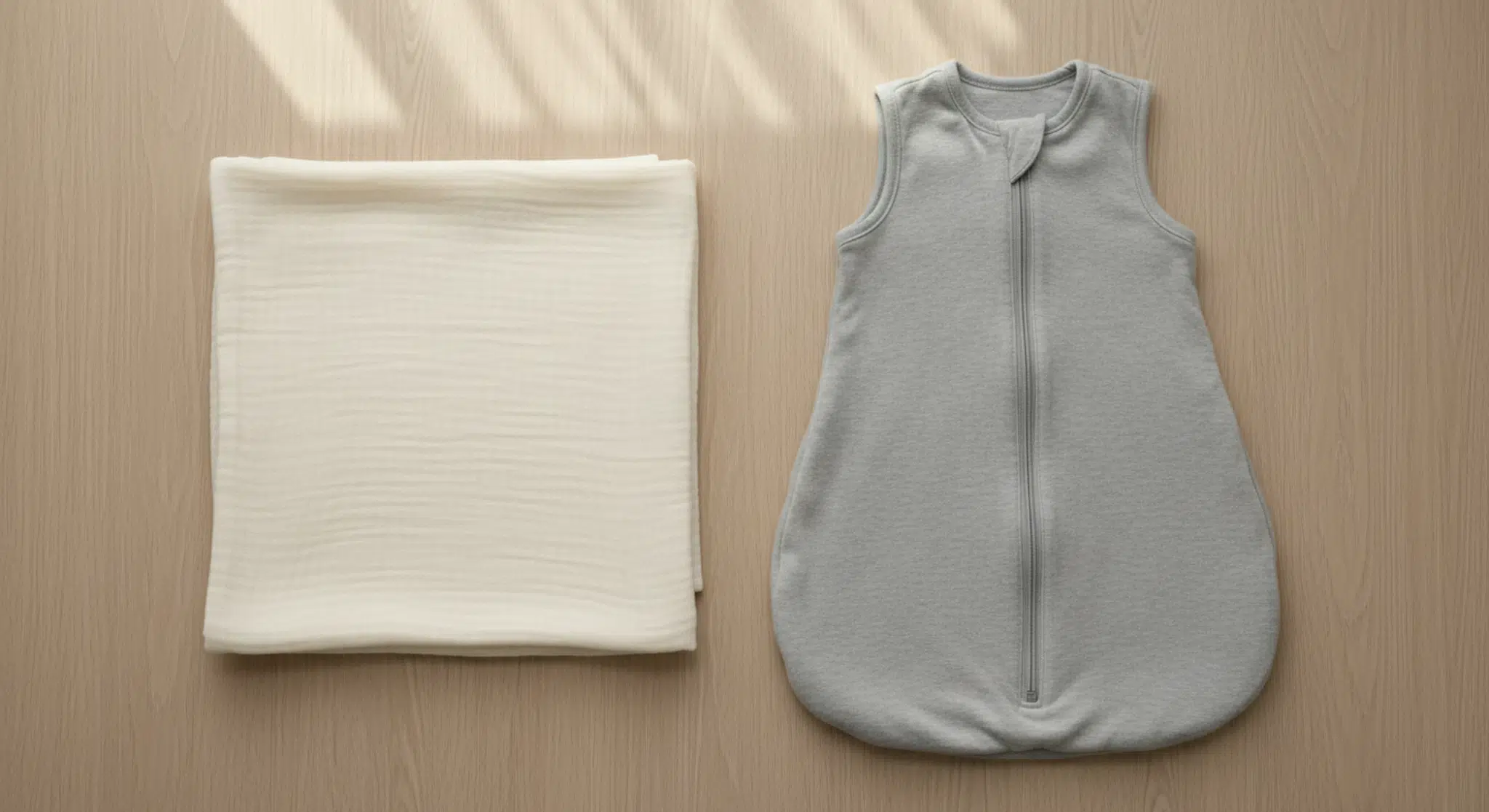


Sleep sack vs swaddle comes down to arms and age: a swaddle wraps a newborn’s arms snugly and has to stop at the first signs of rolling, while a sleep sack is a wearable blanket that leaves the arms free and can be used from birth through the toddler years.
Both keep your baby warm without a loose blanket in the crib, and both are fine for a newborn. The real difference between a swaddle and a sleep sack is what each does with the arms, and that decides how long each is safe to use.
This guide compares swaddle vs sleep sack side by side, by age, and explains when the American Academy of Pediatrics (AAP) says swaddling has to end. Swaddling is optional, too.
Key Takeaways
- A swaddle holds the arms in. A sleep sack leaves them free. That one difference drives the safety rules.
- Stop swaddling as soon as your baby shows any signs of trying to roll over. The AAP says some babies start working on rolling as early as 2 months.
- A sleep sack can be used from birth and, per the AAP, for as long as you want if it does not swaddle and lets your baby move freely.
- Swaddling is optional and does not reduce SIDS risk. A swaddled baby always sleeps on their back.
- Skip weighted swaddles and weighted sleep sacks. The AAP and the CPSC both advise against weighted products for babies.
As an Amazon Associate, Betteroo earns from qualifying purchases.
Table of Contents
Sleep Sack vs Swaddle at a Glance
Quick Answer
| Swaddle | Sleep sack (wearable blanket) | |
|---|---|---|
| What it is | A thin blanket, or a wrap-style sack, that holds the arms snugly against the body | A zip-up or snap-up wearable blanket worn over pajamas |
| Arms | Wrapped in | Free |
| Ages | Birth until the first signs of trying to roll | Birth through the toddler years |
| When to stop | As soon as your baby shows any signs of trying to roll over, which can be as early as 2 months | No set cutoff. Use it for as long as it fits and your child moves freely |
| Safety notes | Back only. Loose at the hips, not too tight at the chest. Watch for overheating. Never weighted | Right size, so it cannot ride up over the face. Match warmth to the room. Never weighted |
| Best for | Newborns who startle awake and settle when wrapped | Babies who fight the wrap, every baby once rolling starts, and daycare |
See how to swaddle a baby for the wrap itself and our baby sleep sack guide for sizing and fit.
The Difference Between a Swaddle and a Sleep Sack
A swaddle works by holding the arms still. Newborns have a startle (Moro) reflex: the American Academy of Pediatrics (AAP) describes how a baby startled by something loud or abrupt extends the arms and legs, pulls the arms back in and may cry. A snug wrap muffles that, and the AAP says that, done correctly, swaddling can be an effective way to help calm infants and promote sleep.
A sleep sack holds nothing still. It is a blanket your baby wears, so nothing is loose in the crib. Because the arms are free, it can stay on after rolling begins. The AAP says sleep sacks that do not swaddle and allow the baby to move freely can be used as long as you want.
Sleep Sack or Swaddle? Which to Use by Age
- Newborn (birth to about 2 months): either one. Use a swaddle if it calms your baby, or a sleep sack if they fight the wrap. Yes, a newborn can use a sleep sack, as long as it is the right size and cannot ride up over the face.
- 2 to 4 months: the changeover window. Watch for rolling attempts daily. The AAP says rolling over usually happens around 3 to 4 months but can happen earlier, and that some babies start working on it as early as 2 months. At the first sign, move to an arms-free sack.
- 4 months and up: sleep sack only. Always start sleep on the back. The AAP says that once your baby is comfortable rolling both ways, you do not need to keep turning them back.
- Toddler: a sleep sack still works. See when to stop using a sleep sack.
Tired nights don’t have to last forever.
Our free two-minute quiz builds a gentle, personalized sleep plan for your baby’s age and temperament.
When You Must Stop Swaddling
The AAP’s wording is direct: stop swaddling as soon as your baby shows any signs of trying to roll over. Not after the first full roll. The reason: the AAP says the risk of suffocation is higher if a baby rolls to their stomach while swaddled.
Rolling attempts often look like rocking from side to side, lifting the hips or shoulders, kicking hard, or ending up on one side. Our guides to when babies roll over and when to stop swaddling go deeper.
A swaddle that keeps coming undone is a second reason to stop. The AAP warns that a loose blanket, including a swaddling blanket that comes unwrapped, could cover your baby’s face and increase the risk of suffocation.
Safe Swaddling: Hips, Chest and Heat
- Hips: the International Hip Dysplasia Institute says the legs should be able to bend up and out at the hips, not be wrapped tightly straight down and pressed together. Swaddling with the hips and knees extended raises the risk of hip dysplasia and dislocation. It says commercial swaddle products should have a loose pouch or sack for the legs and feet.
- Chest: the AAP says you should be able to fit at least two or three fingers between your baby’s chest and the swaddle.
- Position: a swaddled baby goes down only on the back, on a firm, flat, bare surface.
- Heat: the AAP says a baby could be too hot if you notice sweating, damp hair, flushed cheeks, heat rash and rapid breathing, and that overheating can increase the risk of SIDS.
Pick the warmth for your room with our TOG chart and how to dress a baby for sleep.
Swaddle Sacks, Arms-Out Swaddles and Transitional Products
Sort any product by one question: does it hold the arms?
- Swaddle blanket: a large, thin square you fold yourself.
- Swaddle sack or pod: zips or fabric wings do the wrapping. It is still a swaddle and follows the same stop rule.
- Arms-up swaddle: holds the hands near the face. The arms are contained, so it is still a swaddle.
- Arms-out or convertible swaddle: wings or removable sleeves free one or both arms. With both arms out, it works like a sleep sack.
- Transitional swaddle or suit: sold for the gap between the two. Use the AAP’s test: if it does not swaddle and lets your baby move freely, treat it as a sleep sack. If it restricts the arms, treat it as a swaddle.
Weighted versions of any of these are not recommended. The AAP says not to use weighted swaddles or weighted blankets, which can place too much pressure on a baby’s chest and lungs, and its safe sleep guidance also rules out weighted sleepers and other weighted objects. The U.S. Consumer Product Safety Commission’s safe sleep guidance says not to use weighted blankets or weighted swaddles. See also best swaddles for newborns.
When to Switch From Swaddle to Sleep Sack, and How
If your baby is not yet trying to roll, you can go gradually: one arm out for a few nights, then both. If rolling attempts have started, skip the gradual steps and use an arms-free sleep sack from tonight. Our swaddle transition guide has the night-by-night plan for both routes.
If the Startle Reflex Keeps Waking Your Baby
The AAP says the Moro reflex usually peaks during the first month and starts to disappear after about 2 months, so the startle is fading around the time the swaddle has to go. Until it does:
- Lower your baby slowly, supporting the head, since a head that shifts abruptly sets the reflex off.
- Use steady white noise to cover sudden sounds.
Do not go back to the swaddle once rolling attempts have started, and do not use a weighted product as a substitute.
Wearable Blankets at Daycare
The AAP notes that some child care centers have a policy against swaddling, because of the increased risk of SIDS or suffocation if a baby rolls over while swaddled, along with the risks of overheating and hip dysplasia. Ask what your provider allows before the first day, and send a plain, arms-free, non-weighted wearable blanket in the right size. If you swaddle at home, practice naps in the sack first.
Do You Have to Swaddle at All?
No. Swaddling is a soothing tool, not a safety measure, and it is fine to never swaddle. The NIH Safe to Sleep campaign states that swaddling does not reduce SIDS risk, and the AAP notes that swaddling may decrease a baby’s arousal, making it harder for them to wake, which can be a problem. A baby on their back in a well-fitting sleep sack or pajamas, in a bare crib or bassinet, meets safe sleep guidance. See our safe sleep environment checklist.
Related Betteroo Guides
- How to transition out of the swaddle
- How to swaddle a baby
- When to stop swaddling
- Baby sleep sack guide
- TOG chart
- Best swaddles for newborns
When to Talk to Your Pediatrician
Check in before swaddling if your baby was born early, has a medical condition, or is being watched or treated for hip dysplasia. Call if signs of overheating do not ease when you remove a layer, or if your baby seems to be working hard to breathe.
Frequently Asked Questions
Sleep sack vs swaddle: which is better for a newborn?
Either is fine. A swaddle can calm a newborn who startles awake, while a sleep sack suits babies who fight the wrap. Both replace loose blankets. Either way, place your baby on their back on a firm, flat, bare surface and never use a weighted version.
Can a newborn sleep in a sleep sack instead of a swaddle?
Yes. A sleep sack is a wearable blanket that can be used from birth if it is the right size and cannot ride up over the face. The AAP says sleep sacks that do not swaddle and allow free movement can be used as long as you want.
When should I switch from a swaddle to a sleep sack?
Switch as soon as your baby shows any signs of trying to roll over. The AAP notes that some babies start working on rolling as early as 2 months. Do not wait for a full roll: a swaddled baby who ends up on their stomach is at higher risk of suffocation.
Is it OK to never swaddle my baby?
Yes. Swaddling is optional. It is a soothing technique, not a safety measure, and the NIH Safe to Sleep campaign notes that it does not reduce SIDS risk. A baby on their back in a well-fitting sleep sack, on a firm, flat, bare surface, meets safe sleep guidance.
Can my baby roll over in a sleep sack?
Yes, and that is the reason to switch. An arms-free sleep sack leaves your baby free to move. Always start sleep on the back. The AAP says that once a baby is comfortable rolling both ways, you do not need to keep turning them back.
Are weighted sleep sacks or weighted swaddles safe?
No. The AAP advises against weighted blankets, sleepers, swaddles and other weighted objects on or near a baby, noting that weighted swaddles can put too much pressure on the chest and lungs. The Consumer Product Safety Commission also says not to use weighted blankets or weighted swaddles.
Calmer days, better nights.
Betteroo builds a personalized sleep plan for your baby. Take the free two-minute quiz to get started tonight.
7 Sources
- American Academy of Pediatrics (HealthyChildren.org). Swaddling: Is It Safe for Your Baby?
https://www.healthychildren.org/English/ages-stages/baby/diapers-clothing/Pages/Swaddling-Is-it-Safe.aspx - American Academy of Pediatrics (HealthyChildren.org). How to Keep Your Sleeping Baby Safe: AAP Policy Explained.
https://www.healthychildren.org/English/ages-stages/baby/sleep/Pages/a-parents-guide-to-safe-sleep.aspx - Moon RY, Carlin RF, Hand I; AAP Task Force on Sudden Infant Death Syndrome. Sleep-Related Infant Deaths: Updated 2022 Recommendations for Reducing Infant Deaths in the Sleep Environment. Pediatrics. 2022;150(1):e2022057990.
https://pubmed.ncbi.nlm.nih.gov/35726558/ - American Academy of Pediatrics (HealthyChildren.org). Newborn Reflexes.
https://www.healthychildren.org/English/ages-stages/baby/Pages/Newborn-Reflexes.aspx - National Institutes of Health, Safe to Sleep. Ways to Reduce Baby’s Risk.
https://safetosleep.nichd.nih.gov/reduce-risk/reduce - U.S. Consumer Product Safety Commission. Safe Sleep: Cribs and Infant Products.
https://www.cpsc.gov/SafeSleep - International Hip Dysplasia Institute. Hip-Healthy Swaddling.
https://hipdysplasia.org/infant-child/hip-healthy-swaddling/