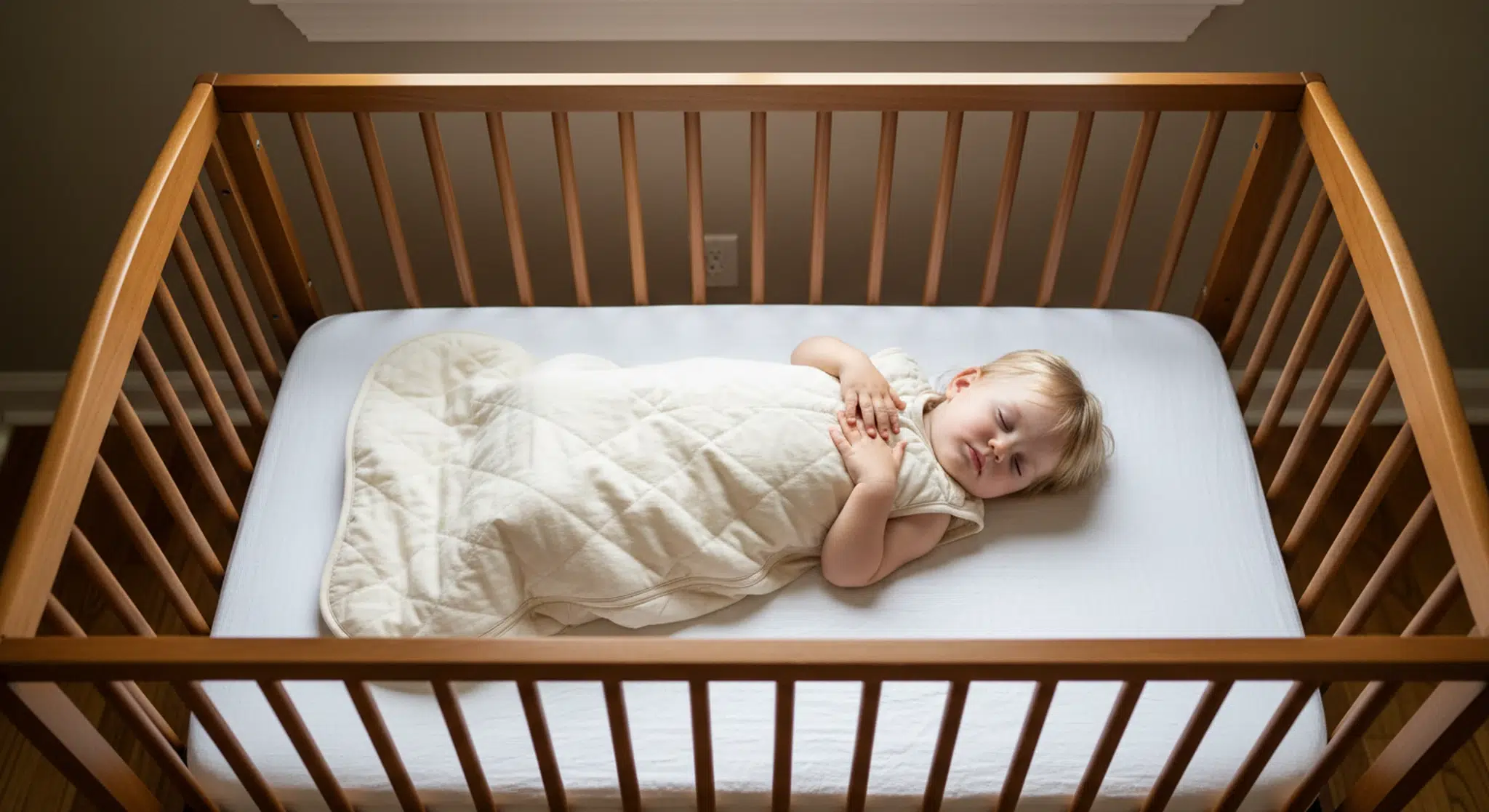
There is no age at which a sleep sack becomes unsafe, and that is the first thing worth knowing, because it is the opposite of the swaddle rule most parents are braced for.
A swaddle has a hard stop: the moment a baby shows any sign of rolling, it comes off, because a swaddled baby who rolls onto their front cannot push themselves back up. A sleep sack leaves the arms completely free, so none of that applies. It stays safe for as long as it fits.
Which means the question is practical rather than medical. This guide covers the real signs it is time to stop, why weighted sleep sacks are the one exception the AAP advises against, how to match TOG to your room temperature, and how to make the switch to pajamas or a blanket without unravelling a night that was working.
Key Takeaways
Most families stop between 18 months and 3 years. There is no medical cutoff, and a sleep sack is safe for as long as it fits properly.
Rolling is not a reason to stop a sleep sack, unlike a swaddle, because the arms are free.
The real triggers are outgrowing the largest size, moving to a toddler bed, night-time potty training, climbing out of the crib, or refusing to wear it.
The AAP and CPSC advise against weighted sleep sacks, swaddles, and blankets for infants. Swap to an unweighted sack of the same warmth.
Match TOG to room temperature. Check for overheating at the back of the neck or the chest, never the hands or feet.
A walking sack with foot openings is the easiest middle step, and keeps the sleep cue while allowing your child to stand safely.
Table of Contents
The Short Answer
Quick Answer
Most families stop using a sleep sack somewhere between 18 months and 3 years, and there is no medical deadline. A sleep sack is safe for as long as it fits, and unlike a swaddle it does not have a hard stop tied to rolling. The usual triggers are practical rather than medical: your child has outgrown the largest size, they have moved to a toddler bed and need to get in and out, they are night-time potty training, or they simply refuse to wear it.
This is the opposite of the swaddle question, and the two get conflated constantly. A swaddle must stop as soon as a baby shows any sign of rolling, usually somewhere around two to four months, because a swaddled baby who rolls onto their front cannot push themselves up. A sleep sack leaves the arms completely free, so rolling is not a reason to stop. If you are looking for the swaddle timeline instead, our guide on when to stop swaddling covers it.
Why Sleep Sacks Exist at All
The American Academy of Pediatrics is clear that no loose bedding belongs in a sleep space for the first twelve months. No blankets, no quilts, no pillows, no bumpers, no positioners. That guidance exists because soft bedding is a documented risk factor in sleep-related infant deaths.
Which leaves a practical problem: babies get cold, and thermostats do not follow a baby’s sleep cycle. A wearable blanket solves it. The child stays warm, nothing can cover their face, nothing can be kicked off at 3am, and nothing can be pulled over their head. That is the entire design brief, and it is why sleep sacks have become close to standard.
They keep warmth consistent through the night without loose fabric.
They cannot be kicked off, which removes a genuine cause of early waking.
They become a sleep cue. Zipping the sack becomes part of the signal that sleep is coming, which is a real and useful association.
They slow down climbing out of the crib, which buys some families several months.
They help with crib escape and bedtime wandering in a way a blanket never will.
The Real Signs It Is Time to Stop
Rather than a birthday, watch for these. Any one of them is a reasonable reason to move on.
They have outgrown the largest size. Most brands stop at around 36 months or a specific height, often about 40 inches. A sack that is too small restricts the legs and hips and is no longer safe. A sack that is too large can slide up over the face, which is the one genuine sleep sack hazard.
They have moved to a toddler bed or floor bed. This is the most common trigger. A child who needs to get up to use the bathroom, or who will be walking around a room, can trip in a sack. If you are approaching this, our guide on when to transition to a toddler bed covers the timing.
They are night-time potty training. A child who cannot get out of their sleepwear independently will not stay dry. Sacks with a two-way zip help, but at some point the sack goes.
They are climbing out of the crib. A sack makes climbing more dangerous, not less, once they are determined enough to try anyway.
They are refusing it. A two year old who fights the sack every night is spending bedtime capital on it. That fight is rarely worth winning.
They are consistently overheating. Sweaty neck, damp hair, flushed cheeks on waking. Usually the fix is a lower TOG rather than abandoning the sack, but not always.
Signs they are not ready, and it is fine to keep going: they are still in a crib, they sleep well, they ask for it, and it fits. Plenty of children wear one until close to three, and there is nothing wrong with that.
Big transitions go better on a full night of sleep.
If bedtime or naps are a struggle, our free two-minute quiz builds a gentle, personalized plan.
This deserves its own section because the marketing is persuasive and the safety guidance is not ambiguous.
The American Academy of Pediatrics advises against weighted swaddles, weighted sleep sacks, and weighted blankets for infants. The concern is that added weight on an infant’s chest can restrict chest wall movement and affect breathing and oxygen levels, particularly in a baby who cannot reposition themselves. Several major retailers have stopped selling weighted infant sleepwear, and the U.S. Consumer Product Safety Commission has publicly warned against these products for babies.
The honest summary is that the evidence offered for weighted infant sleepwear is thin, the mechanism of concern is plausible, and the professional bodies have landed against it. If a weighted sack is currently in use in your house, an unweighted one of the same warmth is the straightforward swap.
Choosing the Right Warmth
Sleep sacks are rated in TOG, a measure of thermal resistance. The higher the number, the warmer the sack. Matching TOG to room temperature is the practical skill, and it is also the fix for most overheating and most early waking from cold.
Room temperature
TOG
What to wear underneath
75 to 81 F / 24 to 27 C
0.2 to 0.5
Short-sleeved bodysuit only
69 to 74 F / 21 to 23 C
1.0
Short or long-sleeved bodysuit
61 to 68 F / 16 to 20 C
2.5
Long-sleeved bodysuit or light pajamas
Below 61 F / 16 C
3.5
Long-sleeved pajamas, consider warming the room instead
A general TOG guide. Follow your specific sack manufacturer’s chart, which takes priority.
The AAP recommends a comfortable room temperature for a lightly clothed adult, generally somewhere around 68 to 72 F. The reliable way to check your child is not too hot is the back of the neck or the chest, not the hands or feet, which are cool in most sleeping children regardless of how warm the rest of them is.
How to Make the Switch
Unlike weaning off a swaddle, this transition is usually easy. The child has full use of their arms already, so nothing about their ability to move changes. What changes is a familiar sleep cue, and that is the part worth handling gently.
Wait for a calm week. Not during illness, teething, a house move, a new sibling, or the first week of daycare.
Try a sack with foot openings first. A walking sack keeps the cue and the warmth while allowing them to stand and step safely. For many families this is the whole transition.
Or go straight to warm pajamas. A footed sleepsuit in a suitable weight often replaces the sack entirely without a conversation.
Introduce a blanket only after twelve months, and start with a small, light, breathable one. A large heavy blanket in a crib is not an upgrade.
Keep everything else identical for the first week. Same order, same lights, same words, same time.
Offer a comfort object if they do not have one and are over twelve months. A small lovey often takes over the cue that the sack was carrying.
Expect a few unsettled nights, then a return to normal. If it is still rough after two weeks, going back and trying again in a month is a completely reasonable move rather than a failure.
The reason families hold onto the sleep sack long past the point it is doing anything thermal is that it is functioning as a boundary. It is the soft, unarguable thing that says the day is over. When it goes, some children who were sleeping fine suddenly discover that they can get out of bed.
If that happens, it is not the sack that was holding the night together. It was the predictability around it, and that can be rebuilt without the sack: the same sequence in the same order, a clear and unhurried goodnight, and a calm, consistent response to getting up. Toddler-bed boundaries take a couple of weeks to establish, and they hold far better when the adult response is boring rather than dramatic.
If bedtime has become a nightly negotiation, or nights have unravelled since a transition, our free two-minute quiz builds a gentle plan around your child’s age and temperament.
Frequently Asked Questions
At what age should you stop using a sleep sack?
There is no fixed age. Most families stop somewhere between 18 months and 3 years, and a sleep sack stays safe for as long as it fits. Most brands make sizes up to around 36 months or about 40 inches in height. Unlike a swaddle, there is no rolling-related deadline, because the arms are free.
Is it safe to use a sleep sack if my baby is rolling over?
Yes. A sleep sack does not restrict the arms, so a rolling baby can still push up and reposition. This is exactly why sleep sacks are recommended as the replacement when a swaddle has to stop. Make sure the neck opening is snug enough that the sack cannot ride up over your baby’s face, which is the one real sizing hazard.
Are weighted sleep sacks safe?
The American Academy of Pediatrics advises against weighted sleep sacks, weighted swaddles, and weighted blankets for infants, and the U.S. Consumer Product Safety Commission has publicly warned against weighted infant sleepwear. The concern is that added weight on the chest can restrict chest wall movement and affect breathing in a baby who cannot reposition. An unweighted sack of equivalent warmth is the straightforward alternative.
How do I transition out of a sleep sack?
Try a walking sack with foot openings first, which keeps the cue and the warmth while allowing your child to stand and step safely. Otherwise move straight to warm footed pajamas, and add a small light blanket only after twelve months. Keep the rest of the bedtime routine identical for the first week, and expect a few unsettled nights before things resettle.
What TOG sleep sack do I need?
Match it to room temperature. Roughly, 0.2 to 0.5 TOG above 75 F, 1.0 TOG at 69 to 74 F, 2.5 TOG at 61 to 68 F, and 3.5 TOG below 61 F, adjusting what they wear underneath. Always follow your specific manufacturer’s chart, which takes priority. Check for overheating at the back of the neck or the chest rather than the hands and feet.
Calmer bedtimes, better nights.
Betteroo builds a personalized sleep plan for your child. Take the free two-minute quiz to get started tonight.