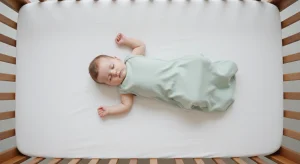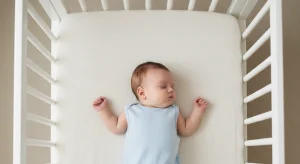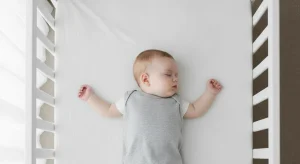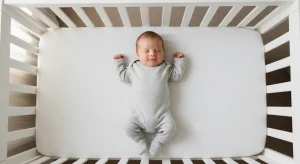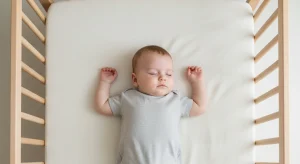


Do babies poop in their sleep? Yes, often, especially newborns who feed through the night, and a poopy diaper should be changed even overnight to protect your baby’s skin.
Do babies poop in their sleep? If you have ever smelled the evidence during a 2 a.m. check, you already know the answer. Newborns feed around the clock, and eating sets their bowels in motion, so night poops are part of the package.
This guide explains why it happens, how night poops change with age, whether to change a diaper your baby slept through, how to do it without waking everyone up, and which signs mean a call to your pediatrician.
Key Takeaways
- Babies often poop in their sleep or around night feeds. Eating triggers the bowels, and newborns eat often.
- There is no official age when night poops stop. They usually fade as stools spread out, night feeds drop and solids start.
- Change a poopy diaper at night. Stool against the skin is a main cause of diaper rash, per the AAP.
- Keep night changes dim, quiet and boring, with one hand on your baby at all times.
- Put your baby back on their back on a bare, flat sleep surface after every change.
Table of Contents
Do Babies Poop in Their Sleep? The Short Answer
Quick Answer
If your baby fills a diaper at 3 a.m. without even opening their eyes, nothing is wrong. Babies eat around the clock in the early weeks, and their bodies respond to every feed. Poop does not wait for daylight.
How often babies poop varies a lot. Children’s Hospital Colorado notes that babies can poop as often as every feeding or as rarely as every two to three days, and that what matters most is that the poop is soft and the baby is feeding and growing well.
Why Babies Poop at Night
- They eat at night: the AAP explains on HealthyChildren.org that newborns sleep about 16 to 17 hours a day but may sleep only 1 or 2 hours at a time. More night feeds mean more chances for a night poop.
- Eating gets the bowels moving: per Cleveland Clinic, when food enters the stomach, nerves signal the colon to start moving. The reflex tends to work more quickly in young children than in adults, and can last from a few minutes to a few hours after a meal.
- Young babies poop often: the AAP says breastfed babies’ stools should soon be yellow and liquid, and formula-fed babies should have at least one bowel movement a day.
- Straining is common: Children’s Hospital Colorado describes infant dyschezia, straining without constipation, in babies 9 months and under. That grunting and pushing often happens during light sleep. See baby grunting in sleep.
Babies can also poop during light, active sleep without fully waking. Some sleep right through it; others stir, fuss or wake because the diaper feels different. Both are normal.
When Do Babies Stop Pooping at Night?
There is no official age. We did not find an AAP, CDC or hospital source that names a month when night poops end, so be cautious of any site that gives you one hard number. What the sources do describe are the changes that make night poops less common over time:
| Stage | What sources say about stools | What it can mean at night |
|---|---|---|
| First days | Meconium, a thick black or dark green stool, passes for the first few days, then stools turn yellow-green (AAP) | Frequent diapers day and night |
| Early weeks | Breastfed stools are yellow and loose; formula-fed babies have at least one stool a day (AAP). Babies may poop as often as every feeding (Children’s Hospital Colorado) | Night feeds often bring night poops |
| 3 to 6 weeks | Some breastfed babies have only one bowel movement a week, which is fine if stools are soft and the baby is gaining weight (AAP) | Many families notice fewer night poops |
| Fewer night feeds | The reflex that moves the bowels is triggered by eating (Cleveland Clinic) | Fewer feeds overnight usually means fewer chances to poop |
| Starting solids | Stools become more solid and variable in color (AAP) | Firmer, less frequent stools; night poops often fade further |
In practice, many babies who still poop at night after the newborn weeks are those still feeding often overnight. That is not a problem to fix: night feeds are normal and important in the first months. When you and your pediatrician agree it is time, our guides to night weaning and when babies sleep through the night explain the next steps.
Stuck on night two or three?
Our free two-minute quiz builds a gentle, personalized sleep plan that adapts when progress stalls.
Should You Change a Poopy Diaper at Night?
Yes. A dirty diaper should be changed, even overnight. The AAP explains that the diaper area spends much of the day in contact with two very irritating substances, urine and stool, and that leaving a wet or soiled diaper on too long can cause chafing. The AAP’s own sleep guidance lists “changing a dirty diaper” among the reasons to attend to a baby at night.
What about a diaper that is only wet? No source we reviewed sets a rule for wet-only diapers overnight. The AAP advises changing diapers frequently, choosing a highly absorbent diaper, and avoiding tight diapers, especially overnight. Many parents change a wet diaper at a night feed anyway, since the baby is awake. If your baby has any redness or rash, change wet diapers promptly too.
| Situation | What to do |
|---|---|
| Poopy diaper, baby asleep | Change it. Stool against the skin is a main cause of irritation (AAP). |
| Poopy diaper, baby waking for a feed | Many parents change before or partway through the feed so the baby can drift off afterward. |
| Wet diaper, skin healthy | Your call. Use an absorbent, well-fitting (not tight) diaper and check the skin at the next change. |
| Wet diaper, rash present | Change promptly and use a thick barrier paste (AAP). |
| Leak or blowout | Change the diaper, clothes and fitted sheet, then put your baby back down on a bare, flat surface. |
How to Change a Diaper at Night Without Fully Waking Your Baby
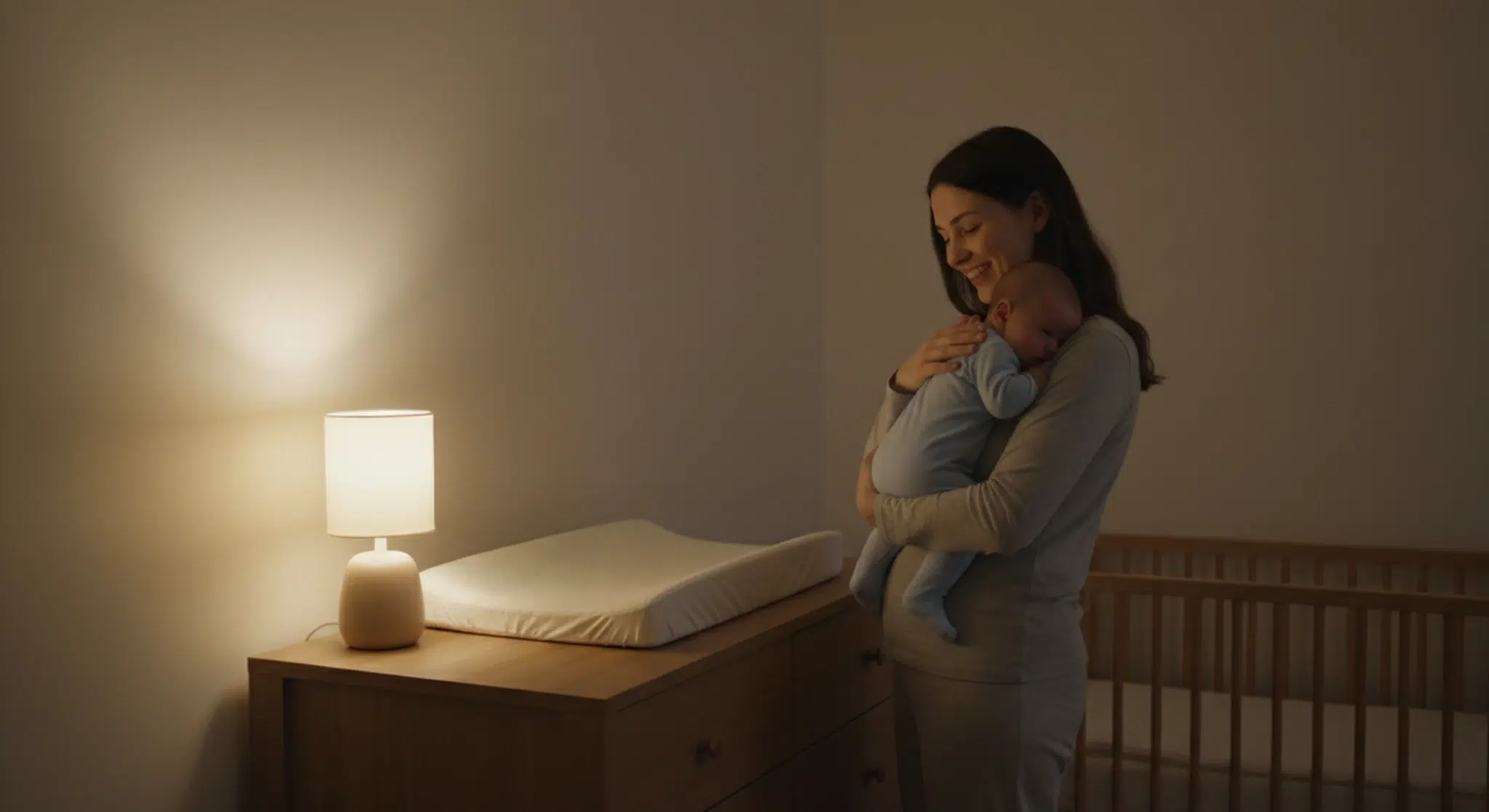
The AAP advises trying not to stimulate or wake babies when you feed or change them during the night, and speaking softly if you speak at all. These practical steps help:
- Set up before bed: keep diapers, wipes, barrier paste and a spare sleeper within reach. The AAP says to keep diapering supplies within your reach but out of your child’s reach.
- Keep the light low: a small night-light or dim lamp is usually enough to see what you are doing without fully waking anyone.
- Stay quiet and boring: no play, no bright screens, little eye contact. Night care should feel different from daytime.
- Keep a hand on your baby: the AAP says never to leave a child on a changing table, even for a moment and even when strapped, and to keep one hand on your baby. Falls from that height can be serious.
- Use paste smartly: the AAP recommends a thick layer of barrier paste (zinc oxide or petrolatum, ideally fragrance-free) and says not to scrub off unsoiled paste; add more on top.
- Pat dry: the AAP suggests patting gently and letting the skin air-dry before the new diaper goes on.
- Choose easy clothes: zip or snap sleepers that open down the legs make night changes faster.
Afterward, place your baby back on their back in a bare crib or bassinet. The AAP says to keep pillows, quilts, comforters, stuffed animals and bumper pads out of the crib and to use a wearable blanket instead of a loose one. Our step-by-step how to change a diaper guide covers the basics.
Should You Wake a Sleeping Baby for a Poopy Diaper?
If you know or can smell that your baby has pooped, it is worth changing, even if it means a brief wake-up, because of the skin irritation the AAP describes. Most babies settle again quickly when the change is calm and dim.
If your baby does wake fully, a short feed or a few minutes of quiet holding usually helps. The AAP also suggests not rushing in at every sound, since babies need a chance to settle themselves; the dirty diaper is the exception, not every whimper.
Never place a baby to sleep on a changing pad, couch or in your arms when you are drowsy. If you are exhausted, put your baby down on their back in their own sleep space before you rest.
Diaper Rash From Overnight Poops
Long stretches in a soiled diaper are one way rashes start. The AAP lists these prevention steps:
- Change diapers frequently.
- Clean gently with alcohol-free, fragrance-free wipes, or water and a gentle cleanser.
- Choose a highly absorbent diaper, and avoid diapers that are too tight, especially overnight.
- Coat irritated skin with a thick layer of barrier paste, such as zinc oxide or petrolatum.
- Do not use over-the-counter antibiotic ointment on diaper rash.
Diarrhea raises the risk, the AAP notes, and so can antibiotics, which can lead to a yeast rash. If a rash looks bright red with red spots at the edges, read diaper rash vs yeast infection and call your pediatrician.
What Normal Night Poop Looks Like
| Feeding | Typical stool, per the AAP | Call the pediatrician if |
|---|---|---|
| Breastfed | Yellow and liquid with seed-like particles; very soft to loose until solids begin | Large amounts of blood, mucus or water appear |
| Formula-fed | Tan or yellow, firmer than breastfed stool, but no firmer than soft clay | Fewer than one stool a day with straining, or hard stools |
| Eating solids | More solid and variable in color; green vegetables can turn it deep green and beets can make it red | Extremely loose, watery or full of mucus |
Children’s Hospital Colorado adds that most colors are normal, but white, black (after the first days) or bloody stool is a reason to call. For a full color guide, see baby poop color and formula-fed baby poop.
If your baby seems uncomfortable or is going less often than usual, our guides on how to make a baby poop and how to help a newborn poop explain gentle options. Children’s Hospital Colorado warns never to give a baby laxatives, enemas or suppositories without asking your doctor first.
Nap-Time and Bedtime Poops in Older Babies and Toddlers
Some older babies and toddlers seem to poop the moment they are laid down for a nap or bedtime. A likely reason is timing: many children eat right before sleep, and Cleveland Clinic says the reflex that moves the bowels after a meal can last from a few minutes to a few hours.
If this pattern is driving you up the wall, a few ideas:
- Leave a little time between a meal or bottle and getting into the crib, so a poop has a chance to arrive before sleep.
- Check and change the diaper as the last step of the bedtime routine.
- Keep the change dim and quiet if it happens after lights out, and go straight back to sleep.
A toddler who has started solids and still poops in their sleep most nights is usually just following their own rhythm. If stools are hard, painful or bloody, talk to your pediatrician.
Related Betteroo Guides
- Baby Poop Color Chart
- How to Make a Baby Poop
- Formula-Fed Baby Poop
- Night Weaning
- Do Babies Sleep With Their Eyes Open?
- Baby Constipation
When to Talk to Your Pediatrician
Night poops on their own are normal. Call based on how your baby looks and what the diapers show.
Call 911 or go to the emergency room if your baby:
- Is very hard to wake, limp or unresponsive.
- Has trouble breathing, or blue or gray lips or skin.
Call your pediatrician right away if:
- Fever in a young baby: a rectal temperature of 100.4 F or higher in a baby under 3 months (AAP).
- Blood, mucus or water in the stool: in large amounts, which the AAP says to report immediately.
- White or black stool: after the first days, or blood in the stool (Children’s Hospital Colorado).
- Signs of diarrhea: the AAP describes diarrhea as more than one bowel movement per feeding, or a sudden increase in very watery stools.
- Fewer wet diapers: the AAP says fewer than four wet diapers a day may be a cause for concern.
Call the office during regular hours if:
- Your baby has not pooped in four days (Children’s Hospital Colorado), or stools are hard and pellet-like.
- A formula-fed baby has fewer than one stool a day and strains (AAP).
- A diaper rash does not improve in 2 to 3 days, or has blisters, pus or crusty sores, or comes with a fever (AAP).
- Your baby seems to be in pain with bowel movements, or you are simply worried.
This article is general education, not medical advice. Trust your instincts and call whenever something seems off.
Frequently Asked Questions
Do babies poop in their sleep?
Yes. Babies, especially newborns, often poop during sleep or around night feeds. Cleveland Clinic says it is normal for infants to poop right after feeding, because eating triggers the bowels to move. Many babies sleep through it, while others stir or wake. Either way, change a dirty diaper to protect your baby’s skin.
When do babies stop pooping at night?
There is no official age. Night poops usually become less common as stools spread out (the AAP notes some breastfed babies poop only once a week by 3 to 6 weeks), as night feeds drop, and as solid foods make stools firmer. Some children keep an evening or early-morning poop for a long time.
Should I change a poopy diaper at night if my baby is sleeping?
Yes. The AAP explains that stool and urine irritate the skin and that leaving a soiled diaper on too long can cause chafing. Keep the change dim, quiet and quick, with one hand on your baby, then lay your baby back down on their back. Most babies settle again quickly.
Do I need to change a wet diaper at night?
No source we reviewed sets a firm rule for wet-only diapers overnight. The AAP advises changing diapers frequently, using a highly absorbent diaper and avoiding tight diapers overnight. Many parents change at a night feed anyway. If your baby has any redness or rash, change wet diapers promptly and use a thick barrier paste.
Is it normal for a baby to poop after every feeding?
Yes. Cleveland Clinic says it is normal for infants to poop right after feeding because of the gastrocolic reflex, and Children’s Hospital Colorado notes babies can poop as often as every feeding or as rarely as every two to three days. Soft stools, good feeding and steady growth are what matter.
Why does my baby poop right when I put them down to sleep?
Timing is the usual reason. Many babies eat right before sleep, and Cleveland Clinic says the reflex that moves the bowels after a meal can last from a few minutes to a few hours. Leaving a little time between the last feed and the crib, and changing the diaper last, can help.
Gentle changes, peaceful nights.
Betteroo builds a personalized sleep plan for your baby or toddler. Take the free two-minute quiz to get started.
7 Sources
- American Academy of Pediatrics (HealthyChildren.org). Baby’s First Days: Bowel Movements and Urination.
https://www.healthychildren.org/English/ages-stages/baby/Pages/Babys-First-Days-Bowel-Movements-and-Urination.aspx - American Academy of Pediatrics (HealthyChildren.org). Diaper Rash.
https://www.healthychildren.org/English/ages-stages/baby/diapers-clothing/Pages/Diaper-Rash.aspx - American Academy of Pediatrics (HealthyChildren.org). Getting Your Baby to Sleep.
https://www.healthychildren.org/English/ages-stages/baby/sleep/Pages/Getting-Your-Baby-to-Sleep.aspx - American Academy of Pediatrics (HealthyChildren.org). Make Baby’s Room Safe: Parent Checklist.
https://www.healthychildren.org/English/safety-prevention/at-home/Pages/Make-Babys-Room-Safe.aspx - American Academy of Pediatrics (HealthyChildren.org). Starting Solid Foods.
https://www.healthychildren.org/English/ages-stages/baby/feeding-nutrition/Pages/Starting-Solid-Foods.aspx - Cleveland Clinic. Gastrocolic Reflex.
https://my.clevelandclinic.org/health/body/gastrocolic-reflex - Children’s Hospital Colorado. Baby Poop Guide.
https://www.childrenscolorado.org/just-ask-childrens/articles/baby-poop-guide/