

Do babies sleep with their eyes open? Some do, usually with the lids partly closed, and eye doctors say that in most cases this is harmless as long as the eyes stay moist and comfortable.
Do babies sleep with their eyes open, or is your little one secretly watching you? It is a common question, and a common sight: a thin line of white under the lids, or eyes that seem to drift while your baby is clearly asleep.
This guide explains what eye doctors call it, how newborn active sleep makes it easier to notice, what (if anything) to do, how to tell it apart from rarer problems, and exactly when to call your pediatrician.
Key Takeaways
- Some babies sleep with their eyes partly open. Eye doctors call it nocturnal lagophthalmos.
- An AAO ophthalmologist says that in most cases there is no problem, though an eye exam can confirm the eyes stay moist.
- Newborn sleep is about half active (REM) sleep, when the eyes move under the lids, so the movement is easy to spot.
- Watch for redness, watering, discharge, cloudiness or squinting, and call if you see them.
- Never add masks, tape or bedding to the crib. Keep the sleep space bare, with your baby on their back.
Table of Contents
Do Babies Sleep With Their Eyes Open? The Short Answer
Quick Answer
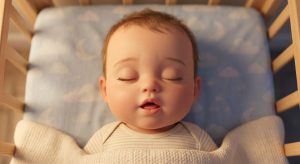
The AAO notes that people who sleep with their eyes open usually do not have them fully open: the lids typically close most of the way, leaving a small gap. That matches what most parents see in babies: a half-mast look, a thin line of white, or one eye a little more open than the other.
What Nocturnal Lagophthalmos Means
Lagophthalmos is the medical term for not being able to close the eyelids completely. Cleveland Clinic describes several types, and the one that matters here is nocturnal lagophthalmos: the eyes close normally while awake but not during sleep. Cleveland Clinic notes that about 20% of people sleep with their eyes open, which gives you a sense of how common the general pattern is (that figure is for people overall, not babies specifically).
The other types are different. Cleveland Clinic lists paralytic lagophthalmos, caused by loss of function in the facial nerve, and mechanical lagophthalmos, caused by structural problems or injury. The AAO also lists being born with eyelids that do not close completely as a possible cause.
| Type | What it means | How it differs from a sleepy baby |
|---|---|---|
| Nocturnal | Lids close fully when awake but not completely in sleep (Cleveland Clinic, AAO) | This is the pattern most parents notice; the baby blinks and closes the eyes normally when awake |
| Paralytic | Facial nerve function is reduced (Cleveland Clinic) | Usually other signs, such as weakness or less movement on one side of the face |
| Mechanical | A structural eyelid problem or injury (Cleveland Clinic) | The eye may not close fully even when awake |
We found no authoritative source that gives a single cause in otherwise healthy babies, so we will not guess. What sources do describe is how baby sleep works, which helps explain why you notice it.
Why Babies Sleep With Their Eyes Partly Open
Newborn sleep looks very different from adult sleep. The American Academy of Pediatrics (AAP) explains on HealthyChildren.org that for newborns, sleep is about equally divided between rapid eye movement (REM) sleep and non-REM sleep. REM sleep is also called active sleep, and the AAP says that during it a baby’s eyes move under the closed eyelids and the baby may twitch or jerk the arms or legs.
Put those two facts together and the picture makes sense. A baby who spends a large share of sleep in active sleep has eyes that are moving under the lids. If the lids are not sealed all the way, you may catch that movement: the eyes drifting, flickering or seeming to roll under a half-open lid. In a relaxed baby breathing comfortably, it is often just active sleep you are watching.
Active sleep is also when you see the rest of the newborn sound and motion show. Our guides to active sleep in newborns, baby twitching in sleep, baby grunting in sleep and baby laughing in sleep cover the twitches, grunts and smiles that usually come along with it.
Stuck on night two or three?
Our free two-minute quiz builds a gentle, personalized sleep plan that adapts when progress stalls.
Active Sleep vs Quiet Sleep: What You Are Seeing
| Feature | Active sleep (REM) | Quiet sleep (deep non-REM) |
|---|---|---|
| Eyes | Move under the closed lids; with partly open lids you may see them drift or flicker | Still |
| Body | May twitch or jerk the arms or legs | Twitching and other movements stop |
| Breathing | Irregular; may pause for 5 to 10 seconds, then come in a burst of rapid breaths, with no change in skin color | Slower and more even |
| Waking | Lighter sleep | Deeper; the baby may be more difficult to wake |
The AAP calls the irregular breathing pattern in active sleep normal as long as skin color does not change, and says babies generally outgrow it by about the middle of the first year.
If your baby’s eyes are partly open during the still, deep stretch of sleep, that can happen too. The lids simply are not meeting. For more on how these stages cycle through a night, see baby sleep cycles and when babies start dreaming.
Is Sleeping With Eyes Open Harmful for Babies?
Usually not. In its Ask an Ophthalmologist answer about a child who sleeps with her eyes open, the AAO says precautions are not necessary and that in most cases there is no problem. The same answer adds that an eye exam is needed to make sure the eyes stay moist enough that the cornea (the clear front window of the eye) is not being damaged, and that in some environments a humidifier or eye ointments and drops may be needed.
The concern, when there is one, is dryness. The AAO explains that even a small gap in the eyelids can dry the eye overnight, and that long-term problems can include exposure keratopathy (damage to the eye surface from drying), scratches, corneal abrasions and corneal ulcers. Those problems are described mainly in adults with ongoing lagophthalmos, but they tell you what to watch for.
Signs that the eye surface is drying out, per the AAO and Cleveland Clinic:
- Redness: red eyes after sleep.
- Watering or dryness: watery eyes, or eyes that look dry.
- Light sensitivity: squinting or turning away from light more than usual.
- Rubbing: a baby cannot tell you an eye feels gritty, but frequent rubbing or fussing with the eyes can be a clue.
If none of these show up and your baby closes the eyes normally while awake, this is usually something to mention at the next well visit, not a reason to worry.
What to Do When Your Baby Sleeps With Eyes Open
Most of the time, the best thing to do is nothing. A calm plan:
- Let your baby sleep: there is no need to close the eyes for them. Touching the eyelids can wake a baby, and the AAO answer says precautions are generally not needed.
- Check the eyes when your baby wakes: look for redness, watering, discharge or squinting. Clear, comfortable eyes are reassuring.
- Mention it at the next checkup: your pediatrician can check the eyelids and refer you to a pediatric eye doctor if needed.
- Ask before trying any remedy: the AAO lists lubricating drops or ointment and, after talking with a doctor, medically safe tape for adults with lagophthalmos. Do not use drops, ointment or tape on a baby unless your pediatrician or eye doctor tells you to.
- Ask before adding a humidifier: the AAO answer notes a humidifier may help in some environments; check with your pediatrician first and keep any device and cord well away from the crib.
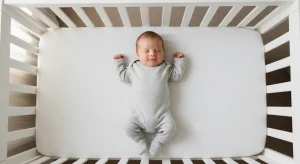
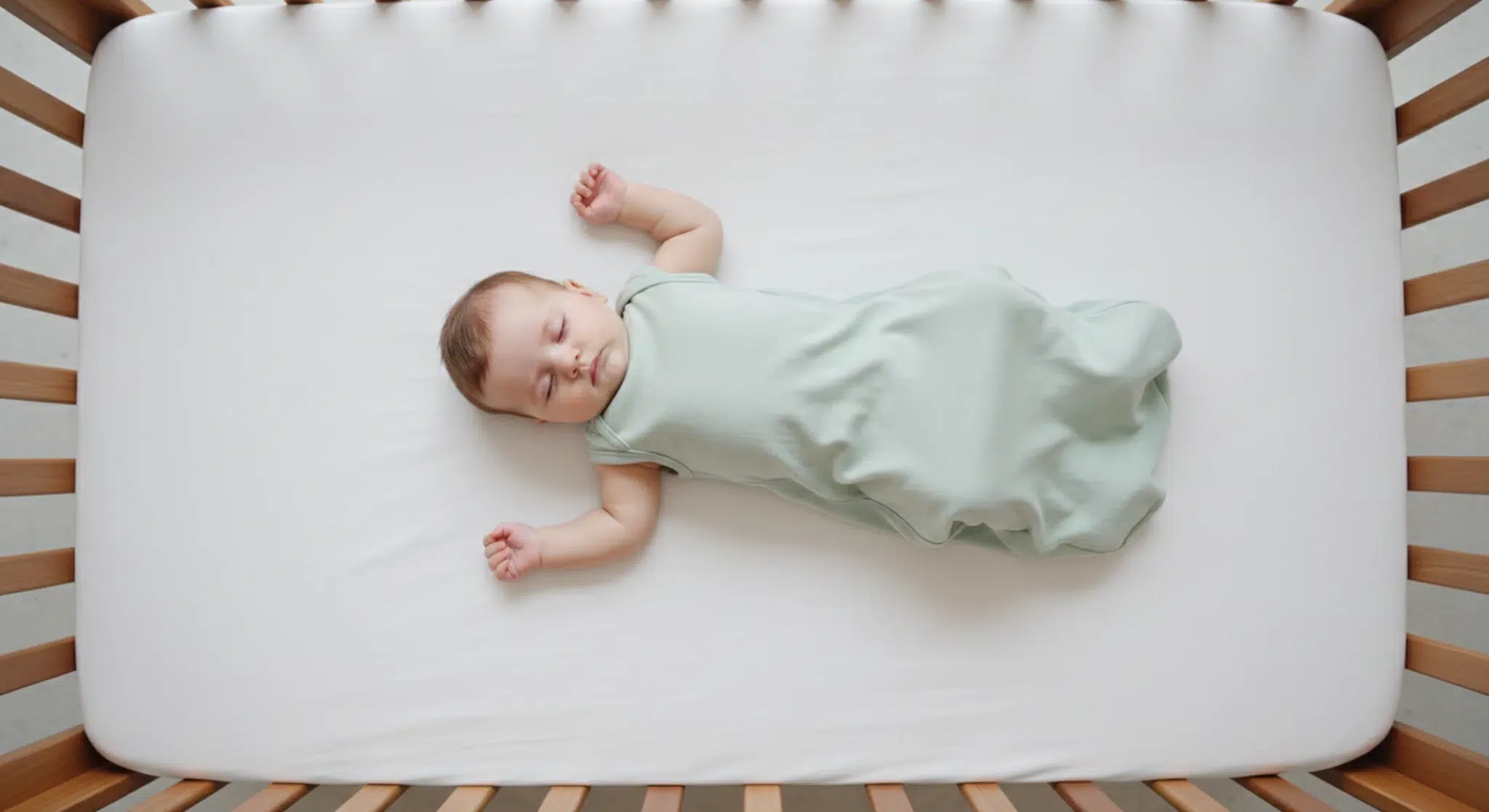
Do not add a sleep mask, eye cover or anything else to the crib. The AAP says soft objects and loose bedding raise the risk of entrapment, suffocation or strangulation, and that babies should always be placed on their backs to sleep. Keep the sleep space bare: a firm, flat mattress with a fitted sheet, and a sleep sack instead of a blanket if you want extra warmth. Our safe sleep environment checklist walks through the setup.
Eyes Open, Eyes Rolling or Staring: When It Might Be Something Else
Partly open eyes in a peacefully sleeping baby are different from eye movements that come with stiffening or repeated jerks. The AAP describes infantile spasms, a rare type of seizure in babies, on HealthyChildren.org:
- What they look like: a sudden stiffening of the body; the back may arch and the arms, legs and head may bend forward. Some spasms are subtle, with only the eyes rolling up or a small tummy crunch.
- Pattern: they come in clusters, one after another every few seconds.
- Timing: they are most common right after a baby wakes up and rarely happen during sleep.
- Age: they typically begin between 2 and 12 months of age, most often between 4 and 8 months.
The AAP advises talking to your pediatrician right away if you suspect infantile spasms, and taking a video of an episode to show the doctor. That is the key difference: a single still baby with half-open eyes who is breathing calmly is a very different picture from repeated eye-rolling with body jerks or crunches in a cluster, especially just after waking.
If you are ever unsure what you saw, a short phone video is the most useful thing you can bring to your pediatrician.
Do Babies Grow Out of Sleeping With Their Eyes Open?
Many parents notice it less over time, but we did not find an authoritative source that gives a set age when it stops, so we will not promise one. What the AAP does say is that newborn sleep is about half active sleep, the stage when eye movements are easiest to see. As that pattern matures, you may simply see fewer of the moments that caught your eye in the early weeks.
If it continues into later infancy or childhood, the AAO answer still applies: in most cases there is no problem, and an eye exam can confirm the eyes are staying moist.
Curious how your baby’s eyes develop in other ways? See newborn vision.
Related Betteroo Guides
- Baby Grunting in Sleep
- Baby Laughing in Sleep
- Newborn Snoring
- Do Babies Poop in Their Sleep?
- When Do Babies Sleep Through the Night
- Baby Sleeping Position for a Stuffy Nose
When to Talk to Your Pediatrician
Partly open eyes in a comfortable, normally waking baby can usually wait for a routine visit. Get help sooner in these situations.
Call 911 or go to the emergency room if your baby:
- Has a blue, gray or very pale color, or pauses in breathing with a change in skin color. The AAP notes that normal pauses in active sleep come with no color change.
- Is limp, very hard to wake, or not responding to you.
- Is having a seizure that does not stop, or is struggling to breathe.
Call your pediatrician right away (same day) if:
- You see possible spasms: repeated eye-rolling with stiffening, jerks or tummy crunches, often in clusters after waking (AAP). Take a video if you can.
- The eyelid is very red or very swollen: or the clear front part of the eye looks cloudy (Seattle Children’s).
- Your baby is under 12 weeks and has a fever: Seattle Children’s lists this as a reason to seek care now, and advises not giving fever medicine before your baby is seen.
- Your baby looks or acts very sick: (Seattle Children’s).
Call the office during regular hours if:
- The eyes look red, watery or irritated after sleep, or your baby squints or seems bothered by light (AAO, Cleveland Clinic).
- There is pus or the eyelids are stuck together, which Seattle Children’s says usually means the eye is infected.
- One eye never fully closes, even when your baby is awake, or one side of the face seems to move less than the other.
- The eyes are wide open during sleep rather than just a small gap, or you simply want a professional look.
This article is general education, not medical advice. You know your baby best: if something feels wrong, call.
Frequently Asked Questions
Do babies sleep with their eyes open?
Some do. The lids usually close most of the way but leave a small gap, which eye doctors call nocturnal lagophthalmos. An ophthalmologist writing for the American Academy of Ophthalmology says that in most cases there is no problem, though an eye exam can confirm the eyes stay moist enough. Mention it at a checkup, and call sooner if the eyes look red or irritated.
Is it normal for a newborn to sleep with eyes half open?
It is common and usually harmless in a baby who is breathing comfortably and wakes normally. Newborns spend about half their sleep in active sleep, when the AAP says the eyes move under the lids, so partly open lids make that movement easy to see. Call your pediatrician if the eyes look red, watery, cloudy or irritated.
Why do my baby’s eyes roll back when sleeping?
During active sleep, the AAP says a baby’s eyes move under the closed lids, so with partly open lids you may see them drift or roll. That is usually normal. Repeated eye-rolling with stiffening, jerks or tummy crunches in clusters, often just after waking, can be infantile spasms, so call your pediatrician right away and take a video.
Should I close my baby’s eyes when they sleep?
There is no need. Touching the eyelids can wake your baby, and an American Academy of Ophthalmology answer says precautions are generally not necessary. Do not use tape, eye drops, ointment or a sleep mask on a baby unless your pediatrician or eye doctor recommends it. Just check that the eyes look clear and comfortable when your baby wakes.
Can sleeping with eyes open damage a baby’s eyes?
Usually not. The concern is dryness: the AAO explains that a small eyelid gap can dry the eye overnight and, over time, irritate or injure the eye surface. Signs include redness, watering, light sensitivity and frequent rubbing. If you notice these, call your pediatrician, who may refer you to a pediatric eye doctor for an exam.
Do babies grow out of sleeping with their eyes open?
Many parents notice it less over time, but no authoritative source we found gives a set age when it stops. In childhood, an AAO ophthalmologist says that in most cases it causes no problem, though an exam can confirm the eyes stay moist. Cleveland Clinic notes about 20% of people sleep with their eyes open.
Gentle changes, peaceful nights.
Betteroo builds a personalized sleep plan for your baby or toddler. Take the free two-minute quiz to get started.
7 Sources
- American Academy of Ophthalmology. Sleeping With Eyes Open.
https://www.aao.org/eye-health/tips-prevention/sleeping-with-eyes-open - American Academy of Ophthalmology, Ask an Ophthalmologist. What to Do for Child Sleeping With Eyes Open?
https://www.aao.org/eye-health/ask-ophthalmologist-q/what-to-do-child-sleeping-with-eyes-open - Cleveland Clinic. Lagophthalmos.
https://my.clevelandclinic.org/health/diseases/24413-lagophthalmos - American Academy of Pediatrics (HealthyChildren.org). Phases of Sleep.
https://www.healthychildren.org/English/ages-stages/baby/sleep/Pages/Phases-of-Sleep.aspx - American Academy of Pediatrics (HealthyChildren.org). How to Keep Your Sleeping Baby Safe: AAP Policy Explained.
https://www.healthychildren.org/English/ages-stages/baby/sleep/Pages/a-parents-guide-to-safe-sleep.aspx - American Academy of Pediatrics (HealthyChildren.org). Infantile Spasms: What Parents Need to Know.
https://www.healthychildren.org/English/health-issues/conditions/seizures/Pages/Infantile-Spasms-What-Parents-Need-to-Know.aspx - Seattle Children’s Hospital. Tear Duct: Blocked.
https://www.seattlechildrens.org/conditions/a-z/tear-duct—blocked/