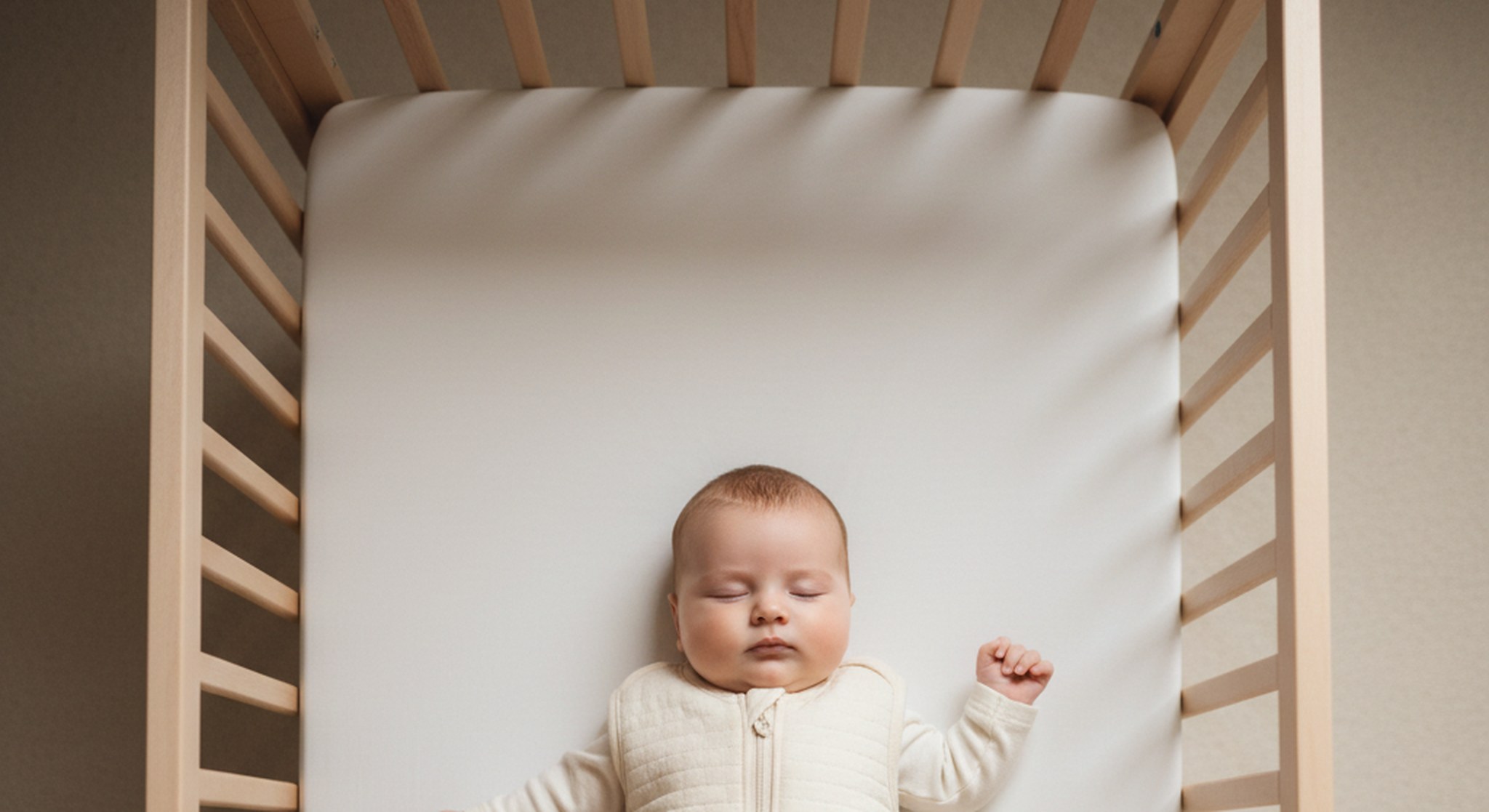
A baby’s sleep cycle lasts about 50 to 60 minutes, roughly half of it in light, active sleep, which is why babies wake so easily and take short naps, and these cycles gradually lengthen and mature toward the adult pattern over the first few years.
Understanding how your baby actually sleeps can turn a lot of frustration into reassurance. Once you know that babies wake between short sleep cycles by design, those 30 minute naps and frequent night stirrings start to make sense.
This guide explains the stages inside a baby’s sleep cycle, how long cycles last at different ages, why they cause common sleep struggles, and how you can work with your baby’s biology instead of against it.
Key Takeaways
A newborn sleep cycle is about 50 to 60 minutes, shorter than an adult’s roughly 90 minute cycle.
Around half of a newborn’s sleep is active sleep, the light, dreamlike stage where babies move, twitch, and wake easily.
Babies fully rouse between cycles, so linking cycles into longer sleep is a skill that develops over time.
By 3 to 4 months, sleep matures into more defined stages, which is behind the well known 4 month regression.
Short naps and frequent wakings are usually normal cycle behavior, not a sign that something is wrong.
Table of Contents
The Stages Inside a Baby’s Sleep Cycle
Newborn sleep is simpler than adult sleep. In the early weeks, babies move mainly between two stages. Active sleep is the light, dreamlike stage, similar to REM, where you see fluttering eyelids, twitches, smiles, irregular breathing, and small sounds. Quiet sleep is the deeper, calmer stage where your baby lies still and breathes evenly and is harder to wake.
A newborn spends close to half of their total sleep in active sleep, which is much more than an adult. This active stage is thought to play an important role in the rapid brain development of infancy. Our active sleep in newborns guide takes a closer look at this stage.
How Long Is a Baby Sleep Cycle?
The length of a sleep cycle changes as your baby grows:
Newborns: A full cycle runs about 50 to 60 minutes, split fairly evenly between active and quiet sleep.
3 to 4 months: Sleep begins to organize into more distinct stages, closer to the mature structure with several stages of non REM sleep plus REM.
Toddlers and beyond: Cycles gradually lengthen toward the adult pattern of about 90 minutes, and the share of REM sleep drops from around half at birth to roughly 30 percent by the first birthday and to adult levels by about age 5.
Because newborn cycles are so short, your baby moves in and out of light sleep many times a night. That is completely normal and built into how their sleep works.
Struggling with your baby’s sleep?
A personalized plan meets your baby where they are, at every age and stage.
At the end of each cycle, every sleeper, adult or baby, comes up into a brief lighter state before drifting back down. Adults rarely remember these moments because we resettle automatically. Babies often fully wake instead, because the skill of linking one cycle to the next is still developing.
This is exactly why so many babies take 30 to 45 minute naps, waking right at the end of a single cycle, and why they stir and cry between cycles at night. It is not a flaw in your baby or your routine. As your baby matures and learns to connect cycles, naps lengthen and night sleep consolidates. Our contact naps guide can help if your baby only bridges cycles in your arms for now.
The 4 Month Shift Every Parent Should Know
Around 3 to 4 months, a baby’s sleep undergoes a major reorganization. Sleep matures from the simple newborn pattern into a more adult like structure with defined stages and more time in lighter sleep at the start of each cycle. This is a permanent, healthy step forward in development.
The downside is that this new pattern often means more waking for a while, which is the root of the classic 4 month sleep regression. Knowing it is a sign of your baby’s brain maturing, not a setback, can make those weeks easier to weather. Our sleep regression ages guide explains what to expect.
Working With Your Baby’s Sleep Cycles
You cannot change your baby’s biology, but you can support it. A few practical steps help your baby move through cycles more smoothly:
Watch wake windows so your baby goes down drowsy but not overtired, which makes it easier to link cycles.
Use a consistent, calming pre sleep routine to signal that sleep is coming.
Give your baby a moment to resettle at the end of a cycle before stepping in, so they can practice bridging on their own.
Keep the sleep space dark, cool, and quiet, with white noise if you use it, to reduce disruptions at light points in the cycle.
Always place your baby on their back in a bare crib for every sleep.
Sleep cycles are only part of the picture. It also helps to know roughly how much total sleep, and how many naps, your baby needs at each stage, since that shapes their whole day.
Newborns (0 to 3 months): about 14 to 17 hours over 24 hours, spread across many short sleeps day and night.
4 to 6 months: about 12 to 16 hours including naps, often settling toward 3 naps, with longer night stretches emerging.
6 to 12 months: about 12 to 16 hours, usually with 2 naps.
12 to 18 months: about 11 to 14 hours, dropping from 2 naps to 1 nap somewhere around 13 to 18 months.
One more detail about newborn sleep: alongside active and quiet sleep, very young babies pass through brief transitional or indeterminate sleep as they move between the two. As your baby matures past around 3 months, these phases organize into the more defined stages of light sleep, deep sleep, and REM.
Frequently Asked Questions
How long is a baby’s sleep cycle?
A newborn sleep cycle lasts about 50 to 60 minutes, shorter than an adult’s roughly 90 minute cycle. Cycles gradually lengthen and mature over the first few years toward the adult pattern.
Why does my baby wake up after 30 or 45 minutes?
Babies fully rouse at the end of each short sleep cycle, and the skill of linking one cycle to the next is still developing. A 30 to 45 minute nap usually means your baby woke at the end of a single cycle, which is normal.
What is active sleep in babies?
Active sleep is the light, dreamlike stage, similar to REM, where babies move, twitch, smile, breathe irregularly, and wake easily. Newborns spend close to half their sleep in this stage, which supports rapid brain development.
Why does sleep change at 4 months?
Around 3 to 4 months, a baby’s sleep reorganizes from the simple newborn pattern into a more adult like structure with defined stages. This healthy step forward often brings more waking for a while, which is the 4 month sleep regression.
Are short naps and frequent wakings normal?
Yes. Both are usually normal cycle behavior rather than a sign of a problem. As your baby matures and learns to link sleep cycles, naps lengthen and night sleep gradually consolidates.
Sleep that works with your baby’s biology
Get a personalized plan built around your baby’s age and natural sleep cycles.
Paruthi S, et al. Recommended Amount of Sleep for Pediatric Populations: A Consensus Statement of the American Academy of Sleep Medicine. Journal of Clinical Sleep Medicine, 2016. https://jcsm.aasm.org/doi/10.5664/jcsm.5866