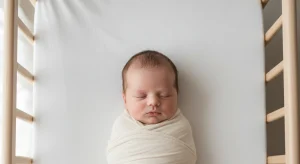
Newborn vision is blurry but busy: babies see best at 8 to 12 inches, love faces and high contrast, and have good color vision by about 5 months.
When your newborn gazes up at you during a feed, they really are looking at you. At that close range, your face is one of the clearest things in their world.
This guide explains what newborns can see, how far they can see, when babies can see color, how baby vision develops month by month, simple ways to support it, when eye color becomes final, and which signs mean a call to your pediatrician.
Key Takeaways
Newborns see best at 8 to 12 inches, about the distance to your face while feeding.
Babies see some color from birth, many more colors by 2 to 4 months, and have good color vision by about 5 months.
Brief eye crossing or drifting is common until about 2 to 3 months; constant crossing after 4 months needs a check.
Faces, high-contrast patterns, tummy time, and slow tracking games support vision development.
Call your pediatrician for a white pupil, eyes that do not track by 3 months, or constant eye turning.
Table of Contents
What Can a Newborn See?
Newborn vision is blurry but real. At birth, babies see best at about 8 to 12 inches away, which happens to be roughly the distance to your face when you hold them for a feed. Beyond that, the world is soft and fuzzy. Newborns are drawn to high contrast (black and white, light and dark edges), to movement, and above all to faces.
Their eyes also do not always work together yet. For the first couple of months, it is common to see one eye drift or the eyes briefly cross. The AAP notes that this random movement usually fades by 2 to 3 months.
When Can Babies See Color?
Newborns can see some color, just not the way adults do. They pick up brightness and contrast best, and strong, saturated colors like red stand out earliest. Over the first few months, color vision improves quickly:
Birth to 1 month: mostly contrast and brightness. Bold reds may register, but pastels and similar shades blur together.
2 to 3 months: babies begin telling apart more colors, such as red and green.
By 4 months: the AAP says babies are better at seeing colors and different shades of them.
Around 5 months: the American Academy of Ophthalmology (AAO) says babies have good color vision, though not quite as fully developed as an adult’s.
So if you are wondering when babies can see color, the short answer is: a little from the start, much more by 2 to 4 months, and quite well by about 5 months.
Baby Vision Development Month by Month
Age
What your baby can likely see and do
Newborn
Sees best 8 to 12 inches away; prefers faces and high contrast; eyes may wander or cross briefly.
1 month
Briefly focuses on your face; notices bright objects up to about 3 feet away.
2 months
Follows a moving object or face with their eyes; eyes start working together more smoothly.
3 months
Focuses on faces and close objects; tracks toys; may bat at a dangling toy.
4 months
Reaches for and grabs objects; sees more colors and shades.
5 months
Depth perception improves; good color vision; recognizes familiar faces from across the room.
6 to 8 months
Sees details and differences between objects; better hand-eye coordination as crawling begins.
9 to 12 months
Judges distances well; picks up small objects with thumb and finger; eye color is usually settled.
1 to 2 years
Vision develops rapidly; depth perception and hand-eye coordination are well developed.
3 to 5 years
Most children see about as well as adults.
Typical milestones for full-term babies. Premature babies usually follow their adjusted age. Sources: AAP, AAO, AOA.
How Far Can Newborns See?
A newborn sees most clearly at 8 to 12 inches. Their visual acuity at birth is estimated at roughly 20/400, meaning fine details are hard to make out at a distance. By 1 month, babies may notice bright objects a few feet away, and by around 6 months their acuity has improved dramatically. By preschool, most children reach adult-level vision.
Tired nights don’t have to last forever.
Our free two-minute quiz builds a gentle, personalized sleep plan for your baby’s age and temperament.
Babies are wired to look at faces. Even in the first days, they prefer face-like patterns over other shapes, and within weeks they study your eyes and mouth. High-contrast patterns, like a black-and-white checkerboard or the edge of your hairline against your skin, are the easiest things for immature eyes to see. That is why simple black-and-white cards are so popular in the newborn months.
How to Support Your Baby’s Vision
Hold your face close: talk, smile, and make expressions at 8 to 12 inches during feeds and cuddles.
Offer high-contrast toys and books: simple black-and-white or bold-colored patterns are ideal in the first months.
Move slowly: hold a toy in front of your baby and move it slowly side to side to practice tracking.
Change positions: switch which arm you feed on and which end of the crib your baby faces, so both eyes get practice looking in different directions.
Plenty of tummy time: reaching, pushing up, and looking around on the floor builds the eye and body coordination that vision needs. See our tummy time by age guide.
Hang a mobile out of reach: 8 to 12 inches from your baby’s eyes is ideal, securely attached and removed once your baby can push up.
Talk as you walk around the room: it encourages your baby to follow you with their eyes.
Skip screens: screens do not help infant vision development, and the AAP recommends avoiding screen media (other than video chatting) before 18 to 24 months.
Baby Eye Color: When Is It Final?
Many babies, especially those of European descent, are born with blue or gray eyes that can darken over the first year as the iris builds pigment. Babies with darker skin are often born with brown eyes that stay brown. The AAO notes that by 9 to 12 months, your baby’s eyes are probably their final color, though subtle changes can continue into toddlerhood.
Vision Screening for Babies
Your baby’s eyes are checked at birth and at every well-child visit. The pediatrician looks for a “red reflex” (the red glow you see in flash photos), checks how the eyes move and line up, and watches how your baby follows objects. The American Optometric Association also recommends an eye exam between 6 and 12 months of age, and children who were premature or have a family history of eye problems may need earlier or more frequent checks.
Call your pediatrician if you notice any of these:
A white, gray, or cloudy pupil, or a white glow in photos instead of a red one
Eyes that constantly cross, turn in or out, or do not move together after about 4 months
Not following faces or objects by about 3 months
Eyes that shake, jiggle, or wander constantly
Excessive tearing, redness, crusting, or pus
Extreme sensitivity to light
Drooping eyelid that covers the pupil
Most vision problems in babies are very treatable, especially when found early. When in doubt, ask.
Frequently Asked Questions
What can a newborn see?
A newborn sees best at about 8 to 12 inches away, which is about the distance to your face when you hold them. They prefer faces, movement, and high-contrast patterns, and everything farther away looks blurry.
When can babies see color?
Babies can see some color, especially bold red, from birth. Color vision improves quickly between 2 and 4 months, and by about 5 months babies have good color vision, although it keeps maturing.
How far can newborns see?
Newborns see most clearly at 8 to 12 inches. By about 1 month they may notice bright objects a few feet away, and vision improves a lot over the first 6 months.
When do babies start tracking objects?
Most babies start following a moving object or face with their eyes around 2 months, and by 3 months their eyes should work together to focus and track.
Is it normal for a newborn’s eyes to cross?
Yes, brief crossing or drifting is common in the first few months while the eyes learn to work together. If the eyes cross constantly or still drift after about 4 months, see your pediatrician.
Calmer days, better nights.
Betteroo builds a personalized sleep plan for your baby. Take the free two-minute quiz to get started tonight.