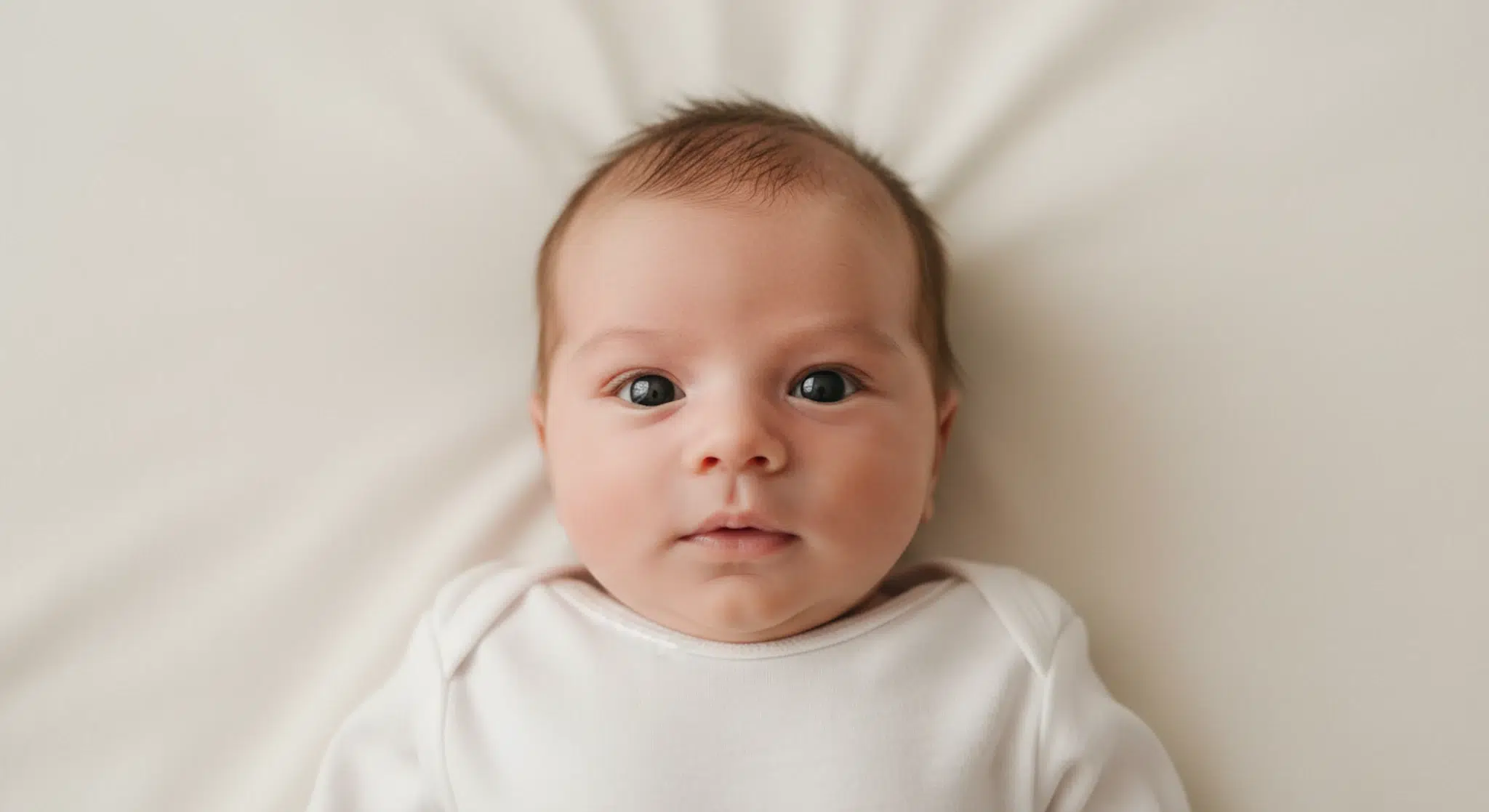
Are all babies born with blue eyes? No: in a Stanford study of newborns, about 63% had brown eyes and only about 21% had blue eyes, because eye color depends on how much melanin a baby’s iris already has at birth.
If your newborn arrived with deep brown eyes when everyone told you to expect blue, nothing is wrong. It is one of many surprises of the newborn stage. And if your baby’s eyes are slate blue, they may or may not stay that way.
Here is what the research actually shows about newborn eye color, why some babies look blue-eyed at first, how eye color genetics works, and the few eye changes that are worth a call to your pediatrician.
Key Takeaways
Not all babies are born with blue eyes. Brown is the most common newborn eye color.
In a 2016 Stanford study, 63% of newborns had brown eyes and about 21% had blue eyes.
White newborns in that study were far more likely to start out blue-eyed, and blue eyes may darken.
Eye color depends on iris melanin and many genes, not one dominant brown gene.
A white pupil or white glow in photos needs a prompt call to your pediatrician.
Table of Contents
Are All Babies Born With Blue Eyes? The Short Answer
Quick Answer
No. In a 2016 Stanford study of 192 healthy full-term newborns, 63% had brown eyes and only about 21% had blue eyes shortly after birth. Many babies with lighter skin are born with blue or gray eyes because their irises have little melanin yet, and those eyes may darken over the first year. In that study, Asian and Hispanic newborns were especially likely to have brown eyes at birth.
The idea that every baby starts out blue-eyed is one of the most repeated newborn myths. It is easy to see why: if most babies in your family were born with slate-blue eyes that later turned hazel or brown, it looks like a rule. But it is a pattern in some families, not a rule for all babies.
This page answers the myth question. For the month-by-month timeline of when eye color shifts, see our full guide to when babies’ eyes change color.
What the Stanford Newborn Eye Color Study Found
The most cited evidence comes from the Newborn Eye Screening Test (NEST) study at Lucile Packard Children’s Hospital at Stanford. Researchers from Stanford’s Byers Eye Institute (Ludwig and colleagues, published in Acta Ophthalmologica in 2016) photographed the eyes of healthy, full-term newborns in their first days of life, and a pediatric retina specialist recorded each baby’s iris color.
Eye color at birth
Share of 192 newborns
Brown
63.0%
Blue
20.8%
Green or hazel
5.7%
Indeterminate (could not be classified)
9.9%
Partial heterochromia (two colors in one eye)
0.5% (one baby)
Birth prevalence of iris color in the NEST study (Ludwig et al., Acta Ophthalmologica, 2016).
The authors concluded that newborn eye color covers a broad range with brown the most common, and they suggested that changes in melanin production over time may explain the popular myth that all infants are born with blue eyes.
Keep the limits in mind. This was one hospital, 192 babies, and color judged from photos by a single reviewer. Parents did not report race for over a third of babies, and very few Black or Native American families were enrolled, which the authors say limits how far the results apply to those groups. Still, it is a prospective study of newborns checked within days of birth, which is exactly the question the myth is about.
Why Some Newborns Have Blue or Gray Eyes: Melanin in the Iris
Eye color comes from melanin, the same pigment that colors skin and hair. MedlinePlus Genetics, from the National Institutes of Health, explains that eye color is directly related to the amount of melanin in the front layers of the iris. Very light blue eyes have little pigment there, and dark brown eyes have a lot.
The American Academy of Pediatrics (AAP) explains it through melanocytes, the cells that make melanin. If they release only a little melanin, a baby’s eyes stay blue. If they get “really busy,” eyes look brown. MedlinePlus Genetics describes a continuous range, from very light blue to dark brown.
At birth, some babies’ irises have not built up much melanin yet. In babies whose families carry genes for lighter coloring, that can make the eyes look blue, gray or slate at first. The AAP says it takes about a year for melanocytes to finish their work, so a blue-eyed newborn may end up with green, hazel or brown eyes, or may stay blue.
Babies who inherit genes for more pigment often already have plenty of melanin in the iris at birth, so their eyes look brown from day one. That is why the myth breaks down: a newborn’s eye color reflects how much pigment their iris has already made, and that varies from baby to baby.
Big days go better with a good night of sleep.
Got a little one at home too? Our free two-minute quiz builds a gentle, personalized sleep plan for babies and toddlers.
The Stanford study broke results down by the ethnicity and race parents reported. The pattern fits what you would expect from pigment genetics:
Group (parent-reported)
Babies
Brown at birth
Blue at birth
Hispanic or Latino
82
74.4%
7.3%
Not Hispanic or Latino
109
54.1%
31.2%
Asian
45
80.0%
2.2%
White
64
34.4%
54.7%
Selected rows from Table 1 of Ludwig et al., 2016. Other colors and groups not shown; groups overlap because ethnicity and race were asked separately.
The researchers found that significantly more Asian and Native Hawaiian or Pacific Islander newborns had brown eyes, and significantly more white newborns had blue eyes. Hispanic newborns were significantly less likely than non-Hispanic newborns to have blue eyes.
Two takeaways stand out. First, even among white newborns, about a third had brown eyes at birth, so the myth does not hold even there. Second, the study enrolled only one Black newborn, so it cannot tell us percentages for Black babies. What we can say from the genetics is that eye color tracks iris melanin, and babies who inherit more pigment tend to have darker eyes.
Will My Baby’s Blue Eyes Change Color?
Maybe. Blue eyes at birth can stay blue or darken. The AAP notes that the change slows after about 6 months (around the time of the 6-month milestones) but there can still be plenty of change left, and that it is risky to call eye color before the first birthday. The changes the AAP describes come from melanocytes adding pigment, so newborn eye color tends to deepen over time rather than lighten.
Change can also continue past the first year for some children. The Stanford authors cite the Louisville Twin Study, which found that 10% to 20% of children had a change in iris color between 3 months and 6 years of age.
The Genetics of Eye Color: Why the Old Punnett Square Is Too Simple
Many of us learned in school that brown is dominant, blue is recessive, and a simple grid predicts a baby’s eye color. MedlinePlus Genetics says scientists once thought that, but later studies showed the model was too simplistic: eye color involves multiple genes.
Gene or region
What it does, per MedlinePlus Genetics
OCA2 (chromosome 15)
Makes the P protein, which helps melanosomes (the structures that make melanin) mature. Less P protein means less melanin in the iris and lighter eyes.
HERC2 (next to OCA2)
Contains a region that controls OCA2 activity. At least one common variant here reduces OCA2 expression and lightens eye color.
Other genes
ASIP, IRF4, SLC24A4, SLC24A5, SLC45A2, TPCN2, TYR and TYRP1 have smaller effects that combine to produce the full range of colors.
Main genes involved in eye color.
The Stanford paper notes that at least 16 genes influence iris color, with OCA2 and HERC2 explaining most of the variation. Because several genes add up, parents can have children whose eyes look quite different from their own.
Two blue-eyed parents: usually have blue-eyed children, but MedlinePlus Genetics says that, although uncommon, they can have a brown-eyed child. The AAP puts it as very likely, but not every time.
One brown-eyed and one blue-eyed parent: the AAP says the odds are about even.
Online eye color calculators give a guess at best. Wait and watch, and enjoy the surprise.
Heterochromia: Two Different Eye Colors
Heterochromia means the eyes are different colors, or one eye has more than one color. Cleveland Clinic describes three types:
Complete: one eye is a completely different color from the other.
Sectoral (partial): a distinct wedge or section of one iris is a different color.
Central: an inner ring of the iris is a different color from the outer part.
It is uncommon: in the Stanford study, one baby out of 192 had partial heterochromia and none had complete heterochromia. Cleveland Clinic says many people with heterochromia have no underlying health problem. But it can be linked to conditions present from birth, including congenital Horner syndrome, Waardenburg syndrome, Sturge-Weber syndrome and neurofibromatosis type 1.
The AAP specifically advises telling your doctor if your child has one brown eye and one blue eye, because it can be a sign of a rare genetic condition called Waardenburg syndrome. Cleveland Clinic adds that a smaller pupil or a drooping eyelid on one side alongside different eye colors is worth mentioning, since those can point to Horner syndrome. Your pediatrician will decide whether an eye specialist should take a look.
Eye Signs That Matter More Than Color
Eye color is almost always just a fun surprise. A few eye appearance changes are different and deserve a prompt call to your pediatrician.
A white or grayish-white pupil: the AAP lists this as a warning sign of a vision problem. It may show up first in a flash photo.
A white glow in flash photos: the American Academy of Ophthalmology (AAO) explains that a healthy eye usually shows a red reflex in flash photos. A white reflex can come from the angle of the photo, but a white reflex covering most of the pupil can be a sign of cataract, retinal detachment, infection inside the eye or retinoblastoma, a rare childhood eye cancer. The AAO says to bring the photo to your pediatrician or a pediatric ophthalmologist.
Very light eyes with vision signs: albinism is an inherited condition with reduced or absent pigment in the eyes, hair and skin. The AAO says vision ranges from normal to severely impaired, and eye doctors look for nystagmus (shaky eye movements), misaligned eyes and light sensitivity.
Eyes that flutter, cross or seem very light sensitive: the AAP lists eyes that flutter quickly side to side or up and down, eyes that are often overly sensitive to light, and crossing or drifting that happens regularly after 4 months.
Not following faces by about 3 months: the AAP says babies should be able to track a moving object by about 3 months, and to tell the doctor if your baby cannot make steady eye contact by then.
Newborn eye color on its own, blue, gray, brown, green or somewhere in between, is not a medical concern. Bring up eye appearance at a well visit or call sooner based on these signs.
Call the office promptly if you notice:
A white, grayish-white or cloudy-looking pupil, or a white glow in one eye in flash photos (AAP, AAO)
One brown eye and one blue eye, or a sudden new difference in color between the eyes (AAP, Cleveland Clinic)
Different eye colors together with a smaller pupil or droopy eyelid on one side (Cleveland Clinic)
Eyes that flutter quickly side to side or up and down (AAP)
Mention it at the next visit, or call if you are worried, if:
Your baby cannot make steady eye contact or follow a moving toy by about 3 months (AAP)
Crossing or drifting happens regularly after 4 months (AAP)
Eyes are always watery, often seem very sensitive to light, or eyelids droop (AAP)
Redness in an eye does not go away in a few days, or there is pus or crust (AAP)
Call 911 or go to the emergency room if your baby has an eye injury with bleeding or a visible wound, or seems seriously ill. Trust your instincts: if something about your baby’s eyes looks wrong, you never need to wait for a scheduled checkup to ask. This article is general education, not medical advice.
Frequently Asked Questions
Are all babies born with blue eyes?
No. In a 2016 Stanford study of 192 healthy newborns, 63 percent had brown eyes at birth and about 21 percent had blue eyes. Babies with lighter coloring are more likely to start with blue or gray eyes, while babies with more pigment are usually born with brown eyes.
Why are some babies born with blue eyes?
Eye color depends on melanin in the iris. Some newborns, especially those with lighter coloring, have little iris melanin at birth, so their eyes look blue or gray. If their melanin-making cells produce more pigment over the first year, the eyes can turn green, hazel or brown.
Can a baby born with brown eyes turn blue?
It is not the usual pattern. The American Academy of Pediatrics explains that eye color changes in babies as melanin-making cells add pigment, so eyes tend to get darker rather than lighter. If one eye seems to be getting lighter or looks different from the other, mention it to your pediatrician.
At what age do babies’ eyes change color?
The American Academy of Pediatrics says it takes about a year for the melanin-making cells to finish their work, and change slows after about 6 months. Some children change later: one study found 10 to 20 percent changed between 3 months and 6 years.
Can two blue-eyed parents have a brown-eyed baby?
Yes, though it is uncommon. MedlinePlus Genetics explains that eye color involves several genes, not one dominant brown gene, so the simple school chart does not always hold. Two blue-eyed parents usually have blue-eyed children, but not every time, because several genes are involved.
Is it normal for a baby to have two different colored eyes?
Different colored eyes, called heterochromia, are uncommon and often harmless, but they can be linked to conditions present from birth such as Waardenburg or Horner syndrome. The American Academy of Pediatrics advises telling your doctor if your child has one brown eye and one blue eye.
Gentle changes, peaceful nights.
Betteroo builds a personalized sleep plan for your baby or toddler. Take the free two-minute quiz to get started.
Ludwig CA, Callaway NF, Fredrick DR, Blumenkranz MS, Moshfeghi DM. What colour are newborns’ eyes? Prevalence of iris colour in the Newborn Eye Screening Test (NEST) study. Acta Ophthalmol. 2016;94(5):485-488. (PMC, NIH) https://pmc.ncbi.nlm.nih.gov/articles/PMC4956505/