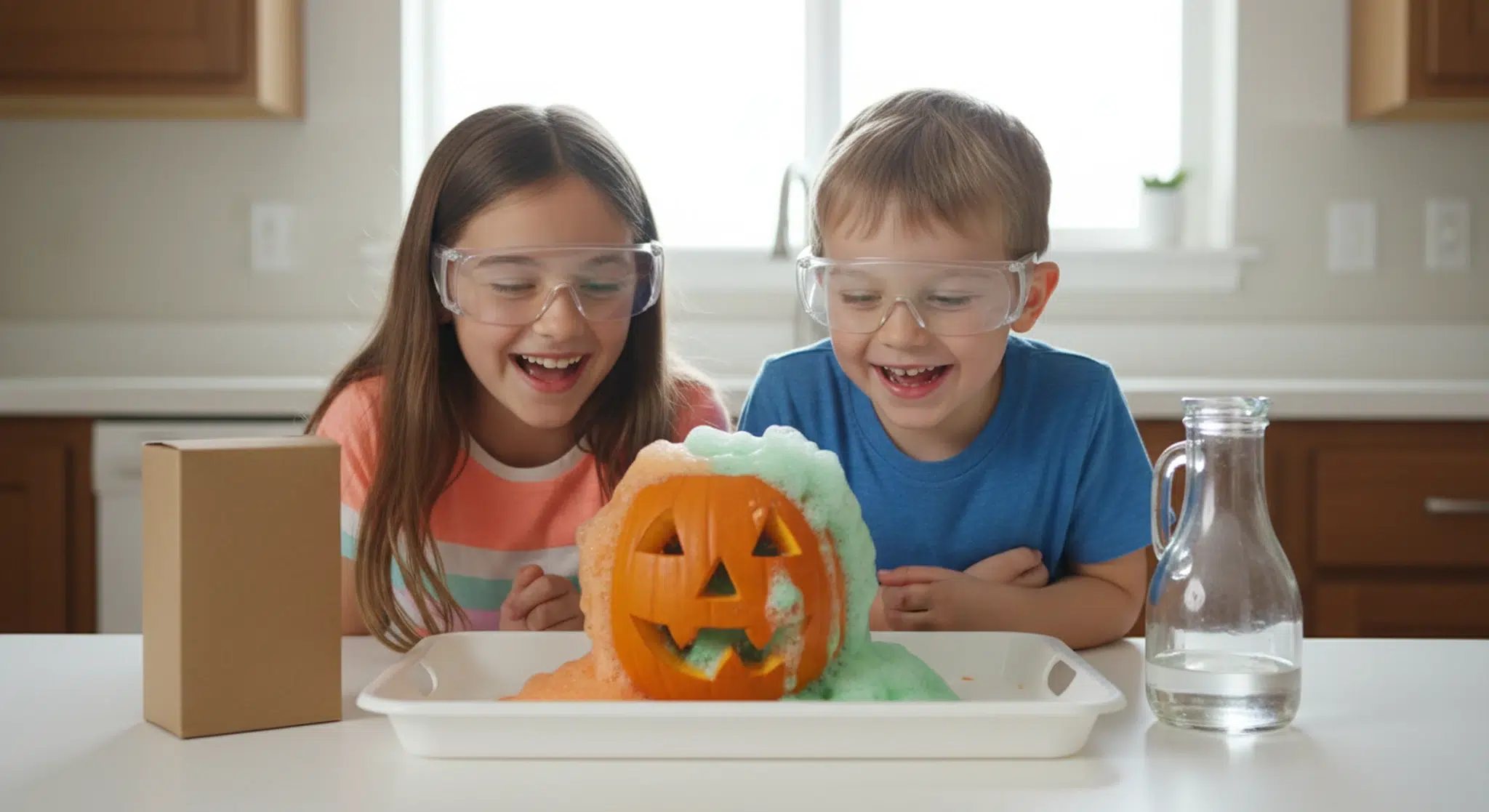


Halloween STEM activities turn pumpkins, ghosts, and candy into hands-on science, and most of them use things you already have in your kitchen.
October is the perfect month to sneak some science into the fun. Kids who would groan at a worksheet will happily spend an hour making pumpkins erupt, ghosts dance, and potions glow.
Here are 15 Halloween STEM activities and Halloween science experiments for preschoolers through tweens, each with materials, simple steps, and the science behind it. You will also find picks by age, a quick guide to turning any activity into a real experiment, and important safety tips.
Key Takeaways
- The easiest Halloween science experiments use baking soda, vinegar, dish soap, and a pumpkin.
- Static electricity, density, dissolving, and fluorescence can all be explored with Halloween supplies.
- Engineering challenges like candy catapults and spider webs build problem-solving skills.
- Adults should handle carving tools, hydrogen peroxide (3% only), and slime activators; skip dry ice with kids.
- Keep small candies, balloons, and button batteries away from babies and toddlers.
Table of Contents
What Are Halloween STEM Activities?
Halloween STEM activities use the holiday’s pumpkins, ghosts, candy, and spiders to explore science, technology, engineering, and math. They are hands-on, a little bit messy, and perfect for classrooms, homeschool days, parties, and rainy October afternoons. Best of all, the “spooky” theme keeps kids asking questions, which is the whole point of STEM.
Each activity below lists an age range, the materials you need, simple steps, and the science behind it, so you can explain what is happening. Most use things you already have in the kitchen.
Halloween Science Experiments
1. Pumpkin Volcano (Pumpkin-cano) (ages 3+ with help)
- You’ll need: a small carved pumpkin, baking soda, vinegar, dish soap, and food coloring
- How to do it: scoop out the pumpkin, set it on a tray, add 3 tablespoons of baking soda, a squirt of dish soap, and a few drops of coloring, then pour in vinegar and watch it foam out of the mouth.
- The science: vinegar (an acid) reacts with baking soda (a base) to make carbon dioxide gas. The soap traps the gas in bubbles, creating the foamy eruption.
2. Dancing Tissue Ghosts (ages 4+)
- You’ll need: tissue paper, scissors, tape, a balloon, and a wool sweater or your hair
- How to do it: cut small ghost shapes from tissue paper and tape their bottoms to a table. Rub the balloon on your hair or a sweater, then hover it over the ghosts and watch them rise and dance.
- The science: rubbing the balloon moves electrons onto it, giving it a static charge that attracts the light tissue paper.
3. Ghost Balloon Inflator (ages 5+)
- You’ll need: an empty plastic bottle, a white balloon with a ghost face drawn in marker, baking soda, vinegar, and a funnel
- How to do it: pour 1/2 cup of vinegar into the bottle, use the funnel to add 2 tablespoons of baking soda into the balloon, stretch the balloon over the bottle’s mouth, then lift it so the baking soda drops in.
- The science: the acid-base reaction produces carbon dioxide gas, which has nowhere to go but into the balloon.
4. Dissolving Candy Corn (ages 4+)
- You’ll need: candy corn, clear cups, and different liquids (water, warm water, vinegar, oil, soda)
- How to do it: drop one candy corn into each cup and check every 5 minutes. Which liquid dissolves it fastest?
- The science: sugar dissolves in water, and warm water speeds it up because the molecules move faster. Oil does not dissolve sugar at all.
5. Floating Letters Candy Experiment (ages 5+)
- You’ll need: candy-coated chocolates with a printed letter, a shallow white plate, and water
- How to do it: set the candies letter side up in a plate, gently pour in water, and wait a few minutes. The letters float free and drift to the surface.
- The science: the printed letter is made of edible ink that does not dissolve in water, while the colored sugar coating does.
Big days go better with a good night of sleep.
Got a little one at home too? Our free two-minute quiz builds a gentle, personalized sleep plan for babies and toddlers.
Halloween Engineering, Chemistry, and Math Challenges
6. Bubbling Witch’s Brew (ages 4+)
- You’ll need: a big bowl or plastic cauldron, baking soda, vinegar, dish soap, green food coloring, and plastic spiders
- How to do it: add baking soda, soap, and coloring to the cauldron, then let kids pour in vinegar and stir with a spoon for bubbling, foaming brew.
- The science: another acid-base reaction; changing the amount of soap or vinegar changes how much foam you get.
7. Pumpkin Elephant Toothpaste (ages 7+ with an adult)
- You’ll need: a small carved pumpkin or bottle, 1/2 cup of 3% hydrogen peroxide (drugstore strength only), dish soap, food coloring, 1 packet of dry yeast, and 3 tablespoons of warm water
- How to do it: an adult pours the peroxide, soap, and coloring into the pumpkin. Mix the yeast with warm water for 30 seconds, pour it in, and step back as foam pours out.
- The science: yeast contains an enzyme (catalase) that quickly breaks hydrogen peroxide into water and oxygen. The soap turns the oxygen into mountains of foam. Wear safety glasses and never use stronger peroxide.
8. Glowing Potion Under a Black Light (ages 6+)
- You’ll need: tonic water (it contains quinine), a clear glass, and a black light (UV flashlight)
- How to do it: turn off the lights and shine the black light on the tonic water. It glows blue. Compare it with plain water.
- The science: quinine absorbs invisible ultraviolet light and gives it off as visible blue light, a process called fluorescence.
9. Spider Web Engineering Challenge (ages 5+)
- You’ll need: painter’s tape, a doorway, and small balls of paper or cotton balls as “flies”
- How to do it: tape a web across a doorway, sticky side facing you. Kids toss “flies” to see what sticks, then redesign the web to catch more.
- The science: it is a design challenge in patterns and structure, just like real engineers testing, improving, and testing again.
10. Candy Catapults (ages 6+)
- You’ll need: craft sticks, rubber bands, a plastic spoon, and soft pompoms or mini marshmallows
- How to do it: stack and band 7 sticks together, place 2 more on top in a V, wedge the stack between them, tape a spoon on top, and launch. Measure how far each shot goes.
- The science: the bent sticks store potential energy that becomes kinetic energy on release. Launch soft items only, and never at faces.
11. Apple Mummies (ages 7+)
- You’ll need: apple slices, cups, salt, baking soda, a kitchen scale, and a notebook
- How to do it: weigh each slice, cover some in salt, some in baking soda, some in a mix, and leave one uncovered. Reweigh and observe after 7 days.
- The science: salt and baking soda draw water out of the apple, which is how ancient Egyptians dried out and preserved mummies.
12. Sink or Float Pumpkin Test (ages 3+)
- You’ll need: a large tub of water, a small pumpkin, gourds, and some Halloween objects
- How to do it: predict which items will sink or float, then test them. Most kids are surprised that a heavy pumpkin floats.
- The science: pumpkins are hollow and full of air, so they are less dense than water overall.
13. Cotton Swab Skeletons (ages 5+)
- You’ll need: cotton swabs, black paper, and glue
- How to do it: build a skeleton from cotton swabs, using a real skeleton diagram as a guide, and count the bones along the way.
- The science: a simple introduction to anatomy: adults have 206 bones, and babies are born with more (many fuse as they grow).
14. Pumpkin Seed Math and Life Cycle (ages 4+)
- You’ll need: a pumpkin, a tray, and paper
- How to do it: estimate how many seeds are inside, then count them in groups of ten. Plant a few seeds in a cup and watch them sprout.
- The science: practices estimation, counting, and the plant life cycle from seed to sprout.
15. Spooky Slime (ages 5+ with an adult)
- You’ll need: glue, contact lens solution with boric acid and sodium borate, baking soda, orange or black coloring, and plastic spiders or eyeballs
- How to do it: follow our homemade slime recipe, add Halloween colors, and mix in a few plastic creepy crawlies.
- The science: borate ions cross-link glue’s polymer chains into stretchy slime.
Halloween STEM Activities by Age
| Age group | Best picks |
|---|---|
| Preschool (3 to 5) | Pumpkin volcano, sink or float pumpkins, dancing ghosts, pumpkin seed counting, bubbling brew |
| Early elementary (5 to 7) | Ghost balloon inflator, candy corn dissolving, floating letters, spider web challenge, cotton swab skeletons |
| Upper elementary (8 to 12) | Pumpkin elephant toothpaste, glowing tonic water, candy catapults with measurements, apple mummies |
How to Turn Any Activity Into a Real Experiment
Use the scientific method to stretch the fun and the learning:
- Ask a question: “Which liquid will dissolve candy corn fastest?”
- Make a prediction: have kids write or draw their guess first.
- Change one thing at a time: that is called the variable. Keep everything else the same.
- Measure and record: use a timer, ruler, or scale, and write results in a notebook.
- Talk about the results: was the prediction right? What would you try next?
Halloween STEM Safety Tips
- An adult should handle carving tools, hydrogen peroxide, and any activators.
- Use only 3% (drugstore) hydrogen peroxide, and wear safety glasses for foaming experiments.
- Skip dry ice with kids. It can cause frostbite burns and should only be handled by an adult with insulated gloves in a well-ventilated space, if at all.
- Keep small candies, balloons, and plastic spiders away from babies and toddlers, since they are choking hazards. The AAP warns balloons are a choking risk up to age 8.
- Use battery-powered tea lights instead of candles in pumpkins, and never let young children handle button or coin batteries, which can cause severe injury if swallowed.
- Do experiments on a tray or outdoors for easy cleanup, and wash hands afterward.
For costumes, trick-or-treating, and candy tips, read our Halloween safety tips.
More Halloween Fun for Kids
Pair a science experiment with a Halloween game or craft for a full afternoon of fun. Our Halloween activities for kids and Halloween games for kids guides have dozens more ideas.
Related Betteroo Guides
- Halloween activities for kids
- Halloween games for kids
- Halloween safety tips
- Homemade slime
- Science experiments for kids
Keeping Halloween Fun for the Whole Family
Big, exciting days and sugar can shake up bedtime for kids of all ages. Plan experiments earlier in the day, keep a calm wind-down routine in the evening, and save the most energetic activities for the afternoon. If you have a baby or toddler at home too, set up a safe play space away from small parts while older siblings experiment.
Frequently Asked Questions
What are some easy Halloween STEM activities?
Easy Halloween STEM activities include a baking soda and vinegar pumpkin volcano, dancing tissue ghosts with a static balloon, dissolving candy corn in different liquids, sink or float pumpkins, and a spider web engineering challenge with painter’s tape.
What is a good Halloween science experiment for preschoolers?
Preschoolers love the pumpkin volcano, bubbling witch’s brew, and sink or float pumpkin test. They are simple, visual, and use safe kitchen ingredients with an adult helping.
How do you make a pumpkin volcano?
Scoop out a small pumpkin, place it on a tray, add about 3 tablespoons of baking soda, a squirt of dish soap, and food coloring, then pour in vinegar. The reaction makes carbon dioxide gas that foams out of the pumpkin.
Why does a pumpkin float?
A pumpkin floats because it is hollow and filled with air, which makes it less dense than water overall, even though it feels heavy.
Why does tonic water glow under a black light?
Tonic water contains quinine, which absorbs ultraviolet light from the black light and gives it off as visible blue light. This is called fluorescence.
Gentle changes, peaceful nights.
Betteroo builds a personalized sleep plan for your baby or toddler. Take the free two-minute quiz to get started.
5 Sources
- American Chemical Society. Science for Kids.
https://www.acs.org/education/outreach/kidschemistry.html - Science Buddies. STEM Activities for Kids.
https://www.sciencebuddies.org/stem-activities - American Academy of Pediatrics, HealthyChildren.org. Halloween Safety Tips.
https://www.healthychildren.org/English/safety-prevention/all-around/Pages/Halloween-Safety-Tips.aspx - American Academy of Pediatrics, HealthyChildren.org. Choking Prevention for Babies and Children.
https://www.healthychildren.org/English/health-issues/injuries-emergencies/Pages/Choking-Prevention.aspx - Poison Control (National Capital Poison Center). Borates, Borax, and Boric Acid: Are They Safe?
https://www.poison.org/articles/borates